The Sumerians
The First Civilisation
Chapter 1 — The Land Between the Rivers
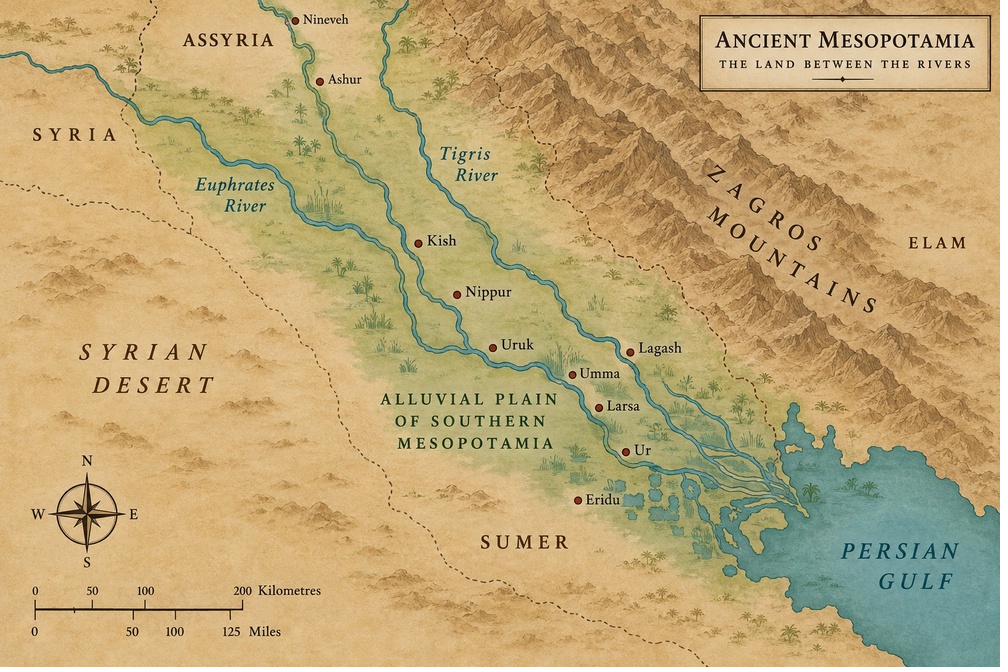
To understand the Sumerians, one must first understand the strange and demanding country in which they lived. The Greeks, looking back from a far later age, gave the region its enduring name: Mesopotamia, "the land between the rivers." The two rivers in question are the Tigris and the Euphrates, twin arteries that rise within a few dozen miles of each other in the snow-fed mountains of eastern Anatolia and then take very different courses across the broad lowlands to the southeast. The Euphrates, the longer and gentler of the two, sweeps in a great arc through what is now southern Turkey, northern Syria, and finally Iraq.
The Tigris, swifter and more violent, hugs the foothills of the Zagros Mountains as it descends. After hundreds of miles of separate journeys the two rivers approach each other again in southern Iraq and finally join, just above the Persian Gulf, in the marshy confluence called the Shatt al-Arab. Between them lies the alluvial plain, and on that plain, more than five thousand years ago, the world's oldest urban civilization came into being. The plain itself is the gift of the rivers. Every spring, when the snows of the Anatolian and Armenian highlands begin to melt, the Tigris and Euphrates swell with cold, silt-laden water and burst their banks.
For thousands of years before any human dug a canal, those annual floods deposited a thin, even layer of fine sediment across the lowlands south of modern Baghdad. Layer upon layer accumulated until the bedrock of the region lay buried beneath dozens of meters of soft, fertile alluvium. Where the plain meets the Gulf, the buildup is so deep that the geological floor of southern Iraq cannot be reached by any ordinary excavation. The Sumerians dug their wells and laid their foundations entirely within the river-given soil of their own world.
This soil, when properly handled, is among the most productive on earth. Irrigated barley grown on Sumerian fields could yield seventy or eighty grains for every grain sown, a return that puts the most prosperous medieval European harvest to shame. But the same alluvium that made the plain rich also held in it the seed of a slow agricultural disaster. Mesopotamian groundwater is heavily mineralized, and the southern climate is so hot and dry that irrigation water evaporates quickly from the surface, leaving its salts behind. Without careful drainage and periodic fallowing, fields gradually grew saltier with each generation.
The Sumerians knew this, fought it, and in the end could not entirely overcome it. The wheat that had flourished in the early third millennium gave way to hardier, more salt-tolerant barley, and by the time of the great Sumerian renaissance under the Third Dynasty of Ur, some of the oldest cultivated plots had begun to fail outright. The story of Mesopotamian civilization is in part the story of a people fighting to keep ahead of the slow poisoning of their own soil. Geography divided Mesopotamia into two very different worlds.
North of modern Baghdad, in what is sometimes called Upper Mesopotamia, the land rises in gentle steps toward the foothills of Anatolia. There the rainfall is sufficient, in most years, for unirrigated farming. The hills are green in spring, the landscape varied with valleys and limestone outcrops, and stone, timber, and metal are accessible in the surrounding mountains. The earliest farming villages of the Near East grew up in this northern arc, and even after southern cities had risen to dominance, the north remained a land of scattered towns embedded in their fields.
The south, by contrast, is a different country altogether. South of Baghdad the plain widens and flattens until the eye finds nothing on the horizon but reed beds, palm groves, and the watery glint of canals. Annual rainfall falls below the threshold needed for farming. Without irrigation, almost nothing of value grows. With irrigation, almost anything will grow, and grow lavishly. It was here, in this paradox of barren plain and luxuriant garden, that Sumer arose. The southern landscape that the Sumerians inhabited would have looked, in many places, more like an enormous river delta than a settled agricultural region.
The Euphrates and Tigris meandered restlessly across the alluvium, building up natural levees of silt along their banks and then, every few centuries, breaking through and changing course altogether. Whole cities could find themselves stranded miles from the water that had once made them prosperous. Ur, in its glory days, was a port at the head of the Persian Gulf; today its ruins sit a hundred and fifty miles inland, the sea having retreated and the rivers having shifted while the city dwindled and died. The Sumerian world was not a stable map.
It was a living network of waterways, dredged channels, and seasonal lagoons, constantly being remade by hand and by flood. In the deepest south, where the land flattens almost to sea level, the rivers slow and spread into the marshlands. These wetlands, which until recent decades stretched across thousands of square kilometers between Basra and Nasiriyah, are unlike anywhere else in western Asia. Towering reeds, some of them ten meters tall, grow in dense beds rooted in shallow brackish water. Buffalo wallow in the channels. Date palms cluster on the slightly raised banks.
The marsh dwellers of the twentieth century, the so-called Ma'dan or Marsh Arabs, lived on artificial reed islands and built houses, mosques, and guest halls entirely of woven reed bundles, an architectural tradition whose Sumerian antecedents are documented in clay tablets and on temple reliefs. When archaeologists rediscovered the cone-mosaic facade of the early temple at Uruk, they found themselves looking at a five-thousand-year-old translation, in colored clay studs, of patterns that contemporary marsh weavers were still producing in mats and screens. Beyond the marshes, the Persian Gulf itself was a permanent presence in Sumerian life.
The shoreline lay much further inland in antiquity than it does today, and the head of the Gulf was a rich estuarine environment full of fish, shellfish, and birds. The Sumerians knew the sea well. Their merchants sailed down the coast to trade with the island of Dilmun, identified almost certainly with modern Bahrain, and beyond it to Magan, the rugged copper-bearing land that was almost certainly the Oman peninsula. From even further away, from the great Indus Valley civilization in what is now Pakistan and northwestern India, came the carnelian, ivory, and exotic woods that the Sumerians called the products of "Meluhha."
In their poetry, the Gulf was not a barrier but a road. Enki, the god of fresh waters and wisdom, was said to have decreed that the cargo ships of Magan should ride at anchor at the quay of Akkad, "as if they were birds in the marshes." For a people whose own rivers were unreliable highways, the open water of the Gulf was a kind of liberation. The climate of southern Mesopotamia was, and is, extreme. Summer temperatures regularly exceed forty-five degrees Celsius, sometimes fifty, and the long, blazing afternoons compelled most inhabitants to retreat into shaded courtyards or onto rooftops where a breath of evening wind might be caught.
Winters are mild, with daytime temperatures often pleasant, but the nights between December and February can be sharply cold, and frost is not unknown. Rainfall is concentrated in a brief winter season; from late April through October the sky is essentially cloudless. The dust storms known locally as the shamal blow down from the deserts to the west and north for weeks at a time, lifting fine particulate from the alluvium and tinting the sun a bronze color through pale orange skies. The phrase "the cloud has covered the land"

in Sumerian poetry was not always metaphor. It is essential to grasp how unlike the Egyptian Nile the Sumerian rivers were. In Egypt, the Nile rose and fell with such metronomic regularity that the agricultural calendar could be read directly from the river's height. The flood arrived in summer, after the harvest had been gathered, and receded in the autumn, leaving a perfectly timed bed of moist black silt for the next sowing. The Egyptians could plan their year on the river's behavior with confidence; they thanked their gods for providence, and most years their gods provided.
The Tigris and Euphrates were not so kind. They flooded in spring, just when the barley was approaching ripeness in the fields, and sometimes destroyed the harvest outright. Their flow was wildly variable from year to year, depending on the snowpack hundreds of miles to the north. Their courses shifted. Their levees broke. A village that had thrived for two centuries on a particular bend of the Euphrates might one morning find that the river had cut a new channel three kilometers to the east, leaving the old fields parched and the wharves stranded in dry mud.
The Sumerian gods of river and storm were not gentle provisioning deities; they were powers to be propitiated, feared, and outwitted. Enlil, the lord of wind and storm, could be a destroyer as readily as a benefactor. The great flood myth that the Sumerians passed on to the Babylonians and through them to the world was no Egyptian fertility metaphor. It was a memory, perhaps multiple memories braided together, of catastrophe. To survive on this plain required collective effort on a scale that nothing in the simpler farming villages of the highlands had demanded.
Every field of any size depended on irrigation, and every irrigation system depended on canals that had to be dug, deepened, and continually cleared of silt. The annual maintenance of a single major canal could require hundreds of people working for weeks. The construction of a new branch involved still more. The control of water at the head gates, the apportionment of flow between competing villages, the timing of releases and shutoffs, the obligations to clear silt and repair levees: all of these were communal matters, and they required organization, record-keeping, and a recognized authority empowered to enforce decisions.
It is no accident that the institutions of writing, hierarchical priesthood, centralized storage, and finally kingship arose in this landscape. The Mesopotamian plain produced abundance only when it was forced to, and forcing it required a society capable of acting in concert. For all its productivity, the southern plain was peculiarly poor in raw materials of almost every other kind. The alluvium contains no usable stone. There is no exposed bedrock anywhere in the south; even ordinary cobbles have to be imported. The local trees, mostly tamarisk, willow, and date palm, yield no construction-grade timber for major buildings.
There is no native metal; copper, tin, lead, silver, and gold all had to be brought in from elsewhere. There is no clay suitable for the higher grades of stoneware, no flint or obsidian for tools, no semi-precious stone for ornament. What the plain provided was grain, fish, dates, reeds, hides, and labor. What it lacked was almost everything else. The Sumerians turned this scarcity into a strategy. They became inveterate traders. From the earliest appearance of their civilization, the cities of southern Mesopotamia maintained complex commercial relationships with the regions that did possess what they themselves did not.
The Zagros Mountains to the east, which were the homeland of the Elamites and a corridor toward the lapis lazuli mines of Badakhshan in distant Afghanistan, supplied stone, timber, copper, and jewels. The Anatolian highlands to the north supplied silver, timber, obsidian, and more copper. The Syrian plain and the Levant supplied resin, oil, hardwoods, and a route to the Mediterranean. The Persian Gulf and beyond supplied diorite, chlorite, copper, and the carnelian and ivory of the Indus Valley. The deserts to the west yielded the immense flocks of the nomadic herders who traded wool, hides, and meat for the surplus grain of the cities.
Sumerian civilization, in other words, did not simply happen on the plain; it draped itself across a continent-wide trading network, drawing in materials from a vast hinterland and exporting in return its grain, its textiles, its fish, and the manufactured goods of its workshops. The neighbors of Sumer figure constantly in its records, sometimes as trading partners, sometimes as enemies, sometimes as both at once. To the east, beyond the marshes and across the Tigris, lay Elam, with its capital at Susa, a parallel civilization with a parallel script and a deep entanglement with Sumer that would last for two thousand years.
The Elamites at one point sacked Ur and brought the Sumerian renaissance to a violent end; at others, they intermarried with Sumerian royalty and exchanged ambassadors. To the north and east, in the foothills of the Zagros, lived the Gutians, the Lullubi, and a long roster of mountain peoples whom the lowlanders regarded as barbaric and dangerous, and whose periodic raids and occasional invasions punctuated Sumerian history. To the west and south stretched the Syrian and Arabian deserts, home to nomadic herding peoples who spoke Semitic languages and who infiltrated, settled, and finally came to dominate the plain itself: first the Akkadians, then the Amorites, then the Aramaeans.
To the northwest, beyond Mari and Ebla, were the Hurrians and beyond them the Hittites and the cultures of Anatolia. The Sumerian kalam, "the land," sat at the southern end of a long corridor of cultural exchange that would eventually link China to the Mediterranean, but in the third millennium BCE the corridor was already busy. The flora and fauna of ancient Sumer would in many respects have been recognizable to the marsh dwellers of recent times. The reed, the date palm, the tamarisk, and the willow were the dominant plants; cucumber, leek, garlic, onion, lentil, chickpea, and sesame the staple crops alongside barley and emmer wheat.
Wild boar rooted in the reedbeds. Lions still hunted gazelle on the higher steppe to the north and west, and royal lion hunts, well attested in Mesopotamian art, continued for millennia. Wild asses, the onager and its hybrid kungas, were captured and harnessed before the introduction of the true horse. Fish were so abundant in the rivers and marshes that Sumerian lexical lists name dozens of varieties, and the dried fish trade was a major industry. Birds darkened the sky during the seasonal migrations along the Persian Gulf flyway; the marshes were full of ducks, geese, ibises, herons, and pelicans, all hunted for the table.
Domesticated sheep and goats, descended from animals first tamed thousands of years earlier in the Anatolian and Iranian highlands, supplied wool and milk; cattle were used as draft animals and for ritual sacrifice; donkeys and onagers carried freight; and the dog had been a partner in human life for many millennia by the time Sumer arose. This setting, unforgiving and inviting in equal measure, did more than supply the Sumerians with their food and their challenges. It shaped their imagination of the world. The cosmology that Sumerian poets wrote down in cuneiform, and that their Babylonian successors inherited and elaborated, mirrors the plain on which it was composed.
The universe, in its earliest articulated form, was a flat earthly disk, ki, suspended between an upper dome of heaven, an, and a vast subterranean ocean, abzu, from whose fresh waters every spring and well drew its life. The earthly disk was surrounded by a salt-water ocean. Above it, the gods walked through their celestial palaces along the slow paths of the sun, the moon, and the planets. Below it, in the kur, lay the dim, dust-eating land of the dead. This mental geography is unmistakably the geography of the alluvium projected outward: a flat land, water above, water below, water on all sides, with mountains visible only in the distance and the sky an immense bowl.
When Sumerians described their gods walking the earth, those gods walked the southern plain, with reed huts in the foreground and ziggurats on the horizon. It is worth pausing on the rhythms of the Mesopotamian year in greater detail, because nothing else in the cultural life of Sumer is intelligible without an understanding of the agricultural calendar that governed it. The year began, in the Sumerian reckoning, in the spring, with the first new moon after the spring equinox. This was the time of the heaviest river flow and of the harvest of the previous autumn's barley sowing; the granaries were being filled with the new crop, the threshing floors were noisy with oxen and sledges, and the cities were full of laborers brought in from the villages for the brief weeks of intensive harvest work.
Through May and June the heat began to climb steeply, and the fields, once cleared of their grain, were left to dry under the sun. July, August, and September were the months of the canal-clearing season, when the labor of the population was organized for the great annual maintenance of the irrigation system: dredging the silt from the channels, repairing the levees, replacing damaged sluice-gates. October brought the first slight cooling; November was the time of plowing and sowing, with the seeder-plows moving across the fields in the cool damp of late autumn.
December, January, and February were the time of waiting, when the sown grain germinated under a thin sheet of winter rain and frost, and the population turned to the indoor work of weaving, brewing, and craft. By March the fields had begun to head, by April they were ripe, and the cycle, with its long rhythm of flood, harvest, fallow, and renewed sowing, began again. Every Sumerian — the king in his palace, the priest in the temple, the woman at the loom, the merchant on the river, the child at the school — lived inside this annual cycle, and the festivals, the political seasons, the school terms, and the commercial calendars all wove themselves around its turning.
The geography of Mesopotamia also did much to determine the shape of Sumerian society in less obvious ways. The flat alluvial plain, with no natural defensive features, made the cities of the south unusually exposed to military attack: there was nowhere to hide an army, no natural choke-points that could be defended by small forces, no mountain fastnesses to which a population could retreat in emergency. The result was that defense had to be done by means of massive fortification — the great mud-brick city walls of Uruk, Ur, Lagash, and the rest — rather than by means of natural terrain.
The construction and maintenance of those walls required the kind of organized communal labor that, as we have seen, also lay behind the irrigation system; in this sense the wall and the canal were the two great public works of every Sumerian city, the two demands that compelled the formation of centralized institutions. The same flatness that made the cities militarily exposed, however, also made the rivers themselves easy highways for transport. A loaded boat could move down the Euphrates from northern Syria all the way to the Persian Gulf without ever encountering a serious obstacle; the slope of the alluvial plain, although gentle, was sufficient to keep the water moving at a reliable pace.
The Sumerians took full advantage of this, and the rivers and canals of their country were dense with commercial traffic from the earliest historical period onward. The boatmen of Sumer, organized in their own guilds, formed one of the more substantial professional classes of the urban economy, and the riverside wharves of the great cities were among their busiest commercial spaces. Modern southern Iraq has changed beyond easy recognition. The marshes were deliberately drained in the 1990s under Saddam Hussein, an act of political violence as much as engineering, and the marsh-dwelling culture that had survived from antiquity was nearly extinguished.
Since 2003 the marshes have been partially restored, with new channels cut and water reintroduced, and some of the old life has come back. The Tigris and Euphrates, dammed extensively upstream in Turkey, Syria, and Iran, no longer flood unpredictably as they once did, and indeed in some seasons run alarmingly low. The cities of the ancient south, Ur, Uruk, Eridu, Lagash, Larsa, Nippur, and the rest, now stand as empty mounds of ruined brick, their ziggurats reduced to weather-eaten lumps, their canal systems traceable only from the air. Yet the bones of the country are recognizable.
The same fierce sun beats on the same flat land. The same Euphrates flows past the same place where, fifty centuries ago, a city called Uruk grew larger than any other settlement on earth. The same date palms cluster along the same banks. The same dust rises on the same wind from the same desert. A few additional features of the Mesopotamian landscape deserve specific notice because they shaped the daily life of the people who inhabited it. The first is the sheer brilliance of the southern light. The clear, dry air of the alluvial plain, combined with the absence of mountains or forests on the horizon, produces a quality of illumination that visitors to southern Iraq have remarked upon for centuries: the colors are intense, the shadows are sharp, the distances are deceptively foreshortened.
The Sumerian art that we recover, with its emphasis on bold outlines, strong contrasts, and the great staring eyes of the votive figures, can be read in part as a response to this distinctive light. The second feature is the dramatic temperature differential between day and night, particularly in the spring and autumn transitional seasons, when the days are warm and the nights are cool, sometimes sharply so. The Sumerians built their houses with thick mud-brick walls precisely to moderate this differential, with the interior of a well-built house remaining several degrees cooler than the exterior in summer and several degrees warmer in winter.
The third feature is the omnipresence of dust. The fine alluvial soil, dried and cracked by the summer heat, is easily lifted by even modest winds, and the air of southern Mesopotamia in the windy months is filled with a fine particulate haze that coats every surface, irritates the eyes and lungs, and gives the light a characteristically golden quality. The Sumerians lived with dust as a constant companion, and the wear patterns on their tools, their stone implements, and even their teeth reflect long exposure to the abrasive particles in the air they breathed.
The setting is half of the Sumerian story, and to walk that landscape, even now, is to begin to understand why the men and women of the alluvium did what they did, built what they built, and feared what they feared. The land between the rivers made a particular kind of civilization possible, and demanded it. Euphrates Tigris Persian Gulf Nippur Kish Uruk Ur Eridu Lagash Umma Larsa N Major Sumerian city-states, c. 2500 BC
Chapter 2 — Before Sumer — The Prehistoric Foundations
Foundations The Sumerians, when they finally step into the historical record around 3100 BCE, do so as a fully formed urban civilization, their cities walled, their temples staged on platforms, their scribes already pressing the first cuneiform marks into damp clay. Like other founding civilizations, they appear deceptively complete. They were, of course, nothing of the sort. Behind the earliest Sumerian tablets lay thousands of years of human experimentation on the Mesopotamian plain and across the wider Near East: village formation, plant and animal domestication, the slow refinement of pottery and weaving, the laying out of small canals, the construction of the first temples, the gradual elaboration of trade networks that linked the Persian Gulf to the Anatolian highlands.
To understand the explosion of urban life that we call Sumer, we must therefore look first at what came before, in the long pre-urban centuries during which the foundations of southern Mesopotamian civilization were quietly poured. The deepest layer of that foundation was the Neolithic transformation. Beginning around 10,000 BCE in the corridor of the so-called Fertile Crescent, which arcs from the southern Levant through southeastern Anatolia and down into the Zagros foothills, human communities began to experiment with the deliberate cultivation of wild grasses and the keeping of animals that had previously been hunted.
Wild emmer wheat, einkorn, barley, lentils, chickpeas, peas, flax, and bitter vetch were brought, by selective harvesting and replanting, into a range of slowly more productive domesticated forms. The wild ancestors of sheep, goats, cattle, and pigs were rounded into closer association with human settlements, with selective breeding gradually producing the tamer, more tractable herds we recognize today. None of these processes was the work of a single generation. Each unfolded across centuries and was repeated, often independently, at multiple sites across the Crescent. By 8000 BCE there were settled farming villages of impressive size at places like Jericho in the Jordan Valley, with its famous round stone tower, and at Çatalhöyük on the Anatolian plateau, where six thousand or more people lived in a dense honeycomb of mud-brick houses entered by ladders through the roofs.
These communities, however, were not yet cities in the Sumerian sense; they had no apparent central authority, no monumental temple hierarchy, no system of writing, and no obvious specialization of labor beyond the seasonal rhythms of farming and the part-time crafts that any village must support. They were the seedbed, not the harvest. In northern Mesopotamia, the rough plain stretching from the Khabur to the upper Tigris and watered by enough seasonal rain to permit unirrigated agriculture, the Neolithic accelerated into a sequence of distinctive village cultures that archaeologists have come to know by the names of the type sites at which their pottery was first identified.
The Hassuna culture, beginning around 6500 BCE and named for a small mound near Mosul, produced cream-colored bowls with simple painted lines and lived in modest rectangular houses of mud brick. Hassuna villagers grew wheat and barley, kept sheep and goats, made flint sickles and basalt querns, and traded for obsidian from the volcanoes of Anatolia hundreds of kilometers away. The Samarra culture, which overlapped Hassuna in time but spread further south, into territory that received less reliable rainfall, made the first known attempts at irrigation in Mesopotamia, digging short channels off the Tigris to extend the cultivable margin.
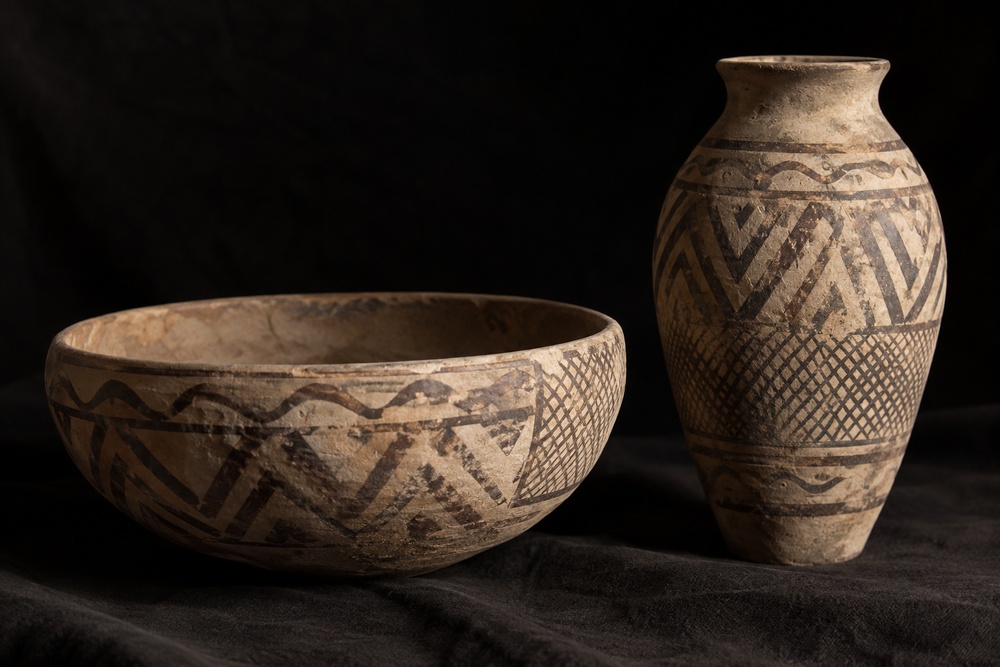
Samarran painted pottery is among the most beautiful of the prehistoric Near East: dark-slipped, finely fired, and decorated with elegant rotational designs of women, fish, scorpions, and birds arranged around a central whirl. By the late seventh millennium, the still more sophisticated Halaf culture had spread across the rain-fed northern arc, with finely painted polychrome pottery in geometric and floral patterns, characteristic round stone-footed houses called tholoi, and trade contacts that reached from the Mediterranean coast to the Iranian plateau. The Halaf people did not, however, settle in the deep south of Mesopotamia.
The southern alluvium, beyond the reliable rainfall line, remained almost empty during their time. To live there required taking on the labor and discipline of irrigation, and the Halafians, with productive rain-fed land available to the north, had no compelling reason to do so. The first communities that did take on the southern plain belonged to a culture archaeologists call the Ubaid, named after a small mound near the ruins of Ur where its distinctive pottery was first excavated. The Ubaid, which began somewhere around 6500 BCE and lasted until roughly 3800 BCE, is the deep root of Sumerian civilization.
Almost everything that later became distinctively Mesopotamian about southern life — the irrigation canals, the mud-brick architecture, the long-lived temple at the heart of the community, the patterns of trade reaching down the Gulf, the use of clay tokens for accounting — appears in nascent form in Ubaid villages, often two or three thousand years before Uruk's first great surge of urban growth. The Ubaid settlers chose their sites with care. They preferred slightly raised places along the natural levees of the rivers, where shallow wells could reach fresh water and seasonal floods would not entirely overwhelm them.
They built houses of sun-dried mud brick, sometimes faced with a fine plaster of mud and chopped straw, often arranged around small interior courtyards. Their villages were modest at first, perhaps a few dozen households, but at certain sites, notably Eridu in the south and Tell el-'Oueili near it, they grew over centuries into something larger and more structured. At Eridu, on the very southern edge of the alluvium, archaeologists in the 1940s and 1950s, working under Iraqi and British direction, dug down through eighteen successive temple levels stacked one on top of the next.
The earliest of these dated to around 5400 BCE: a single small mud-brick room with a shallow niche on one wall and a freestanding offering table in the center. Each subsequent rebuilding made the temple a little larger and more elaborate, with side chambers, buttressed walls, and finally a raised platform; by the late Ubaid, the Eridu sanctuary was a substantial building on a high terrace, the visible ancestor of the great ziggurats that would later dominate the southern skyline. That this temple was sacred from the beginning to the same god, the freshwater deity Enki, and that its sanctity persisted across millennia until the very last temple at Eridu was rebuilt in the first millennium BCE, gives us one of the deepest archaeological links between the prehistoric and the historical periods anywhere in the world.
People came to Eridu to worship Enki for nearly five thousand years. Ubaid pottery, found in shapes that range from simple bowls to elegant boat-shaped vessels, was made on a slow turntable rather than a true potter's wheel, and decorated with painted geometric and floral designs in dark brown or black on a buff or greenish ground. The greenish tint, characteristic of well-fired Ubaid wares, comes from the high lime content of southern Mesopotamian clay and helps archaeologists identify Ubaid trade goods at sites far from the southern plain. For Ubaid pottery turns up everywhere.
It is found up the Euphrates into Syria, across into the middle Tigris, in the foothills of the Zagros, around the Persian Gulf at sites along the eastern Arabian coast, and even on the island of Bahrain. Whether all of these scatters reflect direct Ubaid trading colonies or merely the diffusion of Ubaid manufactures through intermediaries is debated, but the pattern is clear: by the fifth millennium, the Ubaid south had become a major exporter of finished goods and a hub of long-distance exchange. From the Gulf coast came pearls, fish, and probably copper from Oman; from the Zagros, semi-precious stones and timber; from Anatolia, obsidian; from elsewhere, materials whose origins are still obscure.
Ubaid villages were no longer isolated subsistence communities. They were nodes in a network. The internal structure of Ubaid society is more difficult to recover, since the buildings and burials of the period rarely yield strong evidence of social differentiation. House sizes vary modestly but not dramatically. Burial goods are simple. The dead were generally laid out on their backs with a few pots and ornaments. There are no obvious palaces and no obvious grand tombs. What there are, however, are temples; and the prominence of temple architecture, the fact that the temples were larger and more elaborately built than ordinary houses, and the evidence that temple complexes accumulated stocks of grain, suggest that the Ubaid was already a religious-economic society in the form that would later mature in Sumer.
The temple stood at the center of the community both literally and symbolically. It received offerings of grain, fish, and animal sacrifice; it redistributed surplus to dependents; it housed the cult of the patron deity; and it served as a place where the community as a whole expressed and renewed its bond with the powers that made life possible. From very early on, Mesopotamian civilization was a temple civilization, and the temple was the kernel from which other institutions would in time differentiate themselves. The transition out of the Ubaid and into what archaeologists now call the Uruk period began around 4000 BCE.
The boundary is gradual, marked less by a sudden change than by an accelerating set of trends: villages grew into towns, towns coalesced into cities, pottery became less painted and more standardized, the temple complexes became larger and more architecturally ambitious, and the variety of administrative tools, in particular clay tokens, sealings, and bullae, expanded and proliferated. Of all the cities that grew during this period, Uruk grew most spectacularly. Modern Warka, the Iraqi village whose name still preserves the ancient one, sits among the ruins of what was once a city covering some four hundred and fifty hectares — many times the size of any contemporaneous settlement anywhere else in the world.
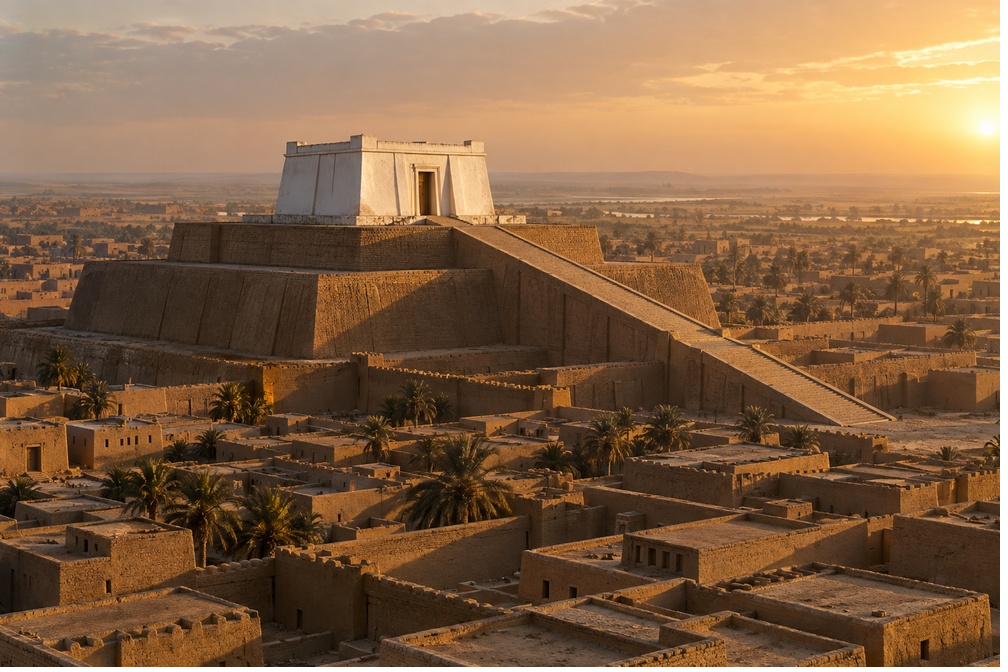
Uruk in the late fourth millennium contained perhaps fifty thousand inhabitants, possibly more. Its central precincts, the Eanna sanctuary of Inanna and the Anu ziggurat of An, were monumental complexes of platforms, halls, and courtyards built on a scale that the previous millennium would not have imagined. The Anu precinct featured the so-called White Temple, a high terrace topped by a whitewashed mud-brick sanctuary visible for miles across the flat plain. The Eanna precinct contained still more elaborate buildings, including a mosaic-fronted temple whose façade was decorated with thousands of small clay cones, glazed in red, white, and black, pressed into the wet plaster to form intricate geometric patterns.
This cone-mosaic technique, an innovation of the Uruk period, was a brilliant solution to the problem of how to give a mud-brick wall the visual richness that stone or marble might have provided in another country. The plain might lack stone, but it was generous in clay and in human labor, and Uruk used both abundantly. What drove the growth of Uruk and the rise of urbanism in the south? No single answer commands consensus. Population pressure played a role; the productive capacity of irrigated alluvium meant that a relatively small area could support a relatively large population, and the continuous arrival of incomers from less productive regions probably swelled the southern centers.
The needs of irrigation themselves favored coordination at increasingly large scales: a network of canals serving thousands of fields cannot be managed by isolated households, and the institutions that arose to manage it tended to concentrate authority and people. Trade also played a role, both as a stimulus and as a result; the centers that could mobilize labor on a large scale could also mobilize textile production for export, attract merchants, and accumulate prestige goods. Religious and ideological factors mattered too. The temples, which had been the centers of their villages, became the centers of cities; the gods of Uruk, Ur, and Eridu became regional powers whose festivals drew worshippers and pilgrims from far around.
These factors did not operate in isolation. They reinforced one another. A bigger town meant more labor, which meant more canals, which meant more grain, which meant more temple wealth, which meant more trade, which attracted more incomers. By the late Uruk period the snowball had become an avalanche. The Uruk period also saw a startling phenomenon known as the Uruk expansion. From around 3600 BCE onwards, settlements appear far up the Euphrates and into northern Syria and southeastern Anatolia which exhibit, in their architecture, pottery, and administrative tools, an unmistakably southern Mesopotamian style.
Some of these sites, like Habuba Kabira on the middle Euphrates, are clearly built from scratch, with walls, gates, regular street grids, and a pottery assemblage almost indistinguishable from that of Uruk itself. Others, like Hac■nebi in southeastern Turkey, are existing local towns that suddenly acquire Uruk-style quarters within their walls, as if a colony of southern merchants had taken up residence among the locals. At Susa, in southwestern Iran, the cultural relationship to Uruk is complex but unmistakable; for a time Susa appears to have been almost a sister city of Uruk.
Whether all of this represents a deliberate imperial expansion driven from the south, a wave of trading colonies seeking access to raw materials, a religious diaspora, or some combination of all three, scholars continue to debate. What is clear is that for several centuries during the late fourth millennium, Uruk-style culture spread far beyond its native plain, only to retract sharply, around 3100 BCE, into the southern heartland from which it had come. The retraction has been variously interpreted as the result of local resistance, internal political crises, climate shifts, or some combination, and its causes are still debated.
The technologies and institutions that crystallized during the Uruk period are foundational for everything that follows. Pottery, which had been hand-built and individually decorated in the Ubaid, was now wheel-thrown on the true fast wheel, mass-produced in standardized forms, and largely undecorated; this looks at first like an aesthetic regression but is in fact the visible signature of a society that had begun to produce on an industrial scale. The plough, attested earlier in some highland sites, came into widespread southern use, dramatically increasing the productivity of agricultural labor. The wheeled cart, drawn by onagers or oxen, allowed bulk transport over land.
Monumental architecture, by which we mean buildings whose construction required the mobilization of substantial labor beyond what any single household could provide, became routine in city centers. Most strikingly of all, the late Uruk period saw the production, in enormous quantities, of small, plain bowls with rapidly tapered sides, the so-called bevel-rim bowl. These bowls, mass-produced in molds rather than thrown on the wheel, are found in their tens of thousands at every Uruk-period site, often discarded immediately after a single use. The most widely accepted interpretation is that they were ration bowls, used to dole out a fixed daily portion of grain or barley porridge to dependent laborers, and as such they are the visible material signature of an organized labor force receiving its keep from a central store.
The bevel-rim bowl is, in a sense, the first paystub. Closely related to the bevel-rim bowl is the emergence of what archaeologists call proto-writing. Throughout the Neolithic, small clay objects of various shapes — cones, spheres, disks, ovoids, sometimes incised with marks — had been used in the Near East as counters or tokens, kept in collections to track livestock, grain, and other commodities. The American archaeologist Denise Schmandt-Besserat made the case in the 1970s and 1980s that these tokens were the direct ancestors of writing. By the late Ubaid and early Uruk periods, tokens are found enclosed within hollow clay balls, called bullae, with the tokens sealed inside and the contents of each ball indicated by impressions of the tokens pressed into the outside surface before sealing.
The next step was to dispense with the tokens themselves and simply impress the marks directly into a flattened tablet. By the late Uruk period, around 3300 BCE, this process produced the first true tablets: small flat pieces of damp clay, dried and sometimes baked, on which the impressions had become abstract numerical signs and pictographic representations of the goods being counted. From there the system developed quickly. Within a few generations the marks had become more and more abstract, the numerical system had been articulated into different scales for different commodities, and the signs had begun to be combined to express not only goods but also the names of officials, places, and gods.
Writing, the most consequential single invention of human history, had emerged out of accountancy. Other innovations of the late Uruk period accompanied the appearance of writing. The cylinder seal, a small drum of stone or bone engraved in negative relief and rolled across a clay surface to leave a continuous impression, replaced the older stamp seal as the standard administrative tool of the south; with it, the Sumerian bureaucracy could authenticate tablets, jar stoppers, door lockings, and bundle wrappings with a swift and unmistakable signature. The temple precincts grew more complex, with administrative rooms separate from cult rooms, scribal chambers, archives, and increasingly elaborate storage facilities.
Specialized crafts, in particular metallurgy, began to develop on a scale that allowed the production of fine vessels, jewelry, and weapons in copper and silver. By the very end of the Uruk period and the transitional Jemdet Nasr phase that follows it, the cities of the southern plain had assembled almost the full complement of features that we associate with civilization: writing, monumental architecture, full-time craft specialization, a permanent priesthood, organized labor, long-distance trade, and the beginnings of social stratification. One question hangs over all of this and remains unresolved: who, precisely, were the Sumerians?
The earliest tablets, written in pictographic signs, do not reveal the language they encode; the signs do not have to be Sumerian, and indeed the earliest, purely logographic tablets are usable in any language. Only in the early third millennium, when Sumerian becomes more securely identifiable through the rebus-style use of signs to spell out grammatical elements, can we say with confidence that the language being written is Sumerian. By that point, however, the cities have been there for centuries. Did the people who built the Ubaid villages, founded Eridu, raised the temple of Enki, dug the first canals, and finally created Uruk speak Sumerian?
Or did Sumerian-speakers arrive later, joining or displacing earlier inhabitants who had spoken some other tongue or tongues? The matter has been argued for over a century. The Sumerian language is a true isolate, with no demonstrated genetic relationship to any other known language family, ancient or modern. It does not appear to be Semitic; it is not Indo-European; it shows no clear cousin in the Caucasus, Iran, or India. Its grammar, with agglutinative morphology, ergative alignment, and a system of nominal classifiers, is recognizable to linguists but unique. Some scholars have argued that the linguistic strangeness of Sumerian reflects an intrusion of speakers from outside the alluvium into a pre-existing culture; others, that the Sumerians were the long-time inhabitants of the plain and that their language is a survival of a once broader linguistic landscape that was later overlaid by Semitic and other intrusions.
The honest answer is that we do not know. The Ubaid and Uruk people may have been Sumerians; they may have been the linguistic ancestors of Sumerians; or they may have been the people from whom the Sumerians took over a partly built civilization. The cuneiform record is mute on this earliest matter, and archaeology can speak only of pots and walls. The origins of the Sumerians remain a mystery hidden in the mud beneath their cities. The chronology of these prehistoric developments deserves a brief summary, because the relative dating of the various Mesopotamian cultural phases has been the subject of considerable refinement over the last several decades.
The Hassuna culture is conventionally dated from approximately 6500 to 5500 BCE; the Samarra culture, which partially overlapped with Hassuna and partially succeeded it, is dated from approximately 6000 to 5500 BCE; the Halaf culture, which followed both, is dated from approximately 6000 to 5000 BCE in its mature form. The Ubaid culture, which overlapped with Halaf in its early stages and then succeeded it in southern Mesopotamia, is dated from approximately 6500 BCE in its earliest phases at sites like Tell el-'Oueili to approximately 3800 BCE in its latest phases throughout the south.
The Uruk period, which grew gradually out of the late Ubaid, is dated from approximately 4000 to 3100 BCE, with its most spectacular florescence coming in the late Uruk phase from about 3500 to 3100 BCE. The Jemdet Nasr period, the brief transitional phase between Uruk and Early Dynastic, is dated from approximately 3100 to 2900 BCE. The Early Dynastic period, the great age of independent Sumerian city-states, runs from approximately 2900 to 2350 BCE, with its three sub-phases conventionally distinguished as Early Dynastic I, II, and III. These dates, established through the careful comparison of stratigraphic, ceramic, and (where available) cuneiform evidence, are calibrated by occasional fixed points such as known reigns and astronomical retro-calculations, and they have become considerably more reliable in recent decades through the application of radiocarbon dating to organic materials recovered from secure stratigraphic contexts.
What is not in doubt is the immensity of what they inherited. By the end of the fourth millennium, the southern Mesopotamian plain had been cultivated, drained, and reshaped by human labor for two thousand years. Its temples were ancient. Its trade networks were global by the standards of the day. Its social institutions were elaborate. Its writing was new and developing fast. The transition from prehistory to history in southern Mesopotamia was not a sudden leap. It was the moment when accumulated experiment finally became dense enough, complex enough, and articulate enough to leave a record.
The deep continuity from prehistoric to historic Mesopotamia is visible in many specific aspects of material culture. The mud-brick architectural tradition that the Ubaid pioneers developed in their small village houses scaled up directly into the great temples and palaces of the Early Dynastic and later periods, with the same basic techniques of mud preparation, brick molding, and bitumen mortar persisting essentially unchanged for thousands of years. The reed-and-clay construction techniques that the Ubaid villagers used for their lighter buildings persisted into the marsh dwellings of southern Iraq into the modern era, and their representation in Sumerian art and on the cone-mosaic facades of Uruk creates a recognizable continuity from the sixth millennium to the twenty-first century CE.
The pottery wheel, introduced in the late Uruk period, persisted as the standard pottery technology of southern Mesopotamia for the next five thousand years. The cylinder seal, invented in the late Uruk period, served as the standard administrative tool of the region for over three thousand years. The writing system, developed across the late fourth millennium, was used continuously for over three thousand years, surviving multiple changes of language and political authority. The cumulative impression is of a civilization built on long durations: institutions, technologies, and practices that, once established, were not lightly abandoned, and that proved capable of persisting across the most significant political and demographic disruptions of the ancient world.
The Sumerians did not invent civilization out of nothing in the third millennium. They picked up, refined, and amplified a project that had been going on, in mud and reed and clay and wheat and grain, for far longer than they themselves remembered. 5000 BC Ubaid period begins 4000 BC Uruk period 3400 BC First writing 2900 BC Early Dynastic 2334 BC Sargon of Akkad 2112 BC Ur III dynasty 2004 BC Fall of Ur 1800 BC Sumerian dies out Earlier Later Timeline of Sumerian civilisation
Chapter 3 — The Dawn of Cities
A city is not merely a large village. It is a settlement of a particular kind, defined less by population than by the kinds of relationships its inhabitants have with one another and with the land around them. In a village, almost everyone is a farmer or a herder; the specialists, if any, are part-timers who farm in the off-season. In a city, by contrast, a substantial fraction of the population produces no food at all. Smiths, scribes, weavers, brewers, priests, soldiers, merchants, prostitutes, and porters live by exchanging their labor or skill for grain produced by others.
The city is the place where this division of labor becomes thick enough to be visible from outside, and the institutions that emerge to coordinate the resulting economy — markets, temple stores, palace bureaucracies, written contracts — become recognizable parts of urban life. By any of these measures, the cities of southern Mesopotamia in the early third millennium BCE were unmistakably cities. They were also, in all probability, the first cities anywhere in the world. The period during which urban Sumer fully matured is called the Early Dynastic, lasting roughly from 2900 to 2350 BCE and conventionally subdivided into three phases.
During these centuries, the southern plain was densely settled and divided among a number of city-states, each anchored on a major urban center, each ruling its hinterland of fields, smaller towns, and irrigation channels, and each engaged in continual rivalry, alliance, marriage, and warfare with its neighbors. The Sumerians themselves saw their world this way. Their conception of legitimate political authority centered on the city: each city had its patron god, its temple, its civic identity, and its rightful king or governor; the larger world was a federation of cities, sometimes peaceful and sometimes not, but never an undifferentiated empire of subjects.
To be Sumerian was to belong to a city. The greatest of these cities, by most measures, was Uruk. The walled circumference of Uruk in the Early Dynastic ran for some nine kilometers and enclosed an area of more than four hundred hectares; Sumerian poetry, which loved precise hyperbole, gave Gilgamesh credit for building those walls and recorded their length as exactly six miles, "with eight gates." Inside lived perhaps eighty thousand people in the city's heyday, more by some estimates, fewer by others, but in any case a population larger than that of any other contemporaneous settlement in the world.
The center of the city contained two great sanctuaries. The Eanna, the "house of heaven," was sacred to Inanna, goddess of love, war, and the morning and evening star, and grew in the Early Dynastic into a complex of temples, courts, and storehouses that occupied a substantial portion of the urban core. The Anu precinct, sacred to An, the sky god from whom Inanna had been said to receive the sceptre of kingship, included the high terrace later known as the ziggurat of Anu and the ancient White Temple. Around these religious centers spread residential quarters, craft workshops, marketplaces, harbor canals branching from the Euphrates that brought goods to the heart of the city, and the granaries and breweries that fed and watered everyone within the walls.
The city was not laid out on a regular grid; it grew organically, with twisting streets, irregular plots, and the dense, courtyarded houses that would remain typical of Mesopotamian urbanism for millennia. From a high vantage Uruk's plan resembled an enormous beehive. The closest rival of Uruk, in both prestige and prosperity, was Ur. Lying further south, near the head of the Persian Gulf in antiquity, Ur was the city of Nanna, the moon god, called Sin in his Akkadian guise. Its temple complex, the Ekishnugal, contained one of the great sanctuaries of southern Mesopotamia; in the time of the Third Dynasty of Ur, more than a thousand years after the Early Dynastic, Ur-Nammu and his son Shulgi would build over its precincts the most famous ziggurat of all.
Even in the Early Dynastic period Ur was a major city, with its own walled core, its own harbor, its own trading fleet plying the waters of the Gulf, and its own royal cemeteries that would, when reopened in the 1920s by Leonard Woolley, yield some of the most spectacular finds in the history of archaeology. Like Uruk, Ur lay on a branch of the Euphrates that has long since shifted its course; in antiquity the city was a port, but the river later moved several kilometers to the west, and the modern ruins, called Tell el-Muqayyar, sit in the desert.
To the north and east of Ur lay the city-state of Lagash, which was actually a tripartite urban entity comprising three closely related towns: the city of Girsu, where the political and religious capital lay; the city of Lagash itself, an older center; and the smaller town of Nina-Sirara. Together they ruled an extensive territory along the Tigris and the lower Iturungal canal. Lagash, more than any other Sumerian city-state, has left us a rich written record of the Early Dynastic period, in part because its scribes recorded an unusual number of detailed administrative documents, in part because its kings, particularly Eannatum and Urukagina, were politically active and produced inscriptions about their reigns.
The chief god of Girsu was Ningirsu, "Lord of Girsu," a vigorous warrior deity sometimes identified with the more general figure of Ninurta. His temple, the Eninnu, "House of Fifty," was one of the great religious complexes of the south, and would be famously rebuilt and embellished in the late third millennium by the pious governor Gudea, whose statues in dark diorite remain among the masterpieces of Sumerian art. Across the lower Iturungal from Lagash lay its bitter rival Umma, with its patron god Shara. The two cities fought intermittently for centuries over a strip of fertile farmland, the Gu'edena or "Edge of the Steppe,"
and their disputes are documented on a series of inscribed boundary markers and on the Stele of the Vultures, the great Lagashite victory monument set up by Eannatum after one of the more decisive of these conflicts. The story of the Lagash-Umma feud is in some ways the central drama of Early Dynastic political history, a multi-generation example of how city-state rivalry could shape the agricultural and demographic life of the entire region. The two cities exchanged victories and reverses for at least two centuries, with periodic peace settlements brokered through the mediation of Mesalim, an Early Dynastic king of Kish, and through the spiritual authority of Nippur.
In the end the rivalry was settled only when both cities were absorbed into the larger empire of Sargon of Akkad in the late third millennium. Eridu, on the marshy southern frontier, occupied a special place in the Sumerian imagination. Tradition held that Eridu was the very first city to be founded, before the great flood, when "kingship descended from heaven" upon Eridu in the antediluvian section of the Sumerian King List. Whether this tradition reflects a real historical priority is difficult to say; the Eridu site does indeed contain some of the earliest temple architecture in the south, with its successive Ubaid sanctuaries piled up over millennia, but other settlements were nearly as old.
What is certain is that the Sumerians regarded Eridu as the city of beginnings, the place where civilization had first taken root, and that they associated it with the wise god Enki, lord of the freshwater abzu. Even when Eridu had dwindled into a small pilgrimage town, its mythical priority was honored. The kings of Ur III rebuilt its temples; the priests of Babylon, more than a thousand years later, still drew on the prestige of Eridu in their theological writings. Nippur, by contrast, was less a political capital than a sacred one.
It was the city of Enlil, the executive god of the Sumerian pantheon, and as such it occupied a position in the religious imagination of the south that no other city could match. No king of Sumer was considered fully legitimate until he had received the blessing of Enlil at Nippur and had been confirmed there by the priesthood of Enlil's great temple, the Ekur, "House Mountain." In practical terms this meant that hegemonic kings, no matter where their political base lay, made a point of patronizing Nippur and dedicating monuments and offerings there.
The result was that Nippur accumulated a continuous record of royal donations across centuries, and its temple archives became the largest single repository of Sumerian literary tablets ever recovered. It was at Nippur, in the late nineteenth century, that the American expedition led by John Henry Haynes uncovered the tens of thousands of literary tablets that have made modern Sumerology possible. Without Nippur, our reconstruction of Sumerian poetry, hymnody, and mythology would be a far poorer thing. Kish, in the north of Sumer near the boundary with the Akkadian-speaking territories, played yet another role.
According to the Sumerian King List, after the great flood "kingship descended from heaven" a second time, this time at Kish, and the city remained for centuries the symbolic seat of post-diluvian kingship. The title "King of Kish" became, in time, a marker of regional hegemony, claimed by ambitious rulers from other cities who wanted to assert their preeminence. The most famous of the early Kish kings was Mesalim, who flourished around 2600 BCE and acted as arbitrator in the early stages of the Lagash-Umma dispute. After Mesalim, the political importance of Kish waxed and waned; it would later be the birthplace of Sargon of Akkad, who began his career as a cup-bearer at the Kishite court.
Today the ruins of Kish, just east of Babylon, lie partly excavated. Several of its early dynasties are known, but the documentation is uneven. Around these greater cities clustered a dense ring of lesser ones. Shuruppak, modern Fara, was the home of the legendary king Ziusudra, the Sumerian Noah, who rode out the great flood in his ark; archaeologically it is one of the best-known Early Dynastic sites, with rich early third-millennium archives. Bad-tibira, "Wall of the Coppersmith," lay near Lagash and Umma; Larak, somewhere in the same region, played a part in flood mythology.
Sippar in the north was sacred to Utu, the sun god, and was an important commercial city. Adab, Isin, and Larsa would later play major political roles. Susa, across the eastern frontier, was the principal city of Elam and a constant presence in Sumerian affairs. The map of southern Mesopotamia in the Early Dynastic period was densely populated with urban centers; from a high enough vantage you could probably see the smoke of two or three cities at any time, and you were never more than a day's walk from the nearest one.
The physical layout of an Early Dynastic Sumerian city followed a recognizable pattern, though no two cities were identical. A high outer wall of mud brick, sometimes faced with baked brick at the gates and corners, enclosed the urban area. The wall ran for kilometers and was punctuated by guarded gates, each named for a god or a direction. Inside the wall, the temple complex of the patron deity stood on its raised platform, often with its own subsidiary wall and its own staff of priests, scribes, and laborers. Near the temple, in the more politically developed cities, stood the palace of the ensi or lugal, the city-governor or king, a complex of receiving halls, residential apartments, archives, and storerooms.
The rest of the city consisted of dense residential blocks of one- and two-story mud-brick houses, generally arranged around small interior courtyards, with workshops, breweries, bakeries, and small shrines distributed throughout. The streets were narrow, often little more than alleys two or three meters wide, and would have been crowded, dusty, and smelly. A network of harbor canals brought river water into the urban core, and at the harbor wharves the boats of merchants, fishermen, and farmers tied up to load and unload their cargoes. Outside the wall stretched the city's territory: irrigation canals, fields of barley and emmer, gardens of vegetables and date palms, pastures, and the smaller satellite towns and villages dependent on the central place.
The population of these cities is the subject of ongoing debate, but informed estimates place Uruk in its prime at perhaps 50,000 to 80,000 inhabitants and the larger Lagash and Ur at perhaps 30,000 to 50,000 each. Smaller cities like Eridu may have housed only 5,000 to 10,000 within their walls. Total population for the Sumerian-speaking heartland in the mid-third millennium has been estimated at perhaps half a million to a million people, distributed across several dozen cities and their hinterlands. By the standards of the modern world these are modest numbers, but by the standards of the ancient world they were enormous.
The contemporary populations of Egyptian cities of the Old Kingdom, of Anatolian and Levantine towns, and of Indus Valley cities, were broadly comparable but rarely larger; what set Sumer apart was the density of urban centers, with so many cities packed into such a small geographical area that the political life of the south was always intensely competitive. The relations between these cities formed a continual, complex weave. Sumerian inter-city politics seems to have run, much of the time, on a loose and unstable balance of power. Cities allied with one another against common rivals, or quarreled over canal water, frontier fields, marriage diplomacy, or trade routes.
Major rivalries — Lagash and Umma, Ur and Lagash, Kish and Uruk — recurred across generations, each renewal carrying forward grievances and memories from the last. Royal correspondence, when it survives, is full of complaints about boundary infractions, lawsuits over runaway slaves, demands for restitution after raids, and requests for reinforcements during sieges. Diplomatic marriages between royal houses were used to seal peace; they were also broken with monotonous regularity. Wars were short, savage, and locally devastating, but they rarely produced lasting territorial gains. A city defeated in battle would be plundered, perhaps required to pay tribute or accept a vassal status, but its institutions and population would generally survive intact, ready to rebel as soon as opportunity allowed.
Sumerian warfare was the warfare of neighbors, with all the particular bitterness that this implies. Despite these continual rivalries, the cities of the south shared a single overarching cultural identity. They spoke a single language, Sumerian, with at most minor dialectal variations. They worshipped the same pantheon, with each city patronizing one or two of the great gods more particularly than the others but recognizing all. They wrote a single script. They followed a common calendar, modeled after the lunar year with its intercalary months. They produced and consumed a common literary tradition, with the great mythological and historical compositions copied in multiple cities and passed down across generations.
They participated in shared festivals at Nippur and elsewhere, and they recognized a common term for the land they inhabited: kalam, "the land," meaning the Sumerian-speaking heartland as opposed to the foreign territories around it. The cities competed and fought, but they did so within a single cultural envelope, and a Sumerian-speaking visitor to any of them would have felt, on the most important matters, at home. The Sumerian King List, our most important native document for the political history of the Early Dynastic, organizes this complex world into a single narrative, though the narrative it provides is more theological than historical.
According to the King List, kingship was a divine institution that descended from heaven and rested, at any given time, in a single city, whose ruler was therefore the legitimate king of the entire land. After a period of years (sometimes a few decades, sometimes thousands of years in the antediluvian sections), the city's hegemony fell, "kingship was carried" to another city, and a new dynasty arose. The list moves through cities in succession: in the antediluvian section, Eridu, Bad-tibira, Larak, Sippar, and Shuruppak hold kingship before the Flood; afterwards it descends to Kish, then to E-Ana (in Uruk), then to Ur, and so on through several cycles.
The pattern, with its insistence on a single legitimate ruler at each moment, is plainly an idealization. In actual fact, multiple Sumerian cities frequently had simultaneous kings, all of whom would have considered themselves perfectly legitimate. But the King List represents how the Sumerians, particularly in the political environment of the late Early Dynastic, came to understand their own past: as a sequence of city-state hegemonies, each rising, holding kingship for a time, and then yielding it to the next. A few features of the Sumerian urban experience deserve more sustained attention.
The first is the relationship between the city and its dependent countryside. A Sumerian city was never an isolated artifact set down in an unfarmed landscape; it sat at the heart of an extensive territory of fields, gardens, palm groves, pastures, smaller towns, and dispersed villages, all of which were administratively and economically integrated with the urban center. The boundary of the city's territory was marked, in many cases, by inscribed stones or by the mouths of branching canals; within the boundary, agricultural land belonged to the temple, to the palace, to wealthy private families, or to ordinary smallholders, with the proportions varying among cities and across periods.
The temple estates of the great cities were enormous, sometimes covering thousands of hectares and worked by tenant farmers who paid rent in shares of the harvest, by client-laborers who received daily rations from the temple stores, and by slaves attached to the institution. The palace estates, where they existed, were similarly organized; private estates, often the property of merchant families or of senior priests, ran from substantial holdings to smallholdings of just a few iku. The smallholders of the Sumerian countryside, often acting through extended family networks, were the backbone of the rural economy and the principal source of the levied labor that maintained the canal system and the city walls.
A second feature worth attention is the relationship between cities of different sizes within the same political orbit. A great city like Uruk or Lagash did not exist alone; it stood at the center of a network of smaller dependent towns, each with its own subsidiary temple, its own modest fortifications, its own local administration, and its own role in the overall economy. Ur, for example, presided over the smaller towns of Ku'ara, Eridu (in its later phase), and several others, each integrated into the broader administrative system of the Ur city-state.
Lagash held sway over Girsu, Lagash-town, and Nina-Sirara, plus a further set of smaller dependent settlements. The city-state was not a simple urban entity but a multi-tiered network with a great city at its hub and smaller centers radiating outward to the boundaries of its territory. The agricultural surplus of the smaller towns flowed inward toward the great city, and the manufactured goods, religious services, and political authority of the great city flowed outward to the smaller towns. The integration was tighter in some city-states than in others, but the basic pattern was characteristic of the entire Sumerian urban system.
A third feature is the long-term demographic dynamism of the urban population. Cities did not grow at a steady pace; their populations expanded and contracted according to the success or failure of harvests, the demands of war, the appeal of urban opportunities, and the periodic crises of plague, famine, and political collapse. Detailed demographic analysis of Sumerian cities is difficult, given the nature of the evidence, but the broad trends are clear. Uruk reached its peak in the late Uruk period, around 3100 BCE, after which its population gradually declined and stabilized at a lower level for the rest of its history.
Ur experienced its great expansion during the Early Dynastic period and again, more famously, under the Third Dynasty of Ur in the late third millennium. Lagash's population fluctuated significantly across its long history, with peaks during the Early Dynastic and Akkadian periods and a notable secondary expansion under Gudea during the Gutian interregnum. The general pattern, however, is one of long-term sustained urbanization: the cities of southern Mesopotamia, having become large in the late fourth millennium, remained substantial population centers for the next two thousand years, even as individual cities rose and fell within that broader continuity.
It is in this Early Dynastic period of city-states, with its temple precincts and its palaces, its scribal schools and its merchant fleets, its long rivalries and its shared culture, that the historical Sumer takes its definitive shape. It is also worth noting the role of geography in shaping the political map of Sumer. The pattern of cities, with major urban centers spaced roughly forty to sixty kilometers apart along the major branches of the Euphrates and Tigris, reflects the practical limits of the irrigation territory that any one city could effectively administer.
Beyond a certain distance from the urban center, the canal system became too thinly served by the city's bureaucracy and labor force, and a new urban node tended to emerge to manage the next downstream or upstream sector. The canal-mediated boundaries between city-states, often the subject of intense disputes such as the long Lagash-Umma feud, were not arbitrary lines drawn on a featureless plain; they corresponded to the practical limits of the water-management systems that each city could support. The political geography of Sumer, in this sense, was a function of its hydrological geography, and the fluctuating boundaries of cities and territories tracked the shifting course of the Euphrates and the changing layouts of the canal networks more than they tracked the abstract claims of royal inscriptions.
The cities had grown, their institutions had matured, their writing had become a flexible literary instrument, their religion had stabilized into the great pantheon, and their economy had reached a sustainable scale. The intellectual and cultural achievements of these cities give us, perhaps, our deepest sense of why the Sumerian world should be considered one of the founding civilizations of human history. By the mid-third millennium, the cities had developed scribal schools that trained students in a multi-year curriculum of reading, writing, arithmetic, and a body of received literary tradition.
They had organized professional priesthoods that conducted complex daily rituals and maintained continuous records of cult practice across centuries. They had developed legal institutions that handled disputes, recorded contracts, and enforced standards of conduct. They had built monumental temples and palaces that required sustained organized labor over years and that demonstrated architectural ambitions far exceeding anything that had previously been attempted in the region. They had created a distinctive visual art that would influence the aesthetic conventions of the entire ancient Near East. They had organized long-distance trade networks reaching to the Persian Gulf, the Iranian highlands, and the Mediterranean coast.
They had begun the systematic observation of the heavens that would, in the centuries to come, develop into the first sustained tradition of mathematical astronomy. The Sumerian cities of the Early Dynastic period, in other words, were not just large settlements; they were the home of a complex civilization whose intellectual, technological, and cultural achievements would echo through the millennia. The dawn of urban life that had begun in the late Uruk period was now, by the middle of the third millennium, full daylight. The Sumerian cities had become a world.
Chapter 4 — Cuneiform — The Invention of Writing
Of all the contributions that the Sumerians made to the long history of human civilization, none has had so deep or so durable an influence as the invention of writing. Before Sumer, nothing that human beings said, sang, calculated, or remembered had been put in any form that could outlast the breath of the speaker. After Sumer, the entire intellectual life of the species could be stored in lines of clay and stone, transmitted across centuries, criticized at leisure, accumulated and refined. Almost everything we now think of as scholarship — accountancy, history, law, literature, science, philosophy — depends on this single technology, and the Sumerians were the first people to make it work.
Writing did not arrive as a flash of inspiration. It evolved, slowly and incrementally, out of an older accounting practice that stretched back into the Neolithic. Throughout the seventh and sixth millennia BCE, communities across the Near East had used small clay objects of various standardized shapes — cones, spheres, disks, ovoids, hemispheres, sometimes incised with shallow lines — as counters for tracking commodities. A cone might represent a small unit of grain, a sphere a larger one, a disk perhaps a sheep, a hemisphere a measure of oil. To account for a transaction or a tax obligation, a person might assemble the appropriate group of tokens in a small bag or basket.
Some of these tokens have been recovered in their hundreds, scattered across sites from the Levant to the Iranian plateau, and their distribution and shapes show a remarkable consistency over thousands of years. By the late Ubaid period, around 4000 BCE, the simple practice of carrying tokens loose had been refined into a more secure system. Tokens representing the contents of a transaction were sealed inside hollow clay balls, called bullae or envelopes, with the surface of the bullae marked by impressions made before the clay dried. To consult the contents, a person had to break the bulla open and count the tokens within; to verify them without breaking, one consulted the impressions on the outside.
The American archaeologist Denise Schmandt-Besserat, beginning in the 1970s, marshaled the case that this token-and-bulla system was the direct ancestor of writing. Her argument, contested in detail but broadly accepted in outline, runs as follows. Once the impressions on the outside of the bullae had become the practical record of contents, the tokens themselves were redundant. Why, after all, store actual three-dimensional objects in a sealed ball, when the marks on the outside could be read directly? The next step, taken by some unknown bureaucrat in the late fourth millennium, was to dispense with the bulla altogether and simply press the relevant marks into a flat tablet of clay.
The tablet had decisive advantages: it could be made quickly, it stored well, it could be easily inscribed with additional marks if the transaction required, and once dried it could be filed in an archive without any risk that the contents would jangle or settle out of order. The clay tablet became the standard medium of Near Eastern administration almost overnight. The earliest tablets, recovered from level IV at Uruk and dating to around 3300 BCE, are still essentially numerical-and-pictographic accounting documents. They record quantities of grain, livestock, beer, oil, and other commodities, with the numerical signs in one part of the tablet and the pictographic signs for the commodities and the persons or institutions involved in another.
Many of them simply record receipts or disbursements without further detail. The pictographs are still recognizably what they depict: a stylized head of an ox, a sheaf of barley, an ear, a foot, a fish, a star. The numerical system is sophisticated from the beginning: there are different numerical signs for counting different commodities, with grain counted in one base and livestock in another, reflecting the different volumetric and discrete realities of the goods being counted. The system already shows the practical genius of the people who built it. The mechanics of writing on clay are worth pausing over, because they shaped everything that followed.
The scribe took a small lump of fine, well-levigated clay, kneaded out the air, and shaped it by hand or in a mold into a flattened cushion the size of a coin or an envelope. While the clay was still damp, he or she pressed the end of a reed stylus into the surface to make the marks. The reed stylus was the key to the whole system. Cut to a length of fifteen or twenty centimeters and trimmed to a wedge-shaped point, the stylus was held in the right hand and pushed obliquely into the clay; when withdrawn, it left an impression with a deep, triangular head and a long, tapering tail.
The Latin word for this characteristic shape is cuneus, "wedge," from which the modern term cuneiform derives. By varying the orientation and depth of the impression, the scribe could produce a small but flexible vocabulary of marks: a vertical wedge, a horizontal wedge, a diagonal wedge, a corner-wedge, and combinations of these in groups. Whole signs were built up out of these basic strokes, in patterns that, with practice, could be inscribed quickly. After the writing was complete, the tablet was either left to dry in the sun, in which case it would last for centuries in a dry climate, or fired in an oven, in which case it became as durable as a piece of brick.
Many of the most important Sumerian and Babylonian tablets owe their survival to having been baked in fires that destroyed the buildings around them; the buildings burned, but the tablets, like clay pots, were merely fired and preserved. In the centuries after the first appearance of writing, the system evolved rapidly in two directions. First, the pictographic signs became more abstract. The original drawings of an ox head, a barley sheaf, or a foot were initially scratched into the clay with a fine point, but the wedge-shaped reed stylus did not lend itself to curved or detailed outlines.
By degrees, the signs were redrawn as combinations of straight wedges that approximated the original drawing but no longer literally resembled it. Within five or six centuries, by 2700 BCE or so, the original pictographic origin of the signs is hardly visible to anyone who is not a trained Assyriologist. The ox head is a constellation of wedges that bears only a schematic relation to its source; the barley sheaf is a rectangle of strokes; the foot is a triangle of points. The system has become, in this sense, fully abstract.
Second, and more fundamentally, the signs began to be used not only as logograms representing whole words, but as syllabic phonograms representing the sound of those words. The breakthrough is what is sometimes called the rebus principle. In any spoken language, many words sound alike or contain similar syllables. A logographic sign for one word, used for its sound rather than its meaning, can therefore stand in for any other word containing the same sound. The Sumerian word for "arrow" was ti, which sounded the same as the Sumerian word for "life."
Once a scribe had used the sign for "arrow" to write the word ti meaning "life," he had committed himself to a phonetic use of the sign that opened up an enormous range of new possibilities. Verbs could be written by combining a logogram for the action with phonograms for the verbal endings. Proper names of people and places, which were essentially impossible to write logographically, could now be spelled out syllable by syllable. Grammatical particles could be expressed. The writing system became capable, in principle, of representing any spoken Sumerian utterance, not just lists of nouns and numbers.
By the middle of the third millennium, cuneiform writing was a mixed system of considerable complexity. It contained several hundred logographic signs, each representing a particular Sumerian word; a substantial inventory of syllabic phonograms, each representing a CV, VC, or CVC syllable; and a smaller set of so-called determinative signs, mute markers placed before or after a word to indicate its semantic class — wood, stone, god, place, animal, profession. A typical sign group on a tablet might combine logograms for the main concepts, phonograms for the grammatical endings and proper names, and determinatives to clarify category.
The system was less economical than a true alphabetic system would have been, but it was tremendously flexible. It could be adapted, with minor adjustments, to languages quite different from Sumerian. Within centuries of its invention, the cuneiform system was being used to write Akkadian, the Semitic language of the Akkadian and later Babylonian and Assyrian dynasties; further afield, it would be used for Hittite in central Anatolia, Hurrian and Urartian in the Caucasus, Elamite in southwestern Iran, and finally a much-simplified syllabic version for Old Persian under the Achaemenid kings of the first millennium.
For more than three thousand years, cuneiform was the dominant writing system of the western Asiatic world. The contents of the surviving cuneiform corpus are an extraordinary cross-section of ancient life. Of the more than half a million tablets that have been recovered and read, the great majority are administrative or economic records: receipts for grain shipments, ration lists for temple workers, contracts for the sale of fields or the leasing of beasts of burden, lawsuits over inheritances, tax registers, payroll lists, invoices from merchant ventures, accounts of stockpiles of weapons.
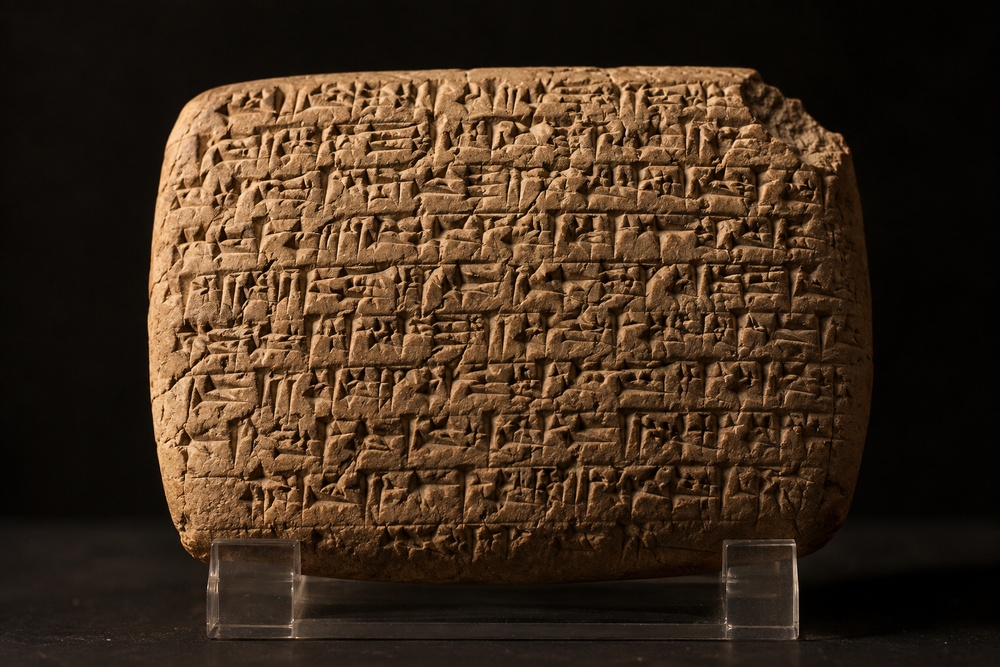
From these humdrum sources we can reconstruct in remarkable detail the economy of southern Mesopotamia at any moment from the late fourth millennium to the first century BCE: who owned what, who owed whom, what crops were sown, what the prices were, how much workers were paid, and what they ate for breakfast. Beyond these everyday records, however, the cuneiform corpus also includes royal inscriptions, treaties, codes of law, letters, schoolbook exercises, lexical lists, mathematical and astronomical texts, divinatory compendia, medical manuals, hymns, prayers, myths, epics, lamentations, debates, proverbs, and love songs.
The tablets give us not only the bones of economic life but the flesh and soul of the civilization that produced them. The training of a scribe, and the institution that made cuneiform literacy possible, was the edubba, the "tablet house" or scribal school. We know about the edubba mainly through a small set of literary compositions, written by scribes for use in their own classrooms, that describe the daily life of a scribal student. The student arrived at the school at dawn, often after a long walk, carrying his lunch in a sack.
The school was usually a single large room or a courtyard with a few smaller rooms, presided over by a senior scribe known as the "father of the school" and his assistants, including the "big brother," a more senior student tasked with helping the younger ones. The day began with the recitation of the previous day's lesson and the inspection of homework tablets. New material was introduced through a complex curriculum that began with the simplest single signs and progressed through bilingual sign lists, vocabulary lists, lists of personal names, mathematical problem sets, model contracts and letters, and finally the great literary compositions: the hymns, the myths, the king lists, the wisdom literature.
A graduating scribe would have spent ten or more years in this regimen and would have copied each major composition many times. Discipline was strict; the literary texts that survive about scribal life describe canings and rebukes for tardiness, sloppy handwriting, and misbehavior. One particularly funny composition, known as Schooldays, narrates the day of a student who is beaten by his teacher for almost every offense, comes home in a foul mood, and persuades his father to invite the teacher home for a flattering dinner, after which the teacher praises him and presents him with prizes.
The composition is a satire, but it is also a recognizable picture of the scribal classroom. The function of scribes in society went well beyond the production of records. Scribes drafted royal inscriptions, copied and sometimes composed literary works, served as administrators in temple and palace, drew up legal documents, kept the books of merchant houses, and accompanied diplomatic missions as personal secretaries to ambassadors. They were a learned class with a strong sense of professional identity, and they regarded their craft with pride, sometimes bordering on snobbery. The literary text known as the "Lament of the Gala-priest"
complains that anyone these days can call himself a scribe, even those who barely know their signs. The complaint is recognizable. Like all literate professions, the Mesopotamian scribal class understood itself as the guardian of a tradition that lesser people might dilute or misuse. Most scribes, in most periods, were men, but female scribes are attested in significant if smaller numbers. The most famous of all is Enheduanna, the daughter of Sargon of Akkad, whom her father installed as en-priestess of Nanna at Ur in the late twenty-fourth century BCE.
Enheduanna composed a sequence of hymns to Inanna and a collection of temple hymns dedicated to the major sanctuaries of Sumer, and she signed her work, identifying herself by name and title in the colophons. She is the first author in human history whose name we know and whose works survive. Other female scribes, less famous but no less real, served as administrative personnel in palaces, temples, and households. The royal women of Lagash had their own scribal staffs, including women, who handled the queens' personal correspondence and accounts. Female literacy was probably never widespread, but it was not absent.
The cuneiform writing system, having served as the dominant script of the ancient Near East for over three thousand years, gradually fell out of use during the last centuries BCE. Aramaic, written in an alphabetic script on parchment and papyrus rather than on clay, became the everyday administrative language of the Persian and Hellenistic empires that ruled Mesopotamia after the fall of Babylon. Sumerian had ceased to be a spoken language some time around 1800 BCE, surviving only as a sacred and scholarly tongue much as Latin would later survive in medieval Europe.
Akkadian held on for longer but increasingly only as a literary and religious language. By the first century CE, cuneiform was being written only by a small remnant of priests and scholars in a few temples, most notably in Babylon and in the city of Uruk, and the last datable cuneiform tablet that we have is an astronomical text from Babylon dated to about 75 CE. Within a generation or two thereafter the script was entirely forgotten. Greek, Latin, and Aramaic writers in the centuries that followed retained dim memories of "the wedge writing"
of the Babylonians, but no one alive in the early centuries CE could read it. Fifteen centuries of obscurity followed. Travelers and antiquarians who visited the ruins of Mesopotamia from the seventeenth century onward brought back samples of the strange wedge marks they found inscribed on bricks and stones, but no one could decipher them. The first decisive break came not from Mesopotamia but from Persia. At Persepolis, the great ceremonial capital of the Achaemenid Persian kings, monumental inscriptions had been carved in three parallel cuneiform versions, in Old Persian, in Elamite, and in Babylonian, the latter two being adaptations of the original Mesopotamian script.
The Old Persian script, simpler than its parents and used to write a language that was related to Sanskrit and other Indo-European languages, presented the easiest target. In the late eighteenth and early nineteenth centuries, several scholars worked on it, beginning with Carsten Niebuhr, who had visited Persepolis and copied inscriptions, and continuing with Georg Friedrich Grotefend, a German schoolteacher who in 1802 published a partial decipherment based on guesswork about the names of Persian kings. By the 1830s, the Old Persian script had been substantially read. The breakthrough on Babylonian cuneiform came through the heroic, and physically improbable, work of Henry Creswicke Rawlinson, a young British army officer stationed in Persia.
Rawlinson became fascinated with the great trilingual inscription carved by Darius I on the rock face at Behistun in western Iran, more than a hundred meters above the road that the inscription overlooked. Climbing the cliff and dangling on ropes for hours at a stretch, Rawlinson copied the Old Persian, Elamite, and Babylonian versions of the inscription over the course of several years in the 1830s and 1840s, often at considerable risk. With the Old Persian text already partly deciphered, Rawlinson and a network of correspondents, including the British scholar Edward Hincks and the French scholar Jules Oppert, were able to extend the decipherment to the Babylonian.
By 1857, four scholars (Rawlinson, Hincks, Oppert, and William Henry Fox Talbot) independently produced translations of a previously unseen Akkadian inscription, brought together by the Royal Asiatic Society in London for an experimental test. Their translations agreed in essentials. The Babylonian script, and with it the door to the entire cuneiform world, had been opened. There remained a final puzzle. As scholars worked through the rapidly accumulating Mesopotamian texts in the 1850s and 1860s, they began to realize that some tablets, particularly older ones, were written in a non-Semitic language that bore no resemblance to Akkadian.
Lexical lists discovered in the libraries of Nineveh and elsewhere matched columns of words in Akkadian against columns of words in this older language. Jules Oppert, in 1869, proposed that the older language was the tongue of a previously unknown people whom the Akkadians had called the people of Sumer, and so coined the term "Sumerian" for the language and people. Sumerian, we now know, is a true language isolate, with no demonstrated genetic relation to any other known family. Its decipherment proceeded through a long, careful, and sometimes contentious process across the late nineteenth and twentieth centuries, dependent above all on the bilingual lexical lists composed by ancient scribes who had themselves been trying, in the early second millennium and later, to preserve a Sumerian tradition that was already fading from active use.
We read Sumerian today through these scholarly intermediaries. The labor of generations of Babylonian scribes has, by an unintended grace, made it possible for the modern world to recover their own past. The state of Sumerology today is that of a mature but still-living discipline. Hundreds of thousands of tablets have been excavated and catalogued, and the digital era has accelerated the pace of publication enormously. The Cuneiform Digital Library Initiative, based at UCLA, has produced an open online corpus of high-resolution photographs and transliterations covering a substantial fraction of the surviving tablets.
The Electronic Text Corpus of Sumerian Literature at Oxford has digitized the major literary compositions in transliteration and translation. The Open Richly Annotated Cuneiform Corpus, ORACC, hosts edited and annotated editions of texts from across the Mesopotamian world. Recent advances in three-dimensional scanning, image processing, and machine learning are now being applied to the more difficult problems: the reading of damaged and poorly preserved tablets, the joining of fragments scattered across museum collections, and the partial automation of the still labor-intensive process of sign recognition. Tablets continue to come out of the ground, both from licensed excavations in Iraq and Syria and, regrettably, from the looting that has accompanied wars, sanctions, and instability in the region.
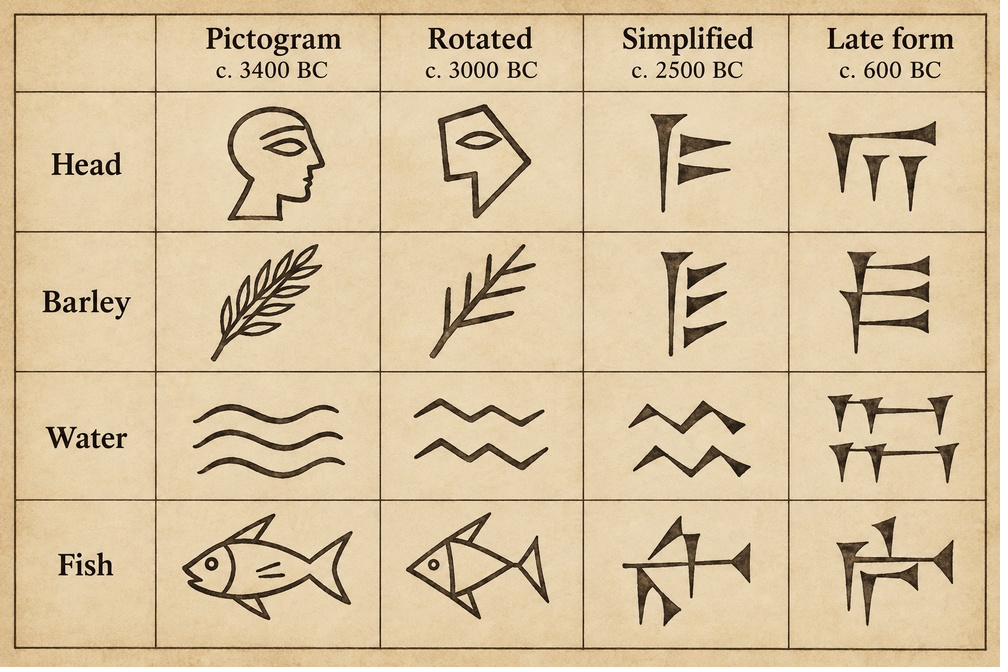
The corpus grows. Most importantly, there remains an enormous backlog of unread or partly read texts in museum collections around the world, and each new generation of Sumerologists and Assyriologists adds to our cumulative understanding of what these texts contain. The deciphering of cuneiform has not ended; it merely deepens. It is worth dwelling for a moment on the sheer physical infrastructure that made cuneiform writing possible at the social scale it eventually reached. The clay used by the scribes was not just any handful of mud from the riverbank; it was a carefully prepared and levigated material, mixed and rested for some hours before use to develop the right plasticity and to remove gritty inclusions that would have blunted the stylus and produced uneven impressions.
Workshops attached to the temple and palace bureaucracies maintained stocks of properly prepared clay, sometimes shaped already into blank tablet "slugs" of standard sizes, ready to be inscribed at need. The reed for the stylus, drawn from the marshes that ran south to the Persian Gulf, was selected for its straightness and its ability to take a good edge when cut at an oblique angle; an experienced scribe would carry several styluses of slightly different sizes, choosing among them according to whether he was about to write a finely detailed colophon, an ordinary administrative entry, or a large monumental inscription.
The dried tablets were stored in baskets, on shelves, or in jars; the larger archives, such as those of the temple of Inanna at Uruk or the palace of Mari, ran to many tens of thousands of tablets and required substantial storage rooms with elaborate filing systems. Scribes used clay or wooden tags, attached to the bundles or jars, to label the contents and the date. The scale of the system, in other words, was much greater than the simple impressionistic image of "wet clay and a reed" suggests. Cuneiform writing was an industry, and the industry rested on the steady, almost invisible work of clay preparers, reed cutters, archive clerks, transport workers, and copyists, without whom the more visible work of the senior scribes would have been impossible.
The internal organization of the scribal class itself was elaborate. At the top of the profession stood the senior scribes attached to the great temples and the palaces, men of considerable wealth and political influence who served as the executive heads of the administrative bureaucracies and who advised the king on matters of policy. Below them stood the journeyman scribes, who did the bulk of the daily work of recording transactions, drafting contracts, and maintaining the running accounts of the institutions that employed them. Below them stood the apprentice scribes, the older students of the edubba who had passed beyond the most basic exercises and were beginning to take on real work under supervision.
Beyond this institutional core were the freelance scribes, sometimes called "scribes of the marketplace," who set up their tables at the city gates or in the public squares and earned their living by drafting letters, contracts, and other documents on demand for the illiterate majority who needed to commit their affairs to writing but had no scribal staff of their own. Even ordinary Sumerians of modest means could thus participate in the literate world; the scribe at the gate would, for a small fee in barley or silver, draft and witness the contracts that one's family or business required, and the resulting tablets would carry their owner's mark and the scribe's signature with the same legal weight as the documents produced by the most elevated palace bureaucracy.
The pervasiveness of writing in Sumerian society, then, did not depend on universal literacy; it depended on a stratified and accessible network of literate professionals who served as the interface between writing and the broader population. The relationship between cuneiform writing and the spoken Sumerian language is more complex than it might at first appear. Sumerian has, as we have seen, several features that make it difficult to write phonetically: an agglutinative morphology that strings together long sequences of grammatical particles to form complex verbal forms, an ergative-absolutive case system distinct from the more familiar nominative-accusative pattern of Indo-European and Semitic languages, and a vocabulary in which many words are short and homophonic, distinguishable to the ear by tonal or contextual features but readily confused on paper.
The writing system that the Sumerians developed handled these challenges through the deployment of multiple sign types in combination: logograms representing the basic semantic content of words, syllabic phonograms representing the grammatical endings and particles attached to those words, and determinative signs to disambiguate between similar-sounding words by indicating their semantic class. The result was a written language that was readable but not necessarily phonetically transparent; a Sumerian text could often be understood at the conceptual level by a reader who did not know the precise vocalization of the words it contained.
This feature of the writing system would prove decisive when, in the early second millennium, the cuneiform script was adapted to write Akkadian and other Semitic languages, where the same logographic-syllabic framework could be put to use with new readings assigned to the inherited signs. A single cuneiform sign could be read in Sumerian one way and in Akkadian another, and bilingual scribes had no difficulty in toggling between the two. The internal flexibility of cuneiform, in other words, was the technical foundation for its long career as the dominant script of the ancient Near East.
A reader holding a small Sumerian school tablet today sees, in the dense pattern of impressed wedges, the exact gesture of a child five thousand years ago: the same fingers, in the same posture, pressing the same shape of stylus into the same kind of clay. Few archaeological objects so directly preserve a human action across so many centuries. The clay is still soft enough, in many cases, to take the impression of a fingerprint. The thumbprint of a Sumerian apprentice who once handled the tablet before it dried is sometimes visible.
Across five thousand years, the line connecting that apprentice to the modern reader is fragile, mediated, easily lost. But it is also, thanks to the brilliance of the writing system that the Sumerians invented, real. Pictogram c. 3400 BC HEAD BARLEY WATER FISH Rotated c. 3000 BC Simplified c. 2500 BC Late form c. 600 BC Evolution of cuneiform signs
Chapter 5 — Gods, Temples, and the Cosmic Order
The Sumerians lived in a world dense with gods. Every river had its presiding deity, every storm its lord, every patch of marsh its spirit, every fever its demon. The land itself was alive with divine personalities, and the boundary between sacred and ordinary was less a hard line than a continuous gradient. To work a field was to participate in the labors of Ezinu, the goddess of grain. To eat bread was to partake in the daily life of Nisaba, the goddess of writing and accounting whose name had once meant grain and whose nature had only later been transferred to scribal craft.
To drink beer was to honor Ninkasi, the goddess of brewing. To swim in the river was to be carried by Enki himself. The Sumerian world was thoroughly enchanted, and the elaborate theological structures that the priests of Eridu, Nippur, Uruk, and Ur built to map out this enchantment were never abstract systems detached from daily experience; they were maps of the world as it was actually lived. At the head of the pantheon stood An, whose name simply meant "heaven." An was the original sky god, the high father from whom all kingship and authority were said to descend.
In the formal lists of the gods, his name appears first, and his city was Uruk, where his temple, the high terrace later called the ziggurat of Anu, marked one of the oldest sacred precincts in the south. In practical terms, however, An was a remote and rather inactive figure. Like the high gods of many polytheisms, he was acknowledged in the formal sense but not particularly active in the daily affairs of human beings. His authority was delegated downward to the more dynamic deities below him, and the great myths and hymns of Sumer rarely make him their central figure.
The most powerful active god of the pantheon was Enlil, the lord of wind, storm, and earth. Enlil's city was Nippur, the religious capital of Sumer, and his temple, the Ekur, "House Mountain," sat at the center of the city on a great platform that would in time grow into the most famous ziggurat outside of Ur. Enlil was the god whose word executed the decrees of the divine assembly. When the gods met in council to decide the fate of cities, of kings, or of humanity, it was Enlil who was said to "fix the destinies."
He was vigorous, sometimes capricious, often terrifying. Sumerian myth attributed to him both the gift of agriculture, by which he brought forth the grain of the fields, and the great Flood that nearly destroyed humankind. He was the god whose anger could shake the foundations of the world, and whose blessing was indispensable for legitimate rule. No king of Sumer, regardless of where his political base lay, was considered fully legitimate until he had been confirmed by the priests of Enlil at Nippur. The relationship between political authority and the cult of Enlil was so close that the standard royal title in Sumerian was, literally, "the one to whom Enlil has given the scepter."
The third great god of the high triad was Enki, the lord of the freshwater abzu, the deep subterranean ocean from which all springs and wells drew their life. Enki's city was Eridu, the southernmost and reputedly oldest of the Sumerian cities, where his temple stood on its platform among the marshes. Enki was a god of an entirely different temperament from Enlil. Where Enlil was vigorous and severe, Enki was clever, mischievous, and warm. He was the patron of crafts, magic, and wisdom; the inventor of all useful things; the friend of humanity, and frequently the protector of human beings from the wrath of the other gods.
In the great myth of the Flood, it is Enki who, against the explicit prohibition of the divine council, secretly warns Ziusudra to build his ark and so saves humanity from extinction. In another myth, Enki and the World Order, it is Enki who lays out the proper destinies of the various lands, rivers, and crafts, organizing the world into a working civilization. In Inanna's Descent to the Netherworld, it is Enki who creates the strange creatures who descend to rescue Inanna from the underworld. He is, in short, the god of intelligence, fertility, and rescue, and he is consistently the most likable figure in the Sumerian pantheon.
His later Akkadian counterpart, Ea, would inherit all of these qualities and pass them on, by way of the Babylonian and Hellenistic traditions, into the wider intellectual life of the ancient Mediterranean. Beside this great triad stood the mother goddess, sometimes called Ninhursag, "Lady of the Foothills," sometimes Ninmah, "Great Lady," and sometimes Nintud, "Lady of Birth." Ninhursag was associated with the mountainous land east of the alluvium, with the wild animals that lived there, and above all with the powers of birth and reproduction. In the myth Enki and Ninhursag, set in the paradisiacal land of Dilmun where pain and aging do not exist, Ninhursag both creates the cosmos's vegetation and engages in a complicated cycle of births and quarrels with Enki, ending with her healing him after he has sickened from eating forbidden plants.
She is the great mother, ancient and fundamental, and her cult, though less politically visible than that of the male gods, was deep and widely observed. Beneath the high gods, each of the major Sumerian cities had its own patron deity, often a member of the high triad's family. Nanna, the moon god, also called Sin or Suen in his Akkadian guise, was the patron of Ur. He was the eldest son of Enlil, the brother of Utu and Inanna, and the god of the lunar month, of nighttime, of cattle, and of the calendar.
His temple at Ur, the Ekishnugal, was the heart of one of the great Sumerian city-states; the famous ziggurat that Ur-Nammu would later build there is dedicated to him. Sumerian months began with the new moon, and the Sumerian calendar, with its lunar cycles and intercalary months, organized the religious and agricultural life of the south around Nanna's slow and reliable progress through the night sky. Utu, the sun god, also called Shamash by the Akkadians, was the son of Nanna and the brother of Inanna. He was the god of justice, of straight paths, of clear judgment.
Worshipped at Sippar in the north and at Larsa in the south, Utu was the deity to whom the wronged appealed. The famous later law code of Hammurabi shows the king receiving the symbols of justice from Shamash, and the iconography of Utu as the god of right judgment goes back into the Sumerian period. Utu rose each morning from the eastern mountains, crossed the sky during the day, and descended into the underworld at night, traveling through it in his chariot to emerge again at dawn. He saw everything, and the wicked could not hide from him.
Inanna, the daughter of Nanna and the sister of Utu, was the most complicated and fascinating deity of the Sumerian pantheon. Her city was Uruk, where her great temple Eanna was the heart of the urban core. She was the goddess of love, of sexual desire, and of warfare, an unlikely combination that the Sumerians appear to have understood as natural. She was associated with the planet Venus, both as the morning and the evening star. She was simultaneously fierce and tender, lustful and aloof, generous and capricious. Sumerian poetry took particular pleasure in her contradictions.
The myth of Inanna's Descent to the Netherworld, one of the longest and most powerful Sumerian compositions, narrates her journey to the realm of her sister Ereshkigal, queen of the dead, where she is stripped of her royal regalia at each of seven gates before being killed and hung as a corpse on a stake. She is rescued by Enki, but only by accepting the substitution of her husband Dumuzi as her replacement. The myth, with its deep themes of death, rebirth, and substitution, would influence later Near Eastern religions in ways still being traced.
As Ishtar, in her later Akkadian guise, Inanna would become one of the most powerful deities of the wider ancient world. Her temple at Uruk continued to be rebuilt and patronized long after Sumerian was a dead language. Other major figures of the pantheon include Ereshkigal, the queen of the underworld, dread and powerful; Nergal, her husband, god of plague and war; Ninurta or Ningirsu, the warrior god of Lagash, slayer of monstrous beasts and patron of agriculture; Nanše, the goddess of fish and dream interpretation; Bau, a healing goddess and consort of Ningirsu; the goddess Geshtinanna, sister of Dumuzi, who shares with him the burden of substitution for Inanna; and many more.
Beneath these major deities crowded a host of lesser gods, demons, and spirits: the protective lamassu and shedu of doorways, the malevolent edimmu and gallu of sickness, the various personal gods who attached themselves to particular families. The pantheon was crowded, articulated by genealogy and function, and continually being elaborated and reorganized by priests and poets. By the end of the third millennium, the great god lists of Sumer named several thousand divine beings, each with a domain and a place in the cosmic family. The cosmology that gave structure to all of this was, like Sumerian theology generally, a synthesis of practical observation and mythological imagination.
The universe began, in the Sumerian view, with a primordial sea, sometimes named as Nammu, the great mother of all. Out of this sea were born An, heaven, and Ki, earth, who together formed a single mountain that was eventually pulled apart, the heavens raised aloft and the earth left below. From their union came Enlil, who fixed the destinies; Enlil's union with the goddess Ninlil produced the moon god Nanna; Nanna's union with Ningal produced Utu and Inanna. The cosmic family branched outward from this center. Beneath the earth lay the abzu, the freshwater deep, and below that the kur or netherworld, the dim and dust-eating realm of the dead, ruled by Ereshkigal.
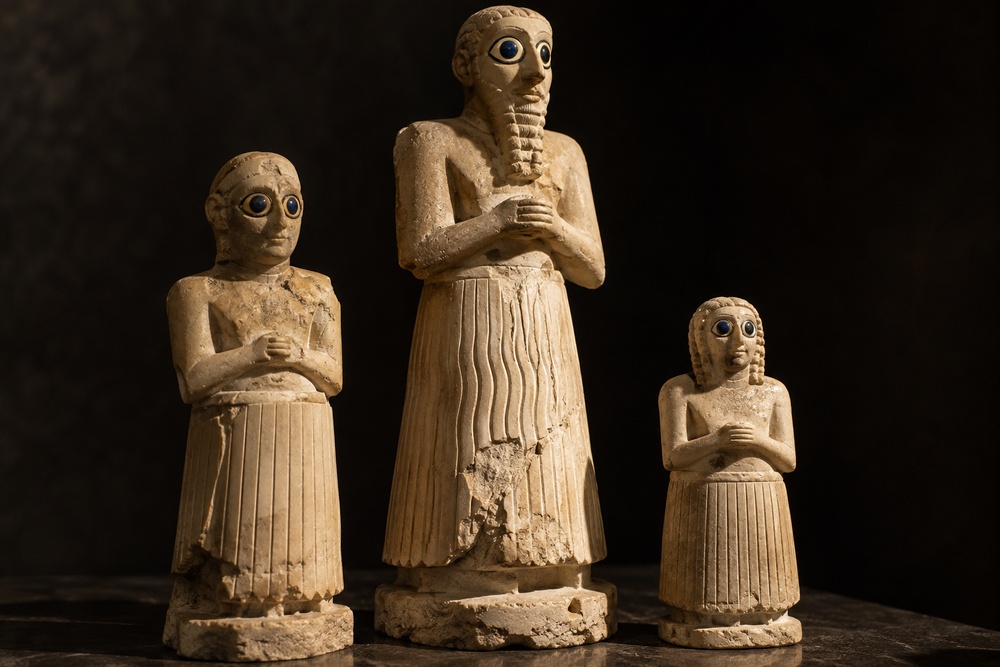
The earth itself was thought of as a flat disk, surrounded by a saltwater ocean and covered by the dome of the heavens, in which the sun, moon, and stars moved on their appointed paths. This worldview is unmistakably the worldview of the southern alluvium projected outward: a flat land surrounded by water, with mountains visible only in the distance and the sky an immense bowl. The temples that housed the gods were the most important buildings in any Sumerian city, and the ziggurat in particular became one of the defining monuments of Mesopotamian civilization.
The earliest temples, going back to the Ubaid period, had been single small mud-brick rooms with niches for offerings. Over many centuries of rebuilding, each successive temple had been laid down on top of the rubble of its predecessor, gradually elevating the sanctuary on a cumulative platform. By the late Uruk period, this organic process had been deliberately formalized: temples were built atop high mud-brick terraces from the start, and the terraces themselves became the focus of architectural elaboration. The terrace was a stage, raising the house of the god above the city around it.
By the Ur III period, the terrace had been refined into the staged ziggurat: a tower of three or more receding tiers of mud brick, faced with baked brick and bitumen, climbed by stone or brick stairways, with the temple proper at the top. The ziggurat of Ur, built by Ur-Nammu and his son Shulgi around 2100 BCE, is the best preserved of all Sumerian ziggurats; restored several times in antiquity and partially reconstructed in the twentieth century, it still rises from the desert floor to a height of some twenty-one meters, with its massive lower terrace nearly a hundred meters long.
The ziggurat at Eridu, the ziggurat at Nippur, the ziggurat at Uruk, and many others followed broadly similar plans. The Sumerians called the ziggurat by various names, including é-temen-an-ki, "house of the foundation of heaven and earth," a phrase that gives some sense of the cosmic significance the structure carried. What went on in these temples was, in part, a daily routine of feeding and serving the god. The cult statue of the deity, a free-standing figure of carved wood overlaid with precious metal and inlaid with semiprecious stones, lived in the inner sanctuary of the temple.
Every day, twice a day, the priests prepared meals for the statue: bread, beer, fresh fruit, roast meat, sweetmeats. The food was placed before the statue, the curtain was drawn, and after the proper interval the curtain was reopened, the food was understood to have been consumed in a spiritual sense, and the priests then ate the leavings as a privileged share. The statue was bathed and dressed in fresh garments at appropriate intervals; on festival days it was crowned with elaborate headdresses, paraded through the streets in a special boat or chariot, taken to visit the statues of other gods at neighboring temples.
When a new statue was made, or when an old one was repaired or moved, the priests performed an elaborate ceremony called the "opening of the mouth," in which the statue was ritually animated, becoming the actual living presence of the god rather than a mere representation. The Sumerians, like most ancient peoples, did not draw a sharp distinction between symbol and reality where the cult was concerned. The statue was the god, and the temple was the god's house in the same way that a king's palace was the king's.
The temple was also, in addition to its religious function, the central economic institution of the city. It owned vast tracts of agricultural land worked by tenant farmers and dependent laborers, large flocks of sheep tended by shepherds in its employ, and fishing fleets that brought daily hauls from the rivers and marshes. Its storehouses received the surplus production of these enterprises, and its officials redistributed grain, wool, oil, fish, and beer to the labor force in the form of monthly rations. The temple maintained its own workshops for weaving, metalworking, leatherworking, and the manufacture of luxury goods for cult and trade.
It supported scribes, accountants, judges, and physicians as part of its staff. It conducted the long-distance trade in materials needed for cult and craft, sending merchants to Dilmun, Magan, and Meluhha and receiving caravans from the Zagros and Anatolia. In the Early Dynastic period, the temple was probably the largest single economic actor in any Sumerian city, and its administration was the cradle in which the great Sumerian achievements of accountancy and writing took shape. The personnel of the temple was elaborate and hierarchical. At the top stood the en, originally a sacral king who united religious and political authority and who ritually represented the marriage of the city's god with the city's goddess.
The institution of the en faded with the rise of the secular lugal, but the title persisted in religious contexts; at Ur, the en was the high priestess of Nanna, often the daughter of the king, who lived in her own residence in the giparu near the great ziggurat. Below the en came the various priests and priestesses with specialized functions: the sanga, who managed the temple's economic affairs; the gala, a class of lamentation priests who, intriguingly, had a tradition of singing in a special female-marked dialect of Sumerian called eme-sal; the various exorcists, diviners, musicians, and singers; and a large staff of menial servants, doorkeepers, kitchen workers, brewers, weavers, and laborers.
The temple supported, in many periods, hundreds of personnel. Among the most famous of all temple officials was Enheduanna, daughter of Sargon of Akkad, whom her father installed as en-priestess of Nanna at Ur in the late twenty-fourth century BCE. Enheduanna composed a sequence of hymns in Sumerian to the goddess Inanna, hymns that are remarkable both for their poetic intensity and for their political content; they read, in part, as the prayers of a woman caught up in the political turmoil of her father's empire and turning to her favorite goddess for protection and vindication.
Her temple hymns, a separate collection dedicated to the major sanctuaries of Sumer, function as a kind of theological gazetteer. She signed her work, identifying herself by name and title, and is the first author in human history whose name we know and whose works survive. The pattern she established, by which a royal daughter served as en-priestess of a major sanctuary, persisted for centuries. The religious calendar of Sumer was punctuated by festivals, of which the most important was the New Year festival, called the Akitu, celebrated each year in spring at the time of the equinox.
The Akitu involved a complex sequence of rites over several days, including the symbolic remaking of the cosmos, the recitation of creation myths, the renewal of the king's authority, and ceremonies of fertility and abundance. In some periods and places it included the so-called Sacred Marriage rite, in which the en-priestess representing the goddess Inanna and the king representing her husband Dumuzi consummated their union in a ritual setting, ensuring through this divine-human marriage the fertility of the land for the coming year. The texts that describe this ritual are remarkably explicit in their poetic detail and have provided modern scholars with a window into a religious practice for which the documentary evidence elsewhere in the ancient world is rare.
Beyond the Akitu, each city celebrated the festivals of its patron god, the cycles of the moon, the various agricultural turning points, and the local commemorations of myth and history. Outside the public cult of the great temples, the Sumerians also maintained a rich tradition of personal religion. Each individual was understood to have a personal god, a minor deity attached to the family or even to the individual, who served as an intercessor between the worshipper and the great gods. When a person was sick, when a venture failed, when ill fortune struck, the standard interpretive framework was that the personal god had become angry or had withdrawn its protection, perhaps because the worshipper had sinned.
The literary genre of the "letter-prayer," in which a sufferer addresses a complaint and a plea to his or her personal god, gives us an intimate look at this dimension of Sumerian religious life. So does the genre of incantation, in which the patient and the exorcist invoke the great gods, particularly Enki, against the demons that were thought to cause illness. Closely related to personal religion was the practice of divination. The Sumerians, like their Babylonian successors, believed that the gods communicated their intentions through signs in the natural world, and that these signs could be read by the trained diviner.
The most prestigious form of divination was extispicy, the inspection of the entrails, particularly the livers, of sacrificed sheep and other animals. The patterns of veins and lobes on the liver, the markings, the exact configuration of features, were taken as a writing of the gods' will. Diviners trained for years to read these patterns and accumulated reference compendia, sometimes inscribed on clay models of livers, that catalogued the meanings of every possible variation. Other forms of divination included the observation of oil poured on water, the smoke from incense, the behavior of birds and animals, and the patterns of the stars.
Astronomy, as we shall see, developed in part as the practical service arm of astrology. What of life after death? The Sumerian view was bleak. The dead descended to the kur, the dim subterranean realm of Ereshkigal, where they led a shadowy and unhappy existence. There were no fires of punishment, no fields of bliss; there was only the gray underworld, where the dead ate dust and drank stagnant water, and from which there was no return. The fate of all human beings was the same, regardless of virtue or status, except that one's situation in the underworld depended in part on the offerings provided by surviving relatives and on the pomp of one's burial.
A king might fare slightly better than a beggar, but only slightly. The bleakness of this view, which Babylonian theology would inherit and elaborate without softening, accounts for the strong Sumerian emphasis on the value of life itself. The Epic of Gilgamesh, in its various versions, returns again and again to the theme that there is no escape from death, that the goddess of beer and revelry has the right of it when she advises Gilgamesh to go home, eat, drink, dress in clean clothes, and love his wife and child.
To a Sumerian, immortality was not an option, and the only way to leave a permanent mark on the world was through one's name, one's achievements, and one's offspring. Above and behind the entire system of gods, temples, festivals, and prayers, the Sumerians articulated a remarkable concept: the me. The me are the divine essences, sometimes translated as "ordinances" or "powers," that govern the various aspects of civilization. There were me of kingship, me of priesthood, me of weaving, me of metalworking, me of music, me of love, me of warfare, me of judgment.
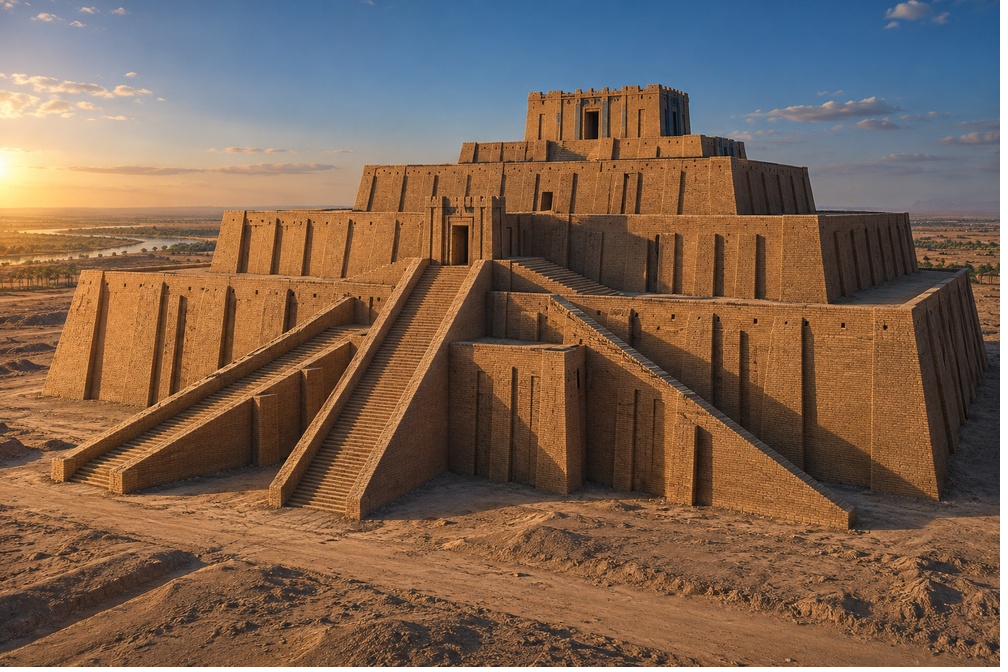
The me were given by the great gods, particularly An and Enlil and Enki, and the city that possessed them flourished. In the myth Inanna and Enki, Inanna, the goddess of Uruk, visits Enki in his city of Eridu and, while he is drunk, persuades him to give her the me of all the great institutions of civilization, which she then carries off in her heavenly boat to Uruk. When Enki sobers up and realizes what has happened, he sends his messenger to take them back, but Inanna outwits him and arrives safely in Uruk with the me intact.
The myth is partly a charming mythological tale of a clever younger goddess outwitting a wiser older god; it is also a theological declaration that the cultural achievements of civilization are not human inventions but divine gifts, located somewhere above and outside human history, given by the gods to particular cities and held by them in trust. The Sumerians were the first people to attempt a sophisticated theology of culture, and the me are its central concept. Two further dimensions of Sumerian religious life deserve particular attention because they illuminate the shape of the system as a whole.
The first is the role of dreams and oneiric divination. The Sumerians believed that the gods could communicate with mortals through dreams, and the interpretation of dreams was a recognized professional skill. The goddess Nanše of Lagash was particularly associated with the interpretation of dreams, and her priestesses developed a substantial tradition of dream-reading that included specific guidelines for distinguishing significant dreams from ordinary ones, for identifying which god had sent a particular dream, and for the appropriate ritual responses to the messages dreams contained. The royal hymns and the personal letters of Mesopotamian rulers occasionally describe specific dreams that the king received and the actions he subsequently took on the basis of their interpretation.
Gudea of Lagash, in particular, recorded in his cylinder inscriptions a detailed account of the dream in which the god Ningirsu appeared to him and commanded him to rebuild the Eninnu temple, with specific instructions for the building's plan and ornamentation. The dream provides the religious legitimization of the building program, and the fact that Gudea presents his architectural undertaking as the direct execution of a divine command, conveyed through the established channel of the prophetic dream, is characteristic of Sumerian piety. The second dimension is the body of magical and protective practices that ran beneath the formal cult of the great temples and provided the religious framework for the everyday concerns of ordinary Sumerians.
Beside the priests of the temples worked a substantial number of exorcists, healers, midwives, and ritual specialists who operated in the home rather than in the sanctuary, and whose practice addressed the small, urgent crises of personal life: the sickness of a child, the difficult pregnancy, the failure of a venture, the suspicion of malevolent magic worked by an enemy, the appearance of an ominous sign such as an unexpected snake in the house. The clay figurines, prophylactic amulets, and inscribed protective bowls that have been recovered from many residential excavations testify to the prevalence of these practices, and the substantial corpus of incantation tablets describes the procedures and the spoken formulas that the ritual specialists employed.
Demons such as Lamashtu, the female demon who was thought to attack pregnant women and infants; Pazuzu, ironically called upon as a protective force against Lamashtu; and the various lilu and lilitu of the Mesopotamian demonic catalogue were treated with elaborate ritual care. The Sumerian religious universe, in other words, was not bounded by the great temples; it extended into every household, every birthing room, every sickbed, and every business venture, with its own everyday practitioners and its own working instruments. The festivals of the Sumerian religious calendar deserve a closer look as well.
Beyond the great Akitu of the New Year, each of the major cities had its own annual festival cycle dedicated to its patron god. At Lagash, the festival of Ningirsu in the seventh month was the great civic occasion of the year, with processions through the city, the carrying of the god's statue from his temple to a riverside resting-place and back, and competitive athletic events in which the young men of the city participated. At Ur, the moon god's festival at the beginning of each lunar month was a city-wide observance, while the great annual festival of Nanna involved the visit of the moon god's statue, by river barge, to the sanctuary of his father Enlil at Nippur, in a journey that became the model for similar god-visits between other cities.
At Uruk, the great festival of Inanna in the spring included the Sacred Marriage rite that was at once a fertility ritual, a political theater of royal legitimation, and an expression of the city's distinctive cult identity. Across all of these festivals, the patterns were similar: processions, sacrifices, public banquets, athletic and musical competitions, the redistribution of food from the temple stores to the urban population, and the temporary suspension of ordinary work in favor of communal celebration. The festivals were not merely religious; they were also social, political, and economic events of substantial importance, marking the rhythm of the year and reinforcing the collective identity of the urban community.
Taken together, the religious life of Sumer was vast, articulated, and intensely felt. The gods were everywhere; the temples were the largest and most permanent buildings in the cities; the priests were among the most powerful and learned people in the society; the festivals punctuated the year; the divinations punctuated the week; the prayers punctuated the day. To live as a Sumerian was to live in continual conversation with the unseen, and the great theological and architectural achievements of Sumerian civilization, the ziggurats above all, are the visible monuments to that conversation.
Long after the political world of the Sumerian city-states had passed away, long after Sumerian had ceased to be spoken in the streets, the gods of Sumer continued to be served. Babylon, Assyria, and even the Persian and Hellenistic empires that came after them, took up the Sumerian gods, gave them new names, rewrote their stories, and continued to honor their temples. The cosmic order that the Sumerians had drawn up in their dim and crowded heavens proved, like their writing system, more durable than the political world that produced it.
The Ziggurat of Ur, c. 2100 BC
Chapter 6 — Kings, Laws, and Warfare
Sumerian political authority did not begin with kings. In the earliest centuries of the urban transition, the institutions that governed the southern Mesopotamian cities were essentially religious. The temple of the city's patron deity owned much of the land, employed much of the labor force, kept the records, organized the public works, and conducted the major rituals; the chief priest of the temple, called the en or ensi, was the principal civic figure. The en was, in a literal sense, the city's highest official, a position that fused religious authority with secular leadership in a way that to modern eyes looks unfamiliar.
The en spoke for the god, and through the god for the city. There seems to have been, in this early arrangement, no separate institution of secular kingship, and certainly no figure recognizable as a king in the militarized sense that would emerge in later centuries. This temple-centered system was eventually displaced by, or grew alongside, a different model: the lugal, literally "big man," whose authority came not from the temple but from the demands of war. As the cities of the southern plain grew larger and their rivalries with one another intensified, a need emerged for a permanent military leader, a person who could be empowered to mobilize the city's resources and command its forces in time of crisis.
In the earliest periods this office may have been temporary; the lugal was elected for the duration of the emergency and stood down when peace returned. But in the conditions of the third millennium, with cities in continual rivalry over canal water, frontier fields, and trade routes, emergencies tended to be continual, and the office of lugal therefore tended to become permanent. By the late Early Dynastic period, the lugal had become a hereditary king with a palace, a personal retinue, a treasury, and a claim to authority that paralleled and sometimes superseded that of the en or ensi.
The two offices, en/ensi and lugal, did not displace one another cleanly. In some cities the older title remained dominant, and the city's chief official was called ensi long after the substantive content of the office had become essentially regal. In Lagash, the title ensi was retained for the city's rulers throughout the Early Dynastic period, even when those rulers were behaving in every practical respect like kings. In Uruk, by contrast, the title lugal came to dominate, and the great rulers of Uruk's heyday, including the legendary Gilgamesh, are kings outright.
In Ur, both titles appear, sometimes interchangeably. The terminological tangle reflects a political reality in which the two strands of authority — the priestly and the military — were braided together in different ways in different cities. By the time of Sargon and the rise of the Akkadian Empire, the lugal had clearly won the contest, and the older en title had become primarily ceremonial, applied chiefly to high priests and priestesses. Our most important native account of the political history of Sumer is the document called the Sumerian King List, compiled in something like its received form during the Ur III period and the early second millennium.
The King List opens with the famous declaration that "kingship descended from heaven" and lays out a sequence of dynasties, each ruling at a particular city, before being supplanted by the next. The earliest section, before the Flood, lists kings of Eridu, Bad-tibira, Larak, Sippar, and Shuruppak, with reigns of preposterous length: tens of thousands of years, in some cases. The Flood then intervenes, sweeping away the antediluvian world. After the Flood, kingship "descends" again, this time to Kish, and then proceeds through a series of post-diluvian dynasties at Kish, E-Ana (in Uruk), Ur, Awan in Elam, Mari, Akshak, and various other cities, alternating among them in a complex pattern.
The reigns gradually shorten, becoming more credible as we approach the historical period; the lengths of reigns of the last few dynasties before the Akkadian conquest are within the bounds of the plausible. The King List is not, however, a straightforward historical record. It is an ideological document. Its central premise — that at any one time only one city held legitimate kingship, with all other rulers being illegitimate or subordinate — is plainly contradicted by the actual evidence, which shows multiple Sumerian cities ruled simultaneously by independent kings. The King List was composed, almost certainly, to legitimate the unified rule of a particular dynasty, perhaps that of Utu-hegal of Uruk or of Ur-Nammu of Ur, by presenting unified rule as the historical norm to which the present moment had returned after a period of fragmentation.
Its lengths of reigns, especially in the antediluvian section, reflect mythological convention rather than fact. Its succession of cities, however, almost certainly contains genuine historical memory, and many of the kings it names are independently attested in royal inscriptions of their own. The King List is therefore best read as a stylized but not arbitrary tradition, partial in its evidentiary value but not without value. Among the most famous of the kings named in the post-diluvian section of the List is Gilgamesh, lugal of Uruk, fifth king of the post-diluvian dynasty of E-Ana.
Whether Gilgamesh was a real historical figure has been debated for over a century, but the balance of evidence now favors a real Gilgamesh somewhere in the early Early Dynastic period, perhaps around 2700 BCE. The walls of Uruk, attributed to him by tradition and visible in the archaeological record, are indeed of unusual scale and date; the earliest royal inscriptions from Uruk include kings closely contemporary with the figure the tradition identifies as Gilgamesh; and the very specific traditions about him, in their most ancient form, lack the wholly mythological character of more obviously legendary figures.
The historical Gilgamesh is therefore probably a real king, a builder of walls and a leader in war against the rival city of Kish, who in subsequent centuries became the focus of an enormous body of legend. The five separate Sumerian poems about Gilgamesh — Bilgames and Huwawa, Bilgames and the Bull of Heaven, Bilgames and the Netherworld, the Death of Bilgames, and Bilgames and Akka — preserve different episodes of his career, and the great Akkadian Epic of Gilgamesh, compiled centuries later, would weave these and other materials into a unified narrative of remarkable depth.
By the Old Babylonian period, Gilgamesh had become the archetypal Sumerian hero-king. The Early Dynastic period was also the era of the great inter-city wars, recorded fragmentarily in royal inscriptions and at greater length on the Stele of the Vultures, the great victory monument set up by Eannatum of Lagash around 2450 BCE. Eannatum, ensi of Lagash, fought and defeated the neighboring city of Umma in a long-running dispute over the boundary of the Gu'edena, the fertile strip of farmland that lay between the two states. The Stele of the Vultures, recovered in fragments from the ruins of Girsu and now housed in the Louvre, depicts Eannatum at the head of his troops in tightly disciplined ranks, marching with shields raised and spears leveled in what may be the earliest representation of phalanx warfare in human art.
Above the human battle, the god Ningirsu of Lagash holds the captives of Umma in a great net, and the inscription on the stele records the divine sanction for Lagash's victory and the curses that will fall on any future ruler of Umma who breaks the boundary settlement that Eannatum has imposed. It is, in its combination of military, political, and theological language, a remarkable document, and one of the earliest historical monuments anywhere in the world. A few generations later, around 2400 BCE, another king of Lagash named Urukagina, sometimes spelled Uru-inim-gina, undertook one of the most important reforms of the Early Dynastic period.
Faced with what he describes as a system of corruption and abuse, in which the priests of the temple, the king's own administrators, and the boatmen and shepherds in royal service had been extorting fees and seizing property from the ordinary population, Urukagina issued a series of decrees in which he declared the abuses ended. He restored, he said, the proper order of things: he would no longer permit the priest to seize the donkey of the dead man's family at funerals; he would no longer permit the boat captain to charge fees on a shipment that he had not in fact transported; he would protect the orphan and the widow from the powerful man.
The decrees of Urukagina, recorded on cones and tablets recovered from Girsu, are the earliest known example of a ruler's explicit reform program directed at the abuses of the powerful, and they have been read by some modern scholars as a kind of early populism. The reforms did not, however, save Urukagina; within a decade of his reign, Lagash was attacked by Lugalzagesi of Umma, who plundered the city, destroyed its temples, and ended the long Lagashite dynasty. Urukagina himself protested the destruction of his city in a poignant inscription that complains that the gods will hold Lugalzagesi accountable.
Lugalzagesi went on to consolidate, briefly, an unprecedented degree of authority over the southern Sumerian cities. He claimed in his inscriptions to rule from the lower sea to the upper sea, from the Persian Gulf to the Mediterranean — a claim that may have exaggerated his actual reach but reflected a real political consolidation. His hegemony, however, was short-lived. Within a generation he was defeated by a rising new power from the north, Sargon of Akkad, who took Lugalzagesi captive and led him in a copper collar to the great gate of Enlil's temple at Nippur, marking the beginning of the Akkadian period and the eclipse of the era of independent Sumerian city-states.
The story of Sargon and the Akkadian Empire belongs more properly to a later chapter, but his entrance onto the stage marks the end of the Early Dynastic political order. Sumerian law, throughout the Early Dynastic period, was probably mostly a matter of local custom, judicial precedent, and the occasional royal decree. The earliest written legal documents that survive are private contracts and lawsuit records, not codes; we have hundreds of these from the Early Dynastic and Akkadian periods, recording the sale of fields, the division of inheritances, the manumission of slaves, the prosecution of theft, the resolution of debt disputes.
From these documents we can reconstruct in considerable detail the substantive law that the Sumerians actually practiced, but we have no codified statement of it from this period. The first known law code in human history comes from the Ur III period and was issued by Ur-Nammu, the founder of the Third Dynasty of Ur, around 2100 BCE. The Code of Ur-Nammu, preserved in fragments on tablets from Nippur and elsewhere, opens with a prologue in which the king celebrates his establishment of justice in the land — he has eliminated bribery, standardized weights and measures, protected the orphan from the rich man and the widow from the powerful man — and then proceeds through a series of specific provisions covering the major areas of social and economic life.
The penalties prescribed in the Code of Ur-Nammu are, strikingly, almost all expressed in terms of monetary fines, paid in silver. A man who has caused another man's eye to be lost owes ten shekels of silver; a man who has cut off another man's foot owes ten shekels; a man who has knocked out another man's tooth owes two shekels. The lex talionis — the eye-for-an-eye logic that would dominate the later Code of Hammurabi three centuries later — is conspicuously absent from the Code of Ur-Nammu, which instead operates on a system of restitution and compensation.
Whether this reflects a genuinely milder ethos or simply the practical preferences of the Ur III administrative class, the Code is a remarkable document, and the model from which all later Mesopotamian law codes descend. Beyond Ur-Nammu, several other royal law codes survive from the early second millennium: the Laws of Lipit-Ishtar of Isin, the Laws of Eshnunna, and most famously the Laws of Hammurabi of Babylon, around 1750 BCE. All of these codes are written partly in Sumerian or partly in Akkadian and are formally similar to the Code of Ur-Nammu, with which they share many specific provisions.
The Mesopotamian legal tradition was thus continuous across the transition from the Sumerian to the Akkadian-speaking political order, and the substance of the law passed forward into the Babylonian and Assyrian world without major rupture. Sumerian legal innovations, in this sense, reach forward into all subsequent Near Eastern jurisprudence and indirectly, through the Bible and other channels, into the legal traditions of the Mediterranean and Western world. War, throughout this period, was a defining feature of Sumerian political life. The Sumerian armies of the Early Dynastic, as represented on the Stele of the Vultures and the Standard of Ur, consisted primarily of close-order infantry equipped with copper-headed spears, shields of leather or wickerwork, and protective helmets of beaten copper.
The Stele of the Vultures shows the soldiers of Lagash advancing in a tight phalanx, their spears leveled, their large shields locked together to form a continuous wall — a formation that anticipates the Greek hoplite phalanx by nearly two thousand years. The Standard of Ur, with its parallel scenes of war and peace, depicts wheeled battle-cars drawn by onagers, four-man crews with javelins and spears, and the close-quarters fighting of unarmored or lightly armored troops. Iron was not yet known; weapons were of copper or, increasingly, of bronze, the alloy of copper and tin that became standard during the Early Dynastic and would dominate Mesopotamian warfare until the Iron Age more than a thousand years later.
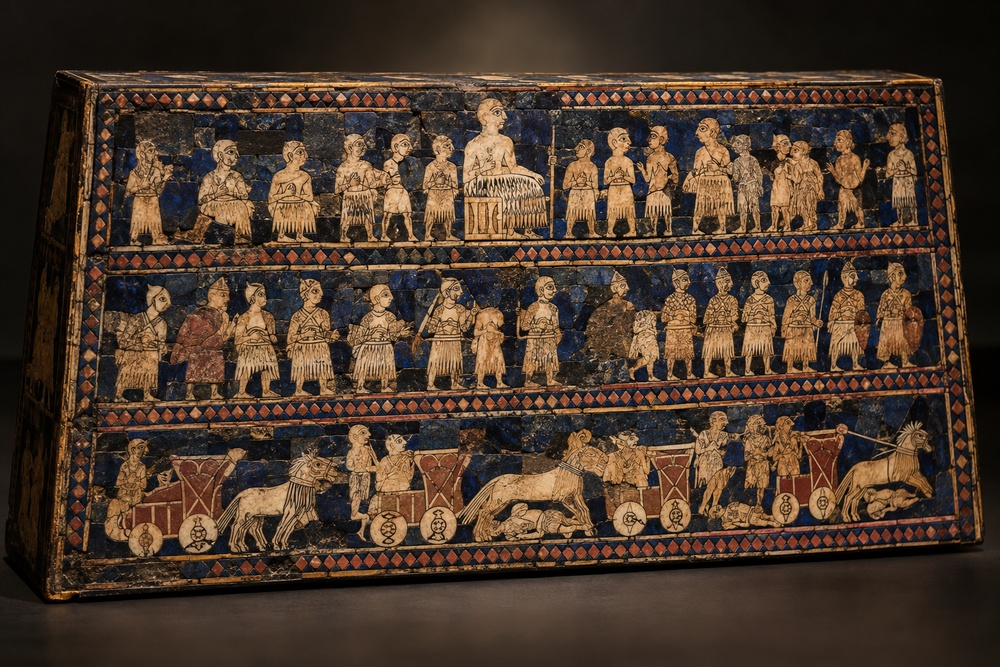
The bow and arrow were used, particularly from the battle-cars, but the dominant weapon was the spear. Sieges were conducted with ramps and battering rams; cities were taken when their walls were breached or their gates forced. Defeated populations were generally enslaved or required to pay tribute, while the king himself, his household, and his treasury were taken as the most valuable prizes. The Sumerians did not have horses, in the modern sense, until very late in their history; the equids of the third millennium were donkeys, onagers, and a hybrid of the two known as the kunga, a sterile but powerful draft animal that was prized for the battle-car.
True horses, descended from the Eurasian steppe horse, did not become common in Mesopotamia until the second millennium, well after the Sumerian political order had ended. The wheeled battle-cars of the Early Dynastic, often represented as four-wheeled wagons rather than two-wheeled chariots, were therefore relatively heavy and slow, used for transport and as elevated platforms for archers and javelin throwers rather than for the rapid maneuver that the chariot would later allow. By the late Early Dynastic, however, the lighter two-wheeled vehicle had begun to appear, and the chariot in something like its classic form was emerging.
Fortifications were a major preoccupation of every Sumerian city. The walls of Uruk, attributed by tradition to Gilgamesh, ran for some nine kilometers and stood several meters tall and several meters thick at the base. Excavation has confirmed walls of impressive scale at many other sites: Lagash, Ur, Eridu, Kish, Nippur, and the rest. The walls were built of mud brick, with their lower courses sometimes faced in baked brick for waterproofing and additional strength. The gates were the most elaborately defended points, with paired towers, multiple gateways set at angles to one another, and dedications to particular gods who were thought to guard them.
Within the walls, the temples and palaces were often given their own additional inner walls, providing a citadel of last resort if the outer walls were breached. The construction and maintenance of these walls required enormous expenditure of labor, organized by the temple and palace bureaucracies and supplied through the corvée — the obligation of every able-bodied free citizen to provide a certain number of days of labor each year to public works. Behind the visible institutions of warfare and fortification stood an elaborate ideology of divinely sanctioned conflict. Sumerian armies marched under the standards of their gods; the gods themselves were thought to march alongside the soldiers, occasionally throwing a great net over the enemy as Ningirsu does on the Stele of the Vultures, or weakening the enemy's resolve, or directing the king's spear to its target.
Victory was a divine gift, attributed in royal inscriptions to the patron god of the victorious city, and defeat was a divine punishment, attributed to the offended god of the defeated. The most extensive surviving meditation on this theology is the great Curse of Agade, composed during or after the fall of the Akkadian Empire, in which the destruction of the Akkadian capital is presented as the deliberate work of Enlil after Naram-Sin had committed an act of sacrilege at Nippur. The poem narrates the divine decision, the calling-down of the mountain peoples to fall upon Agade, the destruction of the city, and the curse that nothing should ever live there again.
The poem is partly historical, partly mythological, and entirely characteristic of the Sumerian way of seeing political events as the visible surface of divine deliberations. Administration, beneath the dramatic surface of war and law, was the daily substance of Sumerian government. The king's bureaucracy and the temple's bureaucracy together produced an enormous quantity of administrative documentation, much of which has survived in the dry climate of southern Iraq. From these tablets we can reconstruct the daily operations of an Ur III provincial governor, the monthly ration distributions of an Early Dynastic temple, the cattle-counting rituals of the Drehem complex near Nippur where the king's tax cattle were processed, and the routine business of dispute resolution at the gates of any city.
The Sumerian state was not, by modern standards, large or intrusive: most of life was lived in the family, the workshop, the field, the marketplace, with the king and his agents intervening only when their authority was specifically engaged. But where the state did act, it acted with the precision that writing made possible, and the documentary trail it left has given modern scholars a more detailed picture of ancient government than survives from any other early civilization. Roads, messengers, and communication tied the system together. The Sumerian state maintained a system of royal couriers who could carry messages from the king to his governors and from one city to another with remarkable speed.
The couriers traveled in stages along established routes, exchanging mounts at way stations operated under royal authority. By the Ur III period, this system had been extended throughout the empire and was being used to coordinate, in something close to real time by ancient standards, the activities of provincial officials hundreds of kilometers from the capital. Letters between governors and the central administration, recorded on small clay tablets and packed into clay envelopes for security, give us an intimate look at the daily concerns of officials: complaints about tax shortfalls, requests for reinforcements against bandit raids, reports on canal maintenance, denunciations of corrupt subordinates.
Government, in Sumer as elsewhere, was a continual flow of paperwork, and the Sumerians were the first people to make that flow of paperwork the visible substance of their state. The mechanics of legal procedure in Sumer give us a clearer view of the working substance of Sumerian justice than the law codes themselves, which represent royal proclamations of an ideal rather than direct records of court practice. The actual cases preserved on contract tablets, lawsuit records, and trial transcripts allow us to reconstruct in considerable detail how disputes were heard, how evidence was presented, and how judgments were rendered.
Most cases were heard at the gate of the city, where the elders of the community and a representative of the king or governor sat to hear the parties' arguments, examine the witnesses, and pronounce the verdict. The atmosphere of the court was relatively informal by modern standards but well-structured by ancient ones; the parties brought their friends and family for support, the witnesses swore their testimony in the name of the gods, the judges consulted the oral traditions of customary law alongside any relevant royal decrees, and the resulting judgment was recorded on a tablet, sealed by the parties and the witnesses, and given to the prevailing party as proof of his or her victory.
Appeals from the city court to the royal court were possible but rare, and the royal court itself, when it heard appeals or original cases of particular importance, applied the same general procedures. The substantive law that emerges from these working documents covers the full range of social and economic concerns: marriage and divorce, inheritance and adoption, the sale of fields and houses, the leasing of fields and animals, partnerships and loans, the manumission of slaves, theft and assault, contract enforcement, fraud, the responsibilities of professional caretakers such as shepherds and physicians, the responsibilities of public officials, the boundaries of properties and the use of shared water rights, and the dozens of other matters that any complex urban society generates.
The substantive law was, by ancient standards, sophisticated and adaptable, and the actual practice of Sumerian justice was probably more nuanced and equitable than the formal language of the royal codes might suggest. The codes themselves, with their schematic if-then formulations, were probably less the operational basis for daily judgment than the ideal projection of royal policy, used by judges as guidelines and by the king's propaganda as evidence of his commitment to justice. The military history of Sumer also includes a number of episodes that, although not as famous as the great inter-city wars or the campaigns of Sargon, deserve mention because they illustrate the variety of conflicts that the southern alluvium experienced.
Coastal raids by sea-going peoples from the Persian Gulf occasionally targeted Sumerian port cities; one inscription records the destruction of a coastal town by such raiders during the Akkadian period. Mountain incursions by the various peoples of the Zagros foothills — Gutians, Lullubi, Hurrians at various periods — were a recurring problem throughout the third and second millennia, and the great northern walls and military levies of the Ur III period were largely directed at containing this threat. Internal rebellions, in which provincial governors broke away from central authority or in which dispossessed populations rose against their rulers, were less common but not unknown; the late Ur III period saw an increasing number of such episodes as central authority weakened.
Naval engagements on the lower Tigris and the Persian Gulf, although less prominent in the surviving record than land campaigns, are attested in several Akkadian and Ur III sources, and the maritime infrastructure of Ur and other coastal cities included substantial fleets of war and transport vessels. Across all of these institutions — the dual offices of ensi and lugal, the dynasties of the King List, the wars of Lagash and Umma, the reforms of Urukagina, the law code of Ur-Nammu, the campaigns of Eannatum, Lugalzagesi, and finally Sargon and his successors — runs a single pattern.
Sumerian government, like Sumerian religion, was pragmatic and articulated. It dealt with the actual problems of irrigation, defense, justice, and trade that faced the cities of the southern plain. It produced, as a byproduct of dealing with those problems, the institutional inventions — kingship, codified law, professional bureaucracy, standing army, royal courier system, monumental fortification — that would become the basic political vocabulary of every subsequent civilization in the ancient and medieval Near East. The kings of Sumer were not the first humans to fight wars, settle disputes, or organize labor; they were the first to do so on a scale that required the formal institutions we now recognize as government, and they were the first whose record of doing so has survived for us to read.
The Standard of Ur — War panel (detail)
Chapter 7 — Daily Life in Sumer
Beneath the high architecture of temples and palaces, beneath the recorded campaigns of kings and the lawsuits of merchants, the daily life of ordinary Sumerians went forward in patterns that the surviving documents allow us to reconstruct in surprising detail. Most of what the great kings did affected most of their subjects only intermittently, and most of the time the ordinary inhabitants of Ur, Lagash, Uruk, and the smaller towns lived as ordinary people have always lived: in houses with families, working trades and farms, eating bread and drinking beer, raising children, falling ill, loving and quarreling and aging.
The clay tablets of Mesopotamia, more than the records of any other early civilization, preserve the texture of this daily life, and the archaeological remains of the cities themselves preserve the physical setting in which it was lived. The typical Sumerian family lived in a mud-brick house arranged around a small interior courtyard. The courtyard, open to the sky, was the center of domestic life, providing light, air, and a working space sheltered from the public street. From the courtyard opened the various rooms of the house: the long, narrow living rooms that ran along its sides, the kitchen with its hearth and oven, sometimes a shrine room with a niche for the household gods, often a private chamber for the master of the house.
Rooms were typically narrow because the wood beams that supported the roof were limited in length; the date palm trunks, willows, and tamarisks of the local landscape rarely yielded straight timbers more than three or four meters long, and longer beams had to be imported at considerable expense from Lebanon or Anatolia. The walls were of sun-dried mud brick, sometimes faced with a layer of plaster, sometimes whitewashed; the roofs were flat, supported by wooden beams covered with reed matting and a layer of pressed mud. In the long summer months, the rooftop was a sleeping space; in the cold winter mornings, the family huddled around the small charcoal-fired braziers that supplied heat.
Larger houses, particularly those of well-off merchants, scribes, and officials, were two stories tall, with the family's living quarters on the upper floor and storage and workshop space below. The most thoroughly excavated example of a Sumerian residential quarter is at Ur, where Leonard Woolley uncovered an entire street of Old Babylonian-period houses preserved up to first-floor height. The houses had whitewashed walls, plastered floors, drainage from the rooftop, and small private latrines connected to underground sewers. They were comfortable, well-built homes, and they remind us that the people who lived in them were not so different from later inhabitants of the same region.
Furniture was sparse by modern standards. A typical Sumerian household had reed mats and woven rugs on the floor, low wooden tables for serving food, a few wooden chests for storing valuables and clothing, oil lamps of clay or, in wealthier households, of bronze, and simple wooden beds for the master and mistress of the house. Children, servants, and the household poor slept on mats on the floor, often in the kitchen or the courtyard. The houses of the rich had elaborately carved chair-thrones with high backs, often inlaid with shell or ivory, but these were status objects rather than functional seats.
Most Sumerians, most of the time, sat on mats or on small wooden stools. The Sumerian family was structured around marriage and patrilineal descent. Marriages were arranged by the parents, often when the children were quite young, and were sealed with formal contracts written on clay tablets. The contract specified the bride-price, called terhatu, that the groom's family paid to the bride's family; it specified the dowry, called nudunnu, that the bride's family contributed to the new household; it specified the conditions under which the marriage could be dissolved and what would happen to the property if it was.
A typical marriage involved a substantial transfer of value in both directions, with the bride bringing her dowry into the marriage as her own property, distinct from her husband's, and recoverable on widowhood or divorce. Polygamy was permitted but rare; most husbands had only one wife at a time, although a man whose first wife was childless might take a second wife or a concubine in order to produce heirs. Divorce was possible for both husband and wife but was easier for the husband. A husband who repudiated his wife without grounds was required to return her dowry and pay a substantial penalty; a wife who left her husband without grounds could be punished severely.
The substantive law of family relations was elaborated in detail in the law codes of Ur-Nammu and his successors, and the lawsuit records that survive give us a vivid picture of the actual disputes that arose. The position of women in Sumerian society was, by the standards of most premodern civilizations, comparatively favorable. Women could own property in their own names, separate from that of their husbands. They could conduct business, sign contracts, bring lawsuits, and serve as witnesses, although their testimony was sometimes given less weight than that of men.
They could be priestesses of the major temples, with all of the prestige and economic power that such positions entailed. They could brew and sell beer, an industry that throughout the third and second millennia was largely run by women; the proprietors of the alehouses where ordinary Sumerians gathered for their evening drinks were almost always called "she" in the surviving texts. They could be physicians, scribes, weavers running their own workshops, traders dispatching their own merchant caravans. Most strikingly, the most prominent priestesses of Sumer included some of the most powerful and learned individuals in the society.
Enheduanna, daughter of Sargon and en-priestess of Nanna at Ur, was the first author in human history whose name we know. Other high priestesses presided over major sanctuaries and lived in their own residences with their own staffs of clerks, servants, and dependents. Among the elite, the women of the royal family were often actively involved in politics and economic life; the queens of Lagash, in particular, ran their own substantial households whose accounts were kept by scribes in their personal employ. The grave goods of Queen Puabi at Ur, recovered by Woolley in the 1920s, include a wealth of jewelry and finery that suggests a woman of considerable standing in her own right, not merely as a king's consort.
None of this should be mistaken for full equality with men. Sumerian society was patriarchal in its formal structure: the head of household was always the father; inheritance descended primarily through the male line; the senior priestess of a sanctuary was almost always subordinated to a male senior priest in the broader hierarchy. But within these limits, women had a recognized social space and significant practical autonomy. Children were prized in Sumerian families as in all ancient societies. A childless marriage was considered a misfortune, and the law codes provided various remedies, including adoption, the taking of a second wife, and the divorce of a barren spouse.
Naming customs varied but typically involved a meaningful name, often invoking the favor of a god: "May Enlil bless him," "Beloved of Inanna," "The god has given to me." Children were nursed by their mothers or by hired wet nurses for two or three years, then weaned onto bread, porridge, and weak beer. Childhood mortality was high; the bones of children fill the cemeteries of Sumerian cities in numbers that distress modern excavators. Those who survived to adolescence began to learn the trades of their parents: a scribe's son went to the edubba; a metalworker's son worked alongside his father in the workshop; a farmer's son followed the plow.
Adoption was common and well-attested in the documentary record, sometimes for the purpose of producing an heir for a childless couple, sometimes for the purpose of training a young person in a particular trade, sometimes as a way of attaching dependents to a household. The food that ordinary Sumerians ate was, by modern standards, simple but nutritious. The dominant grain was barley, which was tolerant of the saline alluvial soil and reliably productive under irrigation. Barley was made into bread, which served as the staple of the diet, and into porridges and beer.
Emmer wheat was also grown, particularly in earlier periods before salinization had made it less productive, and was used for higher-status breads and cakes. Beyond grain, the Sumerian table included a varied range of vegetables: onions, leeks, garlic, lentils, chickpeas, broad beans, cucumbers, lettuce, mustard greens, watercress, and a number of others whose precise modern equivalents are uncertain. Fruit was abundant in season: dates, figs, apples, pomegranates, grapes, mulberries. Sesame was grown for its oil, which was the principal cooking and lighting oil of the south. Spices and condiments included salt (mined from the marshes and from inland springs), cumin, coriander, fenugreek, and a variety of aromatic herbs.
Sweetening was provided by dates, by date syrup, by honey from wild bees, and by the date-palm sap that was tapped and concentrated into a thick syrup. Animal protein came from several sources. Sheep and goats were kept for both wool or hair and meat; lamb and goat were the most commonly consumed meats, particularly on festival occasions. Cattle were too valuable as draft animals to be slaughtered routinely and were eaten only on special occasions or when they were too old to work. Pigs were kept in some periods and not in others; the evidence is mixed and complicated.
Domesticated ducks and geese, along with chickens after their gradual introduction in the second millennium, supplied poultry. Wild game, including gazelle, wild boar, and the various birds of the marshes, supplemented the table. The single most important protein source for many ordinary Sumerians, however, was fish. The rivers and marshes were astonishingly productive, and the dried fish trade was a major industry in the south. Lexical lists name dozens of varieties of fish, and the temples received daily deliveries of fresh and dried fish in quantities that suggest fish was a basic part of the daily diet for much of the population.
Milk, from cattle, sheep, and goats, was rarely consumed fresh; it was processed into butter and various forms of cheese for storage in the hot climate. Three Yale tablets of the Old Babylonian period, written in Akkadian but reflecting culinary traditions that go back deep into the Sumerian period, preserve actual recipes for stews, broths, and roast meats. Reading these recipes today is a startling experience. They list ingredients in proportions, indicate cooking methods, and even sometimes describe the presentation of the finished dish. They show that the cuisine of the Mesopotamian table, contrary to the assumption that ancient food was simple and monotonous, could be quite refined.
One recipe describes a kid stew with leeks, garlic, blood, and a thick coriander-flavored sauce, served with the meat resting on a base of bread. Another describes a partridge roasted with savory herbs. A third describes a soup of beets and pulses thickened with mashed bread. The Sumerian and Babylonian kitchen, when fully equipped, was capable of considerable sophistication. Beer was the universal beverage of southern Mesopotamia. Almost every adult drank it daily, in quantities that would astonish a modern teetotaler; rations of beer were a standard part of the daily allotment for temple workers, soldiers, and laborers, and the Sumerians and Babylonians appear to have considered beer the proper drink of civilized human beings.
Beer was brewed in the household and on a larger scale in dedicated alehouses, often run by women. The beer was made by first baking a special bread of barley and emmer, sometimes mixed with herbs and dates, and then crumbling the bread into water in a fermentation vessel where natural yeasts could begin their work. The resulting beer was thick, often containing visible particulates, and was drunk through long reed straws to filter out the sediment. Multiple varieties were known, ranging from a strong dark beer to a thinner everyday beer for daily consumption to special ceremonial brews used in religious offerings.
The Hymn to Ninkasi, the goddess of brewing, is in part a poetic description of the brewing process and is, in effect, the oldest beer recipe in the world. Modern brewers have several times attempted to reproduce Ninkasi's beer; the results, by accounts, are recognizable as beer but quite different from any modern style. Wine was known but rare in southern Mesopotamia, where the climate was unsuitable for the grape; what wine was drunk in the south came mostly from the highlands of Anatolia and northern Syria, traveling down the Euphrates in jars at considerable expense.
It was a luxury good, reserved for the wealthy and for ritual occasions. Plain water was drunk, but the Sumerians considered most river and canal water unsafe for direct consumption — perhaps with reason, given the parasitic and bacterial loads of standing irrigation water — and preferred their water heavily diluted with beer, or boiled with herbs and barley. Sumerian clothing was made primarily of wool, with linen used for finer garments. The early Sumerian dress, as represented on Early Dynastic statues and reliefs, was the kaunakes, a long skirt or kilt of wool fashioned to look like overlapping tufts of fleece, perhaps in fact made by attaching tufted strips to a backing fabric.
The kaunakes is what we see on the famous Tell Asmar votive figures, with their oversized eyes and tufted skirts. Both men and women wore the kaunakes, with the women's version often longer and reaching to the ankles, while the men's was shorter. By the late Early Dynastic and Akkadian periods, the kaunakes was being replaced by a longer wrapped robe of plain woolen cloth, often pinned at the shoulder, with a fringed border. Linen, lighter and finer, was used by the wealthy in summer and by priests and priestesses for ritual garments.
Footwear consisted of simple sandals of leather, sometimes with elaborately laced uppers for the elite. Headgear varied with status and occupation: ordinary men generally went bareheaded or wore simple cloth wraps, while priests and priestesses wore elaborate headdresses appropriate to their rank, and kings wore the round royal cap that became the standard Mesopotamian symbol of rule. Hair was generally worn long by both men and women in the early period, with men wearing full beards. By the Akkadian period, men's hair had become shorter, and clean-shaven faces were sometimes seen, although the full beard remained the predominant style.
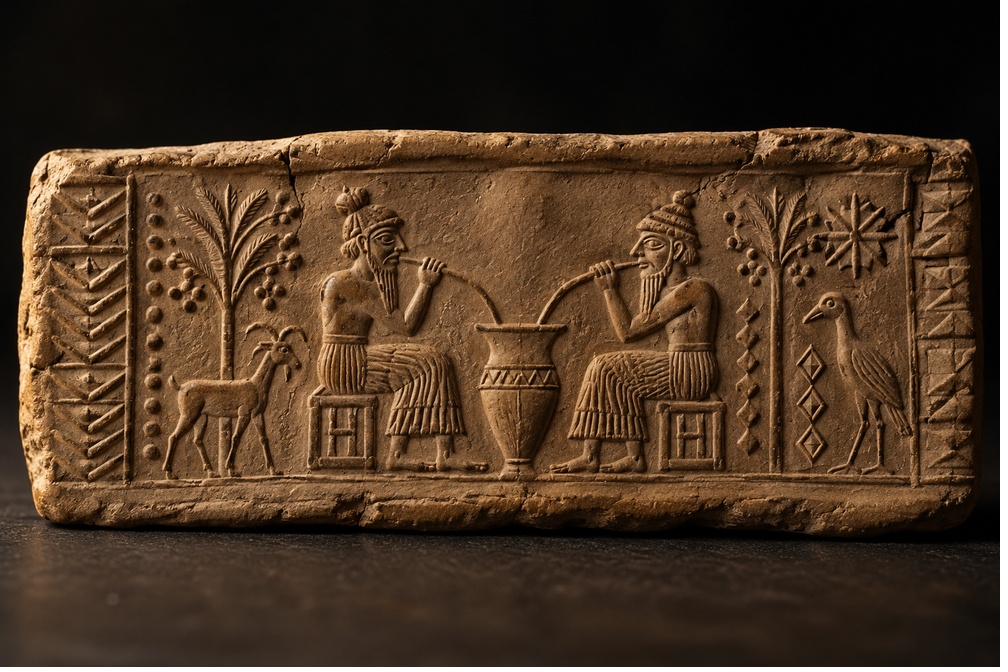
Cosmetics were widely used. Both men and women lined their eyes with kohl, a black powder made of ground galena or stibnite mixed with oil, applied with a small bone or wooden applicator. The cosmetic served a practical purpose, reducing glare from the brilliant southern sun, as well as an aesthetic one. Ointments and perfumes, made from sesame oil infused with aromatic resins and herbs, were applied to the skin and hair. Perfumed oils were poured over guests at banquets and were a standard offering to the gods. Excavations at Ur and elsewhere have recovered the small bone, ivory, and bronze cosmetic tools — applicators, tweezers, ear picks, files — that were a regular part of the elite toilet kit.
Medicine in Sumer was practiced by two parallel professions, working alongside one another and sometimes consulting on the same case. The asu was a practical physician, who diagnosed illness through observation and treated it with herbal preparations, salves, ointments, dietary regimens, and minor surgery. The ashipu was an exorcist or spiritual healer, who diagnosed illness as the work of demons or angry gods and treated it through incantations, ritual purifications, and offerings to the appropriate deities. In practice the two often worked together, and the surviving medical texts include both pharmacological compendia listing herbal remedies and incantation collections invoking divine help.
The pharmacological knowledge that the Sumerians and their Babylonian successors developed was substantial. Willow bark, the natural source of salicylic acid (the active ingredient in aspirin), was used for fevers and pain. Mustard plasters were applied for chest congestion. Fig poultices were used on wounds. Various herbs were used as purgatives, emetics, soporifics, and stimulants. Surgical procedures included the setting of broken bones, the cleaning and dressing of wounds, the extraction of foreign bodies, and even, in some cases, the cutting of cataracts from the eye. The great medical compendium known as the Diagnostic Handbook, compiled in the Babylonian period from earlier Sumerian sources, organized symptoms and prognoses systematically and gave the diagnostic art a remarkably modern logical structure.
Music and entertainment were central to Sumerian life. The principal stringed instruments were the lyre, in various sizes and forms, and the harp, both of which are extensively represented in art and have been recovered in physical form from the Royal Cemetery at Ur. The famous bull-headed lyre from Ur, with its sound box decorated by an elaborately inlaid bearded bull's head of lapis lazuli, gold, and shell, is one of the masterpieces of Sumerian craftsmanship. Wind instruments included reed flutes and double pipes; percussion was provided by drums of various sizes, by clappers, and by sistra.
Songs were composed and performed for many occasions: religious hymns at festivals, work songs in the fields, drinking songs at the alehouses, lullabies, love songs, lamentations at funerals. The texts of many of these have survived in cuneiform, but the music itself, with no notation system, is mostly lost; only fragmentary clues from later periods, in particular some Hurrian and Babylonian musical texts, allow scholars to make tentative reconstructions of how Mesopotamian music actually sounded. Games were a regular part of life. The most famous Sumerian board game is the so-called Royal Game of Ur, examples of which Woolley recovered from the Royal Cemetery and which has since been found at many other Mesopotamian sites.
The game is a race game played on a distinctive twenty-square board with elaborate inlay, with two players advancing their pieces according to the throws of four-sided pyramidal dice. The rules of the game, lost in antiquity, were partially reconstructed in the 1980s by the Assyriologist Irving Finkel of the British Museum from a Babylonian-period tablet that turned out to contain a description of the game's rules. Other games included a form of senet imported from Egypt, a backgammon-like race game, and various forms of dice, including the playing of dice with knucklebones from sheep and goats.
Wrestling and boxing were popular spectator sports; royal lion hunts were a privileged amusement of the elite. Children played with small clay figurines of animals and people, with miniature pottery, and with various improvised toys; the model carts and chariots that have been recovered from many Sumerian sites probably served as toys for children of well-off families. Sumerian society was stratified, although the precise structure of the strata is debated. The broad categories that emerge from the documents are something like the following. At the top was a small elite of royal and priestly families, owning large estates and commanding the resources of the city.
Below them was a substantial class of free citizens, sometimes called awilu in Akkadian or dumu-gir in Sumerian, "sons of the citizen body," who were the proprietors of small farms and workshops, the merchants and craftsmen of the city. Below them was a class of dependents, sometimes called mushkenu, who were free in name but economically tied to the estates of the wealthy or to the temple, working the land or the workshops of their patrons in exchange for rations and a place to live. Below them was the slave class, comprising both prisoners of war and Sumerians who had fallen into slavery through debt.
Slaves could be bought and sold, but they could also own property in their own names, marry, and even purchase their freedom. The class system was therefore not a frozen caste system; movement up and down was possible, particularly through the mechanism of debt slavery and its periodic remission by royal decree. The institution of debt remission, called andurarum or mesharum and proclaimed by the kings of the early second millennium, periodically wiped out the accumulated debts of the lower classes and freed those who had been enslaved for debt, restoring the social fabric and preventing the formation of a permanent class of unfree dependents.
Crime and punishment, for the ordinary Sumerian, were matters mostly of family and community jurisdiction, with the formal courts intervening in more serious cases. Theft, assault, and violation of contract were dealt with by fines and restitution; major crimes such as murder and treason could result in death, mutilation, or perpetual slavery. The local court at the city gate, presided over by the elders of the community or by officials appointed for the purpose, heard most cases; appeals could be taken to the royal court for matters of greater significance.
The legal system, like the rest of Sumerian society, operated on a mix of written law, custom, and the practical judgment of the people involved. A few additional aspects of Sumerian daily life deserve specific attention. The first is the role of festivals and seasonal observances in the rhythm of ordinary households. Beyond the great civic religious festivals of the patron god, the Sumerian household participated in a continual cycle of smaller observances: the monthly new-moon celebrations marking the start of each lunar month, the seasonal markings of the agricultural year, the family commemorations of births, marriages, and deaths, the feasts of the personal god of the household, the periodic visits to the small shrines of the neighborhood.
These observances structured the year for ordinary Sumerians as fully as the great civic festivals structured the calendar of the city as a whole, and they involved similar patterns of food preparation, gift-giving, communal meals, and ritual prayer. The detailed regulations of household religious practice survive only in fragments, but the impression that emerges is of a society in which religion was not segregated into discrete moments of formal observance but rather pervaded the routine activities of daily life. The second additional aspect is the experience of the elderly and the dying.
Sumerian society honored old age in principle, with the elders of the community playing important roles in dispute resolution, in the management of family affairs, and in the transmission of practical and traditional knowledge. In practice, however, the conditions of old age in Sumer were difficult. Without modern medicine, the elderly suffered from the full range of degenerative conditions — joint disease, dental loss, declining vision, infectious illnesses — and the death rate after the age of fifty was high. Those who survived into their sixties or seventies, however, often retained substantial authority within their households and broader communities.
The death of an elderly head of household was an important social event, with elaborate funerary rituals, extended family gatherings, and the formal transmission of property and social position to the next generation. The bones of the elderly recovered from Sumerian cemeteries show the marks of long lives of physical labor, and the funerary inscriptions of the wealthy occasionally celebrate, with what appears to be genuine warmth, the long lives and accumulated wisdom of the deceased. The third aspect is the experience of childhood after the most basic stages of upbringing had passed.
Once a Sumerian child had survived the dangerous early years and reached the age of perhaps seven or eight, his or her life began to take on the shape of an apprenticeship. Children of farming families went into the fields with their parents, learning by doing the techniques of plowing, sowing, irrigating, and harvesting. Children of craftsmen went into the workshops of their parents and learned, by direct observation and graduated tasks, the skills of their family's trade. Children of scribes went to the edubba. Children of priests served as junior temple personnel, fetching, cleaning, and learning the rituals of their parents' service.
The integration of children into the productive and intellectual life of their household was thorough, with relatively little of the modern conception of childhood as a separate stage of life devoted primarily to play and to formal education. By their early teens, most Sumerian children were fully working members of their households, contributing to the family economy and learning the skills they would need for adult life. Marriage came relatively early, often in the late teens or early twenties for both men and women, and the cycle then began again with the next generation.
The texture of daily life that emerges from all of this — the bricks, the courtyards, the kaunakes skirts, the beer through reed straws, the willow bark for fever, the bull-headed lyres, the children's clay animals, the slow moonlit walk home from the alehouse along narrow streets — is recognizably human. The patterns of birth and death give us perhaps the most intimate view of Sumerian daily life. Childbirth, then as in any pre-modern society, was dangerous; maternal mortality from hemorrhage, infection, and obstructed labor was substantial, and the various incantations and ritual practices associated with the birthing room reflect the deep anxieties that surrounded the event.
The midwife, often an experienced older woman from the family or the neighborhood, attended the birth in the home, with the help of female relatives and the absence of men. The newborn was washed, wrapped in cloth, and presented to the mother for nursing; the cord was cut with a special knife, and the placenta was buried in a designated place, often beneath the floor of the house. A small amulet might be tied to the infant's wrist or ankle to protect against the demon Lamashtu, who was thought to attack newborns and nursing mothers.
The naming of the child, often a few days after birth, was a formal occasion involving the whole family and sometimes the household priest. Death, the other great threshold of life, was marked by elaborate funerary rituals: the body was washed, dressed in clean clothing, and laid out in the home for the wake; relatives and friends came to mourn, with the women of the family leading the lamentations; the body was then buried, often in a simple grave dug beneath the floor of the house or in a cemetery just outside the city wall, with grave goods including pottery vessels of food and drink, simple ornaments, and personal possessions.
The dead were thought to need these provisions in their journey to the underworld, and surviving family members maintained the practice of bringing offerings of food and drink to the graves of their ancestors at regular intervals, particularly at the new moon and at certain calendrical festivals. The link between the living and the dead, in Sumerian thought, was real and continuing, and the proper care of the deceased was one of the central obligations of family life. The Sumerians were not strangers in their lives. They cooked dinner, kissed their children, paid their bills, complained about their neighbors, drank too much on festival days, fought in their courts, prayed to their gods, and slept on the rooftops in summer.
Across five thousand years, the fundamentals of human ordinary existence are remarkably constant, and the Sumerian record, more than that of any other early civilization, gives us back our own daily life seen in its original shape, before so many of the small details we take for granted had even been invented.
Chapter 8 — Farmers, Merchants, and Craftsmen
A civilization is, among other things, an arrangement for converting effort into surplus. The cities of Sumer rose because the alluvial plain of southern Mesopotamia, when properly irrigated and cultivated, could produce far more food than the people who farmed it needed for their own subsistence. That surplus, gathered in the temple and palace stores, fed the priests, scribes, soldiers, craftsmen, and merchants who, in their turn, produced the religious, intellectual, military, and economic life of the cities. To understand Sumer in its working dimensions, we must therefore understand the farms, the canals, the workshops, the markets, and the trading networks that together constituted the economy on which all the rest depended.
The agricultural year in southern Mesopotamia was set by the rivers. The Tigris and Euphrates rose in spring, swollen with snowmelt from the highlands, and reached their flood peak in late April or early May. The flood was wild and unpredictable: in a good year it overflowed gently along the natural levees, depositing fertile silt across the lower fields; in a bad year it broke its banks violently, swept away dikes, washed out canals, and drowned villages. The Sumerian farmer's first task each year was to deal with the consequences of the previous flood — repairing levees, reopening clogged channels, re-leveling fields battered by the surge — and to prepare the fields for the autumn sowing.
Through the long summer, when the river ran low and the heat was punishing, the work was the maintenance of the canal system: dredging silt out of the channels, reinforcing the embankments, replacing worn-out sluice gates. The autumn rains, slight but reliable, softened the ground for plowing, and in late October or November the fields were sown to barley and emmer. The grain germinated in the cool, damp winter, headed out in February, ripened in March, and was harvested in April, just before the next flood arrived. The cycle then began again.
The Sumerian Farmer's Almanac, a remarkable instructional text composed in the early second millennium and recovered in multiple cuneiform copies, presents the agricultural year as a sequence of practical instructions from a father to his son. The text covers everything from when to flood the field for the first soaking, to how deep to plow, to the proper ratio of seed to area, to the technique of weeding and harvesting, to the threshing of the cut grain on the threshing floor. It is the oldest agricultural manual in the world and reads as the genuine compressed wisdom of a society that had been farming the alluvium for thousands of years before the text was written down.
Some of its advice is specific and pragmatic in a way that any modern farmer would recognize: do not let your field dry out; do not allow your oxen to trample the seedbed; do not cut your harvest until the grain is fully ripe; do not allow gleaners to come into the field while the grain is still being threshed. Other parts are more ritualistic, prescribing the proper prayers and offerings to the goddess Ninkilim, the lady of field-mice and pests, before the work begins. The combination of practical and ritual instruction is characteristic of the Sumerian way of organizing knowledge.
The dominant grain of the Sumerian field was barley. Hardy, salt-tolerant, and reliably productive, barley was the staple of the diet, the basis of the brewing industry, and the standard medium of exchange in transactions where silver was not used. Emmer wheat was also grown, more in earlier periods than later, and produced the higher-status flour used for banquet bread and ceremonial cakes. As the alluvial soils gradually salinized through the millennia, however, wheat became progressively less productive in the south, and barley took up an ever-larger share of the cultivated area.
The wheat-to-barley shift, traceable in the ration documents and tax records of successive periods, is one of the best-documented examples of long-term environmental change in the ancient world. By the late Ur III period, wheat had nearly disappeared from the southernmost cultivated areas, replaced almost entirely by barley. Beyond grain, the southern fields produced a varied range of secondary crops. Sesame, with its small but oily seed, supplied the principal cooking oil of the household and was also pressed for lamp oil and ointments. Flax was grown in modest quantities for linen, although wool from sheep dominated the textile economy.
Pulses — lentils, chickpeas, and broad beans — provided protein and were an important part of the rotation that helped to maintain soil fertility. Vegetables, grown in small irrigated gardens close to the houses, included onions, leeks, garlic, lettuce, mustard greens, watercress, cucumbers, and melons. The garden of an ordinary Sumerian household was a small but rich source of variety in a diet otherwise dominated by grain. The undisputed king of the orchards was the date palm. The date palm was the "tree of life" of southern Mesopotamia, providing not only its fruit, dense in sugar and protein, but also a remarkable range of other materials.
The leaves were used for thatching and basketry. The fronds, when split and dried, served for mats and screens. The wood, although not strong enough for major construction, supplied roof beams and small building elements. The sap, tapped from the cut crown, fermented quickly into a sweet, slightly alcoholic palm wine. The fruit could be eaten fresh, dried for storage, ground into flour, or boiled down into a thick syrup for sweetening. A single mature date palm could produce a hundred kilograms or more of fruit a year, and the palm groves that lined the canals and rivers of Sumer were among the most productive horticultural landscapes in the ancient world.
The Sumerians knew that the male and female palms had to be pollinated artificially to ensure good crops, and the practice of climbing the male palm to gather pollen, then climbing the female palm to apply it, was a routine task of the spring agricultural calendar. Other orchard crops included figs, pomegranates, grapes (in restricted areas), and various fruits that have been less reliably identified. The technology of Sumerian agriculture was sophisticated by ancient standards. The plow was the central tool, drawn by oxen, with a wooden share faced with copper or, later, bronze.
The Sumerian innovation was the seeder-plow, a specialized tool with a hopper above the share into which a stream of seed was poured as the plow advanced. The seed dropped through a small funnel into the freshly cut furrow, where it was promptly covered by the moving earth. The seeder-plow combined plowing and sowing into a single operation and was unique to Mesopotamia in its time. Threshing was done on a circular threshing floor of beaten earth, where the cut grain was spread out and oxen were driven over it dragging a heavy threshing sledge studded with stone teeth.
Winnowing — separating the grain from the chaff — was done by tossing the threshed grain into the air on a windy day, allowing the lighter chaff to blow away while the heavier grain fell back to the floor. The threshed and winnowed grain was then stored in granaries, large silos of mud brick or reed construction in which it could be kept for several years if necessary. The animals of the Sumerian farm were varied and useful. Sheep, kept in flocks numbering sometimes in the thousands on the great temple estates, supplied wool, the most important textile fiber of the south.
Sumerian wool was a major export commodity; the great wool-producing temple estates of the Ur III period, with their annual shearing festivals and their elaborate accounts of fleece quality, are among the best-documented economic operations of the ancient world. Goats supplied milk and rougher hair used for weaving, as well as meat. Cattle were used as draft animals for plowing and for pulling carts, and were a major source of milk; their meat was eaten only on special occasions. Donkeys carried loads in caravans and on local errands. Pigs were kept in some areas and not in others.
Onagers, the wild ass of the Mesopotamian steppe, were captured young and trained for specialized purposes, particularly to draw the battle-cars and the ceremonial chariots of kings; they were valued for their speed and stamina but were never as docile as donkeys. The kunga, a sterile hybrid of donkey and onager, was the prestige draft animal of the Early Dynastic period, expensive to produce and reserved for royal and military use. The horse, the great late arrival of the second millennium, was unknown in Sumer in its formative period. The dog, a partner in human life since long before agriculture, was a universal feature of the Sumerian household and farm.
Dogs guarded the flocks, hunted with their masters, kept the household, and warned of intruders. Sumerian art depicts dogs of several distinct breeds, including a powerful mastiff-type used for guarding and hunting, a long-bodied sighthound used for coursing gazelle, and various smaller breeds. The dog was occasionally an object of religious veneration, particularly in connection with the goddess Gula or Bau, a healer deity whose iconography included a sitting dog. Cats, by contrast, do not appear to have been domesticated in Mesopotamia and were rarely kept; the cat would emerge as a household animal much later and chiefly in Egypt before spreading.
Holding all of this productive activity together was the irrigation system, the most consequential single technological achievement of Sumerian civilization and the foundation of everything else. The annual flood of the rivers was both the source of fertility and the source of catastrophe; the labor of generations went into the construction and maintenance of a network of canals, levees, sluices, and basins that captured the floodwater, distributed it across the fields, and drained it away again before it could pool and salinize the soil. The major canals were enormous: the great Iturungal canal, which traversed the Lagash territory, was wide enough to carry substantial freight boats.
From these major arteries branched smaller distributors, and from these branched still smaller ditches that delivered water to individual fields through controlled outlets. The flow had to be managed carefully: too much water meant flooding and erosion, too little meant crop failure. The temple and palace bureaucracies maintained elaborate registers of water rights, specifying how many days each farmer was entitled to draw water from a particular branch and in what volume. Disputes over water were among the most common subjects of lawsuit, and the records of such cases give us a window into the daily practice of water management.
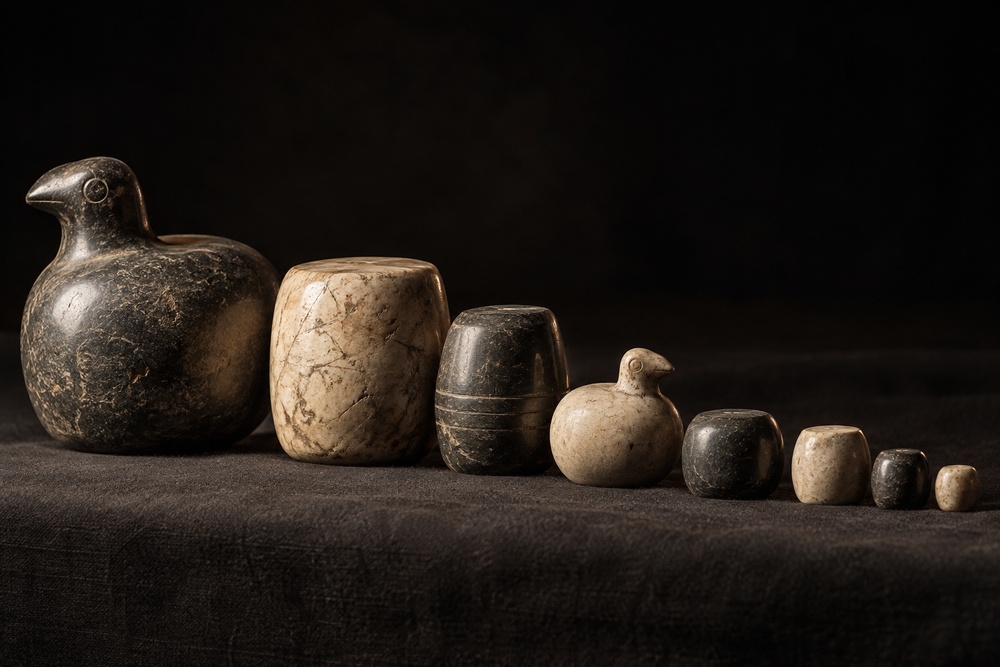
The salinization that gradually undermined the productivity of southern Mesopotamian agriculture was, in retrospect, an inevitable consequence of irrigation in a hot dry climate without adequate drainage. Each year's irrigation water deposited a small amount of dissolved salt on the soil. In a system with good drainage, the salt would have been carried away by the percolating groundwater. In the flat alluvium of southern Mesopotamia, however, the water table was already high, and there was nowhere for the percolating water to go; the salts accumulated in the upper soil layer instead.
Over centuries, the resulting accumulation was sufficient to reduce the productivity of the land substantially, and in some areas to make it useless for agriculture altogether. The Sumerian response was to fallow fields more often, to leach the salts by deliberate flooding when the river was high, and to switch to more salt-tolerant crops; the long-term effect was nonetheless a slow decline in the productive capacity of the southern heartland, and by the end of the third millennium the most productive areas had shifted gradually northward. The story of Mesopotamian agriculture is in part the story of the slow contest between the labor of a people determined to make their land productive and the chemistry of a soil determined to grow saltier with each generation.
Beyond the fields stood the workshops where the products of the land were transformed and the products of trade were finished. Sumerian craftsmen were specialized to a degree that astonishes the casual reader of the records. There were potters, who threw their wares on the fast wheel and fired them in updraft kilns, producing standardized vessels in dozens of sizes and forms. There were smiths who worked copper and, after the development of the bronze alloy, copper-tin bronze, casting weapons and tools, hammering plate, drawing wire. There were goldsmiths and silversmiths whose work in the Royal Cemetery at Ur and elsewhere demonstrates a mastery of casting, granulation, filigree, repoussé, and inlay.
There were lapidaries who carved cylinder seals and small ornaments from stones imported at great expense from distant sources: lapis lazuli from Afghanistan, carnelian from the Indus Valley, chlorite from the Iranian plateau. There were carpenters who worked imported timber into furniture, doors, ships, and the framing of monumental buildings. There were reed-workers, weavers, leatherworkers, basket-makers, brewers, bakers, butchers, fishermen, perfumers, dyers, scribes, sealers, and stonemasons. The temple estates of the Ur III period, in particular, organized this work into large workshops in which dozens or hundreds of craftsmen worked under the supervision of overseers, drawing rations from the central store and producing goods for the temple's use, for trade, or for the royal household.
Many of these craftsmen were women, particularly in the textile industry, where the great wool-spinning and weaving establishments of the temple estates employed thousands of female workers. The bricks of which the cities themselves were built represent a craft activity of immense scale. Sun-dried mud brick was made at workshops near the construction sites by mixing alluvial mud with chopped straw and pressing the result into rectangular wooden molds, then leaving the formed bricks to dry in the sun. Tens of millions of such bricks were produced for major projects.
Baked brick, fired in kilns to a hard ceramic state, was reserved for foundations, drainage systems, the facing of monumental buildings, and other applications where waterproofing or extra strength was needed. The brick standards were rigorous; a king's bricks were often stamped with his name and titles, allowing modern archaeologists to date the various courses of a long-lived monument according to which king's stamp appears in each layer. Sumer's most distinctive economic feature, however, was its dependence on long-distance trade. The southern alluvium provided grain, fish, dates, wool, leather, and reeds — all valuable products in their way, but it provided almost nothing else.
There was no usable stone in the south; no native metal of any kind; no construction-grade timber; no semi-precious stone for ornament or seal-cutting; no obsidian for the finest tools. To equip its workshops, build its temples, decorate its elite, and arm its soldiers, Sumer had to import almost every raw material it used in any quantity beyond grain and reeds. From this necessity emerged one of the great trade networks of the ancient world. The most important southern route ran down the Persian Gulf. Sumerian merchants, sailing in boats made of reed or planks lashed together with rope and waterproofed with bitumen, crossed the Gulf to the island of Dilmun, almost certainly modern Bahrain.
Dilmun was a transit center: a sacred island in Sumerian mythology (the paradisiacal land where Enki and Ninhursag had their adventures), and a major trading entrepôt where goods from further south and east were exchanged with goods from Mesopotamia. From Dilmun, the merchants traveled on to Magan, almost certainly the Oman peninsula, where they bought copper, the most economically important of all imported metals. The copper of Oman, mined from the rich deposits in the foothills of the Hajar Mountains, fed the metalworkers of Sumer for centuries. From Magan, the merchants might continue further to Meluhha, the most distant of the trading partners named in Sumerian texts, almost certainly the Indus Valley civilization in what is now Pakistan and northwestern India.
From Meluhha came carnelian for cylinder seals, ivory from elephants, exotic woods, and various other luxuries; the carnelian beads recovered at Ur from the Royal Cemetery have been chemically analyzed and shown to come from the Khambhat region of Gujarat, more than two thousand kilometers from the city in which they were eventually buried. Other trade routes ran north and east. Up the Euphrates, caravans traveled to the city of Mari and beyond, to Ebla in Syria and to the Anatolian highlands, where silver from the mines of the Taurus and timber from the cedar forests of Lebanon were the principal commodities.
Across the Tigris, Sumerian merchants reached into the Zagros foothills, where they encountered the markets of Elam and beyond them the long lapis-lazuli route that ran through the Iranian plateau to the mines of Badakhshan in distant Afghanistan. The lapis lazuli of Sumerian art, including the great masses of it in the headdress of Queen Puabi at Ur, traveled from Afghanistan over thousands of kilometers of rough country, passing from one trading hand to another, before reaching the southern alluvium. The trade networks of the third millennium, taken as a whole, linked the eastern Mediterranean to the Indus Valley, the Persian Gulf to the Caucasus, and they reached into the deserts of central Asia for materials that could be obtained nowhere else.
The merchants who managed this commerce were called damgar in Sumerian. They were sometimes private operators, working on their own capital and their own account, but more often they worked as agents of the temple or palace, handling trade ventures financed by the great institutions of the city in exchange for a fixed return of goods or a percentage of the profits. The tablets that record their ventures specify, with astonishing precision, the amount of silver or grain advanced, the goods to be obtained, the time period of the venture, and the share of the profits to be returned.
These tablets are, in effect, business contracts, and they show that the basic instruments of medieval and modern commerce — the limited partnership, the loan at interest, the bill of exchange, the long-distance commercial venture financed by capital that the trader does not himself own — were already in use in southern Mesopotamia in the third millennium BCE. The Sumerians were not a barter society; they were a society with a developed commercial and financial system, in which the management of credit and risk was a recognized professional skill. To make this commerce work, the Sumerians developed a remarkable system of weights and measures.
Length was measured in fingers, hands, cubits, and rods, with a cubit of approximately fifty centimeters. Area was measured in iku and bur, with the iku approximately equal to a third of a hectare and the bur eighteen iku. Volume was measured in sila, ban, and gur, with the gur approximately equal to three hundred liters. Weight was measured in shekels, minas, and talents, with sixty shekels to the mina and sixty minas to the talent. The shekel weighed approximately eight grams. These units were standardized across the southern cities by royal decree, with stone reference weights kept in the temples and palaces against which other weights could be checked.
The standardization of weights and measures was one of the proud claims of reforming kings: Ur-Nammu, in the prologue to his law code, took special pride in having "made the bronze sila true, the bronze mina true, the bronze shekel true, and made the great mina true." The medium of exchange, in transactions where the goods themselves were not the medium, was silver, weighed out by the shekel. There was no coined money in the third millennium; coinage as we know it would not be invented for another two thousand years, in Lydia and Greece.
But silver, weighed against standardized stone weights, served all the practical functions of money. Prices of goods, services, and labor were quoted in shekels of silver. Fines and damages were assessed in shekels. Debts were denominated in shekels. The system worked because the value of silver was relatively stable, the supply was sufficient to meet the needs of the urban economy without running short, and the standardized weights and the public reputation of the merchants ensured that transactions could be conducted with confidence. Silver was supplemented, in larger transactions, by gold and copper, and in smaller ones by grain and beer; small daily purchases at the alehouse or the bakery were probably conducted in barley and bread, with silver reserved for major transactions.
The result of all this — the irrigation system, the agricultural surplus, the workshop economy, the long-distance trade, the merchant credit, the standardized weights, the silver currency, the temple and palace bureaucracies that knit it all together — was an economy of remarkable sophistication. The Sumerians were not a primitive subsistence society. They were the inheritors of two thousand years of accumulated economic experience on the alluvial plain, and they had developed an integrated commercial and productive system that, in some respects, would not be exceeded in scale or complexity until the medieval period.
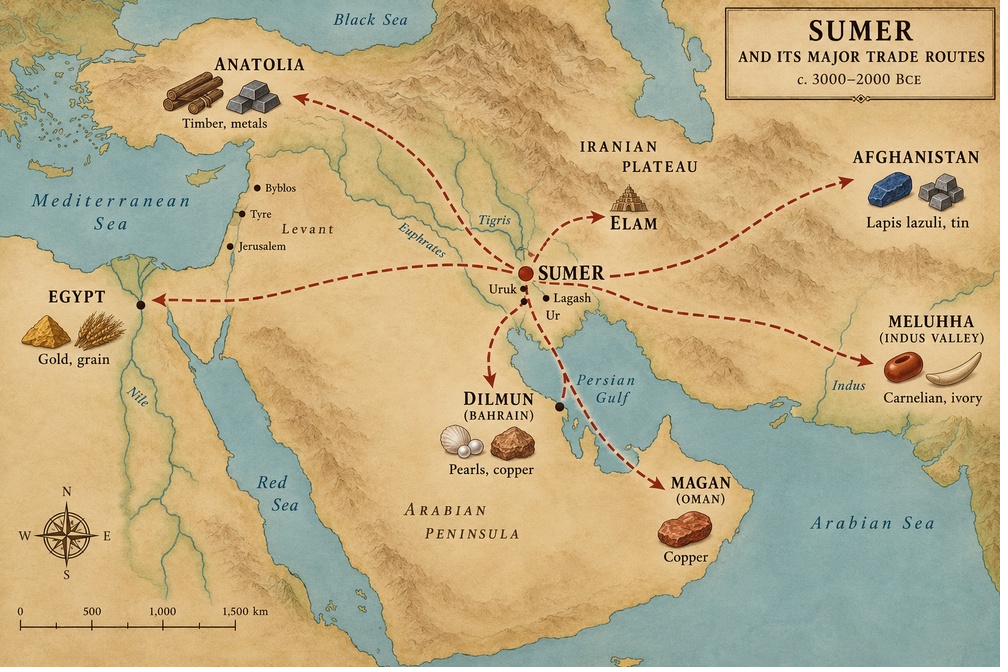
When the Sumerian political world finally passed away, in the early second millennium, the economic infrastructure they had built — the canals, the merchant houses, the trading networks, the weights and measures, the silver-based commerce — passed forward into the Babylonian and Assyrian world without major rupture. It would shape the economy of the entire ancient Near East for the next two millennia. Periodically, however, the economy itself produced social crises that no amount of administrative skill could fully prevent. The interaction of debt, interest, and harvest failure tended, over time, to concentrate wealth and to push the lower classes into debt slavery.
To remedy these accumulating injustices, the kings of Sumer and Akkad periodically issued decrees of debt remission, called andurarum or mesharum. These decrees, proclaimed at the king's accession or at moments of particular crisis, wiped out arrears of taxes and certain categories of private debts, freed those who had been enslaved for debt, and sometimes returned to their original owners property that had been seized in payment of debts. The andurarum decree was a remarkable institution, evidence that the Sumerian and Babylonian kings recognized the tendency of their economic system to produce social inequality and the need for periodic intervention to restore the social fabric.
The institution would echo through later Near Eastern history; the Hebrew Jubilee of Leviticus, in which debts are cancelled and slaves freed in the fiftieth year, is a direct descendant of the Mesopotamian andurarum, and through the Bible the concept would pass into the Western imagination. The accounts of specific economic transactions that survive on the cuneiform tablets give us a direct window into the working life of the Sumerian economy that no aggregate description can match. We can read, for example, the contract by which a certain Lugalkigalla borrowed two and a half shekels of silver from the merchant Ur-Ningirsu in the second month of the third year of King Shulgi, agreeing to repay the loan with interest at the rate of one shekel per mina per month, with his orchard pledged as security.
We can read the receipt by which the temple of Inanna at Lagash acknowledged the delivery of three hundred and twelve sheep from the shepherd Lu-Bau in the seventh month of the fifth year of King Amar-Sin, with the animals categorized by age, sex, and condition and the receipt witnessed by three named officials. We can read the lawsuit filed by the widow Geme-Ninlilla against her brother-in-law for withholding her dowry after her husband's death, and the judgment of the city court ordering the dowry returned. We can read the inventory of the household goods of a deceased weaver, listed item by item by the executor of the estate.
We can read the letter from a worried merchant in Ur to his agent in Susa asking why the expected shipment of copper had not arrived. The accumulation of these specific records, hundreds of thousands of them, gives the economy of Sumer a texture and a particularity that the economies of most pre-modern civilizations entirely lack. We know what the Sumerians paid for their copper, what they charged for their wool, what interest they paid on their loans, what rent they collected on their fields, and what fines they paid for their offenses, and we know all of this in specific cases that we can read in the original.
The economy of Sumer was, in the end, a human achievement of remarkable depth. It supported a civilization that could afford ziggurats, scribal schools, royal banquets, long literary traditions, and a sophisticated material culture. It was sustained by the intelligence and labor of farmers, herdsmen, weavers, brewers, smiths, scribes, and merchants whose names, for the most part, are lost to us but whose handiwork has come down across five thousand years in the form of bricks, grains, tablets, and beads. Behind every monument of the great kings stood the daily work of these ordinary producers, and the achievement of Sumer is, in the truest sense, theirs.
SUMER Egypt Dilmun (Bahrain) Magan (Oman) Meluhha (Indus) Anatolia Elam Afghanistan gold, grain lapis lazuli, tin copper, pearls carnelian, ivory timber, metals Sumerian trade networks, c. 2500 BC
Chapter 9 — Literature and the Life of the Mind
The clay tablets that survive from Sumer are, in their overwhelming majority, the byproducts of a working economy: receipts, ration lists, contracts, lawsuits, inventories. But in among the bookkeeping, scattered through the temple archives and the scribal schools, are tablets of a quite different kind. These are the literary, religious, mathematical, and scientific texts that the Sumerians and their immediate Akkadian-speaking successors composed, copied, and preserved. Taken together, they constitute the oldest surviving literature in the world, and they reveal a depth of intellectual life that the merely administrative tablets only hint at.
The Sumerians were not only farmers, traders, and bureaucrats. They were also poets, mathematicians, astronomers, philosophers, and storytellers, and the products of their minds have come down to us, often by the slimmest archaeological luck, across five thousand years. The literary tradition of Sumer comprised many genres, each with its own conventions and its own social functions. There were myths, narrating the deeds of the gods. There were epics, narrating the deeds of legendary heroes. There were hymns, addressed to gods or to kings or to particular temples. There were laments, mourning the destruction of cities.
There were wisdom texts, instructing the young in the proper conduct of life. There were debate poems, in which two opposing principles or things contended for superiority. There were love songs, royal hymns, school dialogues, lexical lists, mathematical exercises, omen compendia, medical compendia, astronomical observations. The breadth of the literary universe is striking, and only the long survival of its tablets in the dry Mesopotamian soil has allowed us to see it. Of all the works of Sumerian literature, the oldest and most famous is the body of poetry concerning the legendary king Gilgamesh of Uruk.
The Sumerian Gilgamesh tradition, distinct from the much more famous integrated Akkadian Epic of Gilgamesh, comprised at least five separate poems, each treating a different episode of the hero's career. The first, conventionally titled Bilgames and Huwawa (Bilgames being the original Sumerian form of the name, with Gilgamesh emerging in the Akkadian tradition), narrates the king's expedition to the cedar forest of the west to fight the monstrous guardian Huwawa. Gilgamesh, troubled by his eventual mortality, sets out with his companion Enkidu and a band of fifty young men to find lasting fame by killing the monster and bringing back cedar wood for the great gates of Uruk.
The poem describes the long journey, the encounter with the giant, the cunning negotiations by which Enkidu persuades Gilgamesh to spare and then kill the wounded Huwawa, and the triumphant return to Uruk with the timber. The second poem, Bilgames and the Bull of Heaven, narrates Gilgamesh's rejection of the goddess Inanna's marriage proposal and Inanna's subsequent unleashing of the Bull of Heaven against him. Gilgamesh and Enkidu kill the bull, an act for which the gods, according to other traditions, will eventually exact their price. The third poem, Bilgames and the Netherworld, sometimes called Gilgamesh, Enkidu, and the Netherworld, narrates a complex series of events that culminate in Enkidu's descent into the underworld to retrieve objects that Gilgamesh has dropped, his entrapment there, and his ghostly return to give Gilgamesh a long and bleak description of the conditions of the dead.
The fourth poem, the Death of Bilgames, narrates Gilgamesh's death and the funeral honors accorded him. The fifth, Bilgames and Akka, narrates a more historical-seeming episode in which Gilgamesh refuses the demands of King Akka of Kish, calls a council of his city's elders and young men, and successfully resists Akka's siege of Uruk. These five poems, composed in Sumerian probably during the late third millennium and copied repeatedly in scribal schools throughout the early second millennium, are the seedbed from which the great Akkadian Epic of Gilgamesh would grow.
The Akkadian Epic, compiled in something like its standard form during the late second millennium and most fully preserved in the seventh-century library of Ashurbanipal at Nineveh, integrates several of the Sumerian episodes into a single sustained narrative of remarkable depth. It opens with a description of Gilgamesh as the great king of Uruk, oppressing his people; it tells of the creation of Enkidu by the gods to be his match; it describes their friendship, their journey to the cedar forest, their killing of the monster Humbaba (the Akkadian form of Huwawa), the bull of heaven episode, and the death of Enkidu.
The bulk of the second half of the epic is then devoted to Gilgamesh's grief-stricken wandering in search of immortality, his crossing of the waters of death, his encounter with Utnapishtim, the survivor of the great Flood, and his final return to Uruk, having failed to find immortality but having gained a deepened wisdom about the nature of human life. The Flood story that Utnapishtim tells is one of the most famous passages in ancient literature and is closely paralleled, in many specific details, by the biblical story of Noah; the parallels are so close that direct dependence is almost universally accepted.
The Akkadian Epic, in its mature form, is not a Sumerian work, but its raw materials are Sumerian, and the figure of Gilgamesh-Bilgames stands at the head of the world's epic tradition. Beyond the Gilgamesh cycle, Sumerian literature includes a substantial body of mythological narrative. The myth Enki and Ninhursag, set in the paradisiacal land of Dilmun, narrates Enki's complicated genealogical adventures, his sickening from eating forbidden plants, and his healing by the great mother Ninhursag. The myth has been compared to the biblical story of Eden, and the parallels are intriguing if not as close as those of the Flood narrative.
The myth Enki and the World Order narrates Enki's organization of the cosmos, in which he assigns to each land its proper destiny, to each river its proper course, to each crop its proper season, and to each craft its proper tool. The myth is a remarkable theological declaration that the world is fundamentally orderly, that order is the gift of a wise god, and that human civilization is a participation in that divine order. The myth of Inanna's Descent to the Netherworld is one of the longest and most powerful Sumerian compositions, a narrative of the goddess's journey to the realm of her sister Ereshkigal, her death and resurrection, and the substitution of her husband Dumuzi as her replacement in the underworld.
The myth has been read as a meditation on the nature of seasonal change, on the relationship between life and death, on the dynamics of female power, and on the inevitability of substitution and sacrifice. It is a work of remarkable psychological depth and would influence later Near Eastern religion in ways still being traced. Other major mythological narratives include Enmerkar and the Lord of Aratta, a tale of the legendary early king of Uruk and his diplomatic and economic struggle with a distant rival; the Lugalbanda epics, narrating the adventures of another early Uruk hero; and the various creation myths that describe the origins of the world, the gods, and humanity.
The Sumerians did not have a single creation myth comparable to the integrated Babylonian Enuma Elish; rather, they had multiple, partially overlapping narratives that approached the question of cosmic origins from different angles. Some of these would be combined and rationalized in the later Akkadian and Babylonian traditions, but in their Sumerian originals they remain a heterogeneous and sometimes contradictory collection. A genre particularly distinctive of Sumerian literature is the city lament. After the destruction of the Third Dynasty of Ur by the Elamites in 2004 BCE, Sumerian poets composed a series of long, formally elaborate poems mourning the fall of their cities.
The Lament for Ur, the longest and most polished of these, runs to several hundred lines and progresses through a sequence of speakers and themes: the goddess of the city weeps, the city itself laments, the destruction is described in vivid detail, the gods who allowed the destruction are reproached, and a final plea for restoration is offered. Its companion poems, the Lament for Sumer and Ur, the Lament for Nippur, the Lament for Eridu, and the Lament for Uruk, treat related themes from different perspectives. Together they constitute one of the great achievements of Sumerian poetry and one of the earliest sustained meditations in any literature on the experience of catastrophic loss.
The laments are remarkable for their refusal to console: they do not promise that the destroyed city will be rebuilt better than before, do not suggest that the suffering serves a higher purpose, do not offer the bereaved any easy comfort. They sit with the grief and articulate it. The genre would influence later Near Eastern lament traditions, including, at considerable distance, the biblical book of Lamentations, and would shape the way that defeat and exile were understood throughout the ancient Near East. Hymns formed another major genre. Temple hymns, addressed to particular sanctuaries and the gods who lived in them, were sometimes composed in extended cycles.
The most famous such cycle is the collection of forty-two temple hymns attributed to Enheduanna, daughter of Sargon and en-priestess of Nanna at Ur, in which each hymn addresses a different major sanctuary of Sumer with appropriate epithets, mythology, and cultic detail. The collection functions as a kind of theological gazetteer, mapping the religious geography of Sumer through poetry. Royal hymns, in praise of particular kings, were composed in great numbers, especially during the Ur III period; the kings of Ur III, particularly Shulgi, were celebrated in extensive hymn cycles that catalogue their virtues, exploits, and divine favor.
Some of these royal hymns are essentially propaganda, but the best of them rise to genuine poetic power, particularly when they describe the personal qualities of the king or his relationships with his gods. Hymns to particular deities, particularly to Inanna, Enlil, Enki, and Nanna, constitute another large body of religious poetry, and Enheduanna's hymns to Inanna, which have been translated into modern languages multiple times in recent decades, have given her a place in modern feminist and religious imaginations as well as in the academic study of antiquity. Wisdom literature, of the kind that elsewhere in the ancient Near East would be exemplified by the biblical Proverbs, was a major Sumerian genre.
The Instructions of Shuruppak, attributed to the legendary antediluvian king of that name and addressed to his son Ziusudra (the Sumerian Noah), is the longest and most coherent surviving Sumerian wisdom composition. It consists of a long series of practical and ethical maxims, ranging from advice on choosing a wife to admonitions against quarreling with one's neighbors to warnings about the dangers of borrowing money. Some of its proverbs are recognizable in slightly altered form in much later wisdom traditions, including the biblical book of Proverbs. The general Sumerian proverb collections, separate from the Instructions, contain hundreds of short sayings, observations, and witticisms, ranging from the homely and practical to the philosophically pointed.
They give us, perhaps more vividly than any other genre, a sense of the everyday voice of the Sumerian-speaking world. Debate poems, sometimes called precedence disputes, were a particularly characteristic Sumerian genre. The structure was stylized: two opposing principles or objects — Summer and Winter, Hoe and Plow, Sheep and Grain, Bird and Fish, Silver and Copper, Cattle and Grain — each presented its case in extended speech, claiming superiority over its rival, until a god or some other authoritative judge handed down a decision. The disputes are partly humorous and partly serious; they explore, through poetic argument, the relative value of different aspects of the world.
The dispute between Sheep and Grain, for example, is partly a celebration of agriculture but also a serious meditation on the foundations of civilization, with each speaker outlining the contributions her domain makes to human life and dismissing the other as a mere supplement. The dispute between Hoe and Plow argues that the simple, manually operated hoe — the everyman's tool, used in small gardens and rough patches — is superior to the more elegant and prestigious plow, drawn by oxen and used in great fields, because the hoe is more democratic, more useful in more circumstances, and more loyal a friend to the worker.
The dispute poems are one of the more philosophically interesting genres of Sumerian literature, and they show that the Sumerian intellectual tradition included a self-conscious capacity for the comparison of values and the weighing of alternatives. Beyond the literary tradition proper, the Sumerians made foundational contributions to mathematics. The Sumerian numerical system was sexagesimal, based on the number sixty rather than ten. This choice, rooted in the practical advantages of sixty as a number with many divisors (sixty is divisible by 1, 2, 3, 4, 5, 6, 10, 12, 15, 20, and 30, making it especially useful for fractions and apportionment), was developed in southern Mesopotamia in the late fourth millennium and elaborated through the early second.
The sexagesimal system was not a pure base-sixty numeration; it used a sub-base of ten, with separate signs for one and ten, combined to form numbers up to fifty-nine, and a true sexagesimal place value beyond that. The system supported, by the early second millennium, a fully positional notation in which the position of a digit indicated its value: the digit one in the third position counted as three thousand six hundred (sixty squared), in the second position as sixty, in the first position as one. This positional notation, first attested securely in Sumerian and Old Babylonian mathematical texts, is one of the great intellectual inventions in the history of numeration and would not be paralleled in any other ancient mathematical tradition before its independent reinvention by Indian mathematicians in the early first millennium CE.
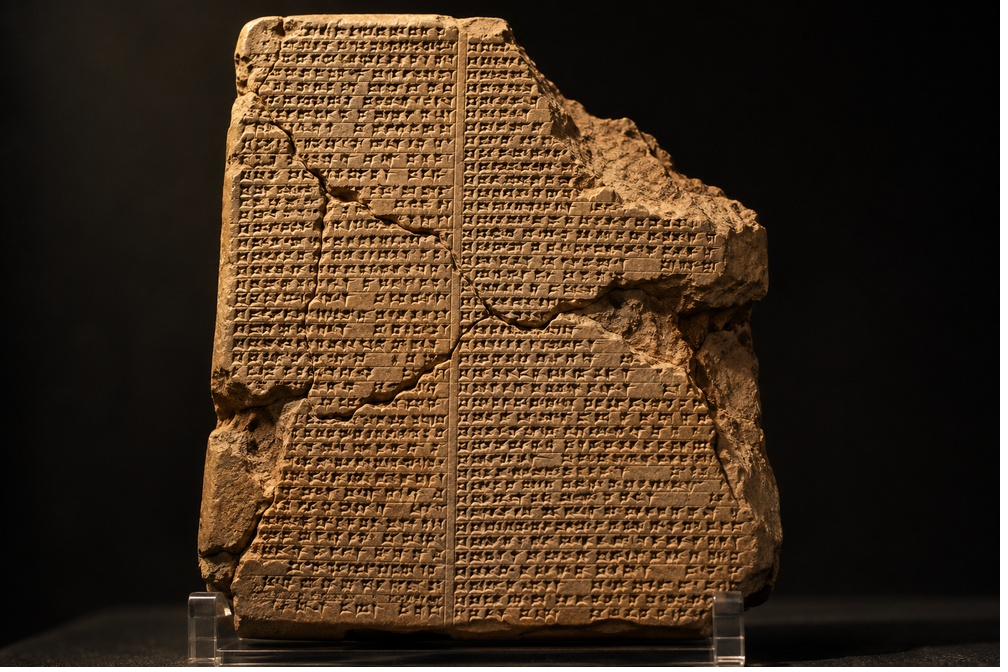
We owe the Sumerian sexagesimal system, in modified form, the sixty-second minute, the sixty-minute hour, the three hundred sixty-degree circle, and the twelve double-hours of the day; the system of measurement of time and angle that we still use is, in its bones, Sumerian. Babylonian mathematicians of the early second millennium, working in a Sumerian-derived tradition, developed an impressive range of mathematical techniques. They could solve linear and quadratic equations. They knew the relationship later called the Pythagorean theorem and could apply it to specific problems. The remarkable tablet known as Plimpton 322, dating to about 1800 BCE, contains a list of fifteen rows of numbers that have been interpreted as Pythagorean triples — sets of three integers that satisfy the equation a² + b² = c² — though the precise mathematical purpose of the tablet is still debated.
They had techniques for calculating the areas of irregular fields, the volumes of granaries, the carrying capacities of ramps, the labor required to dig canals of given dimensions. The standard mathematical problem texts, recovered in their hundreds, present specific worked problems followed by step-by-step solutions, and they show that by the early second millennium Mesopotamian mathematics had reached a level of practical sophistication that would not be exceeded for fifteen centuries. Closely related to mathematics was the practice of geometry, particularly land surveying. The flat, irrigated fields of southern Mesopotamia required careful measurement for the purposes of taxation, sale, inheritance, and irrigation rights, and Sumerian surveyors developed a robust set of techniques for measuring the areas of fields of various shapes.
Triangles, rectangles, trapezoids, and irregular polygons were all routinely calculated. The labor required for canal-digging and brick-laying projects was estimated by sophisticated formulas involving the volume of earth to be moved, the standard rate of work for a single laborer, and the number of days available. The applied mathematics of the Sumerian and Babylonian construction industry was, by the standards of any pre-modern society, remarkably advanced. Astronomy in Mesopotamia developed in close relationship with religion and divination. From the earliest times, the Sumerians observed the heavens, identified the major constellations, tracked the path of the moon through the stars, and noticed that certain bright objects — Venus, Mars, Jupiter, Saturn, and Mercury — moved against the background of the fixed stars in regular but complex ways.
The Sumerian lunar calendar, with its twelve months of about thirty days each and its intercalary thirteenth month inserted at intervals to keep the calendar in alignment with the solar year, was based on direct astronomical observation of the new moon. The lunar zodiac, the path that the moon traces through the stars over the course of a month, was identified and divided into the regions that would later become the twelve zodiacal constellations. By the early second millennium, the great compendium known as MUL.APIN ("The Plow Star"), composed in Akkadian but drawing on Sumerian-period observations, organized the celestial knowledge of the day into a systematic catalogue of stars, constellations, planetary movements, and calendrical relationships.
The astronomical achievements of the Babylonian period, which produced predictive ephemerides of considerable accuracy by the late first millennium BCE, are built directly on the foundations laid in the Sumerian and early Babylonian observations. The motivation for this astronomical work was, in significant part, astrological. The Sumerians and Babylonians believed that the gods communicated their intentions through signs in the heavens, just as they communicated through the entrails of sacrificed animals. An eclipse, a planetary conjunction, an unusual meteor, the first appearance of Venus as morning or evening star — all of these were potential omens, to be read by the trained diviner for what they portended for the king and the state.
The practical demand for accurate prediction of celestial events drove the long observational tradition of Mesopotamian astronomy, and the resulting body of careful records was one of the great scientific achievements of the ancient world. The cuneiform observation diaries of the late first millennium BCE preserve, in some cases, a continuous record of astronomical phenomena going back several centuries, and this record is sufficiently detailed and sufficiently accurate that modern astronomers, by comparing the cuneiform observations against backward calculations of where the planets actually were, have been able to refine our understanding of various long-term astronomical effects.
The Sumerians and their Babylonian successors were the first people to make systematic empirical observations of the natural world over long periods, and their data, recorded on clay, remains usable five thousand years after they began collecting it. Medicine and its theoretical foundations developed alongside the other sciences. The Sumerian and Babylonian medical compendia organize symptoms and prognoses systematically; they associate particular signs with particular diseases; they distinguish between different conditions that present similar symptoms; they prescribe specific treatments. The pharmacological knowledge embedded in these compendia is substantial, with hundreds of medicinal plants, animal products, and minerals identified by name and assigned to specific therapeutic uses.
The medical tradition was empirical in its core, even as it was wrapped in a religious and demonological idiom that attributed many illnesses to spiritual causes and sought spiritual remedies alongside the physical ones. The combination of empirical observation and theological explanation is characteristic of the Sumerian intellectual tradition generally, and it would persist in Mesopotamian medicine for millennia. Lexical lists, finally, deserve a separate notice, because they were the structural backbone of Sumerian intellectual culture in a way that few other genres were. A lexical list was a thematic catalogue: a list of all the names of trees, or all the names of fish, or all the professions, or all the gods, or all the geographic place-names known to the scribe, organized into columns and progressively elaborated through generations of scribal school use.
The earliest lexical lists go back to the Uruk period and are essentially economic vocabulary for the keeping of accounts; by the early second millennium, the genre had grown into vast bilingual compendia in which Sumerian words were paired with their Akkadian equivalents. The lists served as the standard tool of scribal education and as the standard reference for the retrieval of obscure or technical vocabulary; they also served as the matrix through which Sumerian, as a language, was preserved and transmitted long after it had ceased to be spoken.
Without the lexical lists, modern Sumerology would be largely impossible; through them, we recover not only the language but also the categories through which the Sumerians organized their knowledge. The lexical list is, in this sense, the first systematic encyclopedia, and the impulse to organize knowledge by topic and to preserve it through ordered catalogues is one of the deep gifts of the Sumerian intellectual tradition to all subsequent learning. A particular feature of the Sumerian intellectual tradition that deserves separate attention is the practice of writing about writing. The scribes who maintained the literary corpus were intensely self-conscious about their profession, and they composed a substantial body of texts whose subject was the work of the scribe himself.
The "Schooldays" composition, with its satirical account of a student's day at the edubba, is the best-known example of this genre, but there are many others. The dialogues in which two students debate the relative merits of their respective educations; the laments in which scribes complain about the difficulty of their craft; the "father's instructions" in which an experienced scribe advises his son on the proper conduct of the profession; the proverbs and witticisms about scribal work that fill the proverb collections — all of these constitute a meta-literary tradition in which the scribes turned their writing toward the examination of their own condition.
The result is a corpus of self-reflection that is unusual in the ancient world, and that gives us a glimpse of the inner life of the educated class to a depth that few other ancient civilizations allow. The Sumerian scribes were not merely the executors of a craft; they were a thinking community, and their thinking about themselves was part of what they wrote. The astronomical tradition of Sumer and Babylonia developed several specific accomplishments that deserve more detailed mention. By the early second millennium, observers had identified the principal fixed stars and constellations, including the precursors of the modern signs of the zodiac, and had organized them into systematic catalogues.
The "three stars each" tradition, in which thirty-six stars (or rather, three for each of the twelve months) were assigned to particular calendrical positions, allowed the timing of celestial events to be coordinated with the agricultural and ritual calendar. The path of the moon through the stars, traced over the course of each month, was carefully observed and recorded; the recurrent patterns of lunar motion were noted, and the periodicity of certain phenomena, including eclipses, began to be recognized. Eclipse prediction, which would reach a high level of accuracy in the late Babylonian period, has its origins in the systematic observation begun in the Sumerian and early Babylonian periods.
The five planets visible to the unaided eye — Mercury, Venus, Mars, Jupiter, Saturn — were identified by name and their movements tracked, with each planet associated with a particular god (Venus with Inanna/Ishtar, Mars with Nergal, Jupiter with Marduk, Saturn with Ninurta, Mercury with Nabu). The naming and observation of these planets persisted with remarkable continuity from Sumerian times through the Greek and Roman periods, and the very names by which we know the planets in modern English — Roman gods who were themselves identifications of Greek gods who were themselves identifications of Mesopotamian gods — preserve, at four removes, the original Sumerian assignments.
Mathematical literature in Mesopotamia included not only the practical problem texts but also a substantial body of pedagogical material designed to train students in the techniques of calculation. Multiplication tables were memorized; reciprocal tables were used to convert division into multiplication; tables of squares and cubes facilitated the solving of quadratic and cubic problems. The arithmetical scribe of the early second millennium had access to a body of computational technique that was, in some respects, equal to anything available in the European Middle Ages, and that would not be substantially superseded until the Renaissance.
The geometrical tradition was less developed than the arithmetical, but it was not absent; surveyors and architects regularly calculated areas, volumes, and proportions, and the Babylonian mathematicians of the early second millennium occasionally engaged in problems of pure geometric interest, such as the relationship of the diagonal of a square to its side (which they computed to remarkable accuracy in the famous YBC 7289 tablet, where the value of the square root of two is given as 1.41421296..., correct to nearly six decimal places). Underlying all of this was the institution of the edubba, the scribal school, where the literary, mathematical, and scientific traditions were transmitted from generation to generation.
The edubba was not a university in the modern sense, with research programs and faculty governance, but it was an institution of higher learning in the substantive sense: it preserved, transmitted, and gradually elaborated a body of organized knowledge over centuries. The transmission of these traditions across generations and across the centuries is itself a remarkable historical phenomenon. The major literary compositions of Sumerian — the Gilgamesh poems, the city laments, the temple hymns of Enheduanna, the wisdom literature, the debate poems — were copied repeatedly in scribal schools across the early second millennium, with multiple copies of the same composition surviving from different cities and different decades.
The copies are not always identical; small variations in wording, in arrangement, and in detail accumulate from one copy to the next, and modern editors have spent considerable effort reconstructing the textual histories of particular compositions through the comparison of variant manuscripts. The picture that emerges is of a living literary tradition in which texts were not simply transmitted unchanged but were copied with care and intelligence, with each generation of copyists making small adjustments and corrections, and with substantial creative engagement remaining possible within the framework of received tradition.
The Sumerian literary corpus, in this sense, was not a frozen monument but a continuing conversation across centuries, with the works of Enheduanna being read, studied, and reinterpreted by scribes who lived three or four centuries after her death. The Sumerian conception of wisdom, captured in such terms as nam-ku-zu ("knowing-thing-ness") and geshtu ("ear," used metaphorically as the seat of intelligence), recognized the value of learning for its own sake, even as it remained closely tied to practical applications. The Sumerian intellectual tradition, in short, was the first sustained intellectual tradition in human history, and the surviving products of that tradition — the epics, the laments, the hymns, the wisdom texts, the debate poems, the mathematical problems, the astronomical observations, the medical compendia, the lexical lists — constitute the deepest single layer of the cultural inheritance of the literate world.
Numerals Units (1-9): Tens (10, 20, 30...): 60 seconds, 60 minutes, 360 degrees — all Sumerian legacies Sumerian base-60 number system
Chapter 10 — Art and Architecture
The visual arts of Sumer were not separable from the religious, political, and economic life of the cities; they were, in a literal sense, that life made visible. A Sumerian temple was both a building and a theological statement; a cylinder seal was both an administrative tool and a small carved poem of mythological imagery; a votive statue was both a portrait and a perpetual prayer. To understand Sumerian art is therefore to understand the cultures that produced it, and to read the surviving objects with attention to the practical functions they served, the religious meanings they carried, and the aesthetic choices that their makers brought to their work.
The materials of southern Mesopotamia — mud, reed, palm timber, and the imported metal and stone that came up the rivers and across the Gulf — set the basic technical conditions within which the Sumerian visual tradition developed. The result was an art unlike anything else in the ancient world: massive in its architectural ambition, intricate in its small-scale craftsmanship, conventional in its iconography, and surprisingly durable across the long centuries in which it was produced. The defining building of Sumer was the ziggurat, the staged tower that rose at the center of every major city as the dwelling-place of the patron god.
The ziggurat evolved gradually out of the simpler temple platforms of the Ubaid and Uruk periods. The earliest temples in southern Mesopotamia, going back to the sixth millennium BCE, were modest single-room mud-brick structures built directly on the ground. Over the centuries, as each successive temple was rebuilt on the rubble of its predecessor, the cumulative platform on which the temple stood grew taller and more imposing. By the late Uruk period, this organic process had been deliberately formalized: temples were built atop high mud-brick terraces from the start, and the terraces themselves became the focus of architectural elaboration.
The ziggurat in its mature form, fully realized during the Ur III period around 2100 BCE, was a stepped tower of three or more receding tiers of solid mud brick, faced with a thick skin of baked brick laid in bitumen mortar and ornamented with the names and titles of the king who built it. The temple proper, called by various Sumerian names, sat at the very top, accessible by long staircases that climbed the front and sides of the structure. The whole composition was simultaneously functional, in that it raised the holy of holies above the bustle of the city, and symbolic, in that it represented the cosmic mountain on which earth and heaven met.
The greatest of all ziggurats, and the best preserved, is the Ziggurat of Ur, built by Ur-Nammu and his son Shulgi at the end of the third millennium and rebuilt several times in subsequent centuries. The Ur ziggurat, dedicated to the moon god Nanna, stood on a base sixty meters long and forty-five meters wide, rising in three stages to a height of approximately twenty-one meters. Three monumental staircases, two flanking the structure and one rising directly from its front, converged at the top of the lowest terrace, where a gate-tower marked the transition to the upper stages.
The whole was sheathed in baked brick, with each course bearing the stamped name of Ur-Nammu, and the lower terrace was punctuated by drainage shafts that allowed rainwater to escape from the unfired core without saturating it. The ziggurat survived in remarkably good condition into the modern era; in 1850 it was identified by William Kennett Loftus as the principal mound at the site, and the great excavation campaigns of the 1920s by Leonard Woolley uncovered and partially restored it. Saddam Hussein commissioned a more comprehensive reconstruction in the 1980s, with the lower terrace and the front staircase restored to something approaching their original ancient appearance, and the result, although controversial among purists, gives the modern visitor a vivid sense of the original scale and majesty of the structure.
Other ziggurats of comparable importance stood at most major Sumerian cities. The ziggurat at Eridu, dedicated to Enki, was rebuilt many times across millennia and survived as a recognizable mound into the modern era. The ziggurat at Nippur, dedicated to Enlil, was the religious heart of the most sacred city of Sumer and would have been the most prestigious religious monument of the ancient world in its time. The ziggurat at Uruk, dedicated to An, the sky god, with its associated White Temple and its even older mosaic-fronted Eanna sanctuary nearby, was one of the great architectural complexes of the late Uruk and Early Dynastic periods.
The ziggurat at Babylon, the famous Etemenanki dedicated to Marduk, was a Babylonian rather than a Sumerian construction, but it stood directly in the Sumerian architectural tradition, and its destruction by Alexander the Great's successors and its decay over subsequent centuries have left it the rather meager mound that visitors to modern Iraq see today. The biblical Tower of Babel, of course, is a folk memory of one or more of these great Mesopotamian ziggurats, and the suggestion in Genesis that the Tower's builders sought to make a name for themselves by reaching to heaven is, in its bones, a culturally accurate observation about the meaning that the ziggurats carried for the people who built them.
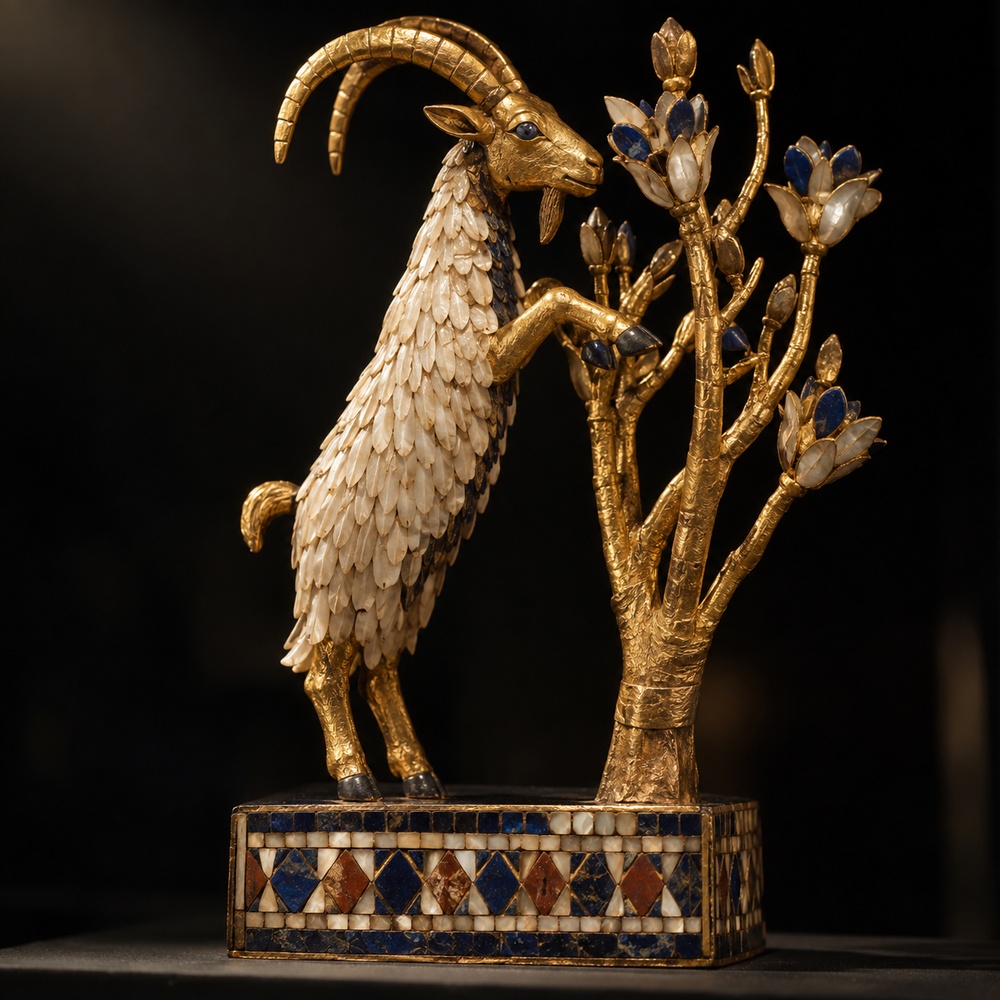
Beyond the ziggurat, Sumerian temple architecture included a variety of other forms. The temple oval at Khafajeh, in the Diyala region, encloses an oval precinct with multiple subsidiary buildings around a central temple platform; the design is unusual and may reflect local rather than mainstream Sumerian conventions. The famous White Temple at Uruk, built atop the Anu ziggurat in the late fourth millennium and so named for its whitewashed exterior, is one of the earliest examples of a fully realized monumental temple in Mesopotamia, with its rectangular plan, its central cella, and its elaborate buttressed exterior.
The Eanna precinct at Uruk, the cult center of Inanna, contained several major buildings during the late Uruk period, including the Pillared Hall and various other structures whose function is not always clear; some of the most striking architectural ornament of the period appears here, particularly the cone mosaics that covered the facades of certain buildings. The cone mosaic technique deserves particular attention, because it is one of the most distinctive achievements of late Uruk-period decoration. The cones were small, conical pieces of fired clay, several centimeters long, with their pointed ends colored in red, white, or black.
They were pressed into the wet plaster of a building's facade with the colored ends out, and arranged in geometric patterns of remarkable visual richness — diamonds, zigzags, triangles, lozenges. From a distance, the result was a polychrome wall surface that could be seen for considerable distances and that animated the otherwise plain mud-brick exterior with a vibrant pattern. The cone mosaics of Uruk, recovered in their thousands by the German excavations of the early twentieth century, are one of the most surprising and beautiful survivals of late Uruk material culture.
The technique would not survive into later Mesopotamian architecture, but its existence in the late Uruk period demonstrates the willingness of Sumerian builders to experiment with surface treatments and to invest considerable labor in pure decoration. Palace architecture as a category distinct from temple architecture emerged gradually in the third millennium. The earliest political authority in Sumerian cities was vested in the temple, and there was no separate "palace" in the sense of a royal residence and administrative complex. As the office of lugal grew in importance, however, kings began to build their own substantial complexes, separate from the temple, in which the residential, administrative, and ceremonial functions of royal government were housed.
The palace at Kish, excavated in the early twentieth century, is one of the earliest substantial palace structures from Mesopotamia, with its multi-room plan, its receiving halls, and its evidence of independent administrative function. The palaces at Eridu, at Ur, at Mari, and at Ebla, all dating to the late third millennium, demonstrate the increasing scale and sophistication of Sumerian and early Akkadian palace architecture. By the Ur III period, palaces had become major architectural complexes in their own right, with large courtyards, ceremonial halls, residential apartments, archives, treasuries, and staff quarters arranged around a central administrative core.
The construction techniques that Sumerian builders used were dictated by the materials available on the alluvial plain. Mud brick was the universal building medium. Sun-dried bricks, made by mixing alluvial mud with chopped straw and pressing the result into rectangular wooden molds, were used for the bulk of every structure. Baked bricks, fired in kilns to a hard ceramic state, were reserved for foundations, drainage systems, the facing of monumental buildings, and other applications where waterproofing or extra strength was needed. Bitumen, the natural petroleum tar that seeps from the ground in many parts of southern Iraq, was used as mortar in baked-brick masonry and as a waterproof coating for terraces, drains, and the lower walls of buildings exposed to flood.
The combination of mud brick, baked brick, and bitumen produced structures of remarkable durability when properly maintained, but they required regular attention. Mud brick that gets wet returns to mud, and a Mesopotamian building left untended for a generation will erode badly. The continual rebuilding of Sumerian temples and palaces, which the King List and the royal inscriptions celebrate, was not vanity; it was structural necessity. Sumerian sculpture in the round, from its earliest substantial appearances in the Early Dynastic period, presents a recognizable and distinctive artistic vocabulary. The most famous early examples are the votive statues from the Square Temple at Tell Asmar, dating to about 2700 BCE.
These figures, recovered in a cache buried beneath the temple floor, represent worshippers in attitudes of perpetual prayer: the head turned slightly upward, the hands clasped before the chest, the eyes wide and intent. The figures are stocky, with thick necks, broad shoulders, and the characteristic kaunakes tufted skirts of the period. The eyes, which are vastly oversized in proportion to the rest of the face, are inlaid with shell and lapis lazuli to produce an effect of intense, focused gaze. The reason for the oversized eyes seems clear: the function of the votive statue was to stand in the temple in perpetual worship, gazing on the cult statue of the god, and the oversized eyes both signaled and enacted that perpetual gaze.
The Tell Asmar statues are among the most haunting objects of the Early Dynastic period, their gaze across five thousand years still arresting to a modern viewer. The high point of Sumerian decorative art is, in many ways, the discoveries of the Royal Cemetery at Ur. The Royal Cemetery was excavated by Leonard Woolley in the 1920s, in a vast cemetery just outside the southeast wall of the city, where some sixteen tombs of unusual richness were eventually identified amid more than a thousand simpler burials. The richest of these tombs, designated as royal by Woolley because of their elaborate construction, their abundance of grave goods, and the presence in some cases of large numbers of attendants who appear to have been killed at the time of the burial, contained an astonishing wealth of objects.
Queen Puabi, whose tomb was largely intact when Woolley reached it, was buried with an elaborate gold and lapis headdress, multiple necklaces of carnelian, lapis, and gold, gold cups, gold and silver bowls, and a profusion of personal ornaments. The famous bull-headed lyre from the King's Grave (Tomb PG 789) bears a sound box decorated with the head of a bearded bull in beaten gold over a wooden core, with eyes and beard of lapis lazuli; the front of the sound box is inlaid with a series of mythological scenes in shell on a bitumen ground.
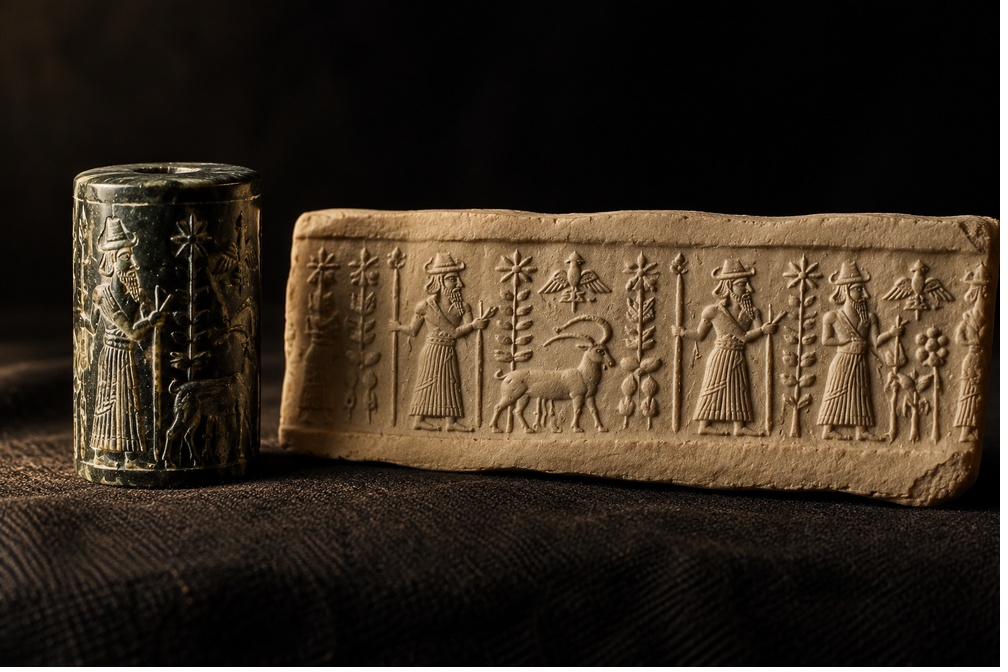
The standard of Ur, recovered from another royal grave, is a rectangular wooden sound box covered on both sides with elaborate inlay panels showing, on one side, scenes of war and triumph, and on the other, scenes of feasting and tribute-bringing. The so-called Ram in the Thicket, actually a small cult stand in the form of a goat rearing up against a flowering bush, is constructed of gold and silver leaf over a wooden core, with hair and beard of lapis lazuli and eyes of shell. The headdress of Puabi, the silver lyre, the gold dagger, the gold cosmetic boxes — the catalogue of objects from the Royal Cemetery would fill many pages, and the level of craftsmanship displayed in them is at the absolute peak of what the third millennium achieved anywhere.
The Standard of Ur, in particular, deserves a longer description. The object, approximately twenty-two centimeters high and forty-eight centimeters wide, is a rectangular wooden box of unknown original purpose, perhaps the sound box of a musical instrument or the base of a freestanding image. Its long sides are covered with three horizontal registers of inlay, the inlay made of small pieces of shell, red limestone, and lapis lazuli set into a bitumen ground. One side, conventionally called the "war" panel, shows in its lowest register the chariots of Ur driving over the bodies of fallen enemies, in its middle register infantrymen marching in the heavy cloaks of the Sumerian close-order phalanx, and in its top register the king of Ur receiving naked and bound prisoners.
The opposite side, the "peace" panel, shows in its lowest register men leading donkeys and bearing burdens in tribute, in its middle register the slaughter and butchering of animals for a feast, and in its top register the king and his court at banquet, with attendant musicians playing a great lyre. The two sides of the standard, taken together, present an idealized cosmology of royal authority: the king dominates his enemies in war, then enjoys the fruits of victory in peace, with all of the social hierarchy of court and city arranged around him.
Few objects from the ancient world articulate the ideology of kingship as clearly as the Standard of Ur. The cylinder seal, a uniquely Mesopotamian invention, deserves separate attention as a major medium of small-scale Sumerian art. A cylinder seal is a small drum of stone, two or three centimeters tall, engraved in negative relief on its outer surface. When rolled across a damp clay surface, the seal leaves a continuous frieze of imagery, repeated as many times as the surface is long enough to allow. The cylinder seal was invented in southern Mesopotamia in the late Uruk period, around 3500 BCE, and quickly displaced the earlier stamp seal as the standard administrative tool for marking ownership and authenticating documents.
Cylinder seals were used to seal jar stoppers, door lockings, the wrappings of bundled goods, and most importantly the closures of clay tablets and clay bullae, providing the equivalent of a signature or notary mark on every kind of administrative artifact. Each seal was unique, often carrying its owner's name in a cuneiform inscription, and the carving on the seal was often a small but elaborately worked image of mythological or ceremonial scenes — a divine combat, a hero subduing wild animals, an introduction scene in which a worshipper is presented to a god, a cultic banquet.
The miniature scale of the seals, often only a square centimeter or two in pictorial area, demanded an extraordinary level of carving precision, and the best Sumerian and Akkadian seals are masterpieces of small-scale relief sculpture. The materials used for seals — chlorite, lapis lazuli, carnelian, hematite, serpentine — were almost all imported from outside Mesopotamia and ranged from common to extraordinarily expensive, allowing the social status of a seal's owner to be partly read in the material from which the seal was made. Royal monuments of the Early Dynastic and Akkadian periods include several works of remarkable historical and artistic importance.
The Stele of the Vultures, the victory monument set up by Eannatum of Lagash around 2450 BCE, is the earliest surviving narrative historical monument in human art. The stele, of which only fragments now survive in the Louvre, depicts on its main face Eannatum at the head of his troops, the soldiers in tight phalanx with their shields locked, a separate scene of the burial of the dead, and at the top a great image of the god Ningirsu of Lagash holding the captives of Umma in a divine net.
The composition combines historical narrative, theological commentary, and political assertion in a way that would set the pattern for Mesopotamian royal monuments for two thousand years. The Naram-Sin Stele, set up by the great Akkadian king Naram-Sin to celebrate his victory over the mountain people called the Lullubi, takes the genre to a different level. The stele, recovered from Susa in the early twentieth century where the Elamites had carried it as plunder, shows Naram-Sin himself at greatly enlarged scale, climbing a mountain in the act of conquest, with his enemies falling and pleading at his feet and the stars of his patron gods watching from above.
The composition is dynamic and naturalistic in ways that earlier Mesopotamian art had not been, and the treatment of landscape and figure-on-figure relationship anticipates much later artistic developments. Naram-Sin's deification, signaled by the horned crown he wears, is artistic confirmation of the political claim by which he made himself the first Mesopotamian king to be worshipped as a god in his own lifetime. The most famous artistic figure of the late Sumerian period, however, is Gudea of Lagash, who governed his city as an independent ensi during the brief Gutian interregnum between the fall of the Akkadian Empire and the rise of the Third Dynasty of Ur.
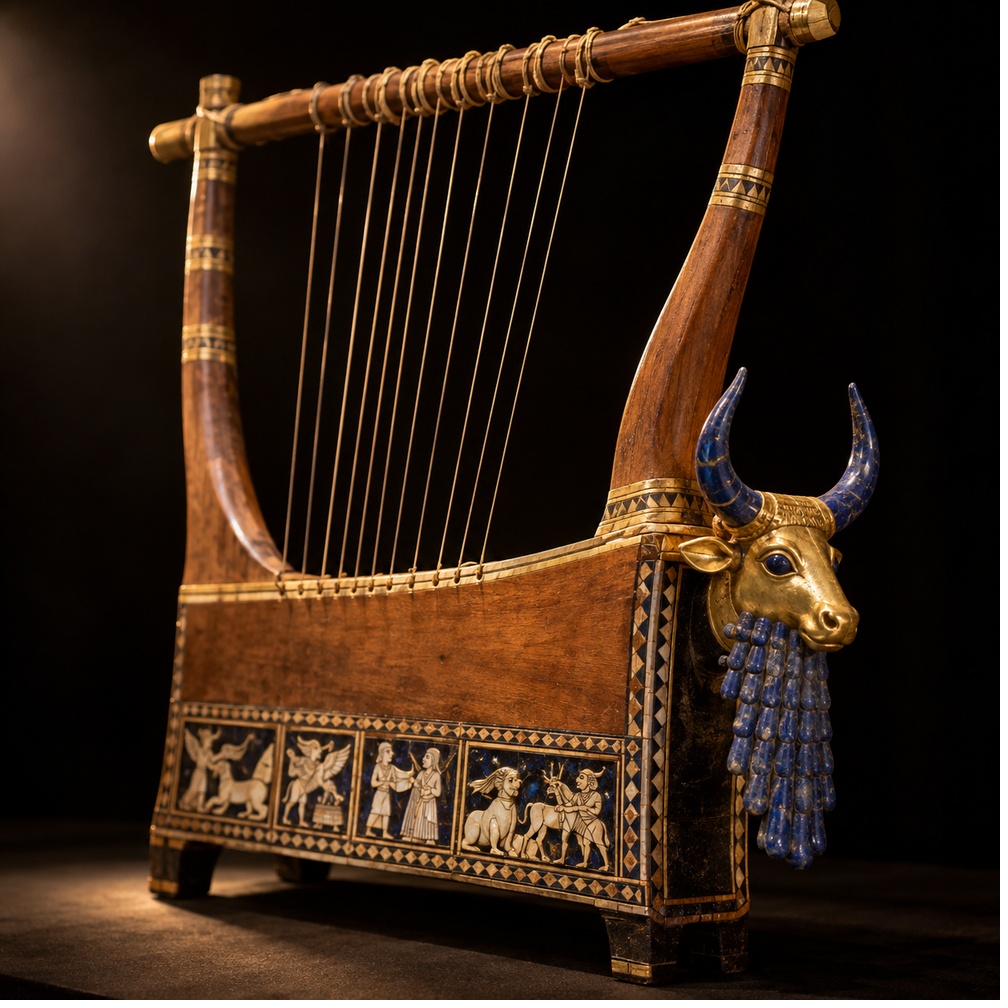
Gudea undertook an ambitious building program, particularly the rebuilding of the great temple of Ningirsu at Girsu, and he commissioned a remarkable series of statues of himself in dark, hard diorite imported from Magan. The Gudea statues, of which more than two dozen survive in major museums, present the ensi in two main types: standing in attitudes of devotion, his hands clasped before his chest in the ancient gesture of worship, or seated, with the architect's plan of the new temple unrolled across his knees. The polished stone of the statues, the calm and inward-looking faces, the meticulous detail of the inscriptions running across their robes, give the Gudea statues a meditative quality that distinguishes them from the more aggressive royal monuments of the preceding Akkadian period.
The series as a whole is one of the great achievements of late third-millennium sculpture in any civilization. Gudea also commissioned a pair of large clay cylinders, the so-called Gudea Cylinders, on which were inscribed the longest single Sumerian literary composition known, a hymn celebrating the rebuilding of the Ningirsu temple. The cylinders are masterpieces of cuneiform calligraphy and one of the great surviving documents of late third-millennium Sumerian piety. Metalwork in copper, bronze, gold, and silver was a major area of Sumerian artistic achievement. The bull-headed lyres of Ur, with their lapis-and-gold heads, are the most famous examples; the helmet of Meskalamdug, recovered from the Royal Cemetery, is a single sheet of beaten gold worked with extraordinary fineness to represent the prince's hair, side-locks, and ear-coverings; the gold dagger of Meskalamdug, with its gold blade, gold-and-lapis hilt, and gold sheath cut into a delicate filigree pattern, is one of the finest single objects of metalwork to survive from the entire ancient world.
The Sumerian metalworking tradition rested on imported raw materials but produced finished objects whose technique and design were entirely the work of the southern alluvium. The lost-wax casting technique, by which complex three-dimensional metal objects could be produced from a melted-out wax model, was in regular use by the third millennium and had reached a high level of refinement. Painting and frescoes existed in Sumer but have largely been lost, because the materials on which they were applied — plastered mud-brick walls — have not survived in conditions that preserve pigment.
We have indirect evidence of substantial use of color: the cone mosaics described above, the inlaid surfaces of the Standard of Ur and similar objects, the polychrome traces still occasionally visible on Sumerian sculpture. Statues and architectural elements that look uniformly stone or brown to a modern viewer were originally polychrome, with eyes inlaid in shell and lapis, lips highlighted in red, hair sometimes blacked, garments sometimes painted in patterns. The visual texture of Sumerian art, in its original setting, was vastly more colorful than what has come down to us.
A distinctive set of artistic conventions governs almost all Sumerian figurative work. Hierarchy of scale is universal: more important figures are shown at larger size than less important ones, regardless of any concern for naturalistic perspective. Frontal eyes are placed on profile heads, in a convention that gives the characteristic combination of profile body, profile face, and the great staring eye visible from the front. Registers are used for narrative composition, with separate horizontal bands of figures stacked one above another to tell a story sequentially or to display the social hierarchy from bottom to top.
Linear perspective, in the Western Renaissance sense, is absent; depth is suggested only by the relative placement of figures rather than by any geometric convergence of lines. These conventions are not crude; they are deliberate aesthetic choices, and they produce an art of great power within their own terms. The role of women in Sumerian artistic production deserves a separate notice. Although the major sculptors, architects, and seal-cutters whose names appear in the surviving inscriptions are almost without exception male, the broader artistic economy of Sumer involved women as a substantial component of its workforce.
The great textile workshops of the temple estates, where the elaborate woven goods that constituted one of Sumer's principal artistic exports were produced, were staffed largely by female workers. The fine embroidery and dyed fabrics that we know from artistic representation, although the actual textiles have not survived, were the products of female labor. Female potters, although less common than male potters, are attested. The lapidaries who produced the small stone ornaments that have been recovered from women's graves were sometimes themselves women. The musicians who performed in the great cult and royal ceremonies, including the lyre-players and singers whose performances accompanied the major religious festivals, included women as well as men.
The artistic culture of Sumer, in other words, was not exclusively male in its production any more than it was exclusively male in its patronage; both Queen Puabi at Ur and Enheduanna at Ur are reminders that the great patrons of Sumerian art included women of substantial wealth and authority. The continuity of these conventions into later Mesopotamian, Assyrian, and even Persian art demonstrates how profoundly the Sumerians shaped the visual imagination of the entire ancient Near East. The relationship between Sumerian art and Sumerian religion was, finally, so close that no clear separation between the two can be maintained.
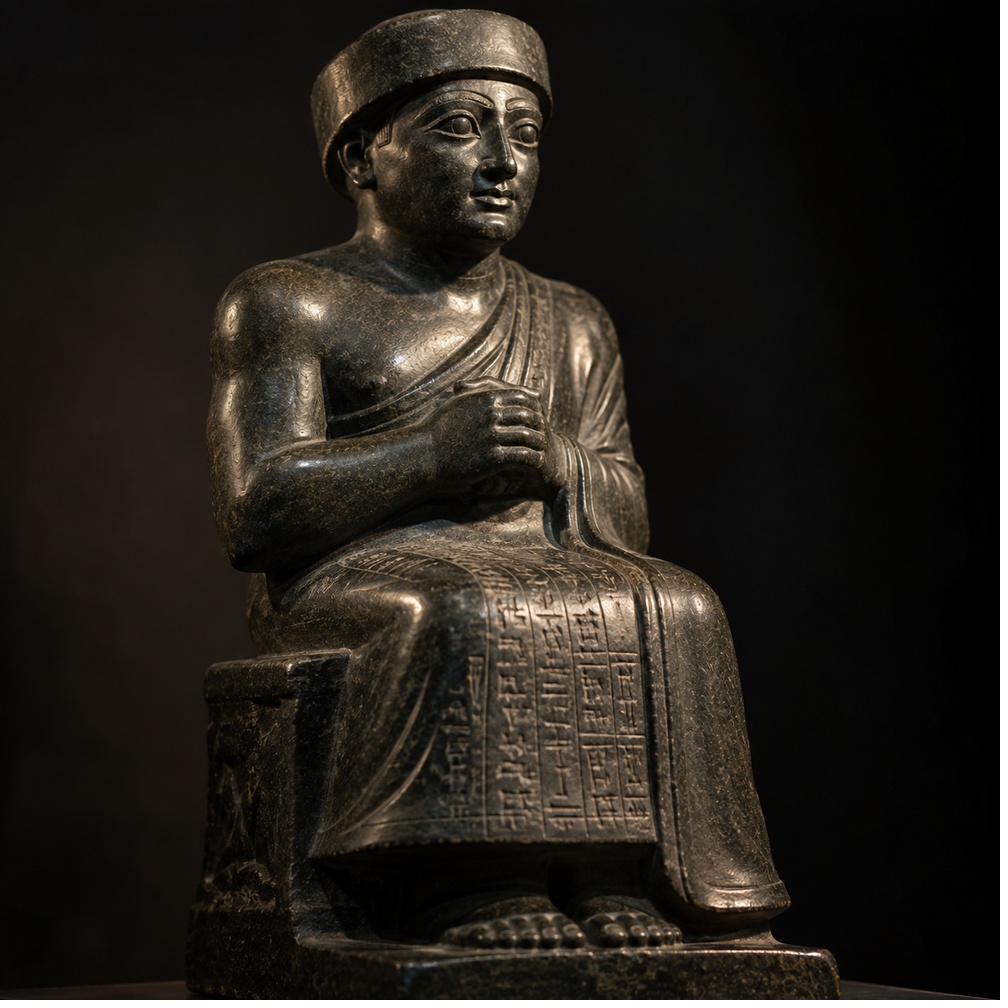
The temples were both buildings and theological statements; the cult statues were both art objects and the actual presence of the gods; the votive figures were both sculpture and the perpetual prayers of their dedicators; the cylinder seals were both administrative tools and miniature mythological narratives. The Sumerian artist did not work in a separate sphere of aesthetic production set apart from the practical and religious life of the community; he or she worked in the service of religious, administrative, and political functions that gave the work its meaning and that integrated it into the broader life of the city.
Modern viewers, accustomed to the museum display of ancient objects in isolation from their original contexts, sometimes find it difficult to grasp this integration; we see the Standard of Ur on a velvet plinth in the British Museum and admire its inlay work, but we are rarely in a position to imagine the full context of a royal Sumerian banquet hall in which such an object might have stood, with the king at his table, the musicians playing, the food being served, the gods invisibly attending, and the political and religious meanings of the standard's iconography being directly read by the assembled guests.
The original life of Sumerian art was that life, and any modern appreciation of the surviving objects must, to be faithful, attempt to reconstruct it. The legacy of Sumerian visual culture, like the legacy of Sumerian writing, would persist long after Sumerian itself had ceased to be spoken, propagated forward through every successor civilization in the region for another two thousand years. The Great Lyre of Ur, c. 2550 BC
Chapter 11 — The Rise and Fall of Empires
The political history of Sumer can be told as the rise and fall of a sequence of unifying powers. For most of the third millennium, the southern alluvium was divided among the rival city-states of the Early Dynastic period — Uruk, Ur, Lagash, Umma, Kish, Eridu, Nippur, and the rest — each pursuing its own interests, alternately allied and at war with its neighbors, none of them ever quite strong enough or quite weak enough to dominate the others permanently. The pattern of inter-city competition lasted, with various local consolidations and brief hegemonies, for some five hundred years.
It was finally broken, near the end of the third millennium, by the arrival of a new kind of political authority: the empire, ruled from a single center, claiming dominion over the whole of southern Mesopotamia and beyond. The empire, in turn, would itself collapse, give way to a brief Sumerian renaissance, and finally yield to the incoming Amorite and Babylonian world that succeeded the Sumerian political order altogether. The story of these successive empires and their collapses is the story of the political end of Sumer. The Early Dynastic period, conventionally dated from about 2900 to 2350 BCE, was the long phase of city-state competition.
We have already met its principal characters: the rival kings of Lagash and Umma, contending across centuries over the boundary of the Gu'edena; the dynasties of Kish, Uruk, and Ur, alternating in the rotating hegemony recorded by the Sumerian King List; the reformer Urukagina of Lagash, attempting to root out the abuses of the temple bureaucracy; the warriors Eannatum, Mesalim, and the legendary Gilgamesh. By the late Early Dynastic, around 2400 BCE, this multi-polar system had begun to consolidate. Lugalzagesi of Umma, after defeating the Lagashite king Urukagina and destroying his city, claimed in his royal inscriptions a hegemony reaching from the lower sea to the upper sea, from the Persian Gulf to the Mediterranean.
The claim probably exaggerates the actual reach of his power, but it reflects a real consolidation: for perhaps a generation, Lugalzagesi was the dominant ruler of southern Mesopotamia, drawing tribute from cities up and down the alluvium and styling himself the king of the entire land. He had pulled together what previous kings had only briefly held — and his moment of triumph was about to be cut short by the appearance of a quite different kind of ruler from the north. The disruptor was Sargon, lugal of Akkad. Sargon's origins are obscure and partly legendary.
The Sumerian and Akkadian traditions, recorded in later texts, describe him as the son of a humble woman, set adrift on the Euphrates as an infant in a basket of reeds sealed with bitumen — a story closely paralleled by the later biblical narrative of Moses — and rescued by a gardener who raised him to manhood. He came to the attention of Ur-Zababa, the king of Kish, in whose service he rose to the position of cup-bearer. He then somehow displaced his master, took the kingship of Kish, and from that base began the campaigns that would carry him across the entire south of Mesopotamia and beyond.
By the time he was finished, Sargon had defeated Lugalzagesi, leading him in a copper collar to the gate of Enlil's temple at Nippur; had subdued every major city of Sumer, from Uruk to Ur to Lagash to Eridu; had extended his power up the Euphrates into Syria and against the Mediterranean coast; had carried his armies eastward into Elam and against the Iranian highlands; and had founded a new capital city, Akkad, at a location that has never been certainly identified but probably lay somewhere near modern Baghdad on the Euphrates.
The empire he created lasted for roughly a century and a half, and it was, in the strict sense, the world's first true empire: a unified political structure encompassing many regions, ruled from a central capital, with appointed governors, a standing army, and a single administrative language alongside the local ones. Sargon's innovations were both political and cultural. He maintained Akkadian, his own Semitic language, as a parallel administrative language alongside Sumerian; from his reign onward, royal inscriptions and many administrative documents were written in Akkadian as well as in Sumerian, beginning the long process by which Akkadian would eventually displace Sumerian as the spoken language of the south.
He appointed Akkadian-speaking governors to oversee the conquered cities, a practice that broke decisively with the older pattern in which each city was ruled by its own dynasty. He maintained a personal standing army, paid from the central treasury, rather than relying solely on the levies of subordinate cities. He installed his own daughter, Enheduanna, as en-priestess of Nanna at Ur, fusing religious and political authority in a way that gave the Akkadian regime visibility and legitimacy at one of the most prestigious shrines of Sumer. The hymns Enheduanna composed during her tenure, particularly her sequence of compositions to Inanna, the goddess of war and her father's patron, give us our most direct glimpse of the political religion of the Akkadian period.
The greatest of Sargon's successors was his grandson Naram-Sin, who reigned around 2254 to 2218 BCE. Naram-Sin extended the empire even further than his grandfather, taking the title "King of the Four Quarters" — meaning, in effect, ruler of the entire world. He campaigned in every direction: into Syria, against Ebla, across the Zagros against the mountain peoples, southward to the Persian Gulf, and into the highlands against various Iranian opponents. His most famous monument, the victory stele set up after his defeat of the Lullubi, depicts him as a heroic figure climbing a mountain in the act of conquest, with his enemies falling at his feet and the stars of his patron gods watching from above.
Most strikingly of all, he wears the horned crown of divinity, signifying his deification. Naram-Sin was the first Mesopotamian king to be worshipped as a god in his own lifetime, and his temples were built in cities throughout the empire to receive offerings to the divine king. The deification of the ruler, an unprecedented step in the political and religious history of Mesopotamia, would be repeated by some later Sumerian kings of the Ur III dynasty, but it was Naram-Sin who established it as a possibility. The Akkadian Empire, however, did not long outlast its greatest king.
Within decades of Naram-Sin's death, around 2200 BCE, the empire began to fragment. The traditional explanation, presented in the great Sumerian poem the Curse of Agade, is that the gods themselves brought about the destruction of Akkad as punishment for an act of sacrilege by Naram-Sin, who had supposedly attacked the temple of Enlil at Nippur in defiance of the gods' will. According to the poem, Enlil responded by calling down upon Akkad the people of the mountains, the Gutians, who descended on the empire and destroyed it. The poem ends with the famous curse: "Akkad is destroyed!
Hail Inanna!" — and then with the more sober prediction that the city of Akkad would never live again, a prediction that has indeed been fulfilled in that no archaeological site has ever been securely identified as the lost capital. The Curse of Agade is partly mythological reconstruction and partly genuine historical memory; the political collapse it describes was real, although its causes were certainly more complex than simple divine punishment. Modern scholarship has identified several contributing factors. Climatological evidence, particularly from sediment cores in the Persian Gulf and from speleothems in caves across the Near East, suggests that around 2200 BCE the region experienced a severe and prolonged drought, sometimes called the 4.2 kiloyear event, which lasted for several generations and disrupted agricultural production across the entire eastern Mediterranean and Near East.
The simultaneous collapse of the Egyptian Old Kingdom, the disruption of the Indus Valley civilization, and the destabilization of Anatolia all appear to be linked to this same climatic episode. In the Akkadian Empire, the drought would have hit the more marginal northern grain-producing areas first, reducing tax revenues and undermining the economic foundation of imperial rule. The Gutian invasions, which the Curse of Agade highlights, may have been less the cause than the consequence of imperial weakness, with mountain peoples taking advantage of an empire already crumbling under climatic and economic pressure.
Whatever the precise mechanism, the result was the political fragmentation of southern Mesopotamia and the disappearance of the Akkadian Empire as a meaningful political force. The period that followed, from approximately 2150 to 2100 BCE, was a kind of dark age, sometimes called the Gutian interregnum. The Sumerian King List preserves a list of Gutian kings of Mesopotamia, but most of the names are otherwise unattested, and the documentary record from this period is unusually thin. The Gutian dominion, such as it was, may have been more nominal than real, with actual political power devolving to local cities that managed their own affairs without much reference to the official Gutian overlords.
It was during this period that Gudea, the famous ensi of Lagash, governed his city in a state of effective independence, undertaking the great rebuilding of the temple of Ningirsu at Girsu and commissioning the diorite statues that have made him one of the most artistically present figures of Sumerian history. Gudea's inscriptions barely mention the Gutians, suggesting that during his tenure the Gutian presence in Lagash was minimal. The Gutian period was not, contrary to the gloomy picture painted by the slightly later Sumerian sources who celebrated the eventual expulsion of the mountain people, an unrelieved disaster.
It was a period of fragmentation and reduced political ambition, but cultural and religious life continued, and at Lagash and other surviving centers there was even something of a flourishing. The expulsion of the Gutians, when it came, was the work of Utu-hegal, king of Uruk, around 2120 BCE. Utu-hegal defeated the Gutian king Tirigan, took him captive, and proclaimed himself king of Sumer. His reign was short — only about seven years — and was followed by the establishment of the Third Dynasty of Ur, generally called the Ur III dynasty, by Utu-hegal's brother (or, in some accounts, son-in-law) Ur-Nammu.
The Ur III period, lasting from approximately 2112 to 2004 BCE, was the great Sumerian renaissance, the last and most thoroughly documented phase of native Sumerian rule, and one of the high points of Mesopotamian civilization in its classical form. Ur-Nammu, the founder of the Ur III dynasty, was a remarkable ruler. He restored the political unity of southern Mesopotamia under a Sumerian-speaking dynasty for the first time since the end of the Early Dynastic period. He undertook a massive construction program throughout the empire, building or rebuilding temples in every major city; the great Ziggurat of Ur, the best-preserved of all Sumerian ziggurats, was begun under his reign.
He promulgated the Code of Ur-Nammu, the world's earliest known law code and the model for all subsequent Mesopotamian law codes. He standardized weights and measures throughout the empire, an administrative achievement of substantial practical importance. He restored Sumerian as the primary language of administration, although Akkadian continued in use as well. His reign of approximately eighteen years (2112-2094 BCE) laid the foundations of an imperial structure that would last for a century. His son, Shulgi, who succeeded him in 2094 BCE and reigned for nearly fifty years, was the great consolidator of the Ur III imperial system.
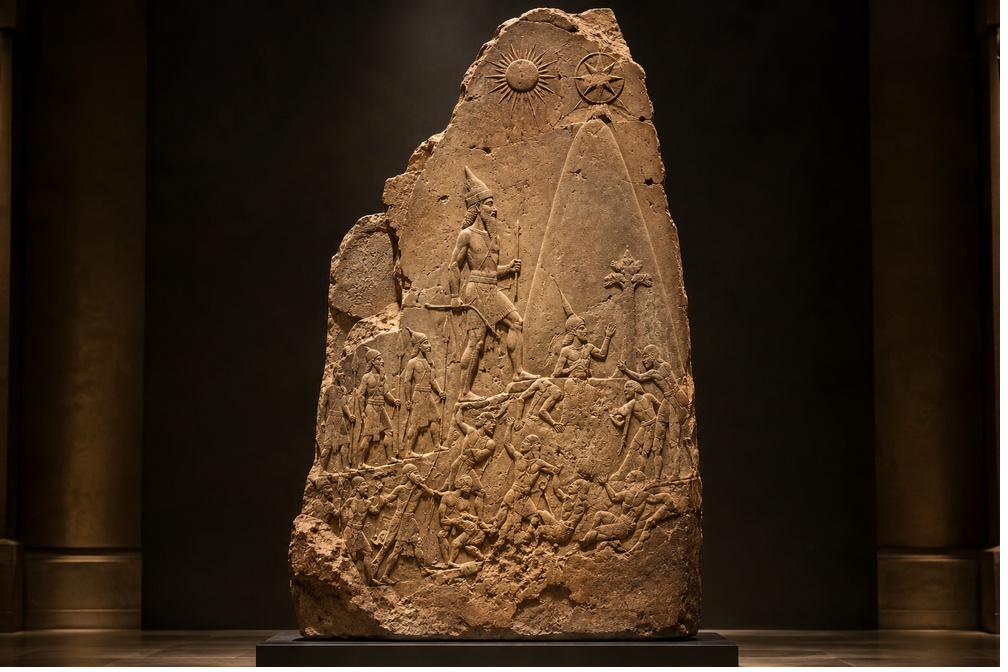
Shulgi extended his father's work in every direction. He extended the empire's borders both east and west, conducting numerous campaigns in the Iranian highlands and along the upper Tigris. He developed an elaborate, hyper-bureaucratic administrative system that has left us perhaps the most detailed documentary record of any pre-modern empire. The famous archive at Drehem, just south of Nippur, recorded the daily intake and disbursement of the king's tax cattle, with each animal's species, age, sex, condition, and ultimate destination meticulously noted; the surviving Drehem tablets number in the hundreds of thousands.
Shulgi reformed the calendar, organized the school system, and was deified during his lifetime, becoming an object of cult worship in temples throughout the empire. He famously claimed, in one of his royal hymns, to have run from Nippur to Ur and back in a single day during a violent storm — a distance of perhaps a hundred and fifty kilometers. Whether the run was historical or symbolic, the hymn captures something of the energetic self-projection of the king. By the time of Shulgi's death in 2046 BCE, the Ur III empire had reached the peak of its territorial extent, administrative integration, and cultural prestige.
Shulgi's successors — his sons Amar-Sin and Shu-Sin, and his grandson Ibbi-Sin — presided over a long, slow decline. Amar-Sin (2046-2038 BCE) continued his father's policies but on a reduced scale; Shu-Sin (2037-2029 BCE) faced increasing pressure from outside the empire, particularly from the Amorite peoples who were infiltrating the western frontier in growing numbers. Shu-Sin built a great defensive wall, "the Wall of Martu Which Keeps the Tidnum Distant," to try to halt the Amorite advance, but the wall, like all such defensive structures, could only delay rather than prevent the demographic pressure it was designed to resist.
By the reign of Ibbi-Sin (2028-2004 BCE), the empire was in serious trouble. Famine struck the southern alluvium, perhaps as a result of agricultural decline associated with continued salinization. Amorite raids became more frequent and more destructive. Provincial governors began to act independently of the central authority. Around 2025 BCE, one of these governors, Ishbi-Erra of Mari, was sent by Ibbi-Sin to the city of Isin to organize the response to a famine and the protection of the surrounding region; instead, he established himself at Isin as an independent ruler, the founder of a new dynasty.
The final blow came from the east. In 2004 BCE, the Elamites under their king Kindattu invaded southern Mesopotamia, defeating Ibbi-Sin's forces and capturing the king himself. Ur was sacked, its temples burned, its statues carried off to Susa, and Ibbi-Sin was led away in chains to die in Elamite captivity. The destruction of Ur was complete and traumatic. The cities of southern Mesopotamia would, in time, be rebuilt, but the political unity of Sumer under a Sumerian-speaking dynasty was permanently ended. The Lament for Ur and its companion city laments, composed in the immediate aftermath of the disaster, are among the most powerful works of Sumerian literature; they preserve, with remarkable rawness, the experience of national catastrophe and have provided modern scholars with one of the few sustained ancient meditations on the experience of imperial collapse.
The period that followed the fall of Ur, conventionally called the Isin-Larsa period (2004-1763 BCE), was one of fragmentation and slow Akkadian-language ascendancy. Multiple cities — Isin under the dynasty of Ishbi-Erra, Larsa under a series of Amorite kings, Babylon as a rising new power in the north, Eshnunna and Mari and various others — competed for hegemony. Sumerian continued to be used for religious, scholarly, and ceremonial purposes, but Akkadian became the dominant spoken language of the south, and the new dynasties were almost without exception Amorite in their origins.
The greatest of the Isin kings, Lipit-Ishtar (1934-1924 BCE), continued the Sumerian-language tradition of Ur-Nammu, issuing his own law code in Sumerian and writing his royal inscriptions in the older language. But Lipit-Ishtar was perhaps the last king to do so substantively. By the time of Rim-Sin of Larsa (1822-1763 BCE), Sumerian had become essentially a learned and ceremonial language, with everyday business conducted in Akkadian. The Isin-Larsa period was finally ended by the rise of Babylon under Hammurabi (1792-1750 BCE), an Amorite king of the First Dynasty of Babylon who united southern Mesopotamia under a single imperial authority for the first time since the fall of Ur.
Hammurabi was the great codifier whose famous law code, written in Akkadian and inscribed on a magnificent diorite stele, became the most widely-known piece of ancient Mesopotamian law in the modern world. By the time of Hammurabi, however, Sumer as a political entity was a memory. The cities of Sumer continued to exist as cities, their temples continued to be honored, their patron gods continued to receive offerings, but the political world of Sumerian-speaking kings ruling Sumerian-speaking subjects was over. The Babylonian world that followed was, in deep continuity, the heir of Sumer; the gods, the literature, the law, the science, the architecture, the writing system all passed forward into the Babylonian period without major rupture.
But the heirs were now Akkadian-speaking, and the Sumerian political moment had ended. Sumerian as a spoken language died out somewhere in the early second millennium, probably during the Old Babylonian period. Its death cannot be precisely dated, because there was no moment when the last native speaker took her leave; rather, the language was gradually displaced by Akkadian as the language of the home and the marketplace, surviving for a few generations as a second language taught in schools and used for religious and ceremonial purposes, until it ceased to be effectively transmitted from one generation to the next as a living tongue.
By the late Old Babylonian period, around 1500 BCE, Sumerian was a learned language that scribes studied with effort and used in restricted contexts. By the first millennium, it was the equivalent of medieval Latin: a language preserved in the educational and religious institutions of the literate elite, used for hymns, scientific and divinatory texts, and the citation of ancient authorities, but no longer the spoken tongue of any community. The administrative system of the Ur III empire deserves a closer description because it represents the high-water mark of pre-modern bureaucratic management.
Under Shulgi and his successors, southern Mesopotamia was divided into a network of provinces, each administered by an ensi who reported to the king. The ensi was responsible for the maintenance of the canal system within his province, the collection of taxes in grain, livestock, and other commodities, the operation of the royal storehouses, the maintenance of public order, and the conduct of the periodic censuses that determined labor obligations and tax assessments. Above the ensi stood a parallel hierarchy of military officials, the šagina or generals, who commanded the regional military forces and who reported directly to the king on matters of defense.
The dual hierarchy of civil and military officials, with both reporting independently to the central authority, was an early example of the division of administrative powers that would later become standard in many imperial systems. Connecting the provinces to the central capital was an extensive network of royal roads and a system of relay messengers; couriers traveling along the royal roads could carry messages from the king to his governors with remarkable speed, and the resulting volume of administrative correspondence has left us a more detailed picture of the working operations of an ancient empire than survives from any other early civilization.
The taxation system of Ur III was unusually elaborate. Taxes were assessed at multiple levels: the provincial ensi collected taxes from the towns and villages within his territory; he then forwarded a portion of his receipts to the central treasury at Ur, with specific commodities (grain, wool, livestock, processed goods) flowing through specific channels. The famous Drehem complex, just south of Nippur, served as the central clearinghouse for the king's tax livestock, with thousands of animals arriving from provinces throughout the empire and being processed into hides, meat, wool, and other products distributed to the central institutions or held in reserve.
The Drehem archive, with its hundreds of thousands of administrative tablets, has allowed modern scholars to reconstruct in remarkable detail the working operations of the Ur III state, and the level of bureaucratic precision it reveals is, by any standard, extraordinary. Every animal received at Drehem was logged with its species, age, sex, condition, and origin; every disbursement was logged with its destination and purpose; periodic balance accounts reconciled the entire flow of cattle through the institution. This was not the loose and improvisatory administration that we might associate with an ancient state; it was, within its limits, modern in its rigor.
Trade and diplomacy under Ur III were also more elaborate than under earlier dynasties. The royal administration sponsored regular trade ventures to Magan, Meluhha, and the lands up the Euphrates, with merchant agents accompanied by royal scribes who recorded every transaction in detail. Diplomatic correspondence with foreign rulers, conducted in both Sumerian and Akkadian, was a regular feature of Ur III politics; the kings of Ur III maintained diplomatic relations with rulers in Elam, in Mari, in Ebla, and beyond. Marriage alliances were used to seal these diplomatic relationships, with princesses from the Ur III royal house given in marriage to foreign rulers and foreign princesses received at the court of Ur.
The empire was, in this sense, an integrated participant in a wider international system of which Sumer was no longer the unquestioned center but remained a major actor. The persistence of Sumerian as a learned language for nearly two thousand years after the death of its last native speakers is one of the most remarkable cultural facts of the ancient world. Through the Old Babylonian, Middle Babylonian, Kassite, Neo-Assyrian, Neo-Babylonian, Achaemenid Persian, and Hellenistic periods, scribes in the great temple schools of Babylon, Nippur, Sippar, and elsewhere continued to copy Sumerian texts, to compile bilingual lexical lists pairing Sumerian words with Akkadian equivalents, to study Sumerian grammar and pronunciation, and to compose new texts in Sumerian on the model of the old.
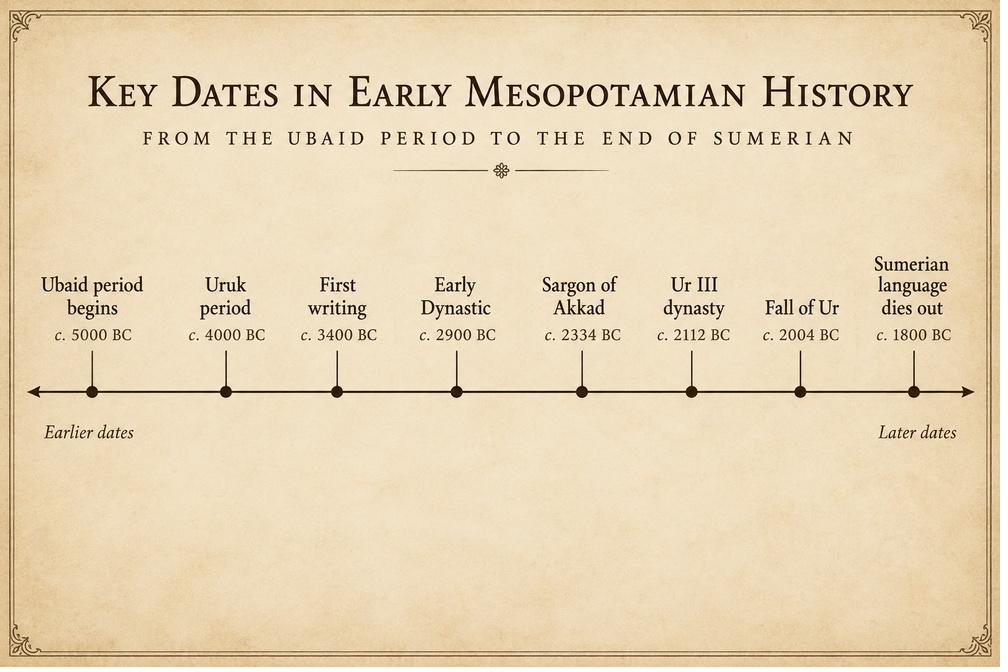
The latest dated cuneiform tablet that we have, an astronomical text from Babylon dated to about 75 CE, includes Sumerian elements alongside its Akkadian. Within a generation or two thereafter, the entire tradition collapsed; the temples that had supported it were closed or abandoned, the priests dispersed, the schools dissolved, and the language that the Sumerians had spoken on the alluvial plain three thousand years earlier was finally lost. It would not be heard again until the nineteenth century, when European scholars, working through the Akkadian-Sumerian bilingual lists in the libraries of Nineveh and elsewhere, slowly recovered enough of the language to begin reading its texts.
A few specific moments in this long afterlife deserve mention. The Old Babylonian period (roughly 1900 to 1600 BCE) was the great age of Sumerian-language literature in its classical form, even though Sumerian was no longer being spoken: the major literary compositions that we now think of as the canonical Sumerian corpus were edited, copied, and transmitted in the schools of Nippur, Ur, Larsa, Isin, Sippar, and Babylon during this period, with the resulting tablets constituting the bulk of our surviving evidence for Sumerian literature. The Kassite period (roughly 1600 to 1155 BCE) saw a partial decline in literary activity but a continuation of the scribal tradition under royal patronage, with the great series tablets — multi-tablet compilations of literary, religious, and divinatory material — being assembled in their canonical forms during these centuries.
The Neo-Assyrian period (911 to 612 BCE) saw the great library of Ashurbanipal at Nineveh, which collected and preserved much of the cumulative cuneiform tradition, including substantial sections of Sumerian literature alongside the more abundant Akkadian material. The Neo-Babylonian period (626 to 539 BCE) and the subsequent Achaemenid Persian period (539 to 331 BCE) saw the continuation of Sumerian literary and religious copying in the temples of Babylon, Borsippa, Sippar, and Uruk, with the priests of Nabu at Borsippa and the priests of Anu at Uruk being particularly active in the late preservation of the older traditions.
The Hellenistic period (331 BCE onward) saw the gradual collapse of the cuneiform tradition, although a small but determined community of priestly scholars continued to produce cuneiform tablets, including astronomical observations and ritual texts, well into the first century CE. The last datable cuneiform tablet, an astronomical text from Babylon, dates to about 75 CE, and within a generation thereafter the entire tradition disappeared. The political world of Sumer had ended in 2004 BCE, but Sumerian itself had survived for another two millennia in the institutions of its successors, and the cultural legacy it transmitted to those successors would, as we shall see, continue to ripple outward for thousands of years more.
5000 BC Ubaid period begins 4000 BC Uruk period 3400 BC First writing 2900 BC Early Dynastic 2334 BC Sargon of Akkad 2112 BC Ur III dynasty 2004 BC Fall of Ur 1800 BC Sumerian dies out Earlier Later Timeline of Sumerian civilisation
Chapter 12 — The Legacy of Sumer
The Sumerian world, as a political and cultural entity, has been gone for four thousand years. The last king of the Third Dynasty of Ur died in Elamite captivity in 2004 BCE; the Sumerian language ceased to be spoken some centuries later; the cuneiform script that the Sumerians had invented was finally abandoned in the first century CE; the cities themselves slowly returned to the desert dust from which their bricks had been made. By the time the Roman emperors held court on the Tiber, southern Mesopotamia was already an ancient land of forgotten ruins, its inhabitants speaking Aramaic and worshipping different gods, its mounds bearing the names of half-remembered legend rather than the names of the cities that had once flourished there.
By the time of the Crusades, no one in Europe or in the Near East could read a cuneiform tablet, and the very existence of the Sumerians had been entirely forgotten. They became one of those vanished peoples whose ghosts haunt only the deep margins of literate memory. And yet, in a paradox that runs through all serious thought about the Sumerian inheritance, this lost civilization has shaped the everyday life of every literate person in the modern world more thoroughly than almost any other ancient culture. The thesis was articulated most influentially in the mid-twentieth century by Samuel Noah Kramer, the great American Sumerologist whose career at the University of Pennsylvania spanned half a century, in his popular book History Begins at Sumer.
Kramer's catalogue of Sumerian "firsts" included writing, schools, codes of law, bicameral political assembly (or its precursor), proverbs, a literature of personal mourning, the figure of the suffering hero who acquires wisdom through loss, the personalized prayer, the city lament, the love song, the catalog as an organizing principle, taxes, organized agriculture on a large scale, recorded medical practice, mathematical astronomy, the predictive use of astronomy in calendrical reckoning, and dozens more. Some of Kramer's claims have been refined or contested by subsequent scholarship; some of his "firsts" are now seen as having parallel or even earlier developments elsewhere in the ancient world.
But the basic point remains. In one way or another, almost everything that we associate with civilization in its formal sense — writing, codified law, the school, sustained literature, organized science — has its earliest documented appearance in the Sumerian record. The most direct legacy of Sumer in our daily lives is the system of measurement we use for time and angle. The Sumerian sexagesimal numeral system, with its base of sixty, gave us the sixty-second minute, the sixty-minute hour, the twelve double-hours that subdivide the day, the three hundred sixty-degree circle, and the sixty arc-minute degree.
When you set the timer on your microwave, you are using a system that emerged on the alluvial plain of southern Iraq five thousand years ago. When you measure an angle, you are using their geometry. When you read a clock face, you are reading a Sumerian invention, refined and transmitted through Babylonian, Greek, Roman, Arab, and medieval European intermediaries, but in its bones recognizably the same system that the temple scribes of Uruk used to count their barley sacks. The seven-day week, although technically a Babylonian rather than Sumerian innovation, was built on Sumerian astronomical foundations and reflects the seven major celestial bodies that the Sumerians and their successors observed: the sun, the moon, and the five planets visible to the unaided eye.
The twelve-month lunar calendar, with its intercalary thirteenth month inserted at intervals to keep the months in alignment with the solar year, is descended from the Sumerian original through Babylonian and Hebrew refinement. The intellectual legacy is broader still. The literary genres of myth, epic, hymn, lament, and wisdom literature, in roughly the form in which we recognize them in the older books of the Hebrew Bible, are continuous in their development with the Sumerian originals. The Flood narrative that we know from Genesis, with the hero warned by his god, the building of an ark, the survival of a remnant on the rising waters, the sending out of birds to find dry land, the eventual landing on a mountain, and the divine covenant against future destruction, is closely modeled, sometimes nearly verbatim, on the Mesopotamian Flood narrative that appears in the Sumerian Eridu Genesis, in the Akkadian Atrahasis, and in tablet eleven of the Akkadian Epic of Gilgamesh.
The dependence is not in doubt; the parallels are too close, and the chronological order — Sumerian first, then Babylonian, then Hebrew — is too clear, for any other interpretation. The biblical Tower of Babel is a folk memory of one or more of the Mesopotamian ziggurats, with its theme of human pride and divine confusion of tongues echoing the long-standing Mesopotamian idiom of monumental architecture as a meeting point between earth and heaven. The biblical Eden, with its garden, its rivers flowing out in four directions, its tree of life and tree of knowledge, has parallels in the Sumerian myth Enki and Ninhursag, set in the paradisiacal land of Dilmun where pain and aging do not exist.
The biblical Jubilee, with its periodic cancellation of debts and freeing of slaves, is a direct descendant of the Mesopotamian institution of andurarum or mesharum, which the Sumerian and Babylonian kings periodically proclaimed for the same purposes. The influence ran beyond the Hebrews into the wider Mediterranean world. The Greek poet Homer, working in the eighth century BCE, almost certainly knew at least some of the Mesopotamian literary tradition through the long centuries of Eastern-Greek contact, and modern scholarship has found numerous parallels between the structure and motifs of the Iliad and the Odyssey on the one hand and the Akkadian epic tradition on the other.
The figure of Gilgamesh, with his half-divine origin, his monstrous companion, his journey beyond the ordinary boundaries of the world in search of immortality, and his eventual return with hard-won wisdom, has clear echoes in the figure of Odysseus and in the broader tradition of the heroic quest. The Greek mathematician Pythagoras, who lived around 530 BCE, almost certainly absorbed elements of his mathematical and astronomical knowledge from Babylonian sources, possibly during travels in the East; the relationships of musical proportion that he made central to his philosophy were known in Babylonian musical theory long before.
The Greek astronomers and astrologers of the Hellenistic period, particularly those working at Alexandria, drew heavily on Babylonian astronomical observations and methods that had been transmitted through long centuries of cuneiform tradition. The Babylonian historian Berossus, writing in Greek around 280 BCE, transmitted to his Hellenistic readers a substantial summary of Mesopotamian history, mythology, and astronomy, much of it reaching back to Sumerian originals; his work survives only in fragments quoted by later authors, but those fragments make clear that the Greeks were aware, in considerable detail, of the cultural depth of the civilization that lay behind Babylon.
After the political death of Sumer and the cultural absorption of its inheritance into the Babylonian, Assyrian, and Hellenistic worlds, the active memory of the Sumerians themselves slowly faded. The Greek and Roman authors of the late ancient world had little knowledge of the deep antiquity of Mesopotamia. The Bible mentions Babylon repeatedly but knows nothing of Sumer as such. The early Christian and Muslim scholars of late antiquity and the medieval period understood that there had been an ancient civilization in the region, but they had no way to read its texts and no clear sense of its institutions or its history.
The mounds that covered the ruins of Sumerian and Babylonian cities were known to local inhabitants and to passing travelers, but they were merely landscape features, ascribed to vague legendary builders, plundered occasionally for bricks to build modern villages, and otherwise left alone. The European rediscovery of Mesopotamia began only in the late eighteenth and early nineteenth centuries, as Western diplomats, traders, and scholars began to penetrate the Ottoman territories that included modern Iraq. The pioneer was Claudius Rich, a young Englishman who served as East India Company resident at Baghdad from 1808 until his early death in 1821.
Rich was a polymath who taught himself a dozen languages, collected manuscripts, and produced the first scholarly accounts of the ruins of Babylon, Nineveh, and several other major Mesopotamian sites. His Memoir on the Ruins of Babylon, published in 1815, was the first systematic European study of any Mesopotamian site, and his collection of manuscripts and antiquities, purchased after his death by the British Museum, formed the nucleus of the British collection of Mesopotamian materials. The serious archaeological exploration of Mesopotamia began in the 1840s with the work of two roughly simultaneous expeditions.
Paul-Émile Botta, French consul at Mosul, dug in 1843 at a mound called Khorsabad, just north of Nineveh, and uncovered the great Assyrian palace of Sargon II, with its remarkable winged bulls and elaborate relief sculptures. Austen Henry Layard, a young Englishman whose original interest had been the discovery of overland routes to India, began excavating in 1845 at the great mounds of Nimrud and Nineveh, where he uncovered a stunning sequence of Assyrian palaces, including the palace of Ashurnasirpal II at Nimrud and, eventually, the great Library of Ashurbanipal at Nineveh.
The library, recovered between 1849 and 1854, contained tens of thousands of cuneiform tablets, including substantial sections of the Akkadian Epic of Gilgamesh, the Enuma Elish, and a vast collection of mythological, religious, divinatory, mathematical, and astronomical texts. Layard's books on his excavations, particularly Nineveh and Its Remains (1849), were international bestsellers and brought Mesopotamian archaeology to a wide popular audience for the first time. It was from the Library of Ashurbanipal that the most famous discovery of nineteenth-century cuneiform studies emerged. In 1872, George Smith, a self-taught British Assyriologist who had begun his career as a banknote engraver and who worked at the British Museum reconstructing fragmentary tablets, was sorting through unread fragments from the Layard collection when he came across a tablet describing the survival of a hero on a great boat through a catastrophic flood.
Smith recognized immediately that he had found a Babylonian version of the biblical flood story. He announced his discovery to the Society of Biblical Archaeology in December 1872, in a public lecture that caused an immediate sensation. The London Daily Telegraph offered the British Museum funding for a return expedition to the site, in the hope of recovering missing fragments of the tablet, and Smith was sent in 1873. Astonishingly, within a few days of beginning to dig, he found a fragment that supplied a missing portion of the same tablet, expanding our knowledge of the flood narrative substantially.
Smith's career was cut short by his early death of dysentery in 1876, on a return expedition, but his work made the Babylonian flood story one of the most famous discoveries in the history of biblical and ancient Near Eastern studies. The independent recognition that there were even older Mesopotamian flood narratives in Sumerian, distinct from the Akkadian version, would come in the next several decades. The recognition of the Sumerians as a separate and earlier civilization came through the patient work of philologists rather than archaeologists. As the cuneiform tablets accumulated in European museums and were gradually published, scholars began to notice that some texts, particularly older ones, were written in a non-Semitic language quite different from the Akkadian whose decipherment had been completed in the 1850s.
Lexical lists in particular, the bilingual columns of words that ancient scribes had used to teach the older language to their students, made clear that this older language existed and that the Akkadians themselves had recognized it as the speech of an earlier civilization. In 1869, the French scholar Jules Oppert, working with materials from Lagash and elsewhere, proposed the name "Sumerian" for the language and the people who had spoken it, deriving the term from the Akkadian word Shumeru, "Sumer," which appears in cuneiform texts as the name of the southern part of Mesopotamia.
The proposal was contested for a time — some scholars argued that the supposedly Sumerian texts were actually a cryptographic version of Akkadian rather than an independent language — but by the 1890s the existence of Sumerian as a distinct, earlier language and the existence of the Sumerian people as a distinct, earlier civilization had been established beyond serious doubt. The major American contribution to early Sumerology was the great expedition to Nippur, organized by the University of Pennsylvania and conducted in four campaigns between 1888 and 1900. Under the directorship of John Henry Haynes, Hermann Hilprecht, and others, the Pennsylvania team excavated the great religious capital of Sumer and recovered tens of thousands of cuneiform tablets, including, crucially, the bulk of what would become the corpus of Sumerian literary texts.
Many of the Nippur tablets had been buried in the rubble of the temple's scribal school and contained school exercises, mythological narratives, hymns, laments, and wisdom texts in Sumerian. The deciphering of these tablets, conducted over the next several decades by Hilprecht, by Stephen Langdon, by Edward Chiera, and by many others, gradually revealed the existence of a substantial Sumerian literature that had been entirely unknown to Western scholarship a generation before. Samuel Noah Kramer, working primarily with the Pennsylvania collection from the 1930s through the 1980s, was the great popularizer and integrator of this material, and his many books — From the Tablets of Sumer (1956), History Begins at Sumer (1959), The Sumerians (1963), and others — brought Sumerian literature into the consciousness of educated readers throughout the Western world.
The most spectacular and influential single archaeological campaign on a Sumerian site was the joint British Museum and University of Pennsylvania expedition to Ur, conducted by Leonard Woolley between 1922 and 1934. Woolley arrived at Ur in 1922, the same year in which Howard Carter discovered the tomb of Tutankhamun, and his work over the following twelve seasons would produce a body of discovery that, in the public imagination of the 1920s and 1930s, was second only to Carter's. Woolley uncovered the great Ziggurat of Ur and its surrounding sacred precinct, partially restoring the lower terrace and the front staircase.
He excavated the Royal Cemetery, a vast burial ground on the southeast edge of the city in which sixteen tombs of unusual richness contained, among other treasures, the headdress and personal jewelry of Queen Puabi, the bull-headed lyres, the Standard of Ur, the Ram in the Thicket cult stand, the helmet of Meskalamdug, the Royal Game of Ur, and a vast inventory of further objects. Woolley dug down through the long stratigraphic sequence of Ur's history, identifying a thick layer of water-laid silt at one level which he interpreted as the deposit of the great Sumerian flood — a controversial interpretation that has not, on the whole, been sustained by subsequent analysis, but which captured the public imagination at the time.
He excavated entire residential quarters of the city, including a remarkable street of Old Babylonian houses preserved up to first-floor height, providing one of the few opportunities to see ordinary Mesopotamian domestic life as it had actually been lived. He also published, in a steady stream of academic and popular volumes, a series of accounts of his discoveries that brought Ur into the popular imagination as one of the great ancient cities of the world. Woolley collaborated, in his later seasons, with the archaeologist Max Mallowan, who would later become the second husband of the novelist Agatha Christie; Christie herself spent considerable time at Mallowan's later excavations and used Mesopotamian settings in several of her detective novels.
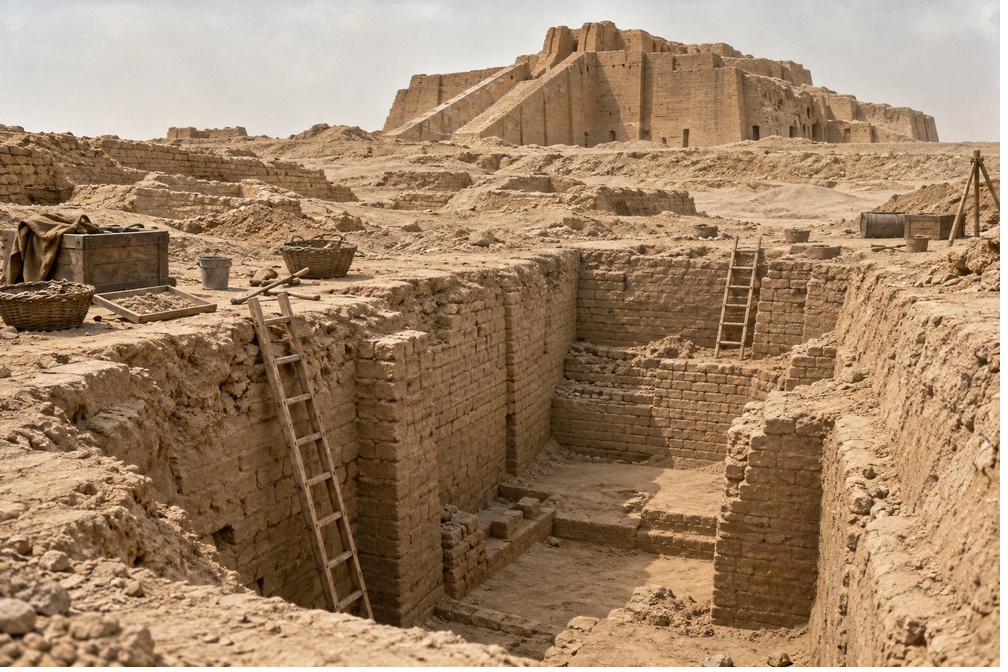
Other major Sumerian sites were excavated during the same general period. The French expedition under Ernest de Sarzec at Tello, the modern name for ancient Girsu of Lagash, ran from 1877 well into the twentieth century and recovered a vast quantity of material, including the diorite statues of Gudea. The German expedition to Uruk, beginning in 1912 and continuing intermittently for the rest of the twentieth century, excavated the Eanna and Anu precincts and produced a long series of detailed studies of the city's stratigraphy. Eridu, Lagash itself, Shuruppak, and many other sites were dug in greater or lesser detail by various national expeditions throughout the twentieth century.
By the late twentieth century, the basic outline of Sumerian archaeology had been established, although many sites remained partially or wholly unexplored, and individual mounds continued to yield significant discoveries. The political turmoil of the late twentieth and early twenty-first centuries has had a devastating impact on Mesopotamian heritage. The Iran-Iraq War of the 1980s, the Gulf War of 1991, the comprehensive sanctions of the 1990s, and the American invasion of 2003 with its long aftermath of insurgency, civil war, and the rise and fall of ISIS — all of these episodes have caused enormous damage to archaeological sites, museums, and ongoing research.
The looting of the Iraq Museum in Baghdad in April 2003, in the chaos that followed the American occupation of the city, resulted in the loss of perhaps fifteen thousand objects, including some of the most important pieces of the museum's Sumerian collection. The international response to the looting led, over the following decade, to the recovery of approximately half of the stolen objects, but many of the most spectacular pieces, including some Sumerian and Akkadian sculptures and seals, remain missing or have been destroyed. Illicit excavation of archaeological sites, particularly in the unprotected southern marshes, continued throughout the period of disorder and produced an ongoing flood of unprovenanced cuneiform tablets, cylinder seals, and small antiquities onto the international art market, much of it eventually traceable to looting at major Sumerian sites.
The destruction by ISIS, between 2014 and 2017, of monuments at Nimrud, Nineveh, Hatra, Mosul, and elsewhere — including the deliberate dynamiting of stone reliefs in the Mosul Museum and at Nimrud — affected primarily Assyrian rather than Sumerian sites, but the loss to the broader Mesopotamian heritage was incalculable. The marshes of southern Iraq, the last remaining living link to the Sumerian environment, suffered a different kind of damage. Beginning in the 1990s, the regime of Saddam Hussein deliberately drained the marshes through a system of canals and dykes designed to depopulate the region and punish the Marsh Arab community, who had supported the post-Gulf War Shia uprising.
By 2002, less than ten percent of the original marsh ecosystem remained. The Marsh Arab population, which had numbered perhaps half a million in the 1950s, was reduced to a few tens of thousands. After 2003, with the fall of Saddam, the local population began to break the dykes and reflood the marshes, and the international community contributed to a partial restoration. By the early 2020s, perhaps half of the original marsh area had been recovered, and a significant fraction of the displaced population had returned. The reed villages, the boats, the buffaloes, the long-tailed birds, the dawn light on the watery channels — all of these have to a substantial extent come back, and a visitor to the southern marshes today can see something close to the landscape that the Sumerians knew, with a continuity of human practice in reed-building and water-management that goes back, in some lines of evidence, more than five thousand years.
Modern Sumerology, despite all of these difficulties, remains a vibrant discipline. The work of decipherment is far from finished. Of the perhaps half-million cuneiform tablets that have been excavated and brought into museum collections worldwide, only a fraction have been fully read and published; backlogs in major collections are vast, and the careful work of transliteration, translation, and contextual interpretation continues at a steady pace. The digital revolution has accelerated the work substantially. The Cuneiform Digital Library Initiative, based at UCLA and now in collaboration with the University of California at Berkeley and the University of Tübingen, hosts an open online corpus of more than three hundred thousand transliterated and partially translated tablets, with high-resolution photographs of many of them.
The Electronic Text Corpus of Sumerian Literature at Oxford has digitized the major Sumerian literary compositions in transliteration, English translation, and substantial scholarly apparatus. Three-dimensional scanning of tablets, the use of structured-light photography to reveal worn signs, the application of machine learning to sign recognition and the joining of fragments — all of these are increasingly part of the working toolkit of Sumerologists in the twenty-first century. New tablets continue to come out of the ground from licensed and unlicensed excavations alike, and the integration of newly recovered texts into the established corpus continues to refine our understanding.
A particular thread of the Sumerian inheritance that deserves separate notice runs through the history of education itself. The institution of the school as a place where children were systematically trained in reading, writing, arithmetic, and a body of received literary tradition was, in its earliest documented form, the Sumerian edubba. The structure of the edubba — with its master and assistants, its graduated curriculum, its discipline, its testing, its prizes for the diligent and beatings for the slovenly, its gradual progression from elementary signs to advanced literary copying — established a basic model of formal schooling that would, in modified forms, run through Babylonian, Assyrian, Hellenistic, Roman, medieval European, Islamic, and modern educational traditions.
The continuities are not always direct, and there are obvious differences between the edubba and a modern school, but the basic conception that the transmission of literate culture is the work of dedicated institutions staffed by professional teachers, and that the young must be removed from the productive economy for some period of years to undergo this training, traces back ultimately to the scribal schools of southern Mesopotamia. The very word "school" comes through Latin schola from Greek schol■, originally meaning "leisure," but the institutional shape behind the word is older than any of these languages, and its earliest documented examples are Sumerian.
The recovery of Sumerian medical knowledge in modern times has been a slow but rewarding process. The medical compendia, with their elaborate descriptions of symptoms, prognoses, and treatments, have been edited and translated piece by piece across the twentieth century, and the resulting picture has revealed a tradition of considerable empirical sophistication beneath the conventional religious and demonological framework that initially obscured its rationality. Specific Sumerian and Babylonian medical observations have been confirmed by modern research; the use of willow bark for fevers, with its accidentally rediscovered active ingredient salicylic acid, is the most famous example, but it is far from the only one.
Sumerian and Babylonian recognition of the role of unclean water in the spread of certain diseases, of the importance of wound cleaning in healing, of the basic principles of bone-setting and joint manipulation, and of the diagnostic value of careful observation and case comparison anticipated, in their core insights, the empirical medicine of much later periods. The Mesopotamian medical tradition was not "modern" in any anachronistic sense, but it was a sophisticated body of practical knowledge developed over many centuries of accumulated experience, and its rediscovery has been one of the more interesting threads of modern Sumerological and Assyriological scholarship.
What does Sumer mean, in the end? The question is broad enough to admit many answers, but a single observation may serve to anchor them. The basic structures of literate civilization — cities, writing, codified law, organized religion with permanent professional priests, sustained literature, theoretical mathematics, observational astronomy, formal education, long-distance commerce financed by credit, the standardized measurement of time and angle, the institutional separation of religious and political authority — appear, in their earliest documented forms, on the alluvial plain of southern Mesopotamia in the late fourth and third millennia BCE.
They appear there not in isolated fragments but in articulate combination, growing out of and feeding into one another, in a single coherent civilization that we call Sumerian. The achievement of the people who built that civilization is one of the deepest in human history. We are, in countless ways, their cultural descendants, even when we have no idea that they ever existed. Every clock face we glance at, every law code we cite, every epic we read, every long division we perform, every brick we lay, every prayer we offer, every weight we measure carries something of their work in it.
To remember the Sumerians, even briefly, even imperfectly, is to recognize a debt that we did not choose but cannot escape; and to recognize, in that recognition, that we are continuous with a human past far older and richer than the few thousand years of recorded history that any one person carries in active memory. The mounds of southern Iraq still hide, beneath their flat brown surfaces, the unread tablets and the unexcavated bricks of cities whose names we know but whose detailed lives we still do not. Some part of who we are, today, in the twenty-first century, was first articulated there, by people whose own names and faces we can no longer recover.
We owe them, at minimum, our attention. The Sumerians did not know that they were founding a civilization whose echoes would still be heard five thousand years later. They were people doing the work of their own time, building their cities, raising their children, fighting their wars, writing their laws, telling their stories. Their sense of their own historical position was, no doubt, quite different from ours; they did not see themselves as the first of anything, but as the present generation of an ancient society reaching back into the dim antediluvian past of their King List.
That we now read them as founders is, in some sense, a category they would not themselves have used. But the recognition is justified by the evidence. They did, in fact, build the first cities, write the first books, codify the first laws, school the first children in formal academic settings, observe the first systematic astronomy, and accumulate the first detailed economic records. The world they made was the matrix from which all subsequent literate civilizations of the western half of Eurasia, in some genealogical fashion, descend. The land between the rivers gave us our beginning.
We are still walking, in many senses, on its inherited soil. The work of remembering them is itself an act of cultural recovery, undertaken patiently across generations of scholars and slowly extending its reach into the wider literate culture of our own time. Each new translation, each new excavation, each new digital corpus brings them, by small increments, more fully back into the conversation of which they were once the founders. The recovery is not finished, and may never be. Tablets remain unread in museum drawers; sites remain unexcavated under the dust of southern Iraq; whole genres of Sumerian literature are known to us only from passing references in later texts.
The Sumerians, even as we know them better than we did a century ago, retain their share of mystery, and the work of meeting them more fully continues. To the extent that we attend to it, the deepest layer of our own civilization gradually becomes more legible to us, and we ourselves more legible to ourselves. Cylinder seal impression — presentation scene