Almost Nothing
A History of the Atom, from Democritus to Dark Energy
For my family —
Marie, Trisha, Dave & Andy.
Preface
This book has one subject and one promise. The subject is the atom — the idea, the object, the inventory, the instrument and the demoted minority constituent it has by stages been revealed to be. The promise is that everything between these covers can be followed by a reader who once sat a Leaving Certificate higher-level physics or chemistry paper, however many years ago, and has since let the details lapse. No prior reading is assumed; no mathematics beyond multiplication and rough orders of magnitude is used in the text; and where a technical term cannot be avoided it is defined where it first appears and again, in plain language, in the glossary at the back.
What the book is not is a textbook. Textbooks teach to a syllabus and reward the dutiful; this book follows a story and rewards the curious. Its eighteen chapters move in three movements. Part I — History traces the atom from a Greek philosophical guess, through alchemy’s furnaces and Lavoisier’s balance, to the bombshell sequence of 1895–1932 in which the supposed indivisible turned out to contain electrons, a nucleus, isotopes and the first manufactured chain reaction. Part II — Anatomy opens the modern atom and looks inside: electron clouds and the periodic table’s hidden logic; quarks, gluons and the nucleus that is mostly bound energy; the Standard Model’s elegant and incomplete inventory; how atoms combine into chemistry and materials; how nuclei transform and what the stars do with them; and how single atoms have, in living memory, become objects we can image, manipulate and address one at a time. Part III — Frontiers reports from the present moment: the manufacture of superheavy elements and the parallel pursuit of fusion power; the conversion of the atom into computer, sensor and instrument; the cosmic audit that finds ordinary atomic matter to be a five-per-cent minority of the universe; the speculations about layers beneath the quark; and a final inventory of the questions still open at the bottom of everything.
A word about the figures. Every chapter carries four — photographs where a photograph illustrates, schematic diagrams where a diagram does the conceptual work, and a small handful of quantitative charts rendered from real data. Where labels appear in a diagram they are part of physics’ standard notation (Greek letters for radiation; standard subshell names; axis labels for charts), not narrative captions. The captions sit beneath each figure and carry the storytelling load.
A word about what the book attempts. A Brief History of Almost Nothing tries to be the kind of book this subject deserves: serious without being dry, honest about what is known and what is not, generous in its credit (especially to the women whose work was for too long credited to others), patient with the reader new to the material, and unwilling to substitute the argument from elegance for the argument from measurement. Some of its frontier chapters will date faster than the rest; an appendix and a timeline mark the dates so the reader can calibrate. Some of its judgements — about which speculative ideas deserve weight, about which open questions matter most — are exactly the judgements that, twenty years from now, will look quaint. That is the price of writing from inside the story rather than after it; it is also part of the pleasure.
A reader who finishes the book should be able to hold up a single gold ring, as Chapter 1 invites them to, and answer the oldest question in physics — does the cutting ever stop? — with the best science of the twenty-first century, and know exactly where that science currently stops, and why.
Claude.ai
June 2026
Part I — History
Chapter 1 — The Invisible Idea
“By convention sweet, by convention bitter; in truth, atoms and the void.” — Democritus of Abdera, c. 420 BCE
The ring that never ends
Take off a gold ring — or imagine one — and consider a strange question. Suppose you had a knife of impossible sharpness and infinite patience. Cut the ring in half. Cut one of the halves in half. Keep going. Each piece is smaller than the last, but each piece is still, unmistakably, gold. The question is simple to ask and was, for more than two thousand years, impossible to answer: does the cutting ever have to stop?
There are only two possible answers, and they describe two completely different universes.
In the first universe, the answer is no. Gold is gold all the way down: a smooth, continuous substance that can be divided forever, the way a line on a page can always, in principle, be divided into shorter lines. Matter, in this universe, is like an idea — it has no smallest piece.
In the second universe, the answer is yes. Somewhere far below the limits of sight, the knife meets a final particle of gold — a grain so small that to cut it would be to destroy it, turning it into something that is no longer gold at all. In this universe, everything you have ever touched is grainy. The smoothness of water, the softness of skin, the seamless gleam of polished metal — all of it is an illusion produced by particles too small and too numerous for our senses to register, the way a photograph in a newspaper dissolves into separate dots when you look closely enough.
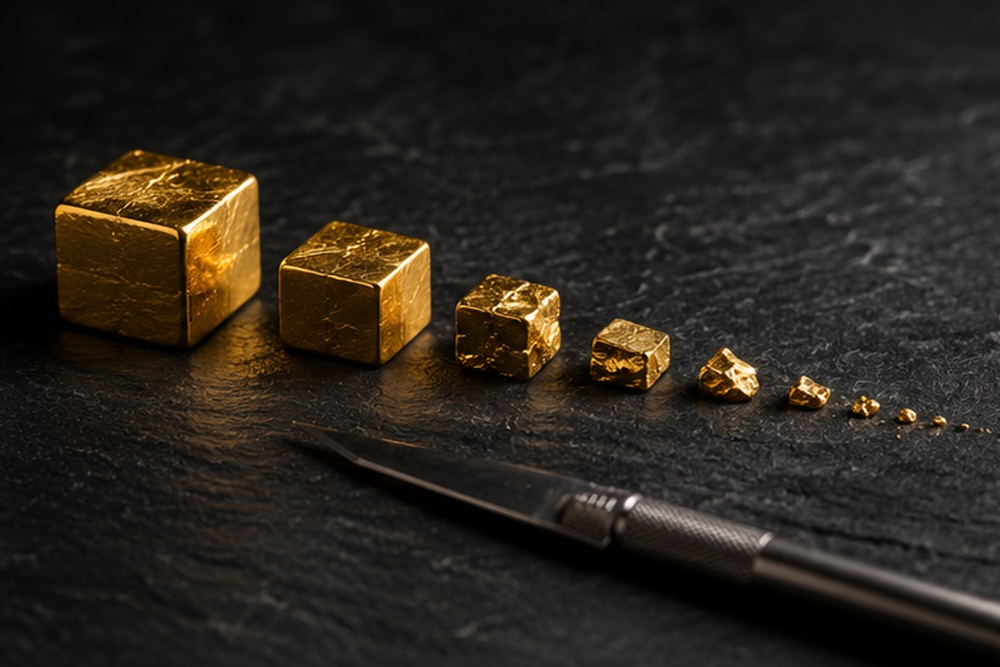
Figure F01-01. Cut a piece of gold in half, and in half again, and each fragment is still gold. The oldest question in physics: does the halving ever have to stop?
This book is the story of how we discovered that we live in the second universe — and of the still more astonishing discovery that came after. Because when we finally found the grain of gold, the atom, and looked inside it, we found that it was almost entirely empty. The atom is a vast, hollow arena: a speck of dense matter at the centre, a few impossibly light particles whirring at its distant edges, and between them — nothing. If an atom were scaled up to the size of a cathedral, its nucleus would be a fly hovering above the altar, and the rest would be void. Every solid thing you have ever leaned on is, by volume, about 99.9999999999996 per cent empty space.
That is the “almost nothing” of this book’s title. The history of the atom is the history of humanity slowly realising that the solid world is built from emptiness — and that the emptiness is the most interesting part.
But the story does not begin with an experiment. It begins, as so much does, with the Greeks, an argument, and a man they called the laughing philosopher.
The question that started everything
Around 600 BCE, in the prosperous Greek trading city of Miletus on the coast of what is now Turkey, a handful of thinkers began doing something genuinely new. Instead of explaining the world through the moods of gods, they asked whether nature might run on rules — and whether, beneath the dizzying variety of things, there might be one underlying stuff from which everything else is made.
Their answers look quaint now, but the question was revolutionary. Thales, the first of them, proposed that everything was ultimately water — not absurd, when you consider that water is the only common substance the Greeks saw routinely turning solid, liquid and vapour. His successor Anaximenes preferred air, which he imagined thickening into wind, cloud, water, earth and stone. Heraclitus championed fire, the very embodiment of change. Around 450 BCE, Empedocles offered a compromise that would prove fatefully popular: not one fundamental stuff but four — earth, water, air and fire — mingling in different proportions to make everything from bone to bronze.
What matters is not which substance each thinker backed. What matters is the shared, radical assumption underneath: that the world’s variety is a surface, and that something simpler and more unified lies beneath it. Every chapter of this book — through Dalton’s atoms, Rutherford’s nucleus, the quark, and the modern hunt for a final theory — is a continuation of that one Milesian hunch.
There was, however, a serious problem brewing, and it was a problem of pure logic. A philosopher named Parmenides argued, with maddening rigour, that change itself was impossible. Nothing, he reasoned, can come from nothing; and nothing that exists can become nothing. Therefore the world must be a single, eternal, unchanging whole — and the change we see all around us must be an illusion of the senses. Few people genuinely believed this (Parmenides’ own student Zeno defended it with his famous paradoxes), but nobody could quite refute it either. Greek thought needed a way to explain how the world could be eternally lawful and visibly changing at the same time.
The answer, when it came, was one of the great ideas in human history.
The laughing philosopher
Sometime around 440 BCE, a thinker named Leucippus — so shadowy a figure that almost nothing is known about his life — proposed a solution, which his student Democritus of Abdera developed into a complete system. Democritus, born around 460 BCE, was said to be cheerful to the point of legend; later tradition named him “the laughing philosopher,” supposedly because human folly amused him. He travelled widely, wrote some seventy works on everything from ethics to geometry, and lived, by most accounts, past ninety. Of all those books, not one survives intact. We know his ideas only through fragments quoted by other authors — many of them critics trying to refute him.
His solution to Parmenides ran like this. Suppose the world is made of two things, and two things only: tiny, solid, uncuttable particles, and the empty space they move through. The particles themselves never change — there is Parmenides’ eternal, indestructible being. But they are forever moving, colliding, hooking together and breaking apart — and that is change. Nothing is ever created or destroyed; things are merely rearranged. A tree grows, a man dies, iron rusts, wine sours: all of it, said Democritus, is nothing but particles regrouping in the void.
He called the particles atomos — Greek for “uncuttable” — and the word, mangled gently by time into atom, has survived twenty-four centuries.
KEY CONCEPT — What “atom” meant, and what it means now To Democritus, atomos meant a particle that cannot be divided, even in principle: the hard floor at the bottom of the gold-cutting experiment. The word has stuck, but the meaning has shifted under it. The things we now call atoms turned out to be very much divisible — they have internal parts, and splitting them reshaped the twentieth century. Today “atom” means the smallest unit of a chemical element that still behaves as that element: the smallest possible piece of gold that is still gold. The truly uncuttable particles, if they exist, lie further down — and they are the destination of this book’s final chapters.
The detail of Democritus’ system is startlingly modern in spirit. His atoms came in countless shapes and sizes, and the properties of substances arose from the shapes, arrangements and motions of their atoms — not from any inner essence. Iron is hard, he suggested, because its atoms are jagged and tangle together; water flows because its atoms are smooth and round and slip past one another; salt tastes sharp because its atoms are spiky. The details are wrong, but the kind of explanation is exactly the one modern science gives. Hardness, fluidity and taste really are consequences of how atoms are shaped, arranged and bound — as we will see properly in chapter 11.
And this led Democritus to his most radical claim, preserved in the fragment at the head of this chapter. Sweetness, bitterness, colour, warmth — these, he said, exist “by convention”: they are experiences created in us, not properties residing in the things themselves. Out there, in truth, there are only “atoms and the void.” It is hard to overstate how far ahead of its time this is. It anticipates by more than two millennia the modern understanding that colour is the brain’s response to wavelengths of light, and taste its response to molecular shapes. The world of our senses is a kind of translation — vivid, useful, and not at all like the original.
One more feature of the atomists’ universe deserves notice: the void itself. For atoms to move, there must be empty space for them to move into. Democritus therefore asserted, flatly, that vacuum exists — that “nothing” is a real feature of the world. This sounds innocuous. It was, in fact, the single most controversial part of the whole theory, and the point on which atomism would be attacked for the next two thousand years.
Why the atom lost
It is one of history’s larger ironies that the atom — the most successful scientific idea ever proposed — was decisively rejected almost as soon as it appeared, and stayed rejected for two millennia. To understand why, you have to meet the man who defeated it: Aristotle.
Aristotle of Stagira (384–322 BCE) was very probably the most influential thinker who ever lived. Student of Plato, tutor of Alexander the Great, he wrote authoritatively on logic, biology, ethics, politics, poetry and physics, and his works became the backbone of education in Europe and the Islamic world for centuries. When medieval scholars wrote simply “the Philosopher,” no name was needed.
Aristotle examined atomism carefully and rejected it on three main grounds.
First, the void. Empty space, Aristotle argued, was not just absent from nature but logically impossible — a genuine vacuum would be “nothing,” and nothing cannot have properties like size or location. He reasoned, too, that a body moving through a true void, with nothing to resist it, would move infinitely fast, which seemed absurd. Nature, in the famous later slogan of his medieval followers, abhors a vacuum. (Hold on to that phrase; its downfall, in a dramatic seventeenth-century experiment involving two teams of horses, will mark the atom’s return.)
Second, the senses. Matter looks and feels continuous. Water pours smoothly; metal polishes to a seamless shine. Aristotle, ever the biologist and observer, preferred to trust appearances over invisible speculation. In his physics, the world below the Moon is made of Empedocles’ four elements — earth, water, air and fire — each a genuine continuum, infinitely divisible, with no smallest part. Each element carries pairings of four basic qualities (hot, cold, wet, dry), and one element can transform into another when its qualities change. This, note, is a theory with real explanatory appeal: it accounts for boiling, burning and condensation in a tidy scheme, and it holds out the promise that one substance might be converted into another — a promise on which alchemy would later be founded.

Figure F01-02. Earth, water, air and fire — Aristotle’s four continuous elements. An elegant, intuitive and wrong picture of matter that ruled Western thought for two thousand years.
Third — and this objection did the deepest damage — purpose. In Democritus’ universe, atoms collide blindly, and everything that exists, including us, is the unplanned outcome of mechanical motion. Aristotle’s universe, by contrast, is saturated with purpose: things have natural places and natural ends; acorns strive to become oaks. A purposeless, mechanical cosmos struck Aristotle as not merely false but unserious. Later, when atomism was adopted and extended by Epicurus (341–270 BCE) — who taught that the gods, if they existed, took no interest in human affairs, that there was no afterlife, and that the sensible aim of life was tranquil pleasure — the atom acquired a permanent association with atheism. For Christian, Muslim and Jewish scholars alike through the medieval centuries, atomism was not just bad physics; it was dangerous company.
So the atom lost. Not because anyone disproved it — nobody could, just as nobody could prove it — but because it lost the argument on philosophical points to an opponent of overwhelming authority. Aristotle’s four elements became the theory of matter for two thousand years.
KEY CONCEPT — A guess is not a theory It is tempting to say Democritus was “right” and Aristotle “wrong,” and in a sense that’s true. But notice what neither side had: a test. No observation available to the Greeks could distinguish a world of atoms from a world of continuous elements. Both pictures explained everyday experience equally well. Democritus’ atomism was a brilliant philosophical guess — but a guess with no way of being checked is not yet science. The whole story of this book’s first part is the slow, two-thousand-year construction of tools and methods — the balance, the sealed flask, controlled measurement — that finally turned the oldest question in physics into one that experiment could answer. Being right is not enough; you have to be able to show it.
The atom survived its long exile thanks largely to a poem. Around 55 BCE the Roman writer Lucretius set out the entire Epicurean system — atoms, void, the natural origin of worlds, the mortality of the soul — in six books of magnificent Latin verse, De Rerum Natura (“On the Nature of Things”). The poem itself then nearly suffered the fate of Democritus’ books. It vanished from circulation for centuries, surviving in a handful of neglected monastery copies, until in 1417 an Italian book-hunter named Poggio Bracciolini found a manuscript in a German monastic library and had it copied. The timing was perfect: Renaissance Europe was newly hungry for ancient learning, and the printing press was about to make books unkillable. Lucretius’ poem put the atom back into circulation among educated Europeans — as poetry, as scandal, and eventually as a hypothesis.
The long detour through alchemy
Between Aristotle and the Renaissance lies a period in the atom’s story that is easy to mock and hard to do justice to: the age of alchemy.
The popular image — a bearded mystic in a smoky cellar, muttering incantations over a crucible, trying to turn lead into gold — is not exactly false. Transmutation of base metals into gold really was a central alchemical goal, alongside the elixir of life and the philosopher’s stone, the master substance supposed to accomplish both. And alchemy really was soaked in secrecy, allegory and mysticism; its texts are deliberately obscure, written in coded language about green lions and red kings, partly to guard trade secrets and partly because alchemists genuinely saw their work as spiritual as much as material.
But dismiss alchemy and you dismiss the laboratory itself. Modern chemistry did not spring from philosophy; it sprang from the alchemist’s bench, and it inherited that bench fully equipped.
Consider what alchemy was actually doing, century after century, while the philosophers argued. In Hellenistic Egypt, practitioners like Zosimos of Panopolis (around 300 CE) were already describing distillation apparatus. In the Islamic world, which preserved and hugely extended Greek learning while Europe’s libraries crumbled, the tradition associated with Jabir ibn Hayyan (eighth century) and the Persian physician al-Razi (ninth) systematised laboratory practice: classifying substances by their properties, describing procedures so that others could repeat them, and refining the essential techniques — distillation, sublimation, crystallisation, dissolution, filtration — that remain the daily grammar of chemistry. The very words betray the lineage: alchemy itself from the Arabic al-kīmiyā, and from Arabic too come alkali, alcohol, elixir, alembic.
Medieval and Renaissance European alchemists, building on translated Arabic texts, learned to prepare the mineral acids — sulfuric, nitric, hydrochloric — substances vastly more corrosive than the vinegar that had been antiquity’s strongest acid, and the indispensable solvents of every laboratory since. Alchemists isolated and described new substances by the dozen. In 1669, in the most famous single alchemical discovery, the German alchemist Hennig Brand — boiling down enormous quantities of urine in search of the philosopher’s stone — instead produced a waxy substance that glowed in the dark: phosphorus, the first element ever discovered by a known, named individual, rather than inherited from antiquity.

Figure F01-03. The alchemist’s workshop: furnace, alembics, retorts and endless distillations. The goals were fantasy; the equipment and technique became the foundations of chemistry.
Notice, too, that alchemy’s central dream — transmutation — was not stupid. It was orthodox Aristotelian science. If all substances are blends of the four elements and their qualities, then changing lead into gold is merely a matter of adjusting the recipe: no more miraculous, in principle, than turning water into steam. The alchemists failed not because they were fools but because they were working from a false theory of matter. (There is a delicious postscript: transmutation is real. Atoms of one element can be converted into atoms of another — it happens in stars, in reactors, and it has even been done, at preposterous expense, to make microscopic quantities of gold. But it requires reaching into the atom’s nucleus, a realm the alchemists could not have touched. That story belongs to chapters 7 and 12.)
In the early 1500s the flamboyant Swiss physician Paracelsus redirected alchemy toward medicine, arguing that its true purpose was making remedies, not gold, and proposing his own trio of principles — salt, sulfur and mercury — to supplement or supplant the four elements. His followers, the iatrochemists (“medical chemists”), pushed laboratory practice into pharmacy and, slowly, toward respectability. By 1600 Europe was thick with practical chemical knowledge — and entirely without a theory of matter that could organise it. The stage was set.
The corpuscular revival
The seventeenth century is rightly called the age of the Scientific Revolution: the century of Galileo, Kepler, Descartes, Boyle and Newton, when systematic experiment and mathematical law replaced inherited authority as the tests of truth. For our story, it is the century the atom came back — wearing a new name, and armed, for the first time, with experiments.
The respectable revival came by two routes. The French priest and philosopher Pierre Gassendi (1592–1655) carefully rehabilitated Epicurean atomism for a Christian audience: atoms, he argued, were not eternal and self-moving but created by God and set in motion by Him — purposeless mechanism replaced by designed mechanism. Meanwhile René Descartes built his own grand system in which all physical phenomena were explained by particles of matter pushing one another — though Descartes, agreeing with Aristotle that void was impossible, packed his universe completely full and denied that his particles were indivisible. To blur these doctrinal differences, seventeenth-century writers favoured the neutral word corpuscle — “little body” — over the philosophically loaded atom. The corpuscular philosophy, in one flavour or another, swept educated Europe.
What gave it teeth was the vacuum.
Recall that Aristotle’s physics required the void to be impossible — and that Democritus’ required it to be real. Here, at last, was a point where the two ancient pictures disagreed about something testable. In 1643 the Italian mathematician Evangelista Torricelli, a student of Galileo’s, filled a glass tube with mercury, stoppered it, and upended it into a basin of mercury. The column fell — but only partway, leaving a gap at the sealed top of the tube. What was in the gap? Air could not have entered. Torricelli’s answer was as bold as Democritus’: nothing was in it. He had made a vacuum on a tabletop, and in the process invented the barometer, for the height of the mercury column measured the weight of the atmosphere pressing on the basin. In 1648 Blaise Pascal’s brother-in-law carried a Torricelli tube up a mountain, the Puy de Dôme, and watched the column drop as the air above grew thinner — proof that we live at the bottom of an ocean of air with empty space, not Aristotle’s plenum, above it.
Then came the showman. Otto von Guericke, mayor of Magdeburg in Germany, invented the air pump — a device for sucking the air out of sealed vessels — and in 1654 staged one of the great demonstrations in scientific history. He fitted together two copper hemispheres, half a metre across, pumped out the air, and invited two teams of horses to pull them apart. Sixteen horses, straining in opposite directions, could not separate two bowls held together by nothing — nothing but the pressure of the surrounding atmosphere pushing on a void. Nature, it turned out, did not abhor a vacuum in the least. A two-thousand-year-old certainty died in front of a cheering crowd.
KEY CONCEPT — Why the vacuum mattered so much The vacuum debate was never really about empty space for its own sake. It was the load-bearing wall of two rival universes. If void is impossible, matter must fill everything, and the continuous elements of Aristotle stand. If void is real, then there can be space between particles — and the graininess of matter becomes possible, even natural. Torricelli’s tube and Guericke’s hemispheres did not prove atoms existed. But they demolished the strongest ancient argument against them, and they did it with public, repeatable experiment rather than philosophical reasoning. The method was as revolutionary as the result.
In England, the wealthy and pious Robert Boyle (1627–1691) — a practising alchemist, as it happens, who hunted the philosopher’s stone in private all his life — had a far better air pump built by his brilliant assistant Robert Hooke, and used it to put the new physics of air on a quantitative footing. Boyle trapped air and squeezed it, and found a beautifully simple regularity: halve the space available to a quantity of air and its pressure doubles; squeeze it into a third of the space and the pressure triples. Air behaves, Boyle suggested, like a crowd of tiny springs, or particles in restless motion, that push back harder the more closely they are confined. It is hard to picture a continuous substance doing this; it is the easiest thing in the world to picture particles doing it. (The full particle explanation of pressure — countless corpuscles drumming on the container walls — would be worked out properly two centuries later, as we shall see.)

Figure F01-04. The air pump: glass receiver, brass cylinder and piston. With instruments like this, the void stopped being a philosophical scandal and became a laboratory tool.
Boyle’s most lasting blow for the atom, though, was a book: The Sceptical Chymist (1661). In it he attacked both the Aristotelian four elements and Paracelsus’ three principles, on the simple, devastating ground that nobody had ever actually extracted earth, air, fire and water — or salt, sulfur and mercury — from real substances in the laboratory. If “elements” meant anything, Boyle argued, it should mean substances that chemical analysis cannot break down any further, whatever those turn out to be — and finding them was a job for experiment, not ancient books. With that, the word element acquired something close to its modern meaning: not a cosmic principle, but a practical, testable category. The hunt for the true elements was open. It would take more than a century, and its triumph — the periodic table — awaits us in chapter 3.
The century closed with the corpuscular philosophy wearing its grandest endorsement. Isaac Newton, whose laws of motion and gravitation had reduced the heavens to clockwork (and who, like Boyle, devoted years of secret labour to alchemy), made no secret of his conviction that matter was particulate. In his Opticks he speculated that God had formed matter at the creation as solid, hard, impenetrable, movable particles — so hard as never to wear out or break. Light too, Newton argued, was a stream of corpuscles. If the greatest scientific authority alive believed in particles, particles were respectable.
Where things stood in 1700
Pause, then, at the turn of the eighteenth century, and take stock — because the position is stranger than it first looks.
The atom — rebranded as the corpuscle — had won the philosophical war. Vacuum had been demonstrated. Aristotle’s elements had been discredited. Air visibly behaved like a swarm of particles. Nearly every leading natural philosopher in Europe assumed matter was grainy.
And yet, in the strict sense, there was still not one shred of evidence that atoms existed. No experiment had counted them, weighed them, or measured them. No one had the faintest idea how big an atom might be, what one element’s atoms had to do with another’s, or what held them together. The corpuscular philosophy explained everything in general and nothing in particular; you could invoke particles of any convenient shape and size to “explain” any observation after the fact, which is another way of saying the idea made no predictions at all. Two thousand years after Democritus, his guess was now fashionable — but it was still a guess.
What changed everything, in the century that followed, was not a better argument but a better instrument, and it was almost comically humble: the weighing balance. The realisation that the path to the invisible led through the relentless, precise weighing of ordinary substances — that you could count what you cannot see by weighing what you can — belongs to the next chapter, and to a French aristocrat with an exquisite laboratory, a brilliant wife, and an appointment with the guillotine.
Chapter 2 — Weighing the Unseeable
“Nothing is created, nothing is destroyed; everything is transformed.” — attributed to Antoine Lavoisier
The instrument of revolution
Revolutions are supposed to begin with manifestos, barricades, visionaries. The revolution that finally made atoms real began with a weighing scale.
Not an ordinary one. By the late eighteenth century, the finest instrument-makers of Paris and London could build balances of breathtaking sensitivity — twin brass pans hanging from a knife-edge beam inside a glass case to keep out draughts, capable of registering a change of less than a thousandth of a gram. A balance like that cannot see an atom, of course; a thousandth of a gram of gold still contains around three million million million of them. But it can do something subtler. It can enforce bookkeeping. If you weigh everything that goes into a chemical change, and everything that comes out, with enough precision and enough stubbornness, then matter can no longer hide what it is doing. The invisible world leaves fingerprints on the visible one — in the weights.

Figure F02-01. The precision balance: twin pans on a knife-edge beam, cased in glass against draughts. The unglamorous instrument that made the invisible world keep honest accounts.
To appreciate what the balance overthrew, you need to meet the theory that ruled chemistry when the eighteenth century opened: phlogiston.
Phlogiston theory, developed in Germany by Johann Becher and Georg Stahl around 1700, was a serious and rather elegant attempt to explain fire. Why do things burn? Because, said the theory, combustible materials contain a fiery substance — phlogiston, from the Greek for “burnt” — which escapes into the air as flame. Wood is rich in phlogiston; burn it and the phlogiston streams away, leaving lifeless ash. Heat a metal strongly and it loses its phlogiston too, crumbling into a powdery calx (what we would call an oxide — rust is one). Charcoal, supposedly brimming with phlogiston, could even donate it back: roast a calx with charcoal and the shiny metal is reborn. The theory tied together burning, rusting and breathing — a candle in a sealed jar gutters out, the theory said, because the trapped air becomes saturated with phlogiston and can absorb no more.
It explained a great deal. It had one small problem, known almost from the start and shrugged off for decades: when a metal burns and supposedly loses its phlogiston, the calx left behind weighs more than the metal did. Something escaping should leave things lighter. Defenders improvised — perhaps phlogiston had negative weight, a buoyancy that lifted the substances containing it — and chemistry carried on. As long as chemists trusted qualities (colour, smell, combustibility) over quantities, the contradiction could be lived with.
The lesson of this chapter is what happened when one man decided that the weights were not a detail. The weights were the whole story.
A new kind of air
First, though, the supporting cast — because the eighteenth century’s great chemical discovery, before anyone could explain it, was that air is not one thing.
To the Greeks and to everyone since, air had been a single element: the invisible, weightless background of the world. Then, in the 1750s in Scotland, a meticulous young chemist named Joseph Black showed that ordinary substances — chalk, magnesia — could be made to release a gas that was definitely not air: it extinguished flames, it suffocated mice, and (his crucial demonstration) it could be weighed, captured, and put back. He called it “fixed air” because it had evidently been fixed inside the solid. Today we call it carbon dioxide. The discovery was a thunderclap: gases were not one elemental air but a whole family of distinct, weighable chemical substances.
Others followed eagerly. In England, the reclusive and fabulously wealthy Henry Cavendish isolated “inflammable air” — a gas so light it seemed almost not to be there, which burned with a pale flame and, as he later showed in one of the century’s most consequential experiments, produced pure water when burned. (Water — Aristotle’s primal element — was therefore not an element at all, but something made.) We call Cavendish’s gas hydrogen, “the water-maker.” And in 1774 Joseph Priestley, a dissenting English clergyman with a genius for experiment, used a large burning-lens to heat a brick-red powder — the calx of mercury — and collected from it a gas with extraordinary properties. A candle burned in it with unnatural brilliance; a mouse sealed in it stayed lively long after ordinary air would have been exhausted. Priestley, a loyal phlogistonist, reasoned that this air supported burning so eagerly because it was empty of phlogiston and thirsty for it, and named it “dephlogisticated air.”
In October 1774, passing through Paris, Priestley described his new air over dinner to a French chemist of his acquaintance. It was, in retrospect, one of the most expensive dinner conversations in the history of science — because the Frenchman listening was Antoine Lavoisier, and Lavoisier understood, as Priestley never quite did, what the discovery actually meant.
The twelve days of mercury
Antoine-Laurent Lavoisier had everything: a fortune (earned, fatefully, as a partner in the Ferme Générale, the private syndicate that collected taxes for the French crown), the finest private laboratory in Europe, and a formidable scientific partner in his wife, Marie-Anne Paulze Lavoisier, who learned English to translate the British chemists for him, kept the laboratory records, and engraved the meticulous illustrations for his books. He had, above all, a conviction: that chemistry would never be a science until it submitted to the balance. Nothing in his laboratory went unweighed.
His masterpiece was an experiment of magnificent patience. Lavoisier placed a measured quantity of mercury in a glass retort whose long, curved neck arched up into a bell jar standing over a bath of mercury, so that the air trapped inside the apparatus was sealed off from the world and its volume could be read. Then he lit the furnace and kept the mercury just below boiling — for twelve days.
Slowly, flecks of red calx formed on the silvery surface. And slowly — this was the point of the whole elaborate arrangement — the trapped air shrank. By the end, about a fifth of the air had vanished, and what remained was strange stuff: a candle drowned in it, a mouse could not live in it. Part of the air, evidently, had been consumed in the burning; the remainder (mostly what we now call nitrogen) took no part.
Then came the counterstroke. Lavoisier collected the red calx and heated it fiercely. It gave back its gas — and the gas it released was Priestley’s “dephlogisticated air,” supporting flame and life with vigour. The quantities matched. Burning was not the release of a mysterious fire-substance. Burning was combination: the metal had been seizing something out of the air, roughly a fifth of it, and that something could be taken back out of the calx again. The mysterious extra weight of the calx was no paradox — it was the weight of the captured gas, sitting in the pan of the balance, demanding to be explained.

Figure F02-02. Lavoisier’s sealed mercury experiment: a sealed world of glass in which nothing could enter or escape unweighed. Twelve days of gentle heat killed the theory of phlogiston.
Lavoisier named the active fifth of the air oxygène, and around it he rebuilt the whole of chemistry. Combustion, rusting and respiration were all, he showed, the same process: combination with oxygen. (Breathing, he demonstrated with the mathematician Laplace, is a slow combustion — we are all, chemically speaking, gently on fire.) Phlogiston — a substance with no weight, or negative weight, that no one had ever isolated — he dismissed as a phantom the science no longer needed.
And beneath the specific discoveries lay the principle that made them possible, the principle Lavoisier elevated into the foundation stone of chemistry.
KEY CONCEPT — Conservation of mass In any chemical change, however dramatic — burning, dissolving, explosion — the total amount of matter does not change. Weigh everything before (including any gases) and everything after (including any gases), and the books balance exactly. Matter is neither created nor destroyed; it only changes partners. This is why sealed vessels were the making of chemistry: only in a closed system can the accounting be trusted. And notice what the principle quietly implies. If matter is never created or destroyed but only rearranged, then matter behaves exactly as if it were made of permanent little units being shuffled. Lavoisier himself refused to speculate about atoms — he considered them beyond the reach of experiment. But his great law was the atom’s opening argument.
In 1789 — the year the Bastille fell — Lavoisier published his Elementary Treatise on Chemistry, the first modern chemistry textbook. In it he defined an element exactly as Boyle had urged: any substance that analysis cannot break down further. He listed thirty-three of them. The list is endearingly imperfect — it includes light and “caloric” (heat, which he wrongly took to be a substance), and several entries like lime that were later broken down after all — but some two dozen of his elements stand in the periodic table today, and the method of the list was flawless: an element is not a philosophical principle but a current experimental fact, a standing challenge to future chemists to break it down if they can.
Lavoisier did not live to see what his revolution became. In the Terror of 1794, the revolutionary government turned on the hated tax syndicate, and Lavoisier went to the guillotine with his fellow tax-farmers on a May afternoon, aged fifty. The mathematician Lagrange mourned that severing that head had taken an instant, but a century might not produce another like it. Marie-Anne, who lost her husband and her father to the same blade in the same hour, survived to publish Antoine’s final memoirs. The new chemistry, by then, could not be killed: it had crossed every border in Europe.
Fixed recipes
The next clue came from a quieter man in a quieter setting. Joseph Proust, a French chemist working in Spain, spent years analysing compounds — substances made of more than one element — and noticed something that sounds almost too simple to matter: a given compound always contains its elements in exactly the same proportions by weight, no matter where it comes from or how it is made.
Copper carbonate from a Siberian mine and copper carbonate synthesised in a Madrid laboratory have precisely the same recipe. Water is always, everywhere, about one part hydrogen to eight parts oxygen by weight — never one to seven and a half, never one to nine. Nature, it seemed, did not blend elements freely like a cook adjusting a sauce; it followed fixed recipes, to the last decimal place.
This was not obvious, and it was not uncontested — the eminent French chemist Claude-Louis Berthollet argued for years that compounds could vary continuously in composition, citing solutions and alloys (which can indeed vary, because they are mixtures, not true compounds — the distinction the debate itself helped sharpen). Proust’s careful analyses won. By about 1808 the law of definite proportions was established: true compounds have fixed elemental ratios.
Pause on how strange that is, if matter is continuous. If elements were smooth, infinitely divisible stuffs, you could surely blend them in any proportions whatever, the way you can mix paint. Why should nature permit one-to-eight and flatly forbid one-to-eight-and-a-bit? Fixed ratios are what you expect from counting, not from blending — the way a bicycle factory uses exactly two wheels per frame, never 2.1. Matter was behaving as if compounds were assembled from indivisible units in fixed numerical combinations.
It took a self-taught schoolteacher from the English north to say so out loud.
The Manchester Quaker
John Dalton is one of the unlikeliest figures ever to stand at the centre of a scientific revolution. Born in 1766 to a poor Quaker weaver in the Lake District, he began teaching school at twelve, never attended a university (as a religious dissenter, Oxford and Cambridge were closed to him anyway), and spent his working life giving private lessons in Manchester. He kept a daily weather diary for fifty-seven years, to the day he died. He was the first person to describe colour blindness scientifically — his own; he reportedly once scandalised fellow Quakers with stockings he believed to be sober grey and everyone else could see were scarlet. The condition is still sometimes called Daltonism.
It was the weather that led him to atoms. Puzzling over the atmosphere — why don’t its gases settle into layers, heavy below and light above? how does water vapour ride among them? — Dalton came to think of gases as swarms of distinct particles, and began to wonder about the particles’ weights. And here he saw what no one had quite seen before: that the chemists’ weight laws, Lavoisier’s and Proust’s, were exactly what a world of atoms would produce — and that they could be used to put numbers on the atoms themselves.
Between about 1803 and 1808, in his New System of Chemical Philosophy, Dalton laid out the theory. All matter is made of atoms, which can be neither created, destroyed nor split. All atoms of a given element are identical to one another — in particular, identical in weight — and different from the atoms of every other element. Compounds are formed when atoms of different elements join in simple whole-number ratios: one of this with one of that, or one with two, or two with three. Chemical reactions do nothing but regroup atoms.
Twenty-three centuries after Democritus, the claims sound similar — but the difference is everything. Democritus’ atoms explained the world in general; Dalton’s made specific, numerical, checkable claims. If water is made of hydrogen and oxygen atoms in a fixed pairing, and water is one part hydrogen to eight parts oxygen by weight, then an oxygen atom must weigh a definite number of times more than a hydrogen atom. The absolute weight of an atom was beyond any instrument — but the ratios of atomic weights were sitting in the chemists’ notebooks, waiting to be extracted. Dalton set hydrogen, the lightest known substance, equal to 1, and began building the first table of relative atomic weights in history.

Figure F02-03. Dalton’s atoms as solid spheres: minute spheres differing in weight from element to element and combining in simple whole numbers — chemistry as the arithmetic of invisible balls.
And the theory promptly made a prediction — the most beautiful of its early career. Suppose two elements can combine in more than one way, as carbon and oxygen do (one combination is the poisonous gas of charcoal burners; the other is Black’s fixed air). If compounds are built from whole atoms, then the different combinations must differ by whole atoms — there is no such thing as half an atom of oxygen. So take a fixed weight of carbon, and compare the weights of oxygen it captures in the two compounds: those weights should stand in a simple whole-number ratio. They do — exactly two to one. One compound, we now know, pairs each carbon atom with one oxygen atom; the other, with two. Dalton found the same neat arithmetic wherever two elements formed multiple compounds: the oxides of nitrogen, the gases of marsh and oil. Nature kept multiplying by small whole numbers.
KEY CONCEPT — Why whole numbers betray atoms Smooth, continuous quantities don’t do whole numbers. Weigh the rainfall in your garden over different storms and you will get any values whatever — 8.3, 11.71, 14.062 — never a parade of exact 1:2:3 ratios. Whole numbers appear when things are counted: wheels on bicycles, eggs in cartons, atoms in molecules. Proust’s fixed recipes and Dalton’s law of multiple proportions showed that chemical combination is counting, not blending. This remains the deep signature of the atomic world, and it will return again and again in this book — in the whole-number charges of the nucleus, the whole-number steps of the quantum atom, the whole numbers that organise the periodic table. Whenever nature insists on integers, look for something discrete underneath.
Dalton’s theory had, it must be said, a serious soft spot, and he knew it. The weight data tell you the ratio of weights in a compound, but not the count of atoms. Water is one to eight by weight, hydrogen to oxygen — but is a water molecule one hydrogen atom with one oxygen atom? Two hydrogens and one oxygen? Two and two? Each guess gives a different atomic weight for oxygen (eight, sixteen, or eight times the hydrogen, respectively). With no way to decide, Dalton fell back on a “rule of greatest simplicity”: assume the simplest formula — one atom of each. Water, for Dalton, was HO, and oxygen therefore weighed about eight hydrogens.
It was a reasonable guess. It was wrong — water is two hydrogens to one oxygen, and oxygen weighs about sixteen — and the error, multiplied through every compound containing hydrogen or oxygen (which is to say, most of them), seeded half a century of glorious confusion.
Trouble with volumes
The way out of the muddle appeared almost immediately — and was ignored for fifty years. It came from measuring gases not by weight but by volume.
In 1808 the French chemist Joseph-Louis Gay-Lussac (a man of some dash, who set a world altitude record ascending past seven thousand metres in a hydrogen balloon to sample the upper air) announced a striking regularity. When gases react, the volumes that combine — measured at the same temperature and pressure — stand in simple whole-number ratios. Two measures of hydrogen gas combine with exactly one measure of oxygen. One measure of hydrogen combines with exactly one of chlorine. The whole numbers again! — and in the volumes this time, which suggested something tantalising: that equal volumes of different gases might contain equal numbers of particles. If so, “two volumes of hydrogen to one of oxygen” would mean, directly, two hydrogen particles for every oxygen particle — and the riddle of water’s formula would be solved by reading it straight off the gas jars.
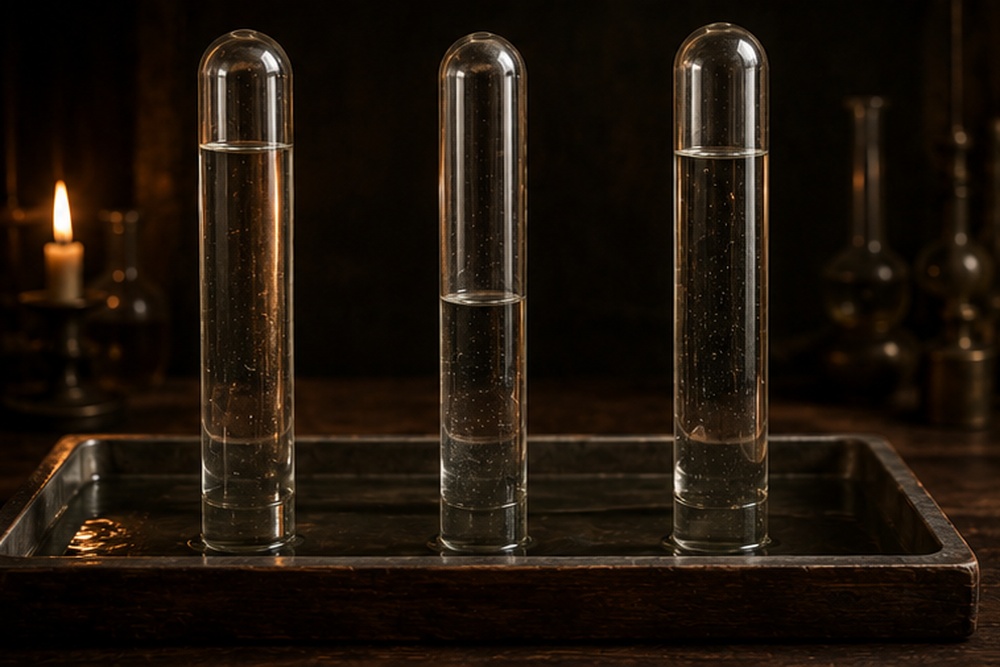
Figure F02-04. Combining gas volumes: gases combine in simple whole-number ratios — two of hydrogen to one of oxygen. The clue that equal volumes hold equal numbers of particles lay in plain sight for half a century.
Strangely, Dalton himself rejected the idea outright — he had convinced himself that particles of different gases must differ in size and so could not pack equally — and he questioned Gay-Lussac’s measurements rather than his own assumptions. (Great scientists earn no immunity from this disease; we shall watch Nobel laureates catch it in later chapters.) Worse, there was an apparently fatal objection. Burn two volumes of hydrogen with one of oxygen and you get two volumes of water vapour. But if each oxygen particle is a single atom, and equal volumes mean equal numbers, then one volume of oxygen contains only enough oxygen for one volume of water. To make two volumes of water vapour, every single oxygen atom would have to be cut in half — and the uncuttable atom was the theory’s first axiom.
The answer came in 1811 from Turin, from a quiet professor with a magnificent name: Lorenzo Romano Amedeo Carlo Avogadro. His insight was a distinction so simple that it is now taught to schoolchildren, yet it eluded the giants of the age: the particles of a gas need not be single atoms. Suppose the gas particles of elements like hydrogen and oxygen are pairs of atoms travelling together — two-atom molecules. Then the arithmetic comes out perfectly. Two volumes of hydrogen (each particle a pair of hydrogen atoms) meet one volume of oxygen (each particle a pair of oxygen atoms); each oxygen pair splits, donating one atom to each of two new water molecules; out come two volumes of water vapour, each particle made of two hydrogen atoms and one oxygen. Equal volumes, equal numbers — saved. Water — settled: H₂O. Oxygen’s atomic weight — sixteen, not eight. Every formula in chemistry — decidable, by combining weights with gas volumes.
KEY CONCEPT — Atom versus molecule An atom is a single particle of an element. A molecule is a cluster of atoms travelling and behaving as one unit — and it may cluster identical atoms (oxygen gas is O₂, two oxygen atoms paired) or different ones (water, H₂O). The free particles of most gases are molecules, not lone atoms. Until this distinction was accepted, “the weight of oxygen” was a hopelessly ambiguous phrase — did you mean the atom or the travelling pair, which weighs twice as much? Half a century of chemical chaos flowed from blurring these two words.
It is one of the sadder comedies in the history of science that essentially nobody listened. Avogadro was geographically and socially remote from the centres of chemistry, he published in a journal few chemists read, his terminology was tangled, and — most damningly — his molecules of paired identical atoms struck the age’s authorities as flatly impossible. The great Swedish chemist Jöns Jacob Berzelius, the most formidable analyst of the era, had built a persuasive theory in which atoms bind because opposite electrical characters attract; two identical atoms, alike in character, should repel like two north poles. So the pairing that made Avogadro’s arithmetic work was dismissed as a contradiction, and the hypothesis gathered dust.
Berzelius himself, it should be said, did heroic service to the atom in every other respect. Working through some two thousand compounds with legendary precision, he produced atomic weight tables of astonishing accuracy, and he gave chemistry its modern shorthand — replacing Dalton’s fussy circular pictograms with plain letters: H, O, C, Fe (from the Latin ferrum), with little numbers to count the atoms. Every chemical formula written since is in Berzelius’ hand.
Half a century of muddle
So chemistry entered its most productive and most confused half-century. The atomic theory worked — nobody could organise the torrent of new compounds without it — yet without Avogadro its central numbers were unfixed. Was water HO or H₂O? Was oxygen 8 or 16? Different schools adopted different conventions; some chemists, despairing of atoms altogether, retreated to purely practical “equivalent weights” and declared the atom a fiction of bookkeeping. By midcentury the same simple substance, acetic acid — the acid of vinegar — could be found written in the literature in well over a dozen different formulas. A young German chemist, August Kekulé (we will meet him again dreaming of carbon chains), called a conference.
The Karlsruhe Congress of September 1860 was the first international scientific conference ever held: some 140 chemists from across Europe, gathered to settle, if they could, what the words atom, molecule and atomic weight should mean. The meeting itself ended inconclusively, as meetings do. The revolution happened, fittingly, in the cloakroom. As the delegates dispersed, friends of a Sicilian chemist named Stanislao Cannizzaro handed out a pamphlet he had written two years earlier — a course outline in which Cannizzaro showed, with merciless clarity, that the half-forgotten hypothesis of his countryman Avogadro resolved every ambiguity at a stroke: take equal volumes to mean equal numbers, let elemental gases be paired molecules where the evidence demands, and every atomic weight and every formula falls into a single self-consistent system.
Read on the journey home, the pamphlet did what the conference could not. The German chemist Lothar Meyer said that as he read it, the scales fell from his eyes and certainty took the place of doubt. Within a few years Cannizzaro’s system — which is to say Avogadro’s, vindicated too late for him to enjoy it, for he had died in 1856 — was the common language of chemistry. Oxygen weighed sixteen. Water was H₂O. The numbers were real at last.
And among the delegates at Karlsruhe, pamphlet in pocket, was a fierce, shaggy young Russian on a government scholarship, twenty-six years old, who would take the newly trustworthy atomic weights home to St Petersburg and ask the next great question: now that we know the numbers — is there a pattern in them?
His name was Dmitri Ivanovich Mendeleev, and he is the subject of the next chapter.
One loose end, before we follow him. For all its triumphs, everything in this chapter — every weight, every ratio, every formula — was still indirect. No one had seen an atom, counted atoms, or measured one. A careful sceptic could still insist, and for decades distinguished sceptics did, that atoms were merely a convenient fiction: a calculating device that worked, with nothing necessarily real behind it. The final, knock-down proof that atoms exist — an experiment that effectively counted them by watching pollen grains jitter in water — would not arrive until the twentieth century was underway, delivered by a Swiss patent clerk in his spare time. That story is waiting in chapter 6. The chemists, meanwhile, stopped worrying about it. The atom paid its way too handsomely to be doubted.
Chapter 3 — The Grand Pattern
“I saw in a dream a table where all the elements fell into place as required.” — Dmitri Mendeleev, as he later recalled to a colleague
Too many elements
Science has a recurring nightmare, and it goes like this: the facts arrive faster than the understanding. By the 1860s, chemistry was living it.
When Lavoisier published his list in 1789, there were thirty-three candidate elements, several of them wrong. Then the discoveries began to pour in. The young Cornish showman-genius Humphry Davy, armed with the newly invented electric battery, used powerful currents to tear apart substances that had resisted every furnace — and out of molten potash and soda came two absurd new metals, potassium and sodium, soft as wax and so reactive they burst into flame on water. Within a couple of years Davy had added calcium, barium, strontium and magnesium to the roll. Electricity, it turned out, could dismantle compounds that fire could not.
Then came an even stranger tool: light. In 1859 the German chemist Robert Bunsen (of burner fame) and the physicist Gustav Kirchhoff discovered that every element, heated until it glows, emits its own unique pattern of coloured light — a set of sharp, bright lines, as individual as a fingerprint, revealed when the light is spread through a prism. The implications were spectacular in every sense. A pinch of unknown mineral in a flame could now announce its contents by colour alone; and within two years the new spectroscope had flushed out two elements nobody had ever suspected — caesium, named for the sky-blue of its lines, and rubidium, for the deep red of its. Most astonishing of all, in 1868 astronomers studying the light of a solar eclipse found a yellow line belonging to no known earthly substance: an element discovered on the Sun, ninety-three million miles before it was ever found on Earth. They named it helium, after the Greek sun god. (Hold those spectral fingerprints in mind, incidentally. Why each element shines its own private pattern of lines was a total mystery — and the answer, half a century later, would crack the atom itself open. That is chapter 5.)
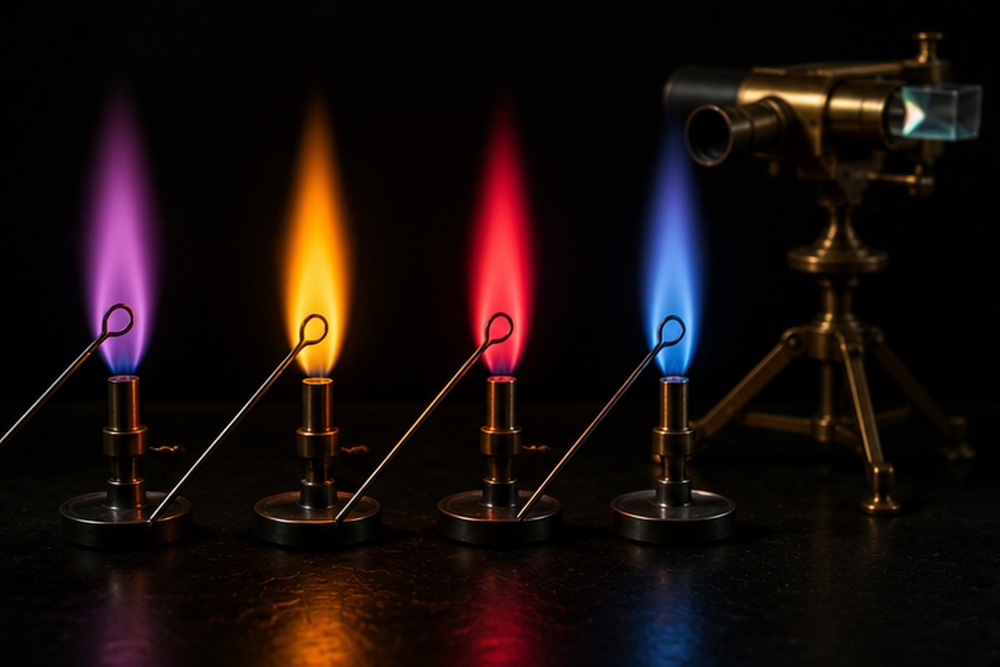
Figure F03-01. Every element burns with its own colours. Flame tests and the spectroscope turned light into a chemical fingerprint — and the roll of elements grew faster than anyone could explain.
By 1869 the count stood at sixty-three elements, and there was no rhyme or reason to them. Some were metals, some gases, one (bromine) a fuming red liquid. Their atomic weights — finally trustworthy after Karlsruhe, as we saw — ran from hydrogen’s 1 to lead’s 207 with no obvious logic. Chemistry possessed a magnificent zoo and no taxonomy: a heap of facts in search of a pattern. Students simply memorised the elements one by one, like irregular verbs.
Yet there were tantalising hints that the heap was not random. Certain elements were family. Chlorine, bromine and iodine — a yellow-green gas, a red-brown liquid, a violet-black solid — look nothing alike, yet behave like siblings: all are vicious reactives, all form near-identical salts with metals, all combine with hydrogen in the same one-to-one pattern. Lithium, sodium and potassium form another clan: soft, silvery, water-hating metals. As early as 1829 the German chemist Johann Döbereiner had noticed something eerie about such trios: in each, the middle element’s atomic weight fell almost exactly halfway between the other two. He called them triads. It smelled like arithmetic. Nobody could say arithmetic of what.

Figure F03-02. A family resemblance: chlorine gas, bromine liquid, iodine crystals. Different faces, identical chemical character — the kind of kinship that begged for an explanation.
The pattern hunters
With reliable atomic weights in hand after 1860, several people, in several countries, almost simultaneously began to suspect the same big thing: that if you lined the elements up in order of atomic weight, their chemical characters repeated at intervals — that the procession of elements was not a march but a waltz, circling back on itself.
History has been unkind to the near-missers, so let us be kind for a paragraph. In 1862 a French geologist, Alexandre-Émile Béguyer de Chancourtois, plotted the elements by weight along a spiral wrapped around a cylinder and noticed that similar elements stacked vertically above one another. He was first — and was ignored, partly because he was a geologist publishing for geologists, and partly because the journal printed his paper without the crucial diagram, rendering it incomprehensible. In 1865 an English sugar chemist, John Newlands, announced that when the elements were listed by weight, each one resembled the element eight places ahead — a “law of octaves,” he said, like the notes of a piano. At a meeting of the Chemical Society he was laughed at; one professor witheringly enquired whether he had tried arranging the elements alphabetically. The Society declined to publish his paper. (Twenty-two years later, the pattern by then world-famous under another man’s name, the same Society sheepishly awarded Newlands its Davy Medal.) And in Germany, Lothar Meyer — the chemist whose eyes had been opened by Cannizzaro’s pamphlet — was constructing element tables of his own through the 1860s that came within a whisker of the full discovery; his definitive version reached print in 1870, a few months too late.
A few months behind whom? Behind a Siberian with a temper, a textbook deadline, and a deck of cards.
The man from Tobolsk
Dmitri Ivanovich Mendeleev was born in 1834 in Tobolsk, deep in western Siberia, the last of a teacher’s enormous brood of children — around fourteen; accounts disagree, which tells you something about the household. Disaster struck early and repeatedly: his father went blind and died; the glass factory his mother Maria reopened to feed the family burned to the ground. Maria Mendeleeva then did something magnificent. Convinced that her youngest was exceptional, she took the teenaged Dmitri on a journey of thousands of kilometres across Russia — much of it by horse-drawn cart — to find him a university place. Moscow turned him away. St Petersburg accepted him into its Pedagogical Institute in 1850. Within months, her work done, Maria died. Mendeleev revered her memory for the rest of his life; decades later he dedicated a major scientific work to her, recalling her deathbed instruction to seek truth patiently and never through illusion.
The young man she launched grew into one of the unmistakable figures of nineteenth-century science: fierce, prodigiously bearded, hair to his shoulders (legend insists he had it cut once a year, in spring), expert on everything from the chemistry of petroleum to the protection of Russian industry, and equipped with a self-confidence that would shortly prove to be the indispensable scientific instrument of the age. In 1860, as a twenty-six-year-old on a state scholarship in Germany, he attended the Karlsruhe Congress and heard Cannizzaro set the atomic weights in order. By 1867 he held the chair of general chemistry at St Petersburg — and found, to his irritation, that there was no decent textbook in Russian to teach from. So he began writing one: The Principles of Chemistry. Which posed an author’s problem that turned out to be a scientific one. Sixty-three elements: in what order should the chapters go?
Chemical solitaire
The decisive day can be dated precisely, because the paperwork survives: 17 February 1869 by the Russian calendar (the first of March by ours). Mendeleev was due to leave St Petersburg that morning to inspect provincial cheese cooperatives — he was a man of many commissions — and the visit was postponed. Instead, over breakfast, he began scribbling element symbols and weights on the back of the letter that had brought the invitation. Then he took a stack of blank cards and made one for each of the sixty-three elements: name, atomic weight, signature properties. And he began to deal them out on the table, arranging and rearranging — by weight, by family, by valency — in a game his colleagues later called chemical solitaire. He worked through the day in a state of mounting obsession. By the account he gave a friend, he eventually fell asleep at his desk and saw the finished arrangement in a dream; awake, he wrote it down, finding only one correction necessary. However literally one takes the dream (scientists’ origin stories improve with age, and Mendeleev told this one years later), by that evening a single handwritten sheet existed bearing the title An Attempt at a System of the Elements, Based on Their Atomic Weights and Chemical Affinity. It went to the printers within days, and was presented to the brand-new Russian Chemical Society in March 1869.

Figure F03-03. Chemical solitaire: sixty-three cards, one per element, dealt and re-dealt until the pattern emerged. The periodic table was discovered at a desk, in a single furious day.
What was on the sheet? In essence, the same object that hangs in every chemistry classroom on Earth. Run through the elements in order of atomic weight, and chemical character repeats at regular intervals. Start at lithium, the soft water-fearing metal: count forward and the elements step from metal towards non-metal, arriving at fluorine’s family and then — abruptly — the cycle resets, and sodium appears, a near-twin of lithium, beginning the march again. Arrange the procession in rows so that each new cycle starts a fresh line, and the family resemblances snap into vertical alignment: Döbereiner’s triads, Newlands’ octaves and Meyer’s curves all turn out to be glimpses of one structure. The rows are called periods — hence the periodic table — and the columns are the families: the alkali metals down one edge, the halogens (chlorine’s clan) near the other.
KEY CONCEPT — Valency: an element’s combining power What exactly “repeats” along the periods? Above all, a number chemists call valency: how many partners an element’s atoms take in compounds. Hydrogen is the unit of the scale — it always takes one partner. Chlorine bonds with one hydrogen (so valency 1), oxygen grips two (valency 2: H₂O), nitrogen three (NH₃), carbon four (CH₄, the methane of natural gas). March along a period and the valencies step up and down in a regular drumbeat; every element in a column shares the same characteristic valency, which is why they form look-alike compounds. To Mendeleev this combining power was simply a brute fact about each element. What an atom could possibly contain that doles out its partnerships in neat integers — one, two, three, four — was a question the table posed and could not begin to answer. The answer (it will take us until chapter 8) turns out to involve the choreography of electrons; but in 1869 the electron had not been discovered, and the atom was still, officially, a structureless little ball.
Had Mendeleev stopped there, he would be remembered as the tidiest of the pattern-hunters — first among equals with Meyer, a maker of useful charts. What he did next is the reason his name is on the table, and it required nerve more than cleverness. He looked at his arrangement and noticed places where the pattern demanded an element and no known element fitted. A space below aluminium; a space below boron; a space below silicon. The timid response — the response of essentially everyone else — would have been to close the gaps and save the chart’s appearance. Mendeleev instead made the boldest move in the history of chemistry: he declared that the gaps were real. The pattern was right, and the world was incomplete. Three elements existed that no human being had ever seen, and the blank spaces in his table were their reserved seats.
Then he went further — much further. Reading along the rows and down the columns from each gap’s neighbours, he predicted the properties of the missing elements, in cold quantitative detail: their atomic weights, their densities, their melting behaviour, the formulas and characters of their oxides and chlorides, even the likelihood that one would first be detected by the spectroscope. He named them provisionally eka-aluminium, eka-boron and eka-silicon (eka, Sanskrit for “one”: one place beyond). And, the supreme touch of audacity: where a known element’s measured atomic weight clashed with the chemistry — tellurium, by weight, ought to come after iodine, yet by character it plainly belonged before — Mendeleev overruled the measurements, swapped the pair, and announced that the weights must have been determined wrongly. The pattern, he insisted, outranked the data.
KEY CONCEPT — Sticking your neck out Recall the lesson of chapter 1: a guess that cannot be checked is not yet science. Mendeleev’s gaps show the other half of that lesson. Any clever scheme can be massaged to fit the facts already known; the test of a deep pattern is whether it successfully forbids and demands — whether it makes claims about the not-yet-observed that could fail. Mendeleev’s predictions were gloriously vulnerable. If eka-aluminium turned up with the wrong density, or never turned up at all, his table was so much wallpaper. Risky predictions, made in public, with numbers attached: that is the gold standard of scientific confidence, and the periodic table is its textbook case — literally.
“Dear sir: kindly remeasure”
The world did not have to wait long. In 1875 a French chemist with the finest name in science, Paul-Émile Lecoq de Boisbaudran, examining a zinc ore from the Pyrenees with a spectroscope, spotted two faint violet lines belonging to no known element — exactly the mode of discovery Mendeleev had suggested. He isolated the new metal and named it gallium, for Gallia, France. (Colleagues noted that gallus is also Latin for “le coq,” the rooster, and have never stopped teasing; Lecoq denied everything.) Gallium proved to be a soft, silvery metal with a party trick: it melts at about thirty degrees, so a solid lump liquefies into mercury-like beads in the warmth of a human palm.
When the published measurements reached St Petersburg, Mendeleev checked them against his four-year-old prediction for eka-aluminium. Atomic weight: predicted about 68, measured 69 — excellent. Density: predicted 5.9; measured 4.7. And here occurred one of the great scenes of scientific history. Mendeleev wrote to the discoverer — in effect: the element you have found is my eka-aluminium; your density figure is wrong; kindly purify your sample and measure again. One can imagine how a letter from a Russian theorist who had never set eyes on gallium was received in the laboratory of the man who had discovered it. But Lecoq de Boisbaudran repeated the work with a purer specimen — and the density came out at 5.9. The pattern on a Petersburg desk had outperformed the discoverer’s own hands. Europe’s chemists sat up very straight.
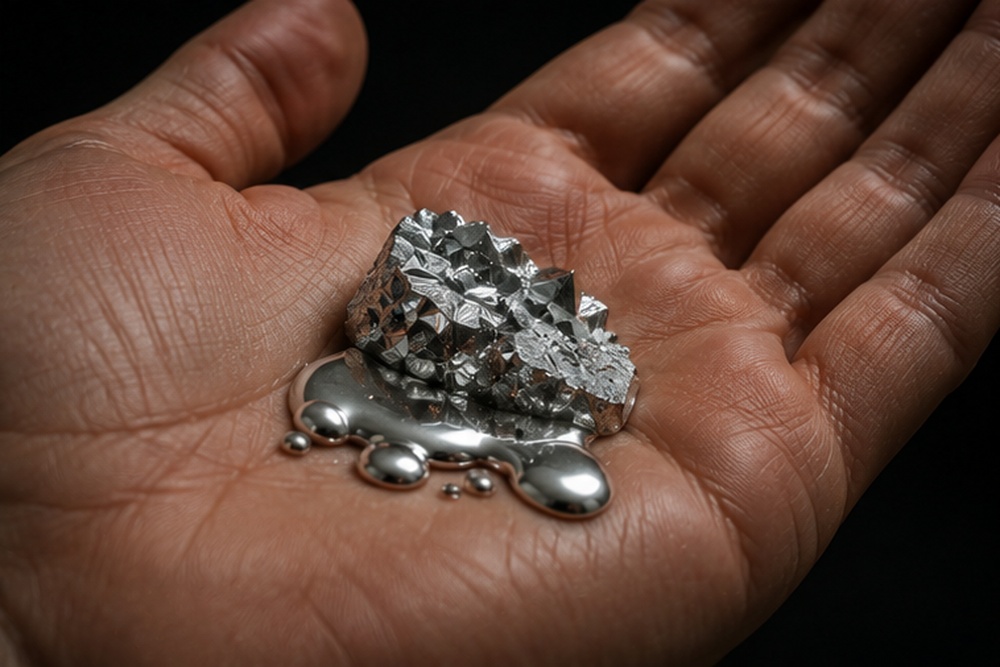
Figure F03-04. Gallium melting in the warmth of a hand — the metal Mendeleev described in detail four years before anyone had seen it. He even corrected its discoverer’s measurement of its density.
Eka-boron arrived next: discovered in Scandinavian ores in 1879 and named scandium, it matched the prediction closely. But the showpiece was eka-silicon. In 1886, in a silver mine near Freiberg, the German chemist Clemens Winkler isolated a grey-white element he named germanium, and the comparison between forecast and fact deserves to be set out in full, because nothing like it had ever been seen in chemistry:
| Property | Eka-silicon (predicted, 1871) | Germanium (measured, 1886) |
|---|---|---|
| Atomic weight | about 72 | 72.6 |
| Density | about 5.5 | 5.35 |
| Colour | grey metal | grey-white metal |
| Density of its oxide | about 4.7 | 4.7 |
| Its chloride | liquid, boiling below 100° | liquid, boiling at 86° |
| Density of that chloride | about 1.9 | 1.9 |
Winkler himself, comparing his laboratory results with the fifteen-year-old prophecy, marvelled in print at the agreement. There could no longer be any serious doubt. The periodic table was not a filing system. It was a law of nature — humanity’s first clear sight of some deep order in matter itself — and chemists everywhere began to feel what physicists would later feel about their own great patterns: that the chart knew more than its maker.
The family nobody invited
The table’s severest test, fittingly, came from the discovery it had not foreseen. In the early 1890s the English physicist Lord Rayleigh noticed a maddening discrepancy in the third decimal place: nitrogen extracted from air was very slightly denser than nitrogen made from chemicals. Most people would have shrugged; Rayleigh and the chemist William Ramsay chased the discrepancy for years, and in 1894 it cracked open to reveal something hiding in every breath since the beginning of the world — a gas making up nearly one per cent of the atmosphere that no one had ever noticed, because it does nothing. It refuses every reaction; it forms no compounds at all. They named it argon, from the Greek for “idle.”
A chemically inert element was a crisis for the table, whose whole logic ran on valency — and argon’s valency was zero, a number the table had no column for. Mendeleev himself was initially sceptical that argon was an element at all. But Ramsay pressed on and, with collaborators, found argon’s relatives one after another: helium (the Sun’s element, finally run to ground on Earth in a uranium mineral in 1895), then neon, krypton and xenon in 1898, distilled painstakingly from liquefied air. An entire vertical family had been missing — and once a “group zero” column was added at the table’s edge, the newcomers slotted in by atomic weight in perfect order, lazy every one. What might have wrecked the table instead completed it, like the finding of a staircase in a house whose floor plan had always implied one. Rayleigh and Ramsay collected Nobel Prizes in 1904 for discovering, in effect, that the table had a blind spot exactly one column wide.
The pattern without a cause
Honesty requires a tour of what still didn’t fit, because the loose threads of 1900 are the plot of our next four chapters.
The tellurium–iodine swap never resolved itself: ever more careful measurements kept stubbornly confirming that tellurium is heavier than iodine, even though chemistry demands it come first. Mendeleev went on insisting the weights were wrong; they were not. He had made the right swap for a reason he could never have guessed — the true ordering principle of the elements is not atomic weight at all, but something that usually marches in step with weight and occasionally breaks step. What that something is will be revealed by a doomed young physicist with an X-ray tube in chapter 7. Hydrogen, the first and simplest element, never found a comfortable seat — a misfit at the head of the table to this day. The “rare earth” metals, a clutch of bafflingly similar elements, refused to fit the columns at all and had to be parked awkwardly to one side, where (look at any wall chart) they remain.
And beneath every detail lay the great unanswered question, the one a sharp student could ask in a sentence and the world’s united chemists could not answer in a library: why? Why should the elements, ordered by weight, repeat their characters in cycles? Why cycles of those particular lengths — eight, eight, eighteen? Why does the pattern run on whole numbers — valencies of exactly one, two, three, four; never two and a half? Mendeleev had done for matter what Kepler had done for the planets: found the true pattern, with no idea of the machinery behind it. Kepler’s laws had eventually been explained by Newton — the planetary pattern turned out to be the visible signature of an invisible force. The periodic pattern, too, had to be the visible signature of something. And there was really only one place that something could hide.
Inside the atom.
Which presented a slight philosophical difficulty, since the atom — by definition, by etymology, by twenty-three centuries of meaning — was the thing with no inside. Mendeleev, for one, would defend that fortress to the end of his life, scowling at the new physics of electrons and radioactivity that erupted in the 1890s precisely because it threatened to give his beloved elements internal parts. He died in 1907, having missed the Nobel Prize by a single vote the year before — and having lived just long enough to see the walls breached. Posterity paid him a better tribute than Stockholm could: element 101, forged atom by atom in a Californian laboratory in 1955, is named mendelevium. His table holds 118 elements now and counting, every one of them in the seat his pattern assigns.
In the next chapter, we breach the walls ourselves. The year is 1897, the place is a Cambridge basement, and the uncuttable atom is about to come apart.
Chapter 4 — The Atom Cracks Open
“…the glowing tubes looked like faint, fairy lights.” — Marie Curie, remembering the radium shed at night
The calm before
In the early 1890s, physics had the contented air of a finished cathedral. Newton’s mechanics governed matter in motion; the new science of thermodynamics governed heat and energy; Maxwell’s equations had united electricity, magnetism and light into one majestic theory. The atom — real or bookkeeping fiction — was at any rate a featureless, indestructible little ball, exactly as Dalton had said. A distinguished American physicist remarked, around 1894, that the great underlying principles seemed to be firmly established, and that the future of physics would likely consist of refining measurements to the sixth decimal place.
Rarely has a forecast aged so badly, so fast. In a single astonishing stretch — November 1895 to the end of 1898 — physicists discovered invisible rays that pass through flesh, atoms that spontaneously pour out energy, two new elements far stranger than any known, and a particle nearly two thousand times lighter than the lightest atom. By the time the dust settled, the “uncuttable” atom of Democritus and Dalton was finished. The atom had parts. Some atoms, left entirely alone, exploded.
This chapter is the story of those few years — and of the cast who made them: a modest German professor working alone at night, a third-generation Parisian academic with a drawer full of uranium, a Cambridge theorist so clumsy his assistants tried to keep him away from his own equipment, and a Polish governess who became the most famous scientist in the world.
It begins, of all places, with a glowing glass tube.
Light in a bottle
By the 1890s, one of the most popular instruments in any physics laboratory was a sealed glass tube with most of the air pumped out and a metal plate fused into each end. Connect the plates to a powerful electrical supply and something lovely happens: the residual gas glows — the principle, much later, behind neon signs. Pump out still more air, though, and the glow in the gas fades while a new effect appears: the glass itself, at the far end of the tube, shines with an eerie green fluorescence. Something invisible was evidently streaming from the negative metal plate down the tube and striking the glass.
A word on the vocabulary, because we shall need it constantly from here on. Electrical experiments involve two kinds of charge — called positive and negative, labels inherited from Benjamin Franklin. Like charges repel each other; opposite charges attract. An electric current is charge in motion. In a tube like ours, the negative terminal is called the cathode and the positive terminal the anode — so the mysterious something streaming from the negative plate was christened cathode rays.
KEY CONCEPT — Reading charge and mass from a deflection Here is the trick on which the whole chapter — much of the whole book — turns. If a moving object carries electric charge, then electric and magnetic fields push it sideways as it flies. From the direction of the swerve, you can read off the sign of the charge: positive and negative charges swerve opposite ways. And from the size of the swerve you can learn about the mass: for a given push, a light object is flung far off course while a heavy one barely deviates — flick a ping-pong ball and a cannonball with the same finger and watch the difference. Invisible particles, in other words, can be interrogated in flight. Sort them with fields, and they will confess their charge and (relative) heft. Physicists have been running this same interrogation, in ever grander forms, from the 1890s to the Large Hadron Collider.
What were cathode rays? Europe split, with suspicious neatness, along national lines. German physicists mostly held them to be waves — some new vibration akin to light, since they cast sharp shadows (a metal Maltese cross placed in the tube printed its crisp silhouette on the glowing glass). British physicists mostly held them to be streams of charged particles, since a magnet visibly bent the beam — and waves, as far as anyone knew, did not bend in magnetic fields. The particle camp was embarrassed, however, by a careful German experiment: Heinrich Hertz had tried deflecting cathode rays with electric fields and seen nothing, which charged particles ought not to be able to get away with. There matters stuck, pending better equipment.

Figure F04-01. A cathode-ray tube: something invisible streams from the negative plate, casting the sharp shadow of a metal cross on the glowing glass. Wave or particle? The answer broke the atom.
The professor who saw through everything
The first thunderbolt struck on the evening of Friday 8 November 1895, in Würzburg, Bavaria. Wilhelm Conrad Röntgen, a thorough, reserved, fifty-year-old professor of physics, was experimenting with cathode-ray tubes — in particular with whether any rays escaped the tube itself. To see faint effects he had darkened the room and jacketed the tube completely in black cardboard. Across the laboratory, well beyond any possible reach of cathode rays (which were known to be stopped by a few centimetres of air), lay a small screen painted with a fluorescent chemical. As the tube crackled into operation, Röntgen noticed, out of the corner of his eye, that the screen was glowing.
It should not have been. Nothing known to physics could leap from a shrouded tube across a room. Most people would have investigated for an afternoon. Röntgen essentially moved into his laboratory for seven weeks, sworn to silence, testing the new rays against everything to hand. They passed through cardboard, through wood, through a thousand-page book, through aluminium; lead, however, stopped them. And then the moment of vertigo: holding a lead disc in the path of the rays, he saw on the screen not only the disc’s shadow but the shadow of the bones inside his own fingers.
Röntgen called them X-rays — x for unknown — and in the week before Christmas he made the photograph that announced them to the world: the hand of his wife, Anna Bertha, exposed for a quarter of an hour, her bones sharp and dark, her wedding ring floating loose around a shadowy finger. Her reported response on seeing it has become legend: she said she had seen her own death. The paper, On a New Kind of Rays, went out in the last days of 1895; within weeks the whole world had gone X-ray mad. Surgeons were locating bullets and setting bones by the new light within months; fairground stalls offered X-ray portraits; one enterprising firm advertised X-ray-proof underwear for the modest. Röntgen, a man of austere principle, refused to patent anything, declaring the rays the property of humanity, and in 1901 received the first Nobel Prize in Physics ever awarded. He gave the prize money away.
(What X-rays actually are — light of very short wavelength, born when fast electrons slam into matter — took years to establish, and the full story of why hot, struck matter emits them belongs to the quantum chapters ahead. For now, what mattered was different: X-rays were a new probe, and they had been found by accident, which raised an electrifying question — what else was lying around undiscovered?)
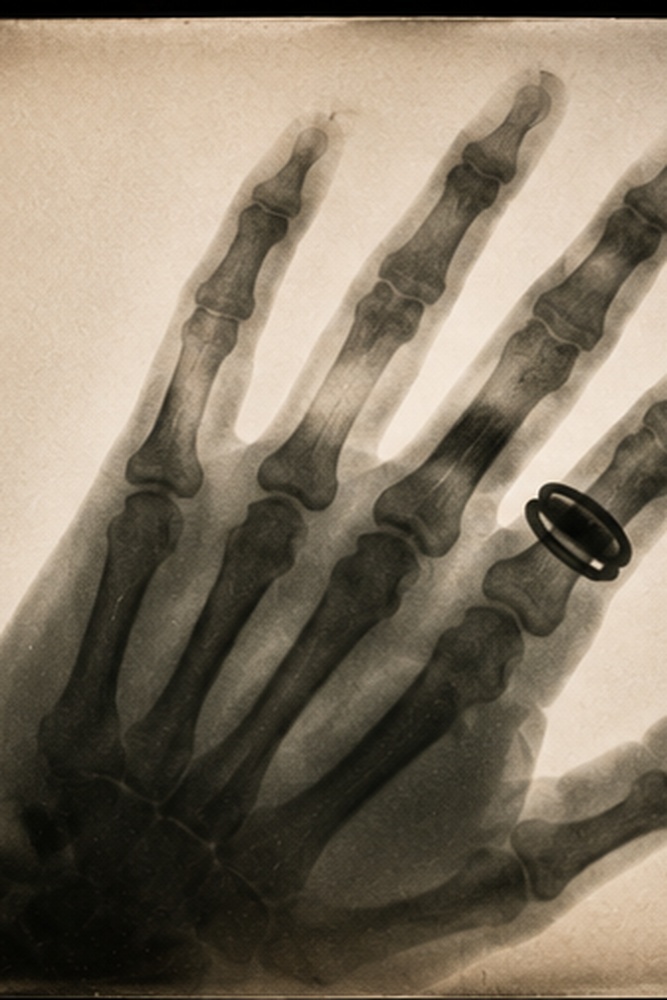
Figure F04-02. The photograph that shook the world: an X-ray image in the style of Röntgen’s 1895 plate of his wife’s hand, wedding ring hanging loose about the bone. “I have seen my death,” she said.
The drawer in Paris
In Paris, the question found its first answer almost immediately — by way of a wrong idea, a spell of bad weather, and a closed drawer.
Henri Becquerel was physics aristocracy: third of four successive Becquerels to hold the chair of physics at the Museum of Natural History. His family’s specialty for two generations had been luminescent materials — substances that glow after soaking up light, as glow-in-the-dark paint does. When news of Röntgen’s rays reached Paris in January 1896, complete with the detail that the X-rays seemed to spring from the glowing patch of glass in the tube, Becquerel leapt to a natural (and wrong) hypothesis: perhaps all glowing substances emit X-rays. Perhaps sunlight could charge up his luminescent minerals to emit penetrating rays.
He had the perfect test specimens to hand: crystals of a uranium salt, splendid glowers. The experiment was simple. Wrap a photographic plate in heavy black paper so that no light can touch it; lay the uranium crystals on top; put the whole thing in sunshine for some hours; then develop the plate. If the sun-charged crystals were emitting anything penetrating, it would pass through the paper and fog the plate. It worked: the developed plate showed the silhouette of the crystals. Becquerel reported, in February 1896, that sunlight stimulated uranium salts to emit penetrating rays.
Then Paris clouded over. For days at the end of February the sun refused to perform, and Becquerel put a freshly wrapped plate, uranium crystals already in place, away in a dark drawer to wait. On the first of March, with the weather still grey — and here history holds its breath, because a less scrupulous man would have waited for sunshine — he decided to develop the stored plate anyway, expecting at most a feeble ghost from the dim daylight. The image came up intense. The crystals had been radiating in the dark, untouched by any sunlight, at full strength, the entire time.
Everything in the original hypothesis was backwards. The glow had nothing to do with it (non-luminescent uranium compounds, he quickly found, worked just as well); the sunlight had nothing to do with it; nothing needed to be done to uranium at all. The metal simply emitted rays — continuously, indefinitely, from within, with no energy supplied from anywhere. It is hard to convey how quietly scandalous that is. A lamp needs fuel; a glowing ember cools; everything in physics that gives out energy is drawing on some account that visibly runs down. Uranium’s account never ran down. Becquerel had found a process with no off switch and no apparent power source — though neither he nor anyone else put it so starkly at the time. Indeed, after the X-ray fireworks, “uranium rays” struck most physicists as a faint and rather niche curiosity. For two years, almost nobody worked on them.
Almost.
One quarter of the air in the room
The two who did were a married couple with, between them, no laboratory, no funding, and no position worth the name — and they chose the subject partly because it was unfashionable: a fresh doctoral topic with no literature to wade through.
Maria Skłodowska had been born in Warsaw in 1867, into a Poland that did not officially exist — partitioned off the map, her city under Russian rule, women barred from its university. She studied in a clandestine “Floating University” that met in changing private rooms, then made a pact with her sister: Maria would work as a governess to fund Bronya’s medical studies in Paris, and Bronya would return the favour. Eight years of other people’s children later, Maria arrived at the Sorbonne, aged twenty-four, with a trunk and a borrowed mattress. She lived in a garret on bread, tea and the occasional egg — she fainted from hunger at least once — and graduated first in her class in physics. In 1894 she met Pierre Curie, a gentle, dreamy, already-distinguished physicist who had concluded that women and science could not mix; he revised the position comprehensively, and they married in 1895. She spent the wedding gift money on two bicycles.
In 1897, casting about for a doctoral subject, Marie Curie chose Becquerel’s neglected rays — and immediately did the thing that separates this story from everything before it. Where Becquerel had judged his rays by the fogging of photographic plates (slow, vague, qualitative), the Curies could measure them. The rays, it was known, make air electrically leaky — they ionise it, letting charge trickle across a gap that should insulate. Pierre and his brother had years earlier invented exquisitely sensitive instruments for measuring just such feeble currents. So Marie’s procedure was this: place a sample beneath a charged plate, and measure, in numbers, precisely how fast the rays let the charge leak away. Strong rays, fast leak. It turned the mystery into arithmetic.
And the arithmetic talked. Testing compound after compound, Marie established a fact whose importance she saw instantly: the intensity of the rays depended only on the amount of uranium present — not on which chemical compound it was locked in, not on whether it was solid or dissolved, wet or dry, hot or cold. Nothing chemical touched it.
KEY CONCEPT — A property of the atom itself Why was that observation worth a revolution? Because everything chemistry can do — burning, dissolving, reacting — rearranges how atoms are joined to one another, and such rearrangements change a substance’s behaviour utterly (consider soft grey graphite and diamond, the same carbon atoms differently joined). Here was a phenomenon that no rearrangement could touch. The rays could not, therefore, be coming from the joins between atoms. They had to be coming from somewhere chemistry cannot reach: from the individual atom’s own interior. Marie Curie named the phenomenon radioactivity, and her conclusion — that it is an atomic property — was the first experimental statement in history about the inside of an atom. It carried a heretical corollary: if atoms have insides that can emit things, atoms are neither structureless nor necessarily permanent. Dalton’s billiard ball had developed machinery.
She then swept the whole known mineral kingdom through her instrument, and the survey turned up two further prizes. First, uranium was not alone: thorium, too, poured out rays (a German chemist found this independently). Radioactivity was a phenomenon of nature, not a quirk of one metal. Second — the anomaly that made everything else happen — certain natural uranium ores, above all the heavy black mineral pitchblende, were far more radioactive than their uranium content could explain. Marie measured, re-measured, and trusted her numbers: something inside pitchblende was vastly more radioactive than uranium itself, and present in such traces that the chemists had never noticed it. The Curies announced, in 1898, that pitchblende must contain at least one unknown element — and Pierre abandoned his own research on crystals to join the hunt.
They found two. In July 1898, a new element that clung chemically to bismuth: Marie named it polonium, after her erased homeland — the first element ever named as a political protest. In December, traces of a second, attached to barium and so ferociously active that its salts visibly glowed: radium. The scientific world’s congratulations came with a raised eyebrow: the evidence was radioactivity itself, plus a few new spectral lines. To convince the chemists, the Curies would have to produce the stuff — weighable, bottled, atomic weight determined.
That labour took four years and has become the most famous ordeal in science. Radium exists in pitchblende at a few parts in ten million; to get it, the Curies obtained tonnes of waste ore residue from the Joachimsthal mines in Bohemia and processed it — by hand — in their “laboratory”: an abandoned wooden shed with a leaking glass roof, formerly the medical school’s dissecting room, judged unfit for cadavers. Marie did much of the brute chemistry herself, dissolving, boiling and crystallising twenty-kilogram batches, stirring vats of seething liquor with an iron rod nearly as tall as she was. “I would be broken with fatigue at day’s end,” she wrote later — and yet the same memoir records the couple slipping back to the shed at night to stand in the dark among their work, watching the faintly glowing vessels shimmer on the shelves like fairy lights. In 1902 she had it: one decigram — a tenth of a gram, a few grains of salt — of pure radium chloride, wrung from roughly a tonne of ore, and an atomic weight (about 225) that put radium firmly in Mendeleev’s table, two rows below its chemical look-alike barium. Radium proved to be roughly a million times more radioactive than uranium: a gram of it pours out enough heat, hour after hour, year after year, to melt its own weight in ice — while remaining, to every chemical and thermal test, utterly indifferent, drawing on no fuel anyone could find.

Figure F04-03. Radium salts glow with their own light and warm themselves with their own heat, indefinitely, from no detectable source. The energy books of physics suddenly refused to balance.
In 1903 the Nobel Prize in Physics went to Becquerel and the Curies — and very nearly went only to Becquerel and Pierre. The nominating establishment had omitted Marie; Pierre, tipped off by a sympathetic Swedish mathematician, made it courteously plain that he would refuse a prize that excluded the person whose doctoral research it crowned. She thus became the first woman to win a Nobel Prize; in 1911 a second (in chemistry, for radium and polonium) made her the first person of any sex to win two. The sequel is sombre, and belongs to this story. Pierre was killed in 1906, his skull crushed under a horse-drawn wagon on a rainy Paris street. Marie, who took over his professorship — the Sorbonne’s first woman professor — worked with radioactive materials for three more decades and died in 1934 of aplastic anaemia, her bone marrow destroyed by the radiation no one had known to fear. Her laboratory notebooks are still radioactive today; they rest in lead-lined boxes in the Bibliothèque nationale, and a reader who wishes to consult them signs a waiver first.
Meanwhile, in a Cambridge basement
We have run ahead of the third thunderbolt, which struck between Becquerel’s drawer and the Curies’ shed. Back, then, to the cathode-ray dispute — and to the Cavendish Laboratory, Cambridge, whose director, Joseph John Thomson, universally “J.J.”, presents one of science’s pleasanter ironies: a supreme experimental physicist so personally maladroit that his staff conspired to keep his hands off the apparatus. His mind was another matter.
Thomson saw that the German wave camp’s best evidence — Hertz’s failure to bend cathode rays with electric fields — might be an artifact of dirty vacuum: leftover gas in the tube, ionised by the rays themselves, would form a conducting fog that shorted out the deflecting field. Pump the tube harder, and the test could be run honestly. In 1897 he ran it. In a properly evacuated tube, cathode rays swerved obediently toward the positive plate. They were charged particles — negative ones — and now the interrogation-by-deflection described earlier could be pressed to its conclusion. Balancing an electric push against a magnetic push, Thomson extracted the ratio of the particles’ charge to their mass, and the number was a scandal: gauged against the lightest object then known — the hydrogen atom, as it behaves in electrified solutions — the cathode-ray particles carried roughly a thousand times more charge per unit of mass. Either they were monstrously charged, or they were almost unbelievably light.
Two further facts settled which, and detonated the deeper charge. First, the particles were always identical — the same charge-to-mass signature whatever metal the cathode was made of and whatever trace gas filled the tube. Second, within a couple of years Thomson managed to measure the charge by itself (by an ingenious method involving droplets condensing on charged particles in moist air), and it came out ordinary — the same basic unit of charge carried by hydrogen in solution. The conclusion was forced: the new particle’s mass was minuscule, somewhere near a two-thousandth of a hydrogen atom’s (the modern figure is 1/1836). And since the same particle emerged from every element tried, it had to be a universal ingredient — a common building block residing inside all atoms, knocked loose by the tube’s electric violence.
Thomson announced the conclusion at a Friday-evening lecture at the Royal Institution in April 1897, and recalled afterwards that distinguished members of his audience believed he was pulling their legs. One can sympathise. He was asserting the existence of matter in pieces smaller than atoms — “corpuscles,” he called them, though the world soon settled on a name already coined for the theoretical unit of charge: the electron. The indivisible atom of Democritus, Dalton and twenty-three centuries had, in a Cambridge basement, been divided.
The beautiful convergence came when the new instruments were turned on each other’s mysteries. The “beta rays” streaming from radium were soon put through the deflection interrogation — and confessed the electron’s exact signature. Radioactive atoms were shooting out electrons from inside themselves, at speeds approaching light’s. The cathode-ray tube and the radium vial, the basement and the shed, had found the same particle.
Naming the bullets
The task of sorting radioactivity’s emissions fell largely to a booming, irrepressible young New Zealander then working under Thomson, of whom this book will have a very great deal to say: Ernest Rutherford. With characteristic directness, Rutherford classified the rays by what it took to stop them, and named them with the first letters of the Greek alphabet. Alpha rays were the heavyweights: stopped by a sheet of paper or the outer layer of skin, barely deflected by a magnet but in the positive direction — massive, positively charged projectiles (years later Rutherford proved them to be identical with helium atoms stripped of electrons, a fact that will matter enormously in chapter 5). Beta rays were the featherweights: penetrating millimetres of aluminium, flung into wide curves by a magnet in the negative direction — our fugitive electrons. Gamma rays, identified shortly afterward, ignored magnets altogether and shrugged off everything short of thick lead: no charge, no mass — a hyper-energetic relative of X-rays and light. (A schematic of the three behaviours appears below; we shall meet all three families again and again.)
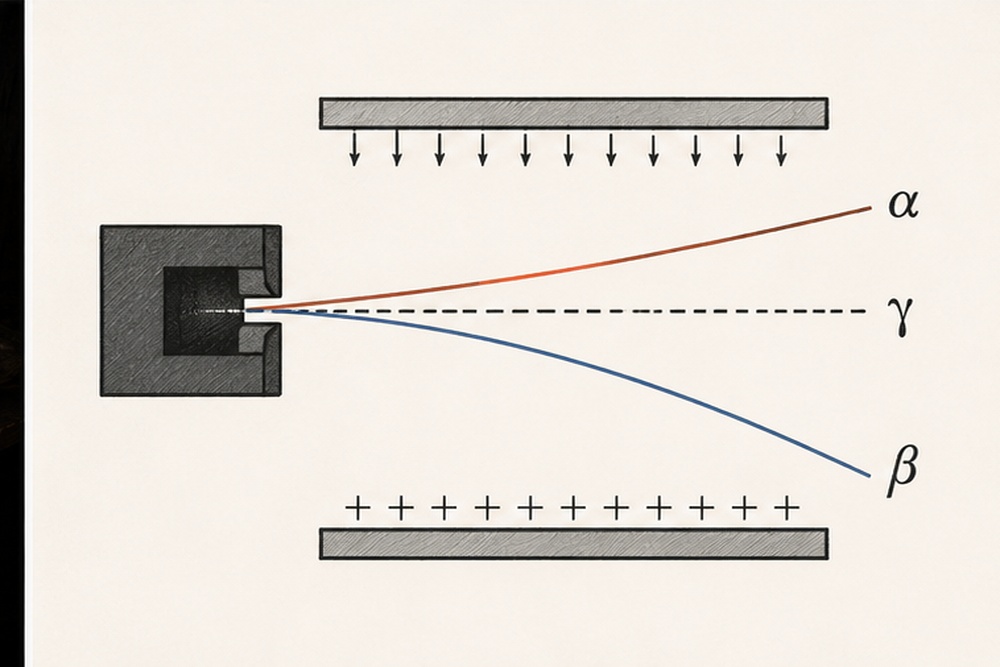
Figure F04-04. Three emissions, sorted in flight: heavy positive alpha, light negative beta, chargeless gamma. (α, β and γ are the conventional Greek letters introduced for these emissions by Rutherford.)
It was Rutherford, too — by now running his own laboratory in Montreal, with the chemist Frederick Soddy — who faced down what radioactivity actually is. Tracking the bewildering rises and decays of activity in thorium samples, the pair established by 1902 a conclusion they hardly dared publish: in radioactivity, atoms of one element are spontaneously changing into atoms of another element, hurling out an alpha or beta particle as they go. Uranium begets new substances; radium itself is a way-station in uranium’s slow cascade toward (it would emerge) stable lead. Soddy, electrified, exclaimed that this was transmutation — and Rutherford, very much aware of chapter 1 of this history, shot back that he must never use that word, or people would have their heads off as alchemists. The irony was total. The alchemists’ dream was real; it had been proceeding by itself, in every uranium vein on Earth, since before the Earth had veins. What the alchemists got wrong was only the agency: no furnace, prayer or philosopher’s stone touches it — and nothing else does either. Each unstable atom simply, in its own unforced moment, lets go.
The pudding
By 1904, then, the atom had confessed to containing electrons and, in some cases, to violent internal events — and physics owed the world a picture of an atom’s inside. Thomson supplied the era’s best attempt. Atoms are electrically neutral overall; so if they contain thousands of negative electrons’ worth of… no — here Thomson’s own measurements bit hard: the electron’s tiny mass meant that even thousands of them would account for almost none of an atom’s weight. His model therefore proposed that nearly all the atom’s mass and all its positive charge formed a diffuse, structureless sphere — a kind of charged mist filling the atom’s whole volume — with the tiny electrons embedded in it at equilibrium positions, free to vibrate, like raisins in a spherical pudding. England, inevitably, named it the plum-pudding model.
Mock it gently if you must, but note what it achieved: it was the first scientific model of atomic structure ever proposed, it explained neutrality, it housed the electron, and its vibrating electrons even gestured toward an explanation of those fingerprint spectral lines from chapter 3. It made the atom a system — something with an architecture that could, in principle, be probed.
All it needed was to be tested. The test required a bullet small enough and forceful enough to be fired into an atom — and nature, with magnificent timing, had just handed physics exactly that bullet: the alpha particle, radium’s own heavy artillery. The man holding the radium was Ernest Rutherford. What happened when he and his students fired it at a sheet of gold thinner than a soap bubble is the most famous surprise in the history of experimental physics, and it is the subject of the next chapter.
Chapter 5 — The Nuclear Atom
“Now I know what the atom looks like!” — Ernest Rutherford to Hans Geiger, 1911
The man from the flax farm
Every so often science produces a figure who seems built to a different scale, and the first half of the twentieth century belonged to one: a big, loud, moustached New Zealander with a voice that made delicate apparatus tremble — assistants claimed his bellow could be heard two floors away, and he was banished from his own laboratory’s most sensitive experiments — who tramped about singing “Onward, Christian Soldiers” off-key while, one after another, the deepest secrets of matter surrendered to him.
Ernest Rutherford was born in 1871 near Nelson, New Zealand, fourth of a dozen children of a flax-miller and a schoolteacher, and grew up digging potatoes, milking cows and disassembling clocks. Scholarships carried him from a country schoolhouse to Canterbury College, and in 1895 came the telegram announcing the scholarship that would carry him to Cambridge — delivered, family legend insists, while he was digging in the potato patch, whereupon he flung down his spade and declared that he had dug his last potato. He arrived at the Cavendish Laboratory just in time for the storm: he was J.J. Thomson’s student through the discovery of the electron, then took a chair at McGill in Montreal, where (as we saw) he and Soddy uncovered the scandal of transmutation. The 1908 Nobel Prize that resulted was, to his vast amusement, awarded in chemistry; he remarked that of all the transformations he had studied, none was so quick as his own, from physicist to chemist.
By then he was back in England, running the physics department at Manchester, equipped with the finest stock of radium outside Paris and a conviction about how to use it. The alpha particle — radium’s heavy, positively charged projectile, which Rutherford had personally proved to be a helium atom stripped bare — was the most concentrated packet of energy a laboratory could command. Most physicists thought of alpha particles as a phenomenon to study. Rutherford understood they were a tool: bullets small enough, fast enough and forceful enough to be fired at atoms themselves.
KEY CONCEPT — Scattering: how to see what you cannot look at Suppose you must map an object you can never see, touch or illuminate. There is a universal method: throw things at it, and study how they bounce. From the pattern of ricochets — how many projectiles fly straight through, how many are nudged slightly, how many rebound, and at what angles — the hidden object’s size, shape and constitution can be reconstructed. A child shaking a wrapped present uses the method; so does a doctor’s tap on your knee; so, with exquisite refinement, does essentially all of modern particle physics, up to and including the Large Hadron Collider, which is at bottom a machine for throwing things at other things very hard and cataloguing the debris. The interrogation-by-deflection of the last chapter told us about the projectiles; scattering turns the same physics around to interrogate the target. Its first great masterpiece is this chapter’s experiment.
One in eight thousand
The work unfolded at Manchester between 1908 and 1913, and the supporting cast matters. Hans Geiger, a methodical young German physicist, was Rutherford’s right hand; Ernest Marsden was a Lancashire undergraduate of twenty. Their experimental life was a special kind of purgatory. The only way to detect individual alpha particles was a screen painted with zinc sulfide, which rewards each alpha strike with a flash of light so faint that observing it meant sitting in a blacked-out room for half an hour first, letting one’s eyes adapt, then counting flashes through a microscope in stints so taxing that a few minutes’ counting demanded a rest. (Geiger’s later invention of the electrical particle counter that bears his name was born directly of this misery.)
The experiment itself was simplicity made profound. A speck of radium in a lead box with a pinhole supplied a narrow beam of alpha particles. In its path stood the target: gold leaf, beaten — as only gold can be — to a film some four hundred atoms thick, a thousandth the thickness of a human hair. Around the foil, the movable scintillation screen and microscope, to count alphas arriving at any chosen angle.
What should happen? On Thomson’s plum-pudding picture, the answer was firm: almost nothing. The atom’s positive charge, remember, was supposed to be spread thin through its whole volume, a tenuous mist; its electrons were two-thousandth-of-a-hydrogen flyweights. An alpha particle — a heavyweight moving at some fifteen thousand kilometres per second — should sail through such an atom like a cannonball through fog, nudged at most a fraction of a degree; and the thousands of atoms it traverses in the foil, nudging randomly this way and that, should mostly cancel out. The beam should pass on through, barely blurred. And overwhelmingly, that is what was seen: the alphas streamed through four hundred ranks of gold atoms essentially as if the foil were not there — itself a quiet point worth pocketing, for it shows directly how empty solid gold must be.
Then, in 1909, came one of the most productive throwaway suggestions in the history of science. Partly to give young Marsden a project of his own, Rutherford proposed that he check whether any alphas were deflected through large angles — a possibility theory rated absurd. Marsden and Geiger duly moved their screen around toward the front of the foil, on the same side as the source, looking for alpha particles bouncing back.
They found them. About one alpha in every eight thousand rebounded from that whisper of gold through more than a right angle — some nearly straight back along their path. Statistically, on the plum-pudding picture, accumulating enough tiny random nudges to turn an alpha around was about as likely as a feather gale stopping a cannonball; the honest expectation was that they could have watched for the age of the universe without seeing one. Rutherford’s reaction, in a recollection he polished for the rest of his life, compared it to firing a fifteen-inch naval shell at a sheet of tissue paper — and having the shell bounce back and hit you.
Figure F05-01. The gold-foil apparatus: a radium source in its lead housing, a film of gold four hundred atoms thick, and a microscope for counting single flashes in the dark. One alpha in eight thousand came back.
The detective’s solution
Rutherford brooded on the rebounds for the better part of two years — “quite the most incredible event,” he called the result — and the reasoning that resolved them is a model of physical detective work, worth walking through slowly, because the answer created the modern atom.
Begin with what a rebound requires. To reverse a massive, fast projectile in a single encounter, you need two things at once. You need an enormous repulsive force — which means the target’s positive charge cannot be a diffuse mist; it must be concentrated, so that an incoming alpha can get terribly close to all of it at once and feel its full undiluted repulsion. (Electrical repulsion grows savagely as distance shrinks: halve the separation and the force quadruples.) And you need the target to be massive — heavier than the alpha itself — because no projectile can bounce backwards off something lighter than itself, any more than a bowling ball rebounds from a ping-pong ball.
Now add the other side of the ledger: the rebounds are fantastically rare, and almost all alphas pass through four hundred atoms untouched. So whatever this concentrated, massive, highly charged object is, it must be minute — a tiny bullseye lost in the atom’s volume, which an alpha almost never comes near. Put the requirements together and the plum pudding inverts. The atom’s positive charge and essentially all its mass are packed into a speck at the centre; the electrons — gnats of negligible mass — inhabit the vast remainder; and the vast remainder is empty. In 1911 Rutherford published the picture, with its precise prediction of exactly how the count of scattered alphas should fall off with angle; Geiger and Marsden then spent a year of dark-room martyrdom counting flashes angle by angle, and the data fitted the formula like a key in a lock. By 1913 it was settled. The atom had a nucleus — the word was soon adopted from biology — and the science of this book had acquired its second great division: the chemistry-facing realm of the electrons, and the buried fortress of the nucleus, each to receive its own further chapters.
The proportions still stop the breath. A nucleus measures around a ten-thousandth of its atom’s diameter. Scale an atom up to a great sports stadium, and the nucleus is a pea at the centre spot — with the electrons as a handful of midges somewhere up in the stands, and nothing whatever in between. By volume, the atom is roughly 99.9999999999996 per cent void; yet the pea-sized speck holds better than 99.9 per cent of the mass. All the solidity of the world — the granite of mountains, the steel of bridges, the chair holding you now — is a sparse scaffolding of almost inconceivably dense specks, separated by relative distances that would do credit to a planetary system. Squeeze the void out of matter, pack human beings nucleus-to-nucleus, and the entire population of the Earth would fit comfortably in a sugar cube (which would weigh, accordingly, several hundred million tonnes). Here is this book’s title made literal: Almost Nothing is precisely what a history of matter is.

Figure F05-02. The scale of the atom: if an atom were a stadium, its nucleus would be a pea at the centre spot — holding 99.9 per cent of the mass. Everything else is empty space, lightly haunted by electrons.
And one more clue, easy to miss amid the drama, was quietly extracted from the scattering counts: the amount of charge on the nucleus. For gold, it came out at roughly a hundred units — strikingly, about half the atomic weight, a ratio that held for other metals tried. Atomic charge, atomic weight: two different numbers attached to each element, marching roughly but not exactly in step. File that carefully; in chapter 7 it unlocks the periodic table.
The atom that shouldn’t exist
There was, however, a monstrous problem, and Rutherford — no theorist, by inclination or pretension — knew it perfectly well. His atom was a miniature solar system: a dense attracting centre, light bodies circulating around it. The trouble is that an electron is not a planet. An electron carries charge, and the physics of Faraday and Maxwell — the most thoroughly verified theory then in existence — is unequivocal about charges that change direction: they radiate. An electron whipping around a nucleus is changing direction continuously, and must therefore pour out light continuously, draining its own energy of motion. Run the numbers and the verdict is annihilation: the electron should spiral inward, broadcasting a death-scream of ever-bluer light, and crash into the nucleus in around a hundred-billionth of a second.
By the lights of classical physics, then, Rutherford’s atom — and hence every atom, and hence all matter — should collapse, instantly and universally. Yet here we all are. Worse: atoms are not merely stable but uniformly stable, every gold atom identical to every other, with no memory of rough handling — ionise one, batter it in a furnace, and it returns to exactly its standard self, emitting exactly its standard fingerprint of spectral lines. Nothing in the solar-system picture explains such regimented identity: planetary systems come in any size whatever, depending on the accidents of their history. Something — some principle entirely missing from classical physics — was dictating to electrons precisely where they were permitted to be, and forbidding everything in between.
The shape of the missing principle was hiding in plain sight, in data physicists had been accumulating for half a century: the spectral lines.
The schoolteacher’s formula
Recall from chapter 3 that each element, energised in a flame or an electrified gas, emits its private barcode of sharp coloured lines. By the 1880s these had been measured by the thousand to superb precision — a vast stamp collection with no postal system. Hydrogen, the simplest atom, offered the cleanest specimen: in the visible range, four crisp lines — red, blue-green, violet, deep violet.
In 1885 a sixty-year-old Swiss schoolmaster named Johann Balmer, a mathematics teacher in Basel with a connoisseur’s love of numerical patterns, played with the four measured wavelengths — and found the lock’s combination. All four wavelengths emerged, with stunning exactness, from one compact recipe involving nothing but whole numbers: plug in three, four, five, six, and out come the red, blue-green, violet and deep-violet lines, correct to the precision of the best measurements. The recipe predicted a next line beyond the visible — duly found. Later workers generalised it: hydrogen’s other line families, in the infrared and ultraviolet, all obeyed the same master pattern with other small whole numbers, every line in hydrogen’s entire repertoire indexed by a pair of integers.
By now the reader knows the rule of thumb this book keeps sounding: when nature insists on whole numbers, look for something discrete underneath. Fixed chemical recipes meant countable atoms. And whole numbers stamped on the light of hydrogen meant — what? For nearly thirty years, nobody had the faintest idea. Balmer’s formula sat in the literature like a crossword answer with no clue: too perfect to be coincidence, too strange to mean anything.
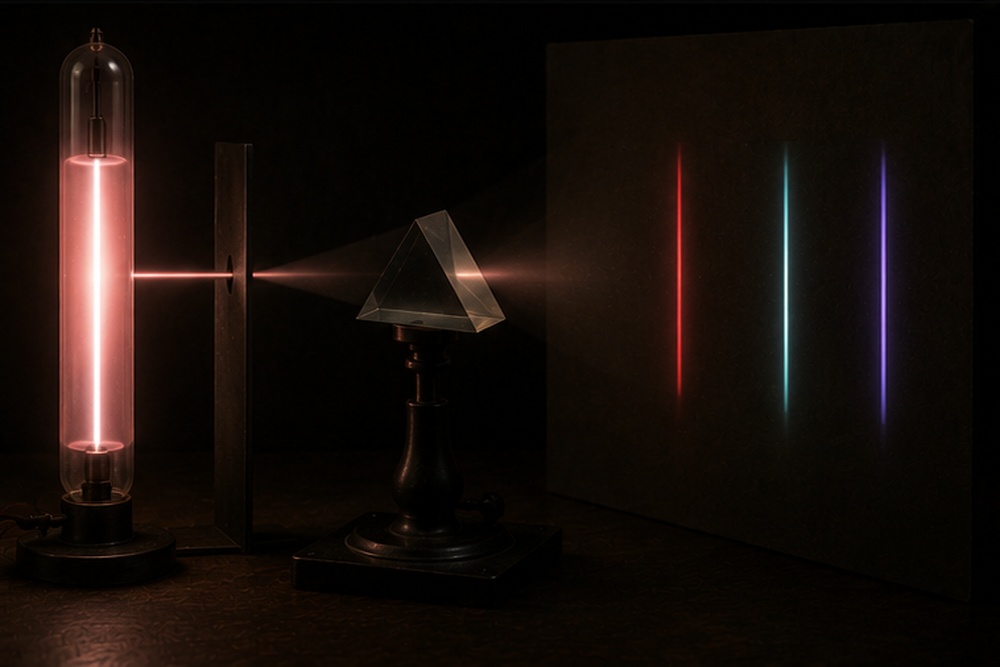
Figure F05-03. Hydrogen’s barcode: the glow of a hydrogen discharge tube, split by a prism into sharp, separate lines of colour. Their spacing follows an exact whole-number recipe — found by a Swiss schoolteacher, explained by no one.
Enter the Dane
The decoder arrived in Manchester in 1912: a shy, mumbling, relentlessly thoughtful Dane of twenty-six named Niels Bohr. He came from Copenhagen’s intellectual aristocracy — son of a professor of physiology, brother of a mathematician who had won an Olympic silver medal at football (Niels himself kept goal, competently, for a leading Danish club) — and he thought the way he spoke: slowly, in drafts, revising every sentence a dozen times, boring impatient listeners into submission and then, somehow, arriving somewhere no quick thinker had reached. He had gone first to Cambridge to work under Thomson, where the great man showed polite minimal interest in the young Dane’s criticisms of his electron theories; Bohr decamped to Manchester, where Rutherford — who measured people fast and was rarely wrong — decided the quiet footballer was the ablest young theorist he had ever met. The respect became lifelong, and consequential: the bombastic colonial experimenter and the murmuring Danish theorist formed one of science’s great father-son partnerships.
Bohr seized the collapse problem, and his escape from it — published in a great trilogy of papers in 1913 — has a directness that still startles. If classical physics says the orbiting electron must radiate and crash, and the world says atoms are stable, then classical physics does not apply inside atoms. Stop apologising for that; postulate the stability. Bohr decreed that an atom possesses a fixed menu of special states — he called them stationary states — in which, contrary to everything Maxwell held sacred, the electron simply does not radiate. Each stationary state has a definite energy; they can be numbered 1, 2, 3… outward from the nucleus (there are the whole numbers, walking in through the front door); and there is a lowest rung — the ground state — below which no further fall is possible. That single decree dissolves the death-spiral: an electron on the bottom rung has nowhere lower to go. It also explains the regimented identity of atoms: every hydrogen atom has the same menu, dictated (Bohr showed) by the same few constants of nature, so every unmolested hydrogen atom sits in the same ground state, indistinguishable from its fellows.
Then the masterstroke, joining his decree to half a century of spectroscopy. Light, Bohr proposed, is emitted only when an electron jumps — abruptly, with no traversal of the space between — from one rung to a lower one; and the light of a single jump carries away precisely the energy difference between the rungs, as one indivisible packet. (That light’s energy comes in packets, and that a packet’s energy sets its colour, was an idea then barely a decade old and still scandalous; its origins with Planck and Einstein are the opening business of the next chapter. Bohr’s gamble was to take it as given.) At a stroke, the spectral barcode makes sense. An element’s lines are not a vibration or a hum; they are a price list — the complete table of energy differences between the rungs of its ladder. Sharp lines, because the rungs are sharp; whole numbers in Balmer’s formula, because the lines are indexed by the rung numbers of the jump’s start and finish; the same lines for every atom of an element, because every atom of an element owns the identical ladder.
KEY CONCEPT — The staircase atom The indispensable picture to carry forward from Bohr: an atom’s electron cannot have just any energy, the way a ball rolling down a ramp can. Its energies are a staircase, not a ramp — the electron can stand on any step, and can never hover between steps. Add energy (heat, electricity, a collision) and the electron is kicked upstairs; it tumbles back down in one or more discrete hops, and each hop flings out one packet of light whose colour exactly encodes the height of that hop. Big hop, energetic packet, violet or beyond; small hop, red or infrared. Read an element’s spectrum and you are reading its staircase, hop by hop. Every neon sign, every sodium streetlamp’s orange, every forensic flame test, every measurement of a distant star’s composition is this one principle at work.
Was it true? The model’s arithmetic, fed nothing but the electron’s known charge and mass and Planck’s new constant, produced Balmer’s formula — and produced the formula’s central measured constant correct to better than one part in a hundred. Coincidence at that precision does not happen. Then came the clincher that converted the doubters. Astronomers had found line series, in hot stars and in the laboratory, that seemed to be hydrogen’s but with mysterious extra lines interleaved. Bohr’s model said: not hydrogen — helium that has lost one electron, whose ladder, scaling with the doubled nuclear charge, should reproduce exactly such a pattern, displaced by a factor his formula specified to four significant figures. Careful spectroscopy in Rutherford’s own laboratory confirmed the prediction on the nail. When the news reached Einstein, he is reported to have said that in that case it was one of the greatest of discoveries. Within a year, direct mechanical proof arrived from a quite different quarter: in Berlin, James Franck and Gustav Hertz fired electrons through mercury vapour and found the mercury atoms would accept energy from collisions only in one exact lump-size, spurning anything less — the staircase, caught in the act by an experiment that had never heard of spectral lines.
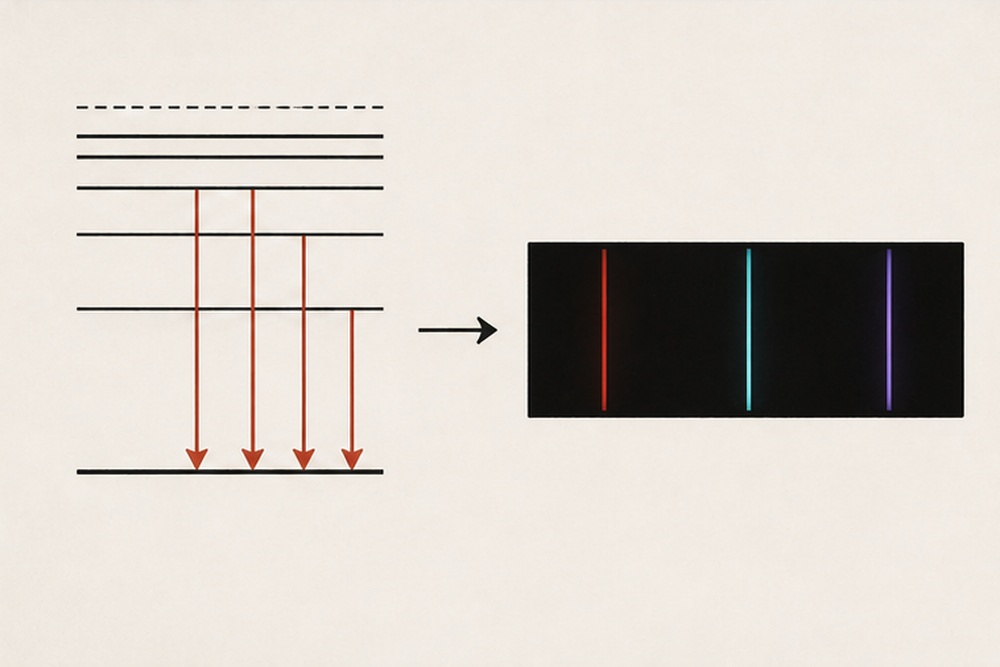
Figure F05-04. The staircase and the barcode: each spectral line is one size of jump between numbered rungs of the atom’s energy ladder.
A triumph with cracked foundations
Bohr’s atom of 1913 ranks among the most successful wrong theories ever devised — and both halves of that description matter.
The successes were real and lasting: the stability of matter, the identity of atoms, the meaning of spectra, the first quantitative bridge between physics and chemistry. The planetary atom with its tidy circular orbits became, and remains, the universal logo of the atomic age, stamped on power stations, comic books and breakfast cereals.
But the foundations were scaffolding, and Bohr said so himself with disarming candour. Why do stationary states exist? Decree. Why does an orbiting electron not radiate? Decree. What does the electron do during a jump, and what decides the moment a jump happens? Silence — a silence with something lawless in it, to which we must return, for it troubled Einstein more than anyone. And beyond hydrogen, the model’s arithmetic simply failed: helium, with merely two electrons, defeated every calculation; the patches and elaborations applied over the following decade — elliptical orbits, tilted orbits, extra quantum numbers grafted on to track the data — improved the bookkeeping while deepening the sense of a theory held together with string. The Bohr atom was, in short, a treaty: classical physics governing the orbits, quantum decrees governing their selection, two incompatible legal systems sharing one atom. Treaties of that kind do not hold. By the early 1920s the brightest of the rising generation — several of them trained in Bohr’s own new institute in Copenhagen, funded famously by Carlsberg brewery money — were convinced that the whole framework had to be torn down to the ground: that the electron was a far stranger thing than a tiny planet, and the atom a far stranger place than a solar system.
They were right. What replaced the orbits — in three convulsive years that overthrew certainty itself, and ignited an argument about reality that has never ended — is the subject of the next chapter. The reader is advised, as the physicists of 1925 were, to hold on to something solid. Insofar as anything is.
Chapter 6 — The Quantum Revolution
“Anyone who is not shocked by quantum theory has not understood it.” — attributed to Niels Bohr
Two clouds
In April 1900, with the nineteenth century closing in satisfaction, the great Lord Kelvin gave a lecture observing that the beauty and clearness of physical theory was obscured by just two clouds — two stubborn little problems that declined to fit. He chose his clouds well. One concerned the behaviour of light from moving sources; pulled at, it unravelled into Einstein’s relativity. The other concerned a question so humble it sounds like a craftsman’s query rather than a crisis: why do hot things glow the colours they do?
Pulled at, that one unravelled physics itself. This chapter is the story of the unravelling — roughly 1900 to 1927, from a reluctant Berlin professor’s “act of desperation” to the strangest, most precise, most relentlessly successful theory in the history of human thought. By the end of it the electron will be neither a particle nor a wave nor a planet; the comfortable solar-system atom of chapter 5 will be demolished by the very people who built it; and the world at its foundations will turn out to run not on certainty but on chance. Einstein, who did as much as anyone alive to start the revolution, spent his last thirty years refusing to accept where it led. The reader is invited to sympathise with both Einsteins.
The colour of heat
Every blacksmith knows the sequence by heart. Iron in the forge glows first a dull deep red; hotter, a bright cherry; hotter still, orange, then yellow, then a blinding yellow-white. The colour ladder is utterly reliable — astronomers, indeed, read the temperatures of stars from it — and by the 1890s German physicists, supported by an industry keen on standardising lamps, had measured with great precision exactly how much light of each colour a hot body emits at each temperature. The full rainbow recipe was known. What was missing was the why — and when theorists computed what the recipe ought to be, from the trusted physics of heat and Maxwell’s trusted physics of light, the answer came out not merely wrong but deranged. Classical theory insisted that any warm object must pour out ever more energy at ever shorter wavelengths — more violet than blue, more ultraviolet than violet, and so on without limit. Your fireplace should be a death ray. The failure was later nicknamed the ultraviolet catastrophe, and the catastrophe was the theory’s, not nature’s: real glowing bodies emit almost nothing at short wavelengths, the rainbow recipe rising to a gentle temperature-dependent peak and falling away again.

Figure F06-01. The colour of temperature: iron in the forge climbs from deep red towards white as it heats. Explaining this everyday ladder of colours broke classical physics.
Enter Max Planck: forty-two, Berlin’s professor of theoretical physics, a man of such instinctive conservatism that he had once advised a student against a career in physics on the grounds that the subject was nearly complete. Planck had spent six years on the glow problem. In the autumn of 1900 he first found, by inspired curve-fitting, a formula that matched the measurements perfectly; then, searching for what could possibly justify his formula, he was driven — in his own later words, as an act of desperation — to an assumption that violated everything he believed. Energy, he found himself supposing, could not be exchanged between matter and light continuously, in any amount, like water from a tap. It could be exchanged only in discrete packets — quanta, he called them, from the Latin for “how much” — and the size of the packet depended on the colour: each packet of violet light carries roughly double the energy of a packet of red, with the exchange rate set by a new constant of nature, h, so small as to beggar description. Make the packets, and the catastrophe dissolves: short-wavelength light is expensive — its packets are large — and a merely warm body simply cannot afford many of them. The glow recipe followed exactly.
Planck announced the result in December 1900, a date as good as any for the birth of quantum physics — though it should be recorded that the father spent years trying to disown the child, labouring to re-derive his formula without the monstrous packets, and failing. He had assumed, in any case, only that energy was exchanged in lumps, perhaps through some quirk of how matter absorbs and emits. The truly scandalous step — that light itself is grainy — he refused. That step was taken five years later, by a twenty-six-year-old examiner of patent applications in Berne.
KEY CONCEPT — Waves in one paragraph Since this chapter turns on the contest between wave and particle, fix the wave idea firmly. A wave is a travelling disturbance — ripples on a pond, sound in air, light (in Maxwell’s physics) as rippling electric and magnetic fields. Its wavelength is the distance between successive crests; its frequency is how many crests pass per second; short wavelength means high frequency. And waves do something particles cannot: they interfere. Where two sets of ripples overlap crest-on-crest they reinforce into a double-height wave; where crest meets trough they cancel to nothing. Overlapping waves therefore paint zebra patterns — bands of strength and bands of dead calm. Find such bands, and you have caught a wave. Remember the zebra stripes; the deepest mystery in physics is wearing them.
The patent clerk
The year 1905 belongs to Albert Einstein the way 1869 belongs to Mendeleev. A failed academic — no university had wanted him — examining patents in Berne, in his spare time he published, within months, the theory of special relativity, the equivalence of mass and energy (of which much more in chapter 9), and two further papers that concern us now. Each alone would have made a career.
One settled the oldest question in this book. Back in 1827 the botanist Robert Brown had peered at pollen granules suspended in water and seen them jitter — ceaselessly, randomly, forever, with no cause he or anyone could find. Brownian motion remained a curiosity for eight decades until Einstein recognised it as a message. If liquids are made of molecules in eternal thermal motion, then a granule small enough is a beach ball in a crowd: battered every instant from all sides by molecular impacts that almost cancel — almost, but never exactly. The visible jitter is the wobbling remainder of invisible bombardment; the atomic hypothesis, for the first time, was poking above the surface of the visible world. And Einstein did what makes science science: he extracted numbers. His analysis predicted precisely how far, on average, a granule of a given size should wander in a minute, at a given temperature — and how those wanderings encode the count of molecules doing the battering. In Paris, the experimentalist Jean Perrin took up the challenge through 1908 and 1909 with heroic patience — tracking thousands of microscopic spheres, dot by dot — and the measurements matched. Better: Perrin assembled a dozen utterly independent methods of counting molecules, from Brownian wanderings to the blue of the sky, and they all converged on the same fantastic figure, the number of molecules in a standard handful of matter: about six followed by twenty-three zeros. (The number defies intuition; one standard illustration must serve. The molecules in a single glass of water outnumber the glasses of water in all the oceans of the Earth — comfortably.) Against converging counts there is no appeal. The chemist Wilhelm Ostwald, for decades the most distinguished atom-sceptic alive, conceded handsomely in print in 1909: the atom was no longer a hypothesis. Twenty-three centuries after Democritus, the case was closed.
Figure F06-02. The jitter that proved the atom: microscopic grains in water dance ceaselessly under bombardment by unseen molecules. Einstein predicted the dance’s statistics; Perrin measured them.
Einstein’s other 1905 paper carried the dynamite. The puzzle this time was the photoelectric effect: shine light on a clean metal surface and electrons pop out. Sensible enough — light delivers energy, electrons absorb it and escape — except that the details mocked the wave picture of light at every point. Dim violet light ejects electrons instantly, though a spread-out wave that feeble should take minutes to deliver an escape ration to any one electron. Blazingly intense red light, for many metals, ejects none at all — yet a wave’s energy depends on intensity, and the red lamp delivers vastly more of it. Turn up the brightness and you get more electrons but not faster ones; change the colour toward violet and each electron flies out with more energy. Energy arriving by colour rather than by quantity: Einstein saw that this is not how waves pay, but exactly how packets would. Suppose, he proposed, that light is not merely exchanged in quanta but travels as quanta — a hail of discrete energy grains (the name photon came later) — each grain’s energy fixed by its colour on Planck’s exchange rate. Then everything follows. One electron absorbs one grain, whole, instantly: hence no delay. A red grain is too small to pay any electron’s escape fee: hence intense red impotence. Brightness counts the grains, colour sizes them: hence more electrons, not faster ones. The explanation was almost insultingly simple — and the proposition was heresy, flatly contradicting a century of interference experiments that proved light a wave (zebra stripes do not lie), and Maxwell’s theory besides. Planck himself, proposing Einstein for the Prussian Academy in 1913, asked that the young man’s lapse over light quanta not be held against him. The American experimentalist Robert Millikan spent a decade in deliberate pursuit of the idea’s destruction — and produced instead its precise confirmation, recording with audible irritation that the equation worked however unreasonable its premise. When Einstein received the 1921 Nobel Prize, it was for the photoelectric effect; relativity, still controversial, went diplomatically unmentioned.
KEY CONCEPT — The price of a packet One photon’s energy is set by its frequency: each step up the rainbow — red, yellow, blue, violet, ultraviolet, X-ray — means a costlier packet. This single rule organises swathes of everyday experience. It is why ultraviolet burns skin and X-rays demand a lead apron while red light and radio waves, in any brightness, are gentle: damage to a molecule is done by single hits, and only a big-enough packet can break a chemical bond. It is why night-vision is hard (infrared packets are too feeble to trip chemistry cheaply) and why photographic darkrooms used red lamps. And it locks perfectly into chapter 5’s staircase atom: an atom can emit or swallow light only in whole packets, and only in the exact sizes matching jumps on its energy ladder. Spectral barcode, meet light’s graininess: the two halves of the quantum story were made for each other.
So by the early 1920s physics held, in growing discomfort, two certified facts: light interferes like a wave, and light pays like a particle. Both verdicts came from impeccable experiments. The discomfort was about to be doubled.
The prince and the standing wave
In 1923 a French doctoral student — Prince Louis-Victor de Broglie, of a family so grand it had a standing claim to ducal honours — submitted a thesis containing one idea, and the idea was this: if waves can behave as particles, then particles can behave as waves. Perfect symmetry, nothing less. To every moving electron, every atom, every object whatsoever, there corresponds a wave, with a wavelength that shrinks as momentum grows — heavier or faster things, stubbier waves. For anything human-scaled the wavelength is so preposterously small that wave behaviour is utterly invisible, which is why billiard balls do not visibly interfere; but for an electron, light and leisurely, the wavelength comes out at about the size of an atom. Which is precisely where everything strange had been happening.
His examiners, unable to decide whether the thesis was profound or preposterous, sent it to Einstein, who replied that the young man had lifted a corner of the great veil. And the corner revealed, almost at once, the answer to the riddle this book has been carrying since chapter 3: why whole numbers? Why does the electron in Bohr’s atom occupy only rungs 1, 2, 3…? Consider a guitar string. Pinned at both ends, it cannot vibrate at just any wavelength: it sustains only those standing waves that fit exactly — the whole string swinging as one arc, or two half-arcs, or three thirds — a built-in menu of whole-numbered patterns, which is why a string sounds a fixed note and its overtones rather than every pitch at once. Now bend the string into a closed loop around a nucleus. A wave running round the loop survives only if it meets itself in step — only if the orbit’s circumference holds a whole number of wavelengths; any fractional fit and the wave interferes itself to death within a few laps. Run the arithmetic with de Broglie’s wavelength and the surviving orbits are exactly Bohr’s: rung 1 is the one-wavelength loop, rung 2 the two-wavelength loop, and so on. The staircase was never a decree. It was a harmony. Atoms have energy levels for the same reason flutes have notes — and the whole-number motif that began with Dalton’s ratios stands explained at its root: electrons are waves, and waves that must close on themselves can only count in integers.
Figure F06-03. Standing waves made visible: sand on a vibrating plate gathers along the still lines of the pattern. Only whole-numbered patterns survive — on plates, on guitar strings, and in atoms.
Speculation, until the zebra stripes were caught. In 1927, at Bell Laboratories in New York, Clinton Davisson and Lester Germer — assisted by a laboratory accident that crystallised their nickel target into unusually perfect form — fired slow electrons at the crystal and found them rebounding not in a smooth spray but in preferred directions: interference bands, in exactly the pattern de Broglie’s wavelength dictated, the crystal’s orderly ranks of atoms serving as the slits. The same year George Paget Thomson in Aberdeen shot fast electrons through thin metal foils and photographed the telltale ringed patterns of a wave. The Nobel committee, with a fine sense of theatre, would jointly honour Davisson and the younger Thomson — whose father, J.J., had won his prize for proving the electron a particle. Both prizes stand. Both are right. That is the situation; physics has merely learned to say it with a straight face.
The only mystery
How can both be right? The cleanest arena ever devised for the question is the double-slit experiment — light’s old proving ground, now loaded with electrons — and although the definitive single-particle versions were technical feats achieved decades later, the logic deserves telling in its pure form, because, as Richard Feynman liked to say, it contains the only mystery; everything else in quantum mechanics is commentary.
Fire electrons at a barrier pierced by two narrow slits, with a detecting screen beyond that records each arrival as a dot. Open one slit: a sensible smudge of dots accumulates behind it. Open the other alone: a matching smudge. Now open both — and the screen fills not with two smudges but with zebra stripes: bands thick with electron strikes alternating with bands where electrons never land, including places that received plenty of hits when only one slit was open. Opening a second door has forbidden arrivals that one door allowed. Waves, of course, do exactly this — each electron’s wave threads both slits and interferes with itself. Very well: slow the gun until electrons pass one at a time, with the apparatus empty between shots, so nothing exists for the electron to interfere with except — what? Each electron still arrives as a single private dot; no smearing, particle-like to the last. But as the dots accumulate, one by lonely one, the stripes assemble out of them, like a pointillist picture painted by a thousand artists who never met. Each indivisible electron has, in some sense that has scalded common sense for a century, taken account of both slits.
It grows stranger. Post a detector at the slits to see which opening each electron uses, and the electrons oblige — fifty-fifty, one slit each, never both. But with the question asked, the stripes vanish; the screen reverts to two dull smudges. Ask which way, and the electron behaves as a particle that went one way; decline to ask, and it propagates as a wave that explored both. No refinement of cleverness evades the bargain — a hundred years of increasingly diabolical proposals have all confirmed it. The lesson, drawn slowly and against maximal resistance: an electron’s journey between source and screen is not a hidden fact we fail to know. Until registered, the electron does not have a single trajectory — and the comfortable picture of a tiny ball tracing a definite path through space, the picture every atom-drawing since Rutherford had assumed, is not approximately right but wrong in kind.
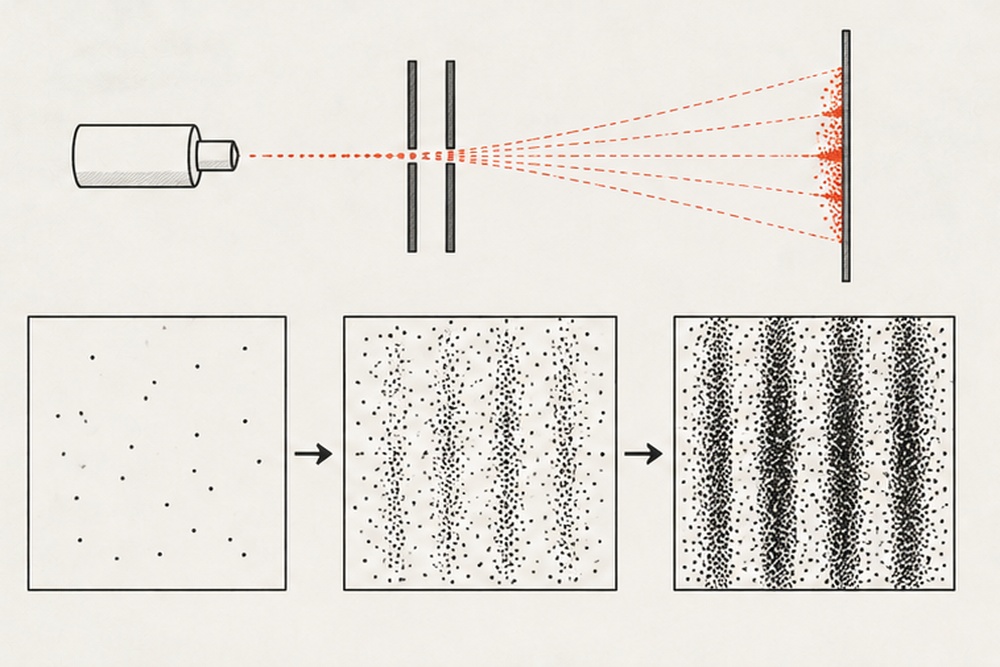
Figure F06-04. One at a time, each electron lands as a single dot — and together the dots paint the stripes of a wave that went both ways.
The demolition crew
By 1925 the Bohr model was a ruin held up by tourism, and the demolition-and-rebuild was carried out, in an astonishing rush, by men mostly in their twenties — Knabenphysik, the elders called it, boys’ physics. Werner Heisenberg, twenty-three, beached by hay fever on the grassless North Sea rock of Helgoland in June 1925, resolved to expel from theory everything unobservable — orbits, paths, the entire planetary scenery — and to build only from what atoms actually deliver: the frequencies and strengths of their spectral lines. The mathematics he improvised (with Max Born and Pascual Jordan supplying its proper machinery, and a parallel construction from the young Englishman Paul Dirac) was abstract beyond anything physics had used, and it worked. Six months later, over Christmas 1925 in a Swiss sanatorium, Erwin Schrödinger — at thirty-eight a near-pensioner by the standards of the moment — took de Broglie’s matter waves and asked the natural question: if the electron is a wave, what is the equation of the wave? His answer, the Schrödinger equation, became to the small-scale world what Newton’s laws are to the large: the engine room of all that followed. Feed it the hydrogen atom and the energy staircase tumbles out — rung by rung, Balmer line by Balmer line — not decreed but derived, the natural harmonics of an electron-wave caught in the nucleus’s grip, an atom’s levels no more mysterious than a flute’s notes. Feed it helium, Bohr’s nemesis, and (with labour) the right answers emerge; feed it molecules, metals, anything, and it has never once been caught in error. The two rival theories, Heisenberg’s and Schrödinger’s, so unlike in spirit, were swiftly proved mathematically identical: one theory in two dialects. Physicists, given the choice, overwhelmingly took the waves.
But what is the wave? Schrödinger hoped it was the electron itself — matter genuinely smeared out, charge spread like butter — and the hope failed within months: his equation’s waves disperse and overlap, while the world’s electrons stubbornly arrive whole, as dots. The answer that stuck came from Max Born in 1926, in a paper whose crucial sentence was added almost as a footnote: the wave is a wave of probability. Where the wave runs high, the electron is likely to be found; where it runs to nothing, never — the wave carries the odds, and the dot, when sought, falls by them. Run the electrons one at a time through the double slit and Born’s rule is exactly what you watch in action: each dot random, the stripes their statistics. This is the point where physics parted company with two and a half millennia of assumption. Quantum mechanics does not predict events; it predicts their betting odds — perfectly, repeatably, to as many decimal places as anyone has ever checked — while declining, even in principle, to say which allowed outcome any single throw will yield. The lawlessness Bohr had smuggled in with his jumps was now the constitution.
KEY CONCEPT — Uncertainty, properly understood In 1927 Heisenberg distilled the new mechanics into its famous principle: position and momentum are a strict trade-off. The more sharply an electron’s position is pinned down, the more wildly indefinite its momentum becomes, and vice versa — with Planck’s h setting the exchange rate, which is why the trade passes unnoticed at human scales. Two misreadings to avoid. It is not a confession of clumsy instruments, as though the electron has a crisp position and speed we are too ham-fisted to read; in a wave-built world the two properties cannot be simultaneously sharp, any more than a musical chord can sound at a single instant — sharpness of one is built from spread in the other. And it is not a licence for “everything is uncertain” hand-waving: the principle is quantitative, austere, and the reason matter exists at all. Squeeze an electron toward the nucleus and its momentum-spread soars, pushing back — that resistance, not the hardness of any little ball, is why atoms have size, why your chair holds, why the void of chapter 5 feels solid. The emptiness pushes back because of a trade-off in a wave.
The picture of the atom this leaves — the electron as a standing cloud of probability lapped around the nucleus, dense where the odds run high, structured in the beautiful harmonic shapes we will tour in chapter 8 — is the one physics holds today, essentially unretouched in a century.
The argument that never ended
Not everyone signed. At the 1927 Solvay conference in Brussels — the most concentrated gathering of intellect in scientific history; seventeen of the twenty-nine in the famous photograph took Nobel Prizes — Einstein opened a campaign against the new orthodoxy that he would prosecute, with undiminished ingenuity and undiminished failure, for the rest of his life. God, he insisted, does not play dice; Bohr is said to have grown weary enough to retort that Einstein should stop telling God what to do. Morning after morning Einstein produced thought experiments to corner the theory into contradiction; evening after evening Bohr, sleepless and muttering, found the flaw. The deepest of Einstein’s challenges — whether the quantum description is complete, or merely the visible part of some crisper hidden machinery — outlived them both, sharpened into experiment, and yielded one of the most astonishing results of twentieth-century physics; it waits for us, with the fate of his dice, in chapter 18.
What no one disputed, then or since, is that the machinery works. Quantum mechanics is the most stringently tested construction of the human mind — in its mature form its predictions have been verified to better than one part in a billion — and, lest it seem a connoisseur’s pleasure, it is also the working manual of the modern world: every transistor in every device you own is an applied quantum effect, as are the laser, the LED, the solar cell, and — as the next chapters will show — the whole of chemistry. By 1927, then, the electron half of the atom had its constitution. But the fortress at the centre had been keeping secrets throughout. The nucleus still owed physics an explanation of Mendeleev’s table, an identity for its inhabitants, and an account of where radioactivity’s energy was banked — and in settling those accounts it would deliver the twentieth century its hinge. The cast completes in the next chapter; the bill arrives at Hiroshima.
Chapter 7 — Completing the Cast
“Perhaps you can suggest some fantastic explanation.” — Otto Hahn, writing to Lise Meitner, December 1938
The number under the table
Three loose threads now dangle from our story, and this chapter ties them off — at a price nobody foresaw.
Thread one, from chapter 3: the periodic table works, but tellurium and iodine sit in defiance of its official ordering principle, and nobody knows why the table works at all. Thread two, from chapter 5: the alpha-scattering counts hinted that a nucleus’s electric charge is a definite whole number of units, roughly half the atomic weight — two different numbers per element, marching almost but not quite in step. Thread three, from chapter 4: radioactive atoms transmute, pouring out energy from some account book physics had not yet found. Pull the threads in order — 1913, 1919, 1932, 1938 — and the atom’s cast assembles: proton, neutron, and a finale that moved physics from the laboratory bench to the centre of world history.
The first pull belongs to a young man with two years to live.
Henry Gwyn Jeffreys Moseley — “Harry” — joined Rutherford’s Manchester circus in 1910, aged twenty-two: Eton and Oxford, ferociously methodical, famous in the laboratory for working until three in the morning on cold tea. By 1913 he had taken up a brand-new tool. It had just been discovered that X-rays could be sorted by wavelength (a crystal serves as the sorting grille, its orderly ranks of atoms acting like the slits of chapter 6), and that when the elements themselves are made the target of an electron beam, each emits its own characteristic X-rays — a barcode again, but this time in the X-ray band, generated by the atom’s innermost electrons, the ones living hard against the nucleus and feeling its charge almost undiluted.
Moseley measured these X-ray signatures for element after element — aluminium, silicon, on up the table — and found the cleanest staircase in the history of measurement. Arrange the elements in periodic-table order and the X-ray frequencies climb with perfect regularity: a fixed, equal step from each element to the next, with none of the wobble and stutter of the atomic weights. (Technically it is the square root of the frequency that climbs in equal steps; the reader may file the detail and keep the staircase.) The conclusion was as solid as the data. There exists, inside each atom, a quantity that increases by exactly one, element to element, rung by rung, all the way up the table — and Bohr’s new atomic model identified it at once: it is the positive charge on the nucleus, counted in whole units. Moseley had found the table’s true ordering principle. Not atomic weight — Mendeleev’s near-miss, right for the deep reason that weight roughly tracks charge — but atomic number: the integer charge of the nucleus, written Z.
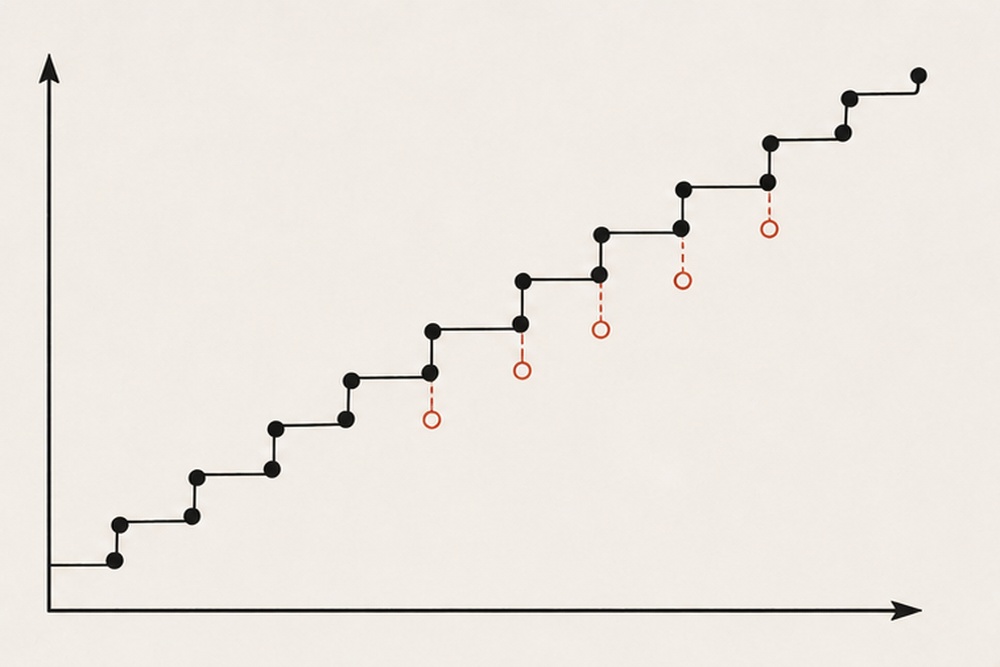
Figure F07-01. Moseley’s staircase: one exact step per element. The height of each tread is set by the whole-number charge of the nucleus — the atomic number, the table’s true ordering principle. Open circles mark the vacant treads of elements not yet discovered when Moseley made the measurement.
Everything snagged on the old ordering came loose at once. Tellurium before iodine? Correct and required: tellurium’s nuclear charge is 52, iodine’s 53; their atomic weights, for reasons waiting a few pages ahead, simply happen to break step — Mendeleev’s swap vindicated by a number he never knew existed. How many elements are there? For the first time, a definite answer: the staircase from hydrogen (Z = 1) to uranium (Z = 92) has exactly ninety-two treads, and Moseley could say precisely which were vacant — numbers 43, 61, 72, 75 and a few more, reserved seats whose occupants were hunted down over the following decades, the last natural stragglers only in the 1940s. Chemistry’s deepest question — what makes an element the element it is? — had its final answer: not weight, not appearance, not history, but a single integer. An atom of gold is an atom of gold because its nucleus holds seventy-nine units of charge; change that number and you change the element, which is what (it was now clear) radioactive transmutation had been doing all along: alpha decay carries off two units, dropping the atom two seats down the table; beta decay adds one, nudging it one seat up.
Moseley’s work was instantly recognised across the world as Nobel-class. He never received the prize: it is not awarded posthumously. When war broke out in 1914 he insisted, over every objection, on enlisting, and on 10 August 1915, at Gallipoli, in the middle of relaying an order, a Turkish sniper shot him through the head. He was twenty-seven. The waste was felt internationally as a kind of scandal — one obituarist judged his death alone enough to make the war an unforgivable crime against science — and Britain thereafter took deliberate care to keep its scientists from the trenches. It is as close as the periodic table comes to having a war memorial.
KEY CONCEPT — Two numbers, finally sorted Every atom now carries two labels, and the rest of this book leans on the distinction constantly. The atomic number, Z, is the count of positive charge units in the nucleus: it fixes how many electrons a neutral atom holds, therefore all of its chemistry, therefore which element it is. The mass number, A, is (we shall see within a few pages) the count of heavy particles of all kinds in the nucleus: it fixes, near enough, the atom’s weight. Z is identity; A is heft. Two atoms sharing Z but differing in A are the same element in different weights — and that single sentence, once the cast of particles is complete, will dissolve every weight anomaly from Prout to tellurium.
Knocking the first brick loose
If the nucleus has a charge of Z whole units, what carries the units? Rutherford — by now Sir Ernest, and from 1919 director of the Cavendish itself, in succession to J.J. Thomson — answered in his usual fashion: by shooting at it.
Through the war years (between submarine-detection work; he once excused his absence from a military committee by remarking that he had been engaged in splitting the atom, which he judged the greater matter), Rutherford had been firing alpha particles through gases. In nitrogen he found something that should not have been there: occasional long, thin tracks of a particle far lighter and more penetrating than any alpha — a particle that all tests identified as the nucleus of hydrogen, the lightest nucleus of all, carrying exactly one unit of charge. Hydrogen nuclei, struck out of pure nitrogen. The conclusion, nailed down by 1919 and confirmed in beautiful cloud-chamber photographs over the following years (an occasional alpha track ending in a tiny fork: the collision itself, caught on film), was epochal twice over. First: the hydrogen nucleus is not merely hydrogen’s core but a universal building block, present inside other nuclei — Rutherford christened it the proton, from the Greek for “first.” Z counts protons. Second, almost in passing: an alpha particle entering a nitrogen nucleus and a proton leaving means the nitrogen has become something else (oxygen, as it proved). Transmutation — which radioactive atoms had been performing spontaneously, on their own inscrutable schedule — had for the first time been performed on demand, by human choice. The newspapers announced that Rutherford had split the atom, and for once the newspapers were not far wrong.
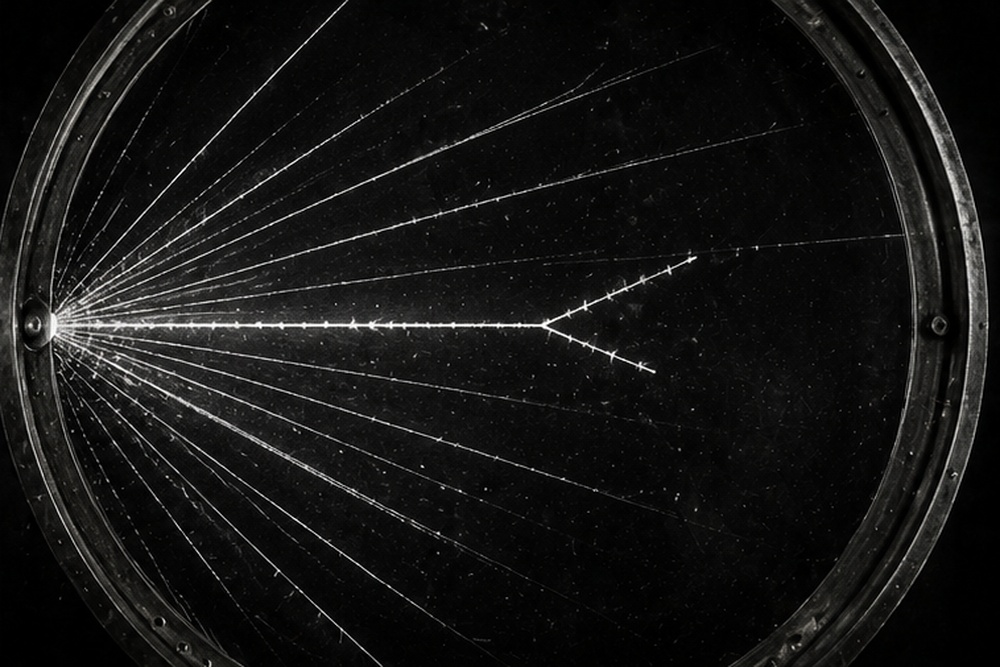
Figure F07-02. Collisions made visible: in a cloud chamber, charged particles condense threads of mist along their flight. A fork at the end of one track is a direct photograph of a nucleus being struck — and changed.
But protons alone could not be the whole nucleus, and simple arithmetic said so. Helium: charge 2, but weight 4. Gold: charge 79, weight 197. Every nucleus beyond hydrogen weighs roughly twice or more what its protons can account for. Something else, heavy but electrically invisible, had to be in there. The 1920s consensus patched the hole with the materials to hand — perhaps the nucleus contained extra protons whose charge was cancelled by electrons imprisoned alongside them — but the patch tore on quantum mechanics: chapter 6’s uncertainty trade-off forbids it, since an electron confined to a space as tiny as a nucleus would acquire so furious a momentum-spread that nothing nuclear could hold it. Rutherford, in a remarkable 1920 lecture, cut to the answer by sheer instinct: there should exist, he proposed, a neutral particle of about the proton’s mass — he was soon calling it the neutron — and he set his Cavendish lieutenants hunting it. The hunt took twelve years, for the most practical of reasons: every detection trick physics owned worked by electricity — deflect the particle, collect its charge, watch it ionise — and a neutral particle answers to none of them. You cannot interrogate what will not feel your fields. A neutron could be caught only indirectly, by the damage it does.
Same element, different weights
While the hunt ran, the weight side of the ledger was being transformed by a parallel discovery, and our second dangling thread comes down.
It had emerged from the radioactivity boom that certain distinct radioactive substances — different histories, different half-lives — were chemically inseparable: not similar, identical, occupying a single seat in the periodic table. Frederick Soddy, Rutherford’s old transmutation partner, named such cohabitants isotopes — “same place” — in 1913 (the word was suggested over dinner by a family friend, the Scottish doctor and novelist Margaret Todd). The clincher came from lead, the ash at the bottom of the radioactive decay chains: lead distilled from uranium ores and lead from thorium ores proved chemically identical but measurably different in atomic weight. Same Z, different A: one element, several weights.
Then came the discovery that this was no quirk of the radioactive heavyweights. At the Cavendish, J.J. Thomson and his assistant Francis Aston, sorting beams of neon atoms with electric and magnetic fields (the interrogation of chapter 4, refined), found ordinary, stable, inert neon splitting into two streams — one of weight 20, a fainter one of weight 22. After the war Aston built the definitive instrument, the mass spectrograph, a precision scale for individual atoms, and put the whole periodic table through it. Two results tumbled out, and together they cleaned up a century of confusion. First, most elements are mixtures of isotopes — tin runs to ten of them. Second, the whole-number rule: weigh any single isotope and the answer lands within a whisker of a whole number (on the scale where hydrogen is 1). The messy fractional atomic weights that had bedevilled chemistry since Dalton — chlorine’s notorious 35.5 — were exposed as averages: chlorine is simply a 3-to-1 blend of isotopes weighing 35 and 37, and its “atomic weight” is bookkeeping across the blend. A speculation a century old was thus half-vindicated: in 1815 the London physician William Prout had noticed how many atomic weights sat near whole multiples of hydrogen’s and proposed that all elements were built of condensed hydrogen — an idea killed in its cradle by chlorine’s stubborn fraction. The fraction was a blend; the building blocks were real. And tellurium–iodine, at very long last, closes: tellurium (Z = 52) happens to be blessed with heavy isotopes and iodine (Z = 53) with a single lighter one, so the averages break step while the charges march in perfect order. Mendeleev’s instinct, Moseley’s staircase and Aston’s scale lock together without a seam.
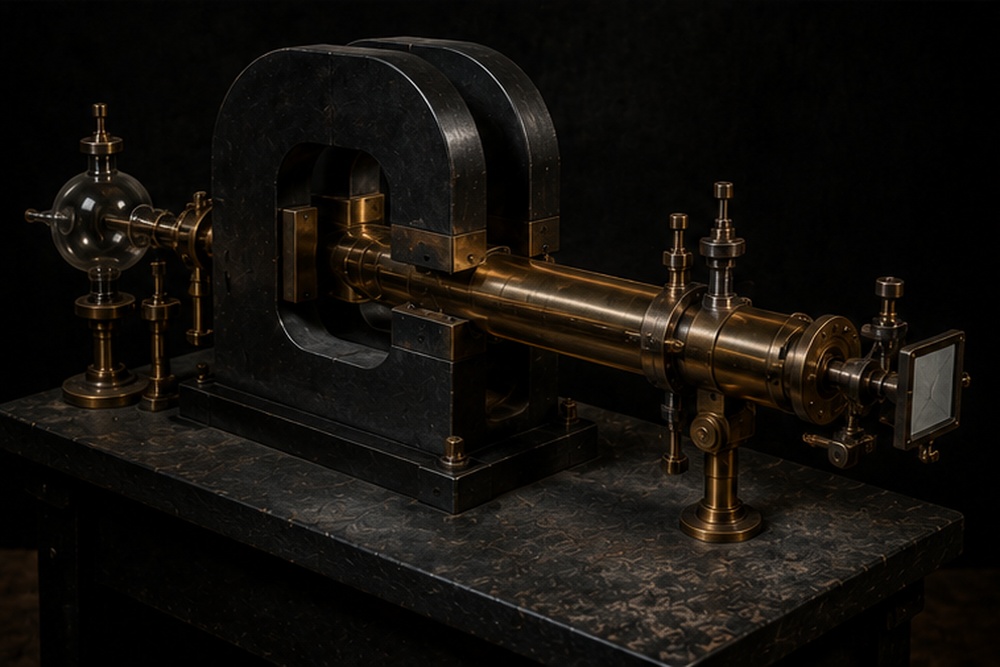
Figure F07-03. A precision scale for atoms: the mass spectrograph sorts atoms by weight along curved paths through electric and magnetic fields. It revealed that most elements are blends of isotopes — and that each pure isotope weighs almost exactly a whole number.
Almost exactly a whole number. Aston’s instrument was precise enough to measure the almost, and recorded that every nucleus weighs slightly less than the sum of its building blocks bought separately — helium about one per cent light, every element shaved by its own small, characteristic sliver. He could measure the discrepancy; he could not spend it. Hold that sliver of missing mass in mind. It is the bill for everything in the last third of this chapter, and chapter 9 will pay it in full.
1932: the year of the neutron
The hunt for Rutherford’s neutral particle ended in 1932 — physics’ annus mirabilis, as it is still called — and the endgame is a study in interpretation, because three laboratories held the decisive evidence and only one understood it. In Germany, Walther Bothe and Herbert Becker had found that beryllium, under alpha bombardment, emitted something of extraordinary penetrating power, which they took for gamma rays. In Paris, Irène Joliot-Curie — Marie’s daughter, raised in the family trade — and her husband Frédéric Joliot put the mystery radiation to paraffin wax, a material rich in hydrogen, and found it knocked protons out at startling speed; they too clung to the gamma-ray reading, though it required the supposed gamma rays to hit like cannon fire. At the Cavendish, James Chadwick — Rutherford’s quiet, careful second-in-command, who had spent the entire First World War interned in a German civilian camp (improvising radioactivity experiments in the stables with toothpaste as a reagent source) and the entire decade since intermittently hunting his chief’s predicted particle — read the Paris paper at breakfast and reportedly informed Rutherford within the hour that he did not believe a word of the interpretation. Light cannot punt heavy: a chargeless wave packet bouncing protons around like billiards violated energy bookkeeping by an order of magnitude. But a neutral particle with the proton’s own mass would do everything seen, effortlessly. Chadwick barely left the laboratory for the next month — colleagues recalled him radiating exhaustion — battering targets, measuring recoils, closing every loophole, and in February 1932 announced the neutron: mass a shade over the proton’s, charge exactly nothing. The Nobel committee, which had passed over so many, moved almost briskly: Stockholm, 1935.
With the neutron in hand, the atom’s construction set was complete, and within months Heisenberg had written down the modern nucleus: protons and neutrons, packed together — Z protons carrying the charge and the identity, plus N neutrons adding heft and (in ways chapter 9 will explore) glue, the two together making the mass number A. Every anomaly in this book’s first half now reads off the model at sight. Isotopes? Same protons, different neutrons. The whole-number rule? A counts particles of near-identical weight. Helium’s charge-2, weight-4? Two protons, two neutrons — and the alpha particle is simply that foursome, ejected whole. The atom of 1932: a nucleus of protons and neutrons, ten-thousandth of the atom’s width, holding 99.9 per cent of its mass; around it, Z electrons in their quantum harmonics; and between, the void. Three particles, one staircase of charge from 1 to 92, and the whole material world — every substance ever touched, smelted, brewed or breathed — assembled from nothing else.
It was, by any sane reckoning, a moment for satisfaction. It lasted about two years.
KEY CONCEPT — The neutron is a key The neutron solved the nucleus, and then immediately unlocked it. Every previous projectile — alpha, proton — carries positive charge, and so does every target nucleus; the projectile must therefore fight uphill against ferocious electrical repulsion, and against heavyweight nuclei like uranium’s (charge 92) it essentially cannot arrive at all. The neutron feels none of that. Chargeless, it strolls through the electrical defences of any nucleus on the table and knocks on the door itself. Slow it down, counterintuitively, and it works better — a dawdling neutron loiters in the nucleus’s grip long enough to be captured. Physics had spent thirty years picking at nuclei with charged needles. In 1932 it was handed a skeleton key.
The key turns
What follows ran on a fuse of barely seven years, and its theatre was a Europe sliding into catastrophe — the two facts are not separable, and this book will not pretend they are.
First, Paris took its redemption. In 1934 the Joliot-Curies, alpha-bombarding aluminium, noticed their target kept radiating after the source was removed: they had manufactured a radioactive isotope of phosphorus — the first artificial radioactivity, the conversion of stable matter into radioactive matter by human act. The discovery (Nobel, 1935 — the family’s fifth) multiplied medicine’s and biology’s toolkit overnight, since tailor-made radioactive atoms can be traced through bodies and reactions like tagged banknotes. Marie Curie, dying that summer of the slow harvest of her own discoveries, examined the evidence in her daughter’s notebook weeks before the end; those present recalled her unmistakable joy.
Then Rome raised the stakes. Enrico Fermi — of whom much more in Part II; enough now that colleagues nicknamed him “the Pope” for his apparent infallibility — grasped the skeleton-key logic instantly and, with his young team, set about neutron-bombarding every element in the cupboard, in atomic-number order. Along the way they stumbled on the slow-neutron effect (a paraffin block, interposed on a hunch one October morning in 1934, multiplied their induced radioactivities a hundredfold — neutrons slowed by bouncing among light atoms are captured far more greedily). At the top of the table they bombarded uranium, element 92, found a confetti of new radioactivities, and drew the obvious conclusion: neutron capture followed by beta decay should nudge uranium up the staircase, so they had presumably created the first elements beyond nature — numbers 93 and 94. The claim made headlines and contributed to Fermi’s 1938 Nobel Prize. It was wrong — magnificently, productively wrong — and one person said so at the time. The German chemist Ida Noddack published, in 1934, the suggestion that nobody had excluded a wilder reading: that the uranium nucleus might have broken into large fragments — elements from the middle of the table. Her paper was ignored by essentially everyone, Fermi included; the objection felt physically illiterate, since on every existing picture of the nucleus, chipping off small pieces was conceivable but cleaving the whole edifice was energetic fantasy. File her name where this book files Avogadro’s.
The truth surfaced in Berlin, in chemistry of the most exacting kind, performed by half a partnership. Otto Hahn, master radiochemist, and Lise Meitner, master physicist — an Austrian Jew who had been the second woman in the world to take a physics doctorate at Vienna and had run the physics of their joint institute for thirty years — had been untangling Fermi’s uranium confetti since 1935. In 1938 the Anschluss stripped Meitner of the Austrian citizenship that had shielded her; with arrest a live possibility she fled, at an hour’s packing, over the Dutch border to eventual refuge in Stockholm, and the collaboration continued by post. That December, Hahn and his assistant Fritz Strassmann, chasing one uranium product through ever finer chemical separations, were forced to a conclusion Hahn confessed he could hardly bring himself to print: the substance was barium — element 56, the middle of the table, half a uranium. Chemistry does not lie, but this seemed to; Hahn wrote to Meitner pleading for some fantastic explanation.
She supplied it within days, on a snow-walk near the Swedish village of Kungälv that Christmas, with her nephew Otto Frisch — another refugee physicist — beside her on skis. Sitting on a log, working on scraps of paper, aunt and nephew assembled the physics. Picture the heavyweight nucleus (as Bohr had taught) not as a rigid solid but as a liquid drop, its ninety-two protons straining to fly apart by mutual repulsion, restrained — barely — by the nuclear glue’s surface tension. Uranium, they realised, sits at the very limit of that bargain. A single slow neutron, absorbed, sets the drop wobbling; the wobble necks; the neck snaps; and the drop divides into two smaller drops — barium and its partner — which then, both fiercely positive, hurl each other apart electrically with colossal violence. How colossal? Meitner, on the log, did the audit this book has been preparing for three chapters. Add up the masses of the fragments and they come to slightly less than the original uranium — Aston’s missing sliver again, about a fifth of a proton’s worth — and Einstein’s 1905 equivalence of mass and energy (the famous equation; its full meaning is chapter 9’s business) converts that sliver at light-speed-squared rates into roughly twenty million times the energy of any chemical reaction, atom for atom. The books balanced perfectly. Frisch, back in Copenhagen, confirmed the fragments’ violence at the bench within weeks, and — borrowing from a biologist friend the term for a cell dividing — gave the process its name: fission.
The end of Part I
The news ran through world physics in January 1939 like current through a wire — Bohr himself carried it to America, working the theory out in mid-Atlantic — and the community converged within weeks on the implication that mattered. Fission, alone among nuclear reactions, is self-serving: each splitting uranium nucleus, besides its two fragments and its gust of energy, releases two or three fresh neutrons — and neutrons are precisely the key that turns the lock. One fission could breed two; two, four; four, eight: a chain reaction, matter igniting matter, the energy of Meitner’s audit multiplied through kilograms rather than atoms. The idea was not even new: the Hungarian physicist Leó Szilárd had conceived it abstractly in 1933 — at a London street crossing, irritated, the story goes, by that morning’s newspaper report of Rutherford dismissing atomic power as moonshine — and had kept his patent on it deliberately secret. Now the abstract had an element. In August 1939, Szilárd drafted, and Einstein signed, a letter to the American president noting that a new and extremely powerful kind of bomb had become conceivable, and that Germany — where fission had been discovered, where Heisenberg still worked — had stopped exporting uranium ore.
What followed belongs mostly to other books, and partly to chapter 12 of this one, where the physics of reactors and the stellar origins of nuclear energy are treated in their own right. Here, the bare hinge. In December 1942, under the football stands of the University of Chicago, Fermi — a refugee himself by then, having travelled on from his Stockholm prize ceremony to America with his Jewish wife Laura rather than return to fascist Italy — assembled a lattice of graphite and uranium and let the first man-made chain reaction run, gently, for twenty-eight minutes. Thirty-one months later, the desert at Alamogordo, then Hiroshima and Nagasaki: a quarter of a million human beings dead by the splitting sliver of mass that Aston had weighed, Meitner had audited on a log in the snow, and Hahn could hardly believe. Hahn alone received the Nobel Prize for fission; Meitner — exiled, omitted, her name absent from the Berlin papers her physics explained — refused throughout her long life to work on weapons, and element 109, meitnerium, now outranks any prize. Rutherford, mercifully or not, saw none of it; he had died in 1937, delayed surgery and the protocol that a peer must be cut by a peer contributing to the loss, his ashes laid near Newton’s in Westminster Abbey. His moonshine dismissal of atomic power survives as science’s standing lesson in humility about its own forecasts: the chain reaction ran within a decade of the remark.
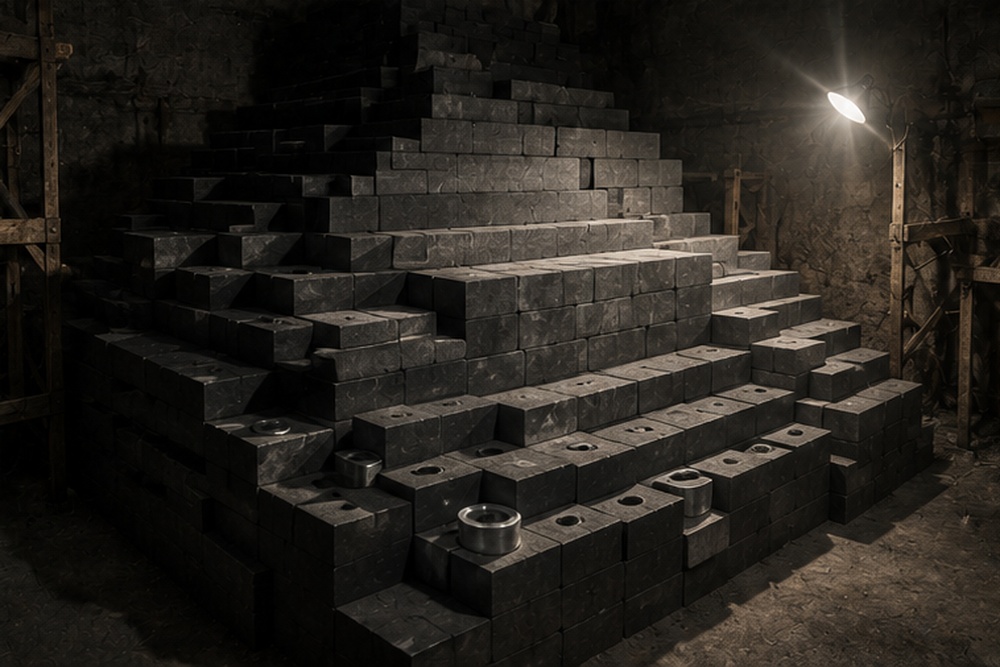
Figure F07-04. Graphite and uranium, stacked by hand under a Chicago grandstand: the first controlled chain reaction, December 1942. Part I of this book ends where the laboratory notebook ends and the history of nations begins.
And here Part I of this book closes, because the story of discovery — the twenty-four-century detective serial from Democritus’ thought experiment to a completed cast of three particles — is told. Electron, proton, neutron; the staircase of ninety-two; the void, the staircase of energies, the probability wave; matter understood from gold ring to nucleus, and the understanding already, within a decade, remaking medicine, energy, war and the moral standing of science itself.
What Part I has not done is sit still with the finished picture and examine how it actually works — why those electron waves arrange themselves into the shells that generate the periodic table; what glue overrules the repulsion of ninety-two protons, and what that glue itself is made of; how atoms join into the molecules and materials of the world; where the atoms themselves were manufactured. These are not historical questions but structural ones, and Part II accordingly changes gear: less biography, more anatomy — a guided tour of the modern atom, system by system, conducted at a steadier and somewhat more rigorous pace. The detective story is over. The anatomy lesson — on the liveliest subject in science — begins.
Part II — Anatomy
Chapter 8 — Clouds, Not Orbits
“I was unable to give a logical reason for the exclusion principle.” — Wolfgang Pauli, Nobel lecture, 1946
8.1 From orbit to orbital
Part I ended with the atom’s cast complete: a nucleus of protons and neutrons, surrounded by electrons governed by the quantum mechanics of chapter 6. Part II begins by asking the question that Part I’s narrative momentum kept deferring: what does that arrangement actually look like, and why does it generate the chemistry we observe? This chapter answers for the electrons; the next descends into the nucleus.
We must first be precise about what was abolished in 1926 and what replaced it. The Bohr–Rutherford picture assigned each electron a trajectory: a definite path, traversed in time, like a planet’s. Quantum mechanics removed trajectories not as a simplification but as a matter of principle — the uncertainty trade-off forbids an electron from possessing simultaneously the sharp position and sharp momentum that any path requires. What the Schrödinger equation provides instead, for an electron bound to a nucleus, is a set of allowed stationary states, each described by a mathematical object called a wavefunction and each possessing a definite energy. The wavefunction’s physical content, on Born’s rule, is statistical: its intensity at any point gives the probability of finding the electron there, should one look.
The standard visual translation of a stationary state is the orbital: a three-dimensional map of where the electron’s probability is concentrated — conventionally drawn as the surface enclosing, say, ninety per cent of it. The change of suffix from orbit to orbital is small; the change of meaning is total. An orbital is not a path the electron follows. It is a standing pattern — chapter 6’s guitar-string harmonics, promoted to three dimensions — that simply is the electron’s state of residence. An electron in the ground state of hydrogen is not circling anywhere; it is, so far as the question has meaning, a spherical haze of probability centred on the proton, densest at the centre and thinning outward without a sharp edge. When this book speaks of the electron “cloud,” that is the intended sense: a cloud of probability, static in overall shape, for as long as the atom is left undisturbed.
One consequence deserves immediate notice, because it quietly answers a question every reader of chapter 5 should have banked: what fixes the size of an atom? A nucleus is a point, for practical purposes; the atom’s hundred-thousand-fold larger bulk is entirely the size of its electron clouds, and that size is set by the compromise described at the end of chapter 6 — electrical attraction pulling the cloud inward, the uncertainty trade-off making over-confinement expensive. The balance point, for hydrogen, sits near a tenth of a millionth of a millimetre, and all atoms, light or heavy, come out within a factor of a few of that figure. Atoms have the size they do because of Planck’s constant; were h smaller, matter would be denser in proportion, and chemistry unrecognisable.
8.2 The address system
Solving the Schrödinger equation for an electron bound to a nucleus yields not one stationary state but an infinite catalogue of them, and the catalogue is indexed by integers — the whole numbers of this book’s running motif, now in their permanent home. Three integers label each orbital; a fourth, introduced in §8.4, labels the electron occupying it. Together they constitute an electron’s complete quantum address.
The principal quantum number, n (1, 2, 3, …) is Bohr’s old rung number, retained and reinterpreted. It sets the orbital’s overall size and, dominantly, its energy: n = 1 is the compact, deeply bound ground floor; each higher n is a larger, looser, more energetic cloud. Orbitals sharing a value of n are said to form a shell.
The orbital angular momentum number, ℓ (0, 1, 2, … up to n − 1) sets the cloud’s shape — how its probability is distributed in angle. Spectroscopic tradition, predating the theory, labels these shapes with letters: ℓ = 0 is s, ℓ = 1 is p, ℓ = 2 is d, ℓ = 3 is f (the letters fossilise old descriptions of spectral line families — sharp, principal, diffuse, fundamental). Within a shell, the subsets of fixed shape are called subshells: thus “2p” denotes the p-shaped orbitals of the second shell.
The orientation number, mℓ (the integers from −ℓ to +ℓ) sets the cloud’s direction in space. An s shape (ℓ = 0) admits one orientation; a p shape admits three, mutually perpendicular; a d shape five; an f shape seven.
The bookkeeping, which matters more than any other arithmetic in this chapter, runs as follows.
| Shell n | Subshells | Orbitals |
|---|---|---|
| 1 | 1s | 1 |
| 2 | 2s, 2p | 1 + 3 = 4 |
| 3 | 3s, 3p, 3d | 1 + 3 + 5 = 9 |
| 4 | 4s, 4p, 4d, 4f | 1 + 3 + 5 + 7 = 16 |
The orbital count per shell is n² — a pattern enforced by the integer rules above, not assumed. Double these figures (for reasons §8.5 supplies) and the sequence 2, 8, 18, 32 appears: the reader who recalls the structure of the periodic table will recognise the lengths of its rows assembling themselves, before a single chemical fact has been invoked.
8.3 The gallery of shapes
The shapes themselves repay a moment’s inspection, both because they recur throughout chemistry and because they make vivid the standing-wave character of the bound electron.
An s orbital is spherically symmetric: a ball of probability. The 1s orbital is a simple dense ball. The 2s is a larger ball — but not a uniform one: it consists of an inner kernel of probability, a spherical gap where the probability falls to zero, and an outer husk. Such a zero-surface is called a node, and nodes are the three-dimensional counterparts of the still points on a vibrating string: the higher harmonics of a string possess more motionless points, and the higher states of an atom possess more nodal surfaces, in exact analogy. Each step up in n adds a node; energy rises with node count. A useful slogan: an excited atom is a higher harmonic of itself.
A p orbital is a dumbbell: two lobes of probability on opposite sides of the nucleus, separated by a nodal plane passing through it — the electron is never found in that plane, and (a standing instruction to the intuition) the question of how it “crosses” from lobe to lobe is a trajectory question, and trajectory questions are void. The three p orbitals of a shell point along three perpendicular axes. d orbitals are predominantly four-lobed cloverleaves in various orientations (one member has its own idiosyncratic dumbbell-and-ring form); f orbitals are more intricate still. The details of d and f geometry matter chiefly to specialists; what matters here is their count — five and seven — and the fact that their lobed, directional forms underlie phenomena as diverse as the colours of transition-metal compounds, the magnetism of iron and the chemistry of the rare earths.
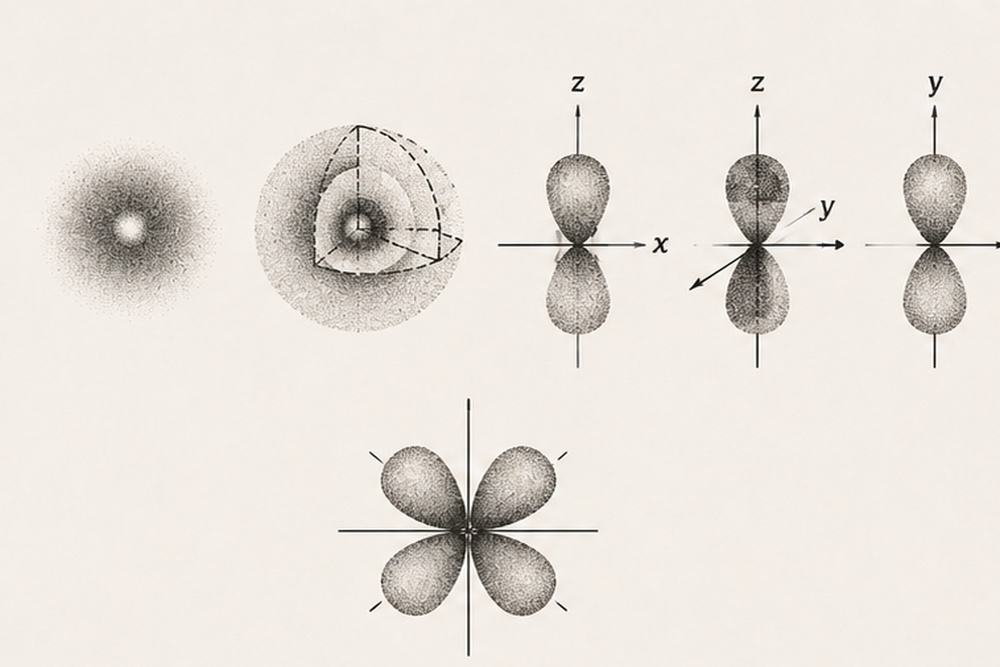
Figure F08-01. The standing waves of the atom: s spheres (the 2s shown in section, with its nodal gap), the three perpendicular p dumbbells, and a four-lobed d orbital. Higher harmonics carry more nodes and more energy.
In hydrogen — one electron, one proton, the only atom for which the equation solves exactly — all orbitals of a given shell share the same energy, and the staircase of chapter 5 is recovered intact, now with its rungs understood as harmonics and its old mysterious decrees (no radiation in a stationary state; light emitted only in jumps) flowing naturally from the wave mechanics. The agreement between calculated and measured hydrogen spectra is, in the modern refinements of the theory, among the most precise accords between thought and observation ever achieved. But hydrogen is one electron. Chemistry begins with the second — and with two discoveries of 1925 that the Schrödinger equation alone does not contain.
8.4 Spin: the fourth coordinate
The first discovery emerged from an experimental anomaly of disarming simplicity. In 1922, in Frankfurt, Otto Stern and Walther Gerlach sent a beam of silver atoms through a deliberately lopsided magnetic field. A silver atom behaves as a minute magnet; classical expectation said the atoms’ magnetic axes would point every which way, and the beam would smear into a continuous band. It did not. It split cleanly into exactly two spots — as though, interrogated about its orientation, each atom were permitted only the answers up and down, with nothing between. Repetition along any other axis gave the same binary verdict. Orientation itself, for the atomic magnet, was quantised to two values.
The interpretation crystallised in 1925: the electron carries, in addition to any motion through space, an intrinsic angular momentum — as though it were a top, eternally rotating at a fixed, unalterable rate — and with it an intrinsic magnetism. The property was named spin, and the name must immediately be half-retracted: the electron is, to the limits of measurement, a point, and a point has nothing to rotate; pictured as a tiny spinning ball, its surface would need to exceed the speed of light. Spin is better regarded as a fourth internal coordinate with no classical counterpart — a built-in two-valuedness, denoted spin-up and spin-down, written m_s = +½ and −½. Its credentials were settled beyond appeal in 1928, when the young English theorist Paul Dirac united quantum mechanics with special relativity in a single equation and found that spin, with precisely its observed properties, emerged unbidden from the union — along with a second, wholly unexpected prediction, the existence of antimatter, whose story belongs to chapter 10. Dirac would remark, in his austere way, that the equation had been more intelligent than its author.
For present purposes the consequence is one of arithmetic: an electron’s complete address comprises four quantum numbers — n, ℓ, mℓ and m_s — and each orbital, being a fixed setting of the first three, offers exactly two distinguishable tenancies, spin-up and spin-down.
8.5 The exclusion principle
The second discovery of 1925 is the load-bearing wall of all chemistry, and it was extracted not from an equation but from the periodic table itself, read with obsessive care by the Viennese prodigy Wolfgang Pauli — a theorist of legendary acuity and legendary scorn (his dismissal of one muddled paper as “not even wrong” has entered the language). Pauli asked the simplest deep question available: why don’t all of an atom’s electrons simply fall into the lowest orbital? Nothing in the Schrödinger equation forbids it; electrical attraction positively recommends it. Were it allowed, every atom would be a slightly different-sized 1s ball, with slightly different-sized chemistry — a world of bland gradation, with no families, no periodicity, no valency, and (it is not too much to say) no readers.
The observed table told Pauli the rule nature actually enforces, and he stated it in 1925 with no derivation offered — see this chapter’s epigraph; the honest admission stood for decades:
No two electrons in an atom may share all four quantum numbers.
Equivalently: each orbital accommodates at most two electrons, and those two must take opposite spins. There is no third vacancy. The Pauli exclusion principle is not a force; no repulsion, however strong, is being invoked. It is a prohibition — a constraint on which combined states are mathematically permitted to exist at all, rooted (as was understood only later, in the quantum theory of fields) in a profound theorem connecting a particle’s spin to its social behaviour. Particles with half-unit spin, the electron among them, are fermions, and fermions are absolute individualists: no two identical fermions will occupy the same state, anywhere, ever. Particles with whole-unit spin — the photon is the familiar case — are bosons, and bosons are the opposite: gregarious, happiest piled into a single shared state, which is the operating principle of the laser. The deep two-party division of nature’s particles will organise much of chapter 10.
KEY CONCEPT — Why you don’t fall through the floor Exclusion, not electricity, is the true source of matter’s solidity. Press your hand on a table: the atoms’ outer electron clouds approach one another, and for the combined system to compress further, electrons would have to crowd into orbitals already holding their permitted pair. The exclusion principle forbids it; the only alternative is promotion to higher, costlier orbitals; and the energy bill for mass promotion manifests as an enormous effective stiffness. The void of chapter 5 resists not because anything hard is present but because the bookkeeping of quantum states is full. Matter occupies space because fermions cannot share addresses — a sentence that would have satisfied Democritus and astonished him in equal measure.
With exclusion in hand, the shell arithmetic of §8.2 completes: capacity per shell is two electrons per orbital × n² orbitals — 2, 8, 18, 32 for n = 1, 2, 3, 4. The numbers of the periodic table’s rows now stand derived from first principles: from the integer-indexed harmonics of a wave equation, doubled by spin, rationed by exclusion. What remains is to build the elements and watch the table assemble.
8.6 Building the elements
The construction principle — German tradition calls it the Aufbau, “building-up,” principle — is stated in one sentence: the atoms of element Z contain Z electrons, which in the ground state occupy the lowest-energy orbitals available, subject to exclusion. One subtlety must be declared before the assembly line starts. In hydrogen, energy depends on n alone; in any atom with more than one electron, the electrons partially shield one another from the nucleus, and the shielding is felt unequally by the differently shaped clouds. An s orbital, uniquely, concentrates real probability at and near the nucleus itself (the dumbbells and cloverleaves all have nodes there), so an s electron regularly penetrates inside the shielding crowd and tastes the nucleus’s pull at nearly full strength. Penetration lowers energy; within each shell, therefore, the subshell energies split in the order s < p < d < f. The splitting is no small correction: by the fourth shell it grows so large that 4s undercuts 3d — the fourth shell’s s subshell fills before the third shell’s d subshell — and similar overtakings recur higher up. The complete filling order is summarised in the standard diagram below; its consequences include, as we shall see, the existence of the transition metals and the exile of the rare earths.
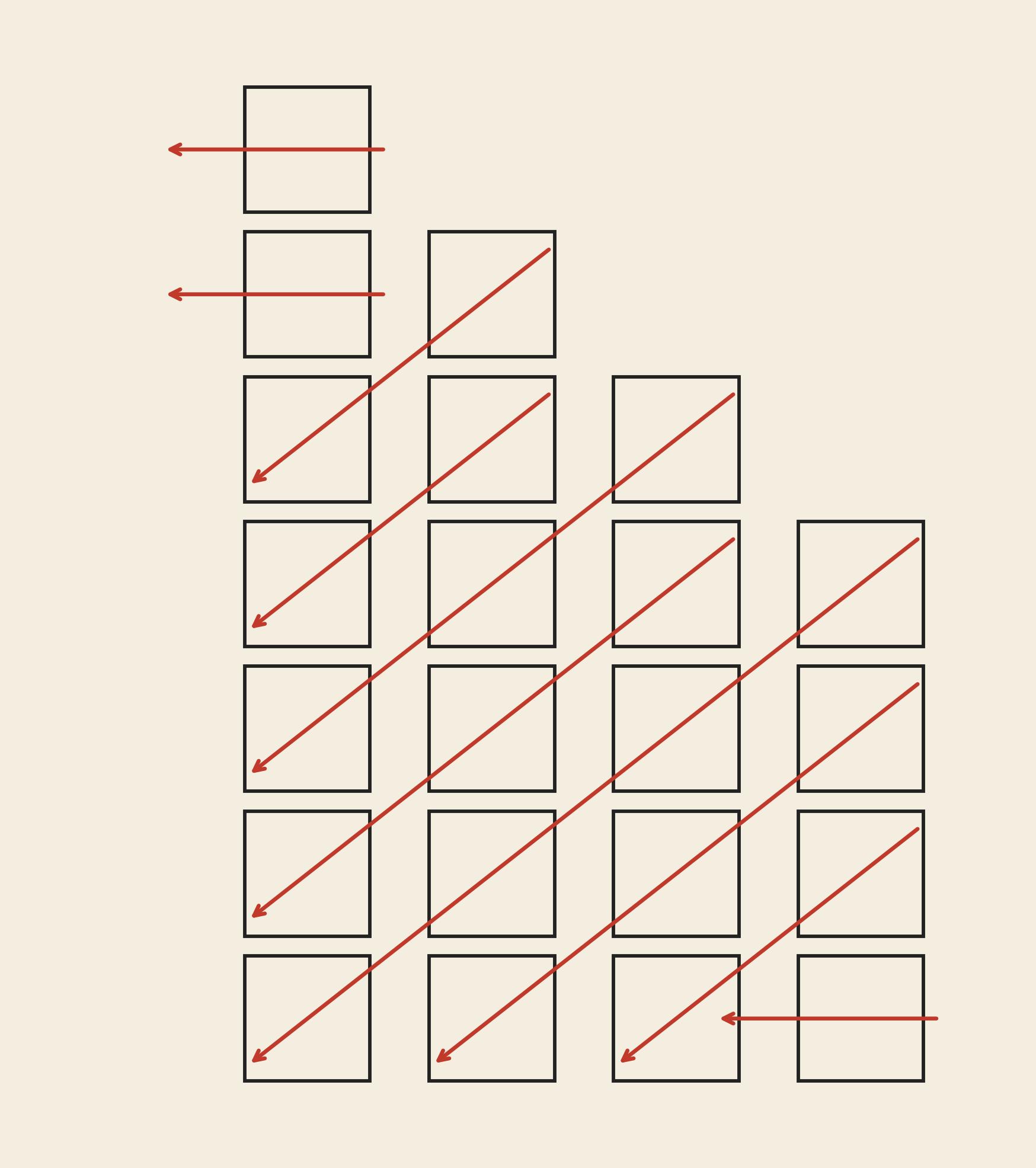
Figure F08-02. The filling order. Penetration makes s subshells cheap: 4s undercuts 3d, and the table’s long middle blocks follow. The diagonal arrows trace the sequence 1s, 2s, 2p, 3s, 3p, 4s, 3d, 4p, 5s, …
KEY CONCEPT — Reading a configuration Chemistry’s shorthand for an atom’s electron arrangement lists each occupied subshell with a superscript count: oxygen is 1s² 2s² 2p⁴, meaning two electrons in 1s, two in 2s, four in 2p. The shorthand is called the atom’s electron configuration, and the rest of this chapter is essentially an argument that the configuration — above all its outermost line — is the element’s chemical personality.
Now the assembly, with the table kept in view.
Hydrogen (Z = 1) is 1s¹. Helium (2) is 1s²: the first shell is full, and the consequences announce the whole pattern. A closed shell is compact, tightly bound, spherically tidy; it neither offers an electron cheaply nor hosts an extra one willingly. Helium accordingly reacts with nothing — the first of the noble gases, and the explanation, promised since chapter 3, of the family that Ramsay had to discover and Mendeleev could not predict.
Lithium (3) must open the second shell: 1s² 2s¹. Its chemical aspect is thereby fixed: beneath a single, loosely held outer electron sits a sealed helium-like core. Lithium’s chemistry consists almost entirely of shedding that one electron — hence a soft, eager, one-valent metal. Beryllium (4) holds 2s²; boron (5) opens 2p; and the subshell’s three orbitals then fill across carbon, nitrogen, oxygen, fluorine — with one refinement worth recording: electrons entering a set of equal-energy orbitals spread out singly, spins parallel, before pairing (Hund’s rule: like strangers boarding a bus, each takes an empty double seat while any remain). Fluorine (9), at 2s² 2p⁵, stands one electron short of a closed shell, and its character follows: the most ferociously electron-hungry element in the table, one-valent from the opposite direction. Neon (10) closes the shell — noble gas — and sodium (11), 1s² 2s² 2p⁶ 3s¹, opens the third, presenting once again a single loose electron over a sealed core.
Pause on sodium, because this is the sentence toward which three chapters have been converging. Sodium’s outer electronic situation duplicates lithium’s; and chemical behaviour is conducted almost exclusively by the outermost — the valence — electrons, since they alone meet approaching atoms, the inner shells riding deep within, screened and sealed. Identical valence patterns, therefore, mean near-identical chemistry. The periodic table repeats because electron configurations repeat. The march across a period is the progressive filling of a shell; the drop to a new row is the opening of the next; the vertical families — alkali metals, halogens, noble gases — are the recurrence, shell after shell, of the same outer arrangement. Mendeleev’s pattern, sixty years a brute fact, is the exclusion principle wearing chemistry’s clothes.
The table’s finer architecture falls out of the filling order’s crossovers. After argon closes 3p, the cheap 4s fills first (potassium, calcium) — and only then does the postponed 3d open, admitting its five orbitals’ ten electrons across scandium to zinc. These ten constitute the first row of the transition metals, and their family resemblance has a structural cause unlike the main groups’: across the row, the outermost shell stays an almost constant 4s pair while the filling proceeds one level down, in 3d. Elements whose surface barely changes as their interior fills will naturally resemble one another — hence the transition block’s broad kinship in metallicity and valency, its gift for coloured compounds and catalysis (those exposed, lobed d orbitals), and the magnetism of iron, cobalt and nickel (Hund’s parallel-spin rule, writ large in a d subshell, leaves unpaired spins whose magnetism can align grain-wide). One honest footnote: the d-block teems with small exceptions and reorderings — chromium and copper, for instance, borrow from 4s to favour half-filled or filled d sets — and the energy rivalry of ns and (n−1)d is genuinely close; the broad architecture, not the last decimal of every configuration, is the load-bearing claim.
The same logic, one floor deeper, explains the table’s basement. In the sixth row the long-postponed 4f subshell — seven orbitals, fourteen electrons — fills two levels beneath the surface, across the elements lanthanum to ytterbium. Fourteen elements whose outer two shells scarcely differ are fourteen near-twins: these are the rare earths whose indistinguishability so tormented nineteenth-century chemistry (chapter 3’s “awkward parking” now stands explained — they are conventionally drawn as a detached row purely to keep the chart’s width printable). Period lengths assemble accordingly: 2 (1s), 8 (2s 2p), 8 (3s 3p), 18 (4s 3d 4p), 18 (5s 4d 5p), 32 (6s 4f 5d 6p) — the sequence 2, 8, 8, 18, 18, 32 that every chemistry student memorises, here derived, integer by integer, from the harmonics of a wave.
| Period | Subshells filled | Length |
|---|---|---|
| 1 | 1s | 2 |
| 2 | 2s 2p | 8 |
| 3 | 3s 3p | 8 |
| 4 | 4s 3d 4p | 18 |
| 5 | 5s 4d 5p | 18 |
| 6 | 6s 4f 5d 6p | 32 |
Valency, the brute combining-power of chapter 3, now reads directly off the configurations: it is the number of electrons an atom can cheaply shed (one for sodium), or the vacancies it can fill (one for fluorine), or — the richest case, deferred to chapter 11 — the unpaired electrons it can share. The strong tendency of light atoms toward the closed 8 of a full s-plus-p octet underwrites the “octet rule” of school chemistry; its limits and the machinery of actual bonding are chapter 11’s business.
8.7 The theory under test
A claim of this generality must answer to measurement, and the cleanest single test is the ionisation energy: the energy required to strip one electron from a neutral atom, measurable to high precision for every element. If the shell picture is right, the quantity should trace a sawtooth across the table — climbing along each period as the nuclear charge mounts and the shell tightens, peaking at each noble gas’s sealed configuration, then collapsing at each alkali metal, whose lone outer electron sits high, screened and cheap. It does exactly this, element after element, period after period; the noble peaks and alkali floors are the shell structure drawn by nature’s own hand. The curve even reproduces the theory’s fine print: a dip from beryllium to boron (the new 2p electron sits above the 2s pair) and from nitrogen to oxygen (oxygen’s fourth p electron must, by exclusion, pair up in an occupied orbital, and the forced cohabitation costs energy — Hund’s rule, visible in a graph).
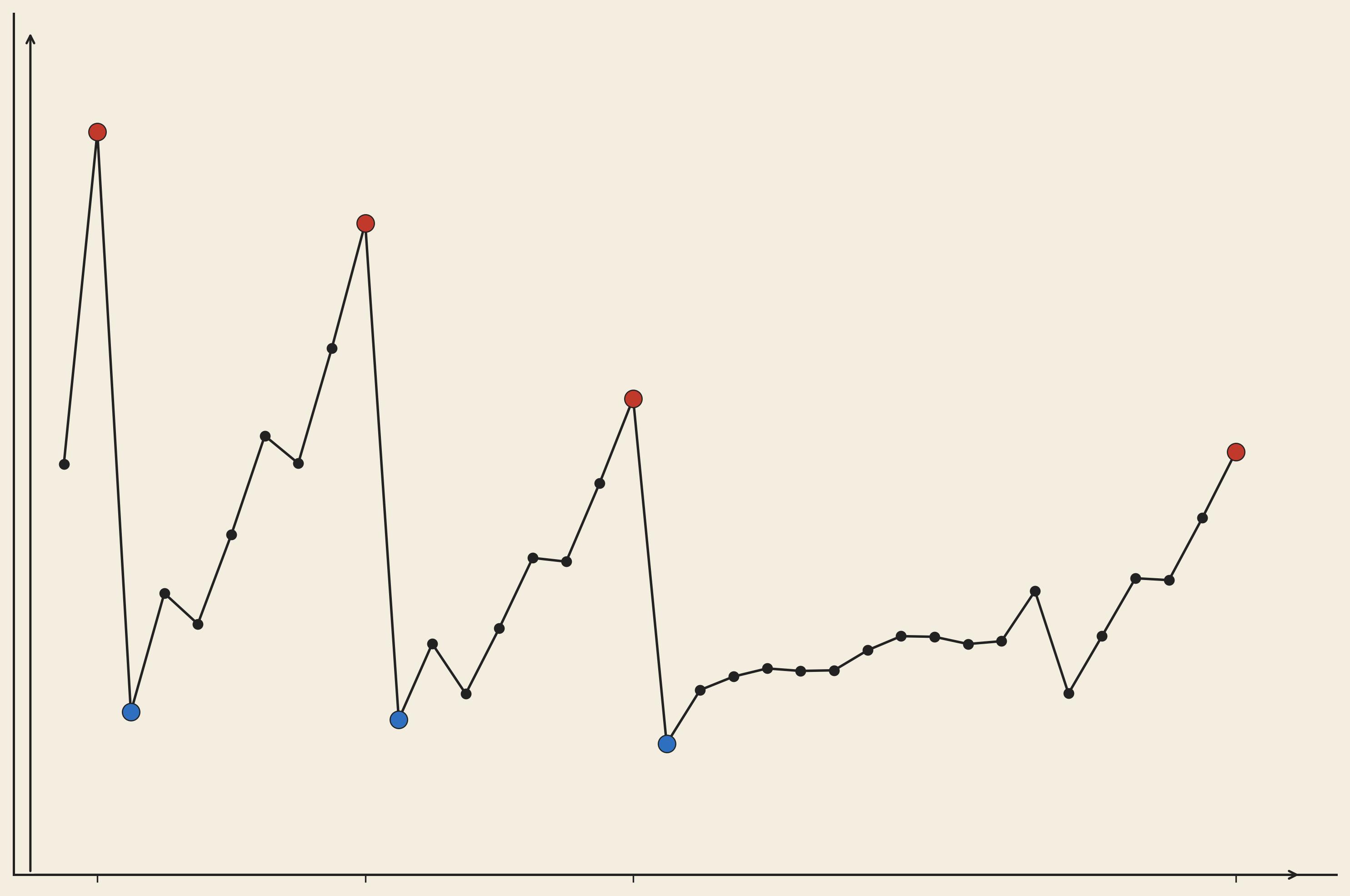
Figure F08-03. The shell structure, measured: ionisation energy saws upward across each period and collapses at each new shell. Even the small dips are theory’s fingerprints. Red peaks mark the noble gases; blue troughs mark the alkali metals.
Corroborations multiply from every quarter. Atomic sizes shrink along each period (same shell, mounting charge) and leap at each new row — measured radii comply. Moseley’s X-ray staircase (chapter 7) is the inner shells reporting for duty: his characteristic X-rays are emitted when an electron falls into a vacancy in the deep 1s level, and their clean dependence on Z reflects how nakedly those innermost electrons feel the nuclear charge. The spectra of every element — the barcodes that began this thread in chapter 3 — are computed from the orbital energy ladders, line by line, to spectroscopic precision. And the noble gases themselves, lit up in a discharge tube, advertise their individual ladders in colour: neon’s red-orange, argon’s violet, each a closed-shell atom’s private price list, sold by the metre to the sign trade.
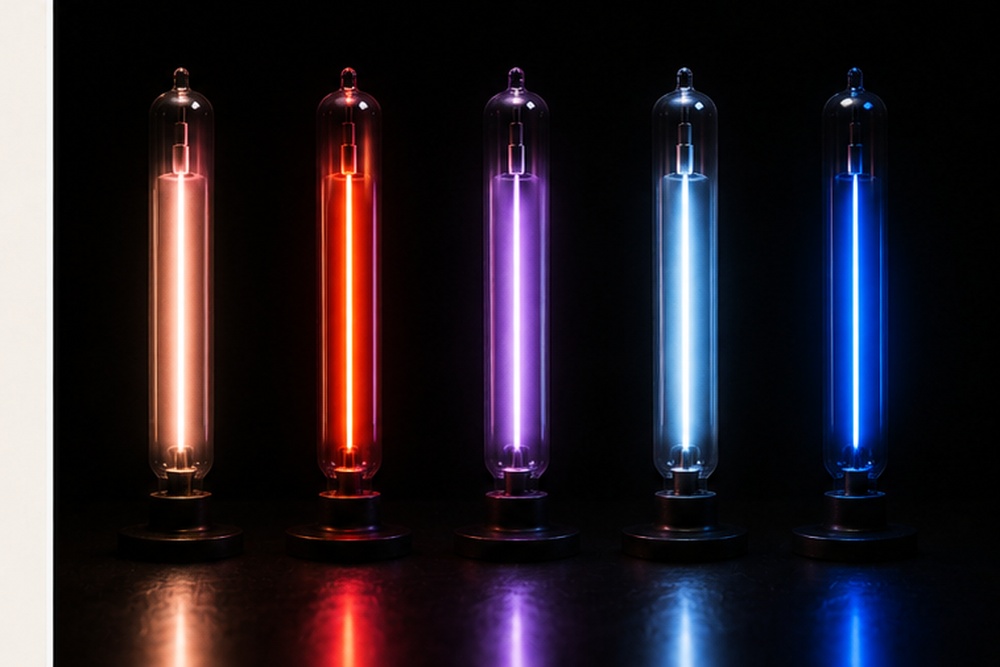
Figure F08-04. Closed shells, on display: noble gases in discharge tubes glow each with its own spectrum — neon red-orange, argon violet — the energy ladders of sealed, unreactive atoms, lit from within.
Two refinements complete the modern picture, and both reach beyond the simple Schrödinger framework. First, in the heaviest atoms the innermost electrons, gripped by nuclear charges approaching a hundred units, move at speeds where Einstein’s relativity materially intervenes, contracting the inner clouds and reshaping the outer ones. This is no curiosity for specialists: relativistic contraction of gold’s outer s orbital shifts its light absorption from the ultraviolet into the blue, and the warm yellow of gold — alone among the white-grey metals around it — is, on the standard analysis, a relativistic effect; mercury’s anomalous liquidity at room temperature has a kindred origin in its relativistically tightened, bond-shy closed 6s pair. The colour of a wedding ring is a quantum-relativistic measurement available on the human hand. Second, in strict honesty: the picture of each electron in its own private orbital is itself an approximation — electrons correlate, dodging one another in ways the one-orbital-each description averages away — and exact solutions beyond hydrogen are not available. But the equations are exact even where their solutions must be computed, and computing them is now a global industry: quantum chemistry routinely calculates the properties of molecules and materials from nothing but the principles of this chapter, a discipline whose reach Dirac foresaw in 1929 when he observed that with quantum mechanics the underlying laws for the whole of chemistry were now known, the difficulty being only that the equations were too hard to solve. Eight decades of mathematics and computing power have been spent, profitably, on his “only.”
8.8 The view from the second floor
Taking stock: the electron cloud is mapped. Orbitals — the three-dimensional harmonics of a confined wave — are indexed by integers; spin doubles each; exclusion rations them; the filling order, set by penetration and shielding, builds the elements in sequence; and the periodic table, with its families, its blocks, its parked rare earths, its sawtooth of ionisation energies and its noble colours, follows in toto. The pattern Mendeleev found and could not explain is the visible surface of four quantum numbers and one prohibition. Chemistry is the exclusion principle, iterated ninety-two ways.
But every claim in this chapter has leaned on a number it took for granted: Z, the charge of the nucleus — the integer that decides how many electrons assemble and therefore which configuration, which family, which element. The cloud is the atom’s face; the nucleus is its identity, its mass, and — as Part I’s ending made plain — its terrible bank account. It is time to descend the five orders of magnitude from the cloud to the speck at the centre, and ask of it the questions we have just answered for the electrons: what is it made of, what holds it together, and why does its bookkeeping of mass and energy run the stars. That is chapter 9.
Chapter 9 — Inside the Nucleus
“Three quarks for Muster Mark!” — James Joyce, Finnegans Wake
9.1 A scandal at the centre
Chapter 8 mapped the atom’s outer hundred-thousandths; this chapter descends to the speck at the middle, and the descent must begin by confronting how implausible the destination is.
Recall the proportions. The nucleus occupies about one ten-thousandth of the atom’s diameter — the pea in the stadium — yet holds better than 99.9 per cent of the mass. The corresponding density defies ordinary description: nuclear matter packs roughly a billion tonnes into a teaspoon. Nothing in terrestrial experience approaches it; the only macroscopic objects built to that specification are neutron stars, which are, in a sense this book will make literal in chapter 12, nuclei the size of cities.
But density is not the scandal. The scandal is electrical. A nucleus of uranium confines ninety-two protons — ninety-two like charges — within a region a few femtometres across (a femtometre is a millionth of a billionth of a metre). Like charges repel, and the repulsion law of chapter 5 is unforgiving at close quarters: halve the distance, quadruple the force. At femtometre separations, the mutual repulsion among ninety-two protons is not a gentle tendency but a continuous electrostatic detonation — yet uranium nuclei sit in the rocks for billions of years. Every nucleus beyond hydrogen is, electrically speaking, a bomb that declines to go off. The first task of nuclear physics, once Chadwick’s neutron completed the inventory in 1932, was therefore to identify the force that overrules electricity on its own ground: stronger than the strongest force classical physics knew, yet so perfectly hidden that twenty-five centuries of natural philosophy never suspected its existence.
The hiding place, it turned out, was range — and in the structure of that answer lies most of this chapter.
9.2 The strong force, surveyed from outside
By the late 1930s, scattering experiments (the Rutherford method of chapter 5, now industrialised) had established the working properties of the new interaction, called simply the strong force. Three properties define it, and each carries consequences that reach to the top of the periodic table.
It is strong. At femtometre range, the attraction between two nucleons — the collective term for protons and neutrons — outpulls their electrical repulsion by a factor of order a hundred. Within its domain, electricity is a minority shareholder.
It is short-ranged. Beyond two or three femtometres the strong force does not merely weaken; it effectively ceases. This is profoundly unlike electricity and gravity, which dilute with distance but never quit, and it explains the force’s perfect historical concealment: two atoms approaching one another bring their nuclei no closer than a hundred thousand femtometres, where the strong force is precisely zero. Chemistry — all of it, from alchemy to Lavoisier — was conducted outside the fortress walls, and could not have detected the garrison.
It is indiscriminate but local. Proton-to-proton, neutron-to-neutron, proton-to-neutron: measured at matched conditions, the strong attraction is essentially the same — it ignores electric charge. But each nucleon binds, in effect, only its touching neighbours; the grip saturates, like the cohesion of water molecules in a drop. (Bohr’s liquid-drop instinct in chapter 7 was thus better than a metaphor.) Electricity, by contrast, never saturates: in a large nucleus every proton repels every other, near or far.
In that asymmetry — local glue against global repulsion — the architecture of the entire nuclear landscape is already implicit, and the neutron’s structural role becomes clear. A neutron is a contributor of glue who pays no electrical tax: adding neutrons dilutes the protons, spaces them, and binds them, all at once. Small nuclei accordingly prosper with neutrons and protons in roughly equal numbers; but as nuclei grow, the global repulsion bill (rising, roughly, as the square of the proton count) outpaces the merely local glue, and ever more neutron padding is required to hold the books. Stable carbon runs 6 protons to 6 neutrons; stable lead, 82 to 126 — three neutrons for every two protons. Plotted with neutron count against proton count, the stable nuclei trace a narrow curved band — the valley of stability — bending steadily neutron-rich as it climbs. Off the valley floor on either side, nuclei are unstable: they adjust their proton-neutron balance by beta decay (the mechanics of which, with its remarkable new force and ghost particle, is chapter 10’s business; its rates and uses are chapter 12’s). And the valley ends. Beyond about 92 protons the glue cannot balance the books at any neutron ration; beyond 83, strictly, nothing is permanently stable. The periodic table does not stop at uranium by accident or by chemistry: it stops because electricity, patient and long-ranged, finally outvotes the strong force. Mendeleev’s chart has an edge, and the edge is a force budget.
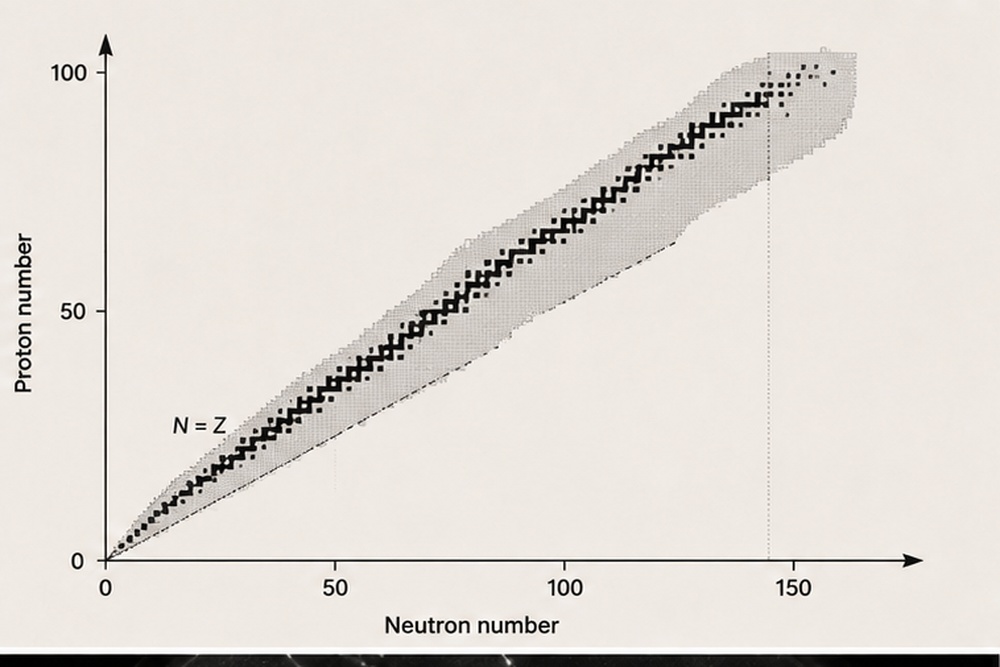
Figure F09-01. The valley of stability. Light nuclei balance protons and neutrons; heavy nuclei demand surplus neutrons to dilute the protons’ mutual repulsion; beyond uranium the books cannot be balanced at all.
One refinement, reported here because it returns decisively in chapter 14: the nucleus, like the atom, has shells. Certain proton or neutron counts — 2, 8, 20, 28, 50, 82, 126, the so-called magic numbers — confer conspicuous extra stability, exactly as the electron counts 2, 10, 18 mark the noble gases. The nuclear shell model that explains them (1949) earned Maria Goeppert Mayer the 1963 Nobel Prize — the second ever awarded to a woman in physics, sixty years after the first went to Marie Curie. Nucleons, too, are waves in a confining well; the harmonics-and-exclusion logic of chapter 8 plays again, one floor down, in a different concert hall.
KEY CONCEPT — The million-to-one gap This is the natural place to install the energy units used for the rest of the book. The electronvolt (eV) is the energy an electron gains crossing one volt — a convenient atomic-scale coin. Chemistry trades in single electronvolts: breaking or making a chemical bond costs or pays a few eV, which is why flames, batteries and biology operate where they do. Nuclear transactions trade in millions of electronvolts (MeV): a single fission pays out around 200 MeV. The gap between the floors is a factor of a million, and it writes history. It is why no furnace, acid or philosopher’s stone could ever touch the nucleus — alchemy failed not by ineptitude but by six orders of magnitude — and why a tonne of uranium can do the work of millions of tonnes of coal. When chapter 12 turns to reactors and stars, this ratio is the entire story.
9.3 E = mc², earned honestly
Twice this book has drawn on the most famous equation in science with a promissory note attached — for Meitner’s fission audit in chapter 7, and Aston’s “missing sliver” before that. The note now falls due, and paying it requires clearing away a thick crust of folklore.
What Einstein established in 1905 — in a three-page afterthought to the relativity paper — is a statement about all energy, not about nuclei, bombs or anything radioactive: energy has weight. Any system that contains energy possesses, by that fact alone, mass — inertia, heft, gravitational pull — in the amount of the energy divided by the square of the speed of light. Equivalently, read in the direction the famous arrangement E = mc² suggests: mass is a measure of contained energy; the two are one ledger kept in two currencies, and c² is the exchange rate. The rate is stupendous because c is: one kilogram of mass corresponds to as much energy as the explosion of some twenty million tonnes of TNT; a single gram, fully cashed, comfortably exceeds the Hiroshima bomb. Nature, in other words, is fantastically wealthy in mass-energy and ordinarily spends almost none of it.
KEY CONCEPT — Mass, properly understood Three corrections to the folklore, each load-bearing. First, the equivalence is universal. A wound watch-spring outweighs a slack one; a hot kettle outweighs a cold one; a charged battery outweighs a flat one — in every case by the stored energy over c², a fraction so minute (parts in a trillion and below) that no scale registers it, but as a matter of principle, strictly true. Second, chemistry “converts mass to energy” exactly as nuclear physics does. Burn a tonne of coal and the products, captured and weighed, would come up short by about a third of a milligram — the mass of the released heat. Nuclear reactions are not different in kind; they are different in scale, cashing fractions near a tenth of a per cent rather than a ten-billionth: the million-to-one gap, reappearing on the scales. Third, nothing material need be “annihilated.” In fission, every proton and neutron present before is present after; what has changed is the binding — the arrangement’s energy content — and the mass difference is the energy difference, relocated. (True annihilation, matter meeting antimatter and cashing the entire ledger, exists, and waits in chapter 10.)
With the equivalence in hand, Aston’s precision measurements of the 1920s (chapter 7) transform from curiosity into oracle. Every nucleus weighs less than its constituent protons and neutrons weigh when free. The deficit — the mass defect — is no bookkeeping error: it is the binding energy, the energy that would have to be supplied to dismantle the nucleus into free pieces, showing up (negatively) on the scales exactly as Einstein requires. A bound system weighs less than its parts because it is bound; the deficit measures the depth of the trap. Aston could weigh, to one part in a thousand, how tightly every nucleus in nature is glued — without ever ungluing one. The nuclear energy ledger of the entire universe was sitting, by the late 1920s, in a Cambridge instrument’s photographic plates, waiting only to be read as a ledger.
9.4 The curve that runs the universe
Read properly, the ledger condenses into a single graph — the most consequential curve in this book, and arguably in twentieth-century history. Divide each nucleus’s binding energy by its nucleon count, giving the average grip on each constituent — the binding energy per nucleon — and plot it against nuclear size, hydrogen to uranium.
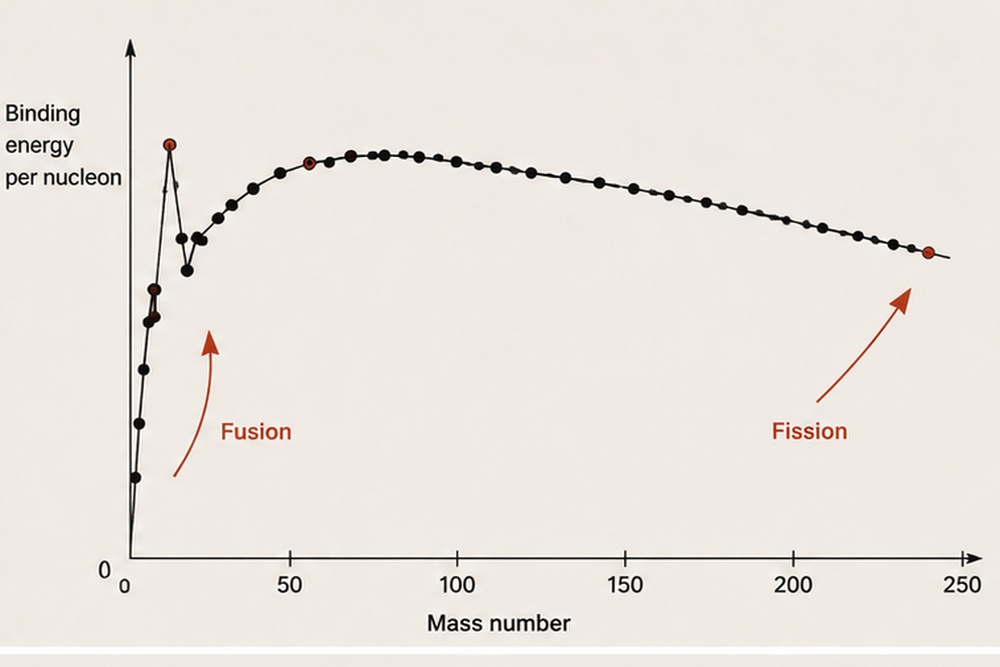
Figure F09-02. The curve that runs the universe: how tightly each nucleus grips its parts. All nuclear energy release — fusion and fission alike — is matter sliding toward the iron summit.
The curve’s shape follows from §9.2’s force budget. At the light end the grip strengthens steeply with size: in a very small nucleus nearly every nucleon sits at the surface, under-coordinated, like the corner pieces of a jigsaw; each addition gives more nucleons a full complement of gluing neighbours. (One spike interrupts the climb: helium-4 — two protons, two neutrons, every particle in a closed, doubly magic embrace — is bound far beyond its station, which is why the alpha particle is nature’s favourite pre-packaged projectile, and why, as chapter 12 will show, the Sun’s business plan is the manufacture of helium.) The climb crests in a broad plateau around iron and nickel — iron-56 and nickel-62 hold the strongest average grip in nature — and then begins a long, gentle decline: from there on, every additional proton’s global electrical tax outgrows the merely local glue it brings, and each nucleon in uranium is held more loosely than each nucleon in iron.
Everything nuclear that matters reads off this one curve at sight. Energy is released whenever nucleons move to a more tightly bound arrangement — downhill in energy means uphill on this curve — and the curve rises toward iron from both directions. From the left: weld light nuclei together — fusion — and the products sit higher on the curve; the binding gain departs as energy, about 0.7 per cent of the fuel’s mass when hydrogen becomes helium. From the right: split a heavyweight — fission — and the mid-table fragments likewise sit higher; the gain, Meitner’s snow-walk audit, runs near 0.1 per cent of the mass. (Fusion, per kilogram, is thus some seven times the richer transaction — a ratio with consequences for chapter 14.) Iron itself is the summit and the dead end: from iron, no nuclear road leads downhill in either direction. Iron is the ash of the universe — the element on which both kinds of nuclear fire go out — and when chapter 12 follows a star through its life, the appearance of an iron core will be recognisable, from this curve alone, as a death sentence.
The curve likewise dispatches a question pending since chapter 4: where radioactivity banks its energy. The Curies’ radium, pouring out warmth “from nowhere,” was spending an inheritance: uranium and its descendants are over-sized, loosely bound arrangements stranded high on the curve’s right slope when the solar system’s matter was assembled, sliding stepwise toward the valley floor at lead, each alpha or beta step cashing a sliver of binding difference. Radioactivity is not a power source but a trust fund — capital deposited, as chapter 12 will detail, in dying stars billions of years before the Earth existed, paid out on a half-life schedule into the planet’s interior heat (a substantial share of the warmth driving volcanoes and continental drift is this very disbursement). The energy books of chapter 4, which would not balance, balance perfectly: they were never closed accounts, merely old ones.
9.5 The zoo, and the pattern in the zoo
The story to this point treats protons and neutrons as elementary — Democritus’ uncuttables, relocated two floors down. The third quarter of the twentieth century demolished that assumption in a manner so faithful to this book’s earlier plot that the reader may experience the history as rhyme.
The instruments of demolition were the great postwar accelerators — machines applying chapter 4’s deflection trick at industrial scale, racing charged particles to within a whisker of light speed and colliding them — together with cosmic rays, nature’s own beam. From the late 1940s the collisions disgorged new particles: not new arrangements of old pieces, but apparently elementary species — pions, kaons, lambdas, sigmas, deltas — strongly interacting cousins of the nucleons (the family is collectively the hadrons), most surviving for fragments of a billionth of a second before decaying. By 1960 the count of “elementary” hadrons had passed a hundred and was still climbing, and the situation had become, by the standards this book has established, familiar: a proliferating zoo of supposedly fundamental species with measurable properties and no organising principle — sixty-three elements in search of a Mendeleev.
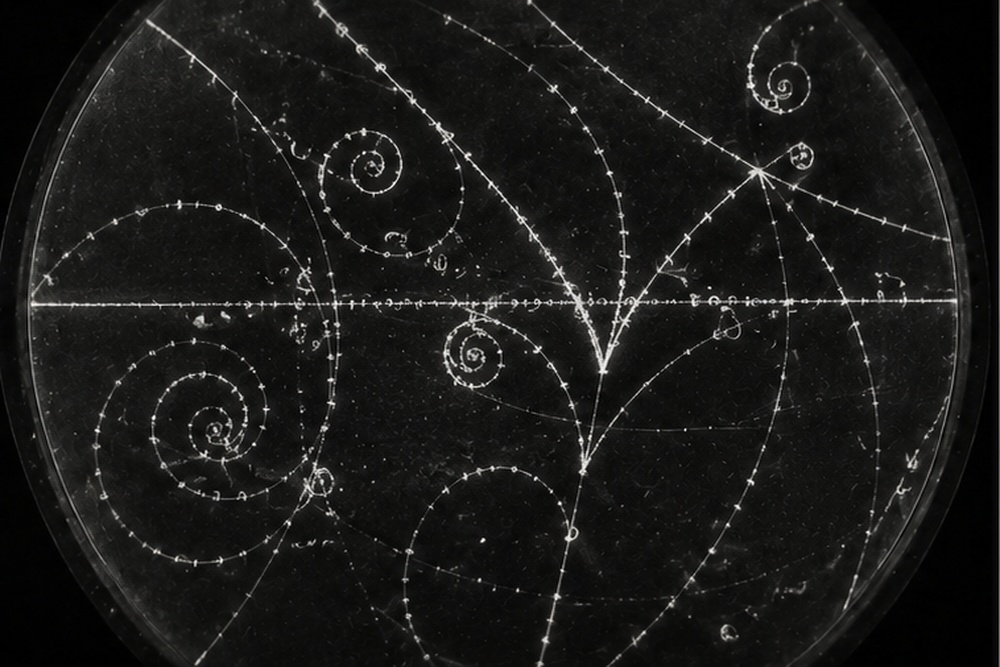
Figure F09-03. The zoo, photographed: in a bubble chamber, charged particles from an accelerator collision leave threads of boiling liquid, curling in the magnetic field — tight spirals for the light, sweeping arcs for the heavy, kinks and forks for the decays.
The Mendeleev was Murray Gell-Mann (with the Israeli physicist Yuval Ne’eman arriving independently). In 1961 he showed that the hadrons fall into geometric families — octets and decuplets, arrayed by their charges and other quantum labels — a classification he named, with a Buddhist flourish, the Eightfold Way; and he played the Mendeleev gambit to the letter: one family of ten had nine known members and a gap, so he predicted the tenth — its charge, its strangeness, its approximate mass — and in 1964 the omega-minus particle duly materialised in a Brookhaven bubble chamber with the forecast properties. Patterns of that fidelity demand machinery beneath, and in the same year Gell-Mann (and, independently, George Zweig) supplied it: the entire zoo could be assembled from a tiny stock of genuinely fundamental constituents, which Gell-Mann — fishing the name from a nonsense line in Finnegans Wake — called quarks. Two species suffice for ordinary matter: the up quark, and the down quark. A proton is two ups and a down; a neutron, two downs and an up; the pions and the rest, quark-antiquark pairs and other small combinations. The price of the scheme was charges never before contemplated — the up carries +⅔ of the proton’s charge unit, the down −⅓ (two ups and a down: +⅔ +⅔ −⅓ = +1; the neutron’s sum, 0 — the arithmetic closes) — and the scheme’s reception replayed 1860 note for note: useful fiction, said the majority, including at times its inventors; an accounting device with nothing necessarily real behind it, not least because, as §9.6 explains, no experiment could extract one.
Reality arrived by the Rutherford method, one floor down. From 1968, experimenters at the Stanford linear accelerator fired electrons of unprecedented energy into protons and studied the recoils — gold foil again, with the proton as the foil — and found the now-classic signature: occasional violent, wide-angle scatters, in numbers and patterns declaring that the electron had struck something point-like, hard and fractionally charged inside the proton’s soft bulk. Three such scattering centres, with precisely the quark model’s charges. The proton, the “first” particle, was a composite — a bag of three quarks — and the atom acquired the lowest storey of its present architecture: matter is quarks and electrons. The electron, for its part, has been interrogated to the present limits of resolution and shows no parts and no size at all: as far as any experiment can discern, it is genuinely elementary — a point. Whether the quarks and the electron are truly the ground floor, or merely the lowest floor yet lit, is a question this book defers, deliberately, to chapter 17.
9.6 Glue that grows: colour and confinement
What binds the three quarks? The answer, developed through the 1970s into the theory called quantum chromodynamics (QCD), completes the chapter’s force inventory and explains, at last, what the “strong force” of §9.2 actually was.
Quarks carry a new kind of charge — not one variety, like electricity, but three, whimsically labelled colour (red, green, blue; the names are pure bookkeeping, with no optical content beyond the rule that the three together, like light’s primaries, sum to neutral “white”). The colour force is conveyed by particles called gluons — the photon’s counterparts — with one decisive structural difference that drives everything: photons are electrically neutral, but gluons themselves carry colour. The force’s own messengers feel the force. Self-interacting messengers turn the familiar behaviour of forces inside out: instead of diluting with distance, the colour force between two quarks holds constant or grows as they separate — the field between them, rather than spreading, bunches into a taut flux tube, a kind of elastic string. Pull two quarks apart and the string does not weaken; it stores ever more energy in its tension, until — the punchline is pure E = mc² — the stored energy exceeds the cost of a fresh quark-antiquark pair, the string snaps, and each loose end leaves the scene respectably partnered. One never obtains a free quark; one obtains two hadrons. This is confinement: quarks are permanent inmates, never observed alone — which is why two generations of experimenters seeking lone fractional charges found nothing, and why the “fiction” verdict held so long. The flip side, asymptotic freedom (its discovery earned the 2004 Nobel Prize), is that at very short range the same self-interaction makes the force fade: quarks deep inside a proton rattle around nearly free. The strong interaction is thus a prison with comfortable cells: liberty within, absolute walls without. Direct evidence stands in the accelerator record — struck quarks emerge as tight sprays of hadrons (“jets,” the snapped string’s debris) flying in the quark’s direction, and in 1979 collisions at the German laboratory DESY yielded clean three-jet events: two quarks and a radiated gluon, the messenger itself caught on the wing.
The §9.2 force between protons and neutrons now takes its true place: it is not fundamental. Nucleons are colour-neutral (“white”) overall, as atoms are electrically neutral; and just as electrically neutral atoms still attract at close range by the residual stickiness of their charge distributions (the van der Waals attraction that lets geckos walk on ceilings — chapter 11), colour-neutral nucleons attract at close range by residual spillover of the colour force — a leakage usefully pictured, following Yukawa’s prescient 1935 theory, as the exchange of pions between them. The strong nuclear force, mover of stars and breaker of cities, is a secondary effect: the faint outside draught of the quark prison. Its mysterious short range, the property that hid it from all prior science, is simply how far the draught carries.
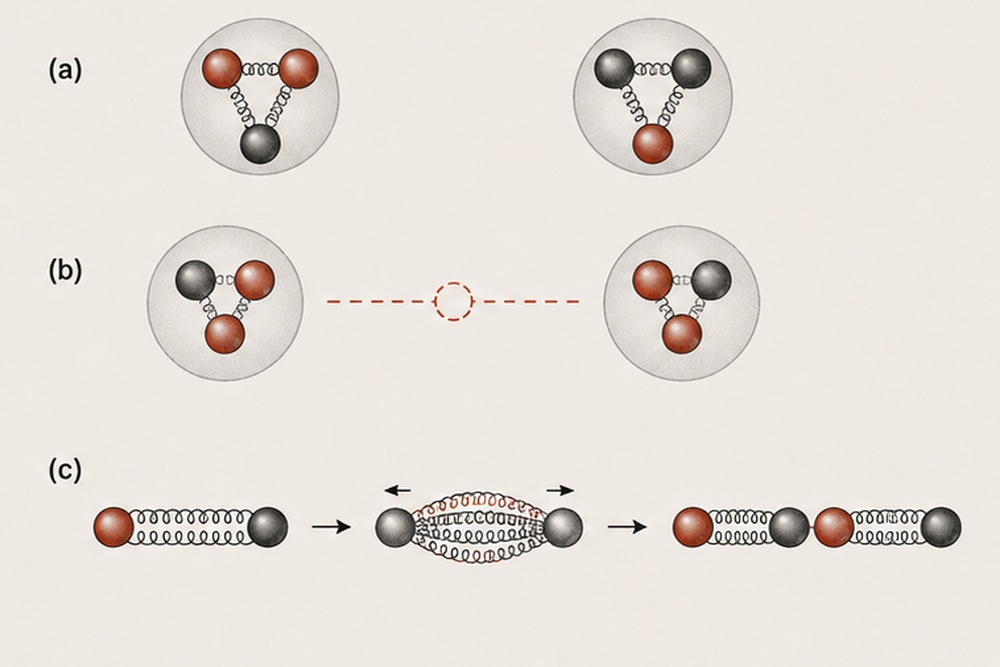
Figure F09-04. The strong force, three ways: (a) gluons binding quarks within nucleons; (b) residual spillover, pictured as pion exchange, binding nucleons to nucleons; (c) the elastic flux tube between two quarks snapping into a new quark-antiquark pair before either quark can be freed.
9.7 The origin of (almost all) mass
One audit remains, and it is the most startling in the book. The proton’s mass is 938 MeV in the energy units of this chapter’s box. The masses of its three resident quarks — two ups at roughly 2 MeV, one down at roughly 5 — total about nine: around one per cent of the whole. The other ninety-nine per cent of the proton’s mass is not matter in any traditional sense at all. It is energy — the furious kinetic energy of the confined quarks and, above all, the energy of the gluon field that cages them — registering on the scales exactly as §9.3 prescribed: energy has weight, and a sealed bag of violence weighs what the violence amounts to. Modern computation has closed the loop: simulating QCD from first principles on supercomputers (“lattice QCD”), physicists now calculate the proton’s and neutron’s masses from the theory’s bare ingredients, and the answers land within a few per cent of measurement — mass, derived.
The conclusion deserves its plain statement. Since essentially all the mass of an atom is its nucleons, and ninety-nine per cent of each nucleon’s mass is confinement energy, it follows that some ninety-nine per cent of the reader’s bodyweight is not the substance of particles but the energy of the fields imprisoning them. (The residual one per cent — the quarks’ own small masses, and the electron’s — has a separate and stranger origin, the Higgs mechanism, which belongs to chapter 10.) Chapter 5 reported that matter is, by volume, almost entirely void; this chapter completes the audit: what little is not void is almost entirely energy. The title of this book, chosen for the emptiness, turns out to have been doubly earned. Solidity is bookkeeping; weight is imprisoned light, loosely speaking; and the ancient intuition of matter as inert, passive stuff has not survived contact with its own foundations.
9.8 Onward to the full cast list
The atom now stands anatomised through two floors: electron clouds above, ruled by exclusion; quark triplets below, ruled by confinement; between them the binding-energy curve, paymaster of stars and reactors alike. But the account has incurred debts. Beta decay was waved at, not explained — it will demand an entire new force and an almost undetectable new particle. The up and down quarks turn out to have four exotic siblings; the electron, likewise. Forces have been described as “exchanges” without credentials. And the one per cent of mass left unexplained awaits its field. Settling all of this is the work of the next chapter: the full inventory of reality’s known ingredients — seventeen particles, four forces, one table — and the atom’s modest, magnificent place within it.
Chapter 10 — The Atom’s Place in the Standard Model
“Who ordered that?” — I. I. Rabi, on the discovery of the muon
10.1 What “fundamental” means
Two chapters of descent have brought the atom’s architecture to quarks and electrons. This chapter completes the inventory — every species of particle and force currently known to be fundamental, the framework physicists call, with studied modesty, the Standard Model — and then locates the atom within it. The result is one of the stranger proportions in science: of the seventeen fundamental ingredients nature is known to stock, ordinary matter — every atom of every element, every substance in the visible universe’s planets, oceans and readers — uses three.
First, terms of reference. To call a particle fundamental is to make a claim relative to resolution: it means that, probed as finely as we can currently probe, the particle shows no parts, no size, no internal structure. The atom held the title for a century; the proton for forty years; each lost it when sharper instruments arrived. The instrument of sharpness is energy. By de Broglie’s relation (chapter 6), a probe’s wavelength — and a wave cannot resolve detail finer than its own wavelength — shrinks as its momentum grows; resolving femtometre structure therefore requires projectiles of enormous energy, which is the first of the two reasons particle physics builds accelerators. The second reason is E = mc² read from left to right: concentrate enough collision energy into a small enough volume and it may condense into new particles — species too massive, and too short-lived, to occur in cold modern matter. An accelerator is thus simultaneously a microscope and a foundry: it resolves the small and it mints the heavy. Everything in this chapter’s inventory beyond the atom’s own three ingredients was discovered, and is studied, in those machines or in nature’s free equivalent, the cosmic rays.
The electron, for the record, has been interrogated at the highest available resolutions and remains a point: no size has ever been measured for it, only ever-shrinking upper limits, presently below a thousandth of a proton’s radius. The same holds for the quarks. They are fundamental in the operative sense — so far. Chapter 17 will weigh the question of whether “so far” is the end of the story.
10.2 Force, on the quantum books
Before the inventory, a credential long owed. Since chapter 9 this book has spoken of forces as the exchange of particles — gluons between quarks, pions between nucleons — without saying what such language means. The meaning comes from the deepest structural idea in modern physics, quantum field theory, and it can be stated without mathematics.
In this framework the basic furniture of the universe is not particles but fields: continuous, space-filling quantities, one field per species, of which the familiar electromagnetic field is the prototype. What we call a particle is a quantum of its field — a discrete, indivisible ripple, the smallest excitation the field’s accounting permits. The photon is a ripple of the electromagnetic field; the electron, of an electron field that likewise fills all space (which is why every electron in the universe is perfectly identical to every other: they are notes struck on the same instrument). Two charged particles influence one another because each disturbs the shared field and feels the other’s disturbance; itemised at the quantum level, the disturbance travels as photons — transient, unobserved intermediaries, virtual in the jargon — whose continual exchange registers, on the average, as the smooth push or pull of classical experience. The cartoon of two skaters lobbing a ball, recoiling apart at each throw, captures the repulsive case; attraction has no honest playground analogy and the reader should hold the cartoon loosely. What should be held tightly is the framework’s report card. Quantum field theory applied to electromagnetism — quantum electrodynamics, QED, perfected around 1948 — predicts the electron’s magnetic strength to twelve significant figures, and measurement agrees: the most precise accord between theory and experiment ever achieved, equivalent to forecasting the distance from Dublin to Sydney to within the width of a bacterium. Whatever discomfort the ontology of “virtual particles” may cause, the bookkeeping is beyond serious dispute.
One theorem of the framework does heavy lifting throughout this chapter: the range of a force is set by the mass of its messenger. A massless messenger, like the photon, can be exchanged over any distance — hence electromagnetism’s infinite reach. A massive messenger can exist, fleetingly, only on borrowed energy (the uncertainty trade-off of chapter 6, lending against time), and the heavier the loan the shorter the term: massive messengers make short-range forces. Yukawa’s pion-exchange picture of the nuclear force was this theorem applied in reverse — from the force’s femtometre range he predicted the messenger’s mass. And the theorem frames the puzzle to which we now turn: a force so short-ranged that it operates only within a single proton’s breadth, whose messengers would have to be monsters.
10.3 The feeble force and the ghost
The debt outstanding since chapter 9 is beta decay: a neutron, left alone, transforms within minutes into a proton, an electron — and something else, whose identification is one of physics’ best detective stories.
The case opened with an accounting irregularity. Alpha particles leave their parent nuclei with sharp, fixed energies — staircase physics, as expected. Beta electrons do not: from identical nuclei undergoing identical decays, they emerge with a continuous smear of energies, from nearly nothing up to a maximum, as though the fixed transaction were paying out random fractions of itself. Energy, the books said, was simply going missing — and the crisis was taken so seriously that Bohr himself was prepared, by 1930, to abandon energy conservation at the nuclear scale. The alternative was proposed in December of that year by Wolfgang Pauli, in a famous letter addressed to a radioactivity conference (“Dear radioactive ladies and gentlemen…”) and described by its author as a desperate remedy: suppose each beta decay emits, alongside the electron, a second particle — neutral, nearly or exactly massless, and so feebly interacting that no instrument had ever registered one. The invisible accomplice carries off the missing energy, in randomly divided shares with the electron: the smear explained, conservation saved, at the price of a particle apparently designed to be undetectable. Enrico Fermi domesticated the idea: he named the fugitive the neutrino (“little neutral one”), and in 1934 built around it the first quantitative theory of beta decay — a paper the journal Nature rejected as too speculative and remote from reality, a verdict its editors have had ninety years to enjoy.
In the Standard Model’s mature language, here is what beta decay is. Inside the neutron, one down quark transforms into an up quark — changing the trio udd to uud, neutron to proton — by emitting a messenger called the W boson; the W, existing only on the briefest borrowed time, immediately converts into an electron and an antineutrino, which exit the scene. The interaction responsible is the fourth and last of nature’s known forces, the weak force, and it is unlike all the others in the only respect that ultimately matters: it is the sole force that can change a particle’s identity. Gravity moves things; electromagnetism binds atoms; the strong force binds nuclei; only the weak force transmutes — quark species into quark species, and with them element into element. Every beta decay in every radioactive substance, every step in the decay chains that warm the Earth’s interior, and — decisively, as chapter 12 will show — the reaction that lights the Sun, runs through this one identity-changing channel. The force’s proverbial weakness and its absurdly short range (a thousandth of a proton’s breadth) are two faces of one fact, by §10.2’s theorem: its messengers, the electrically charged W and the neutral Z boson, are enormous — nearly ninety and about a hundred times the proton’s mass respectively. Predicted in detail by the theory that unified the weak and electromagnetic forces in the late 1960s, both were manufactured and detected at CERN in 1983, masses as forecast: the exchange picture of force, certified at the foundry.
The neutrino itself graduated from desperate remedy to laboratory commonplace. Direct detection came in 1956, beside a nuclear reactor (whose fissioning core emits them in astronomical floods); the experimenters telegraphed the news to Pauli, who had wagered it could never be done. The particle’s elusiveness remains the stuff of legitimate awe: a neutrino’s odds of interacting are such that a beam of them would penetrate a light-year of solid lead with roughly even chances; of the hundred trillion or so solar neutrinos passing through each reader’s body per second, a handful will scatter within that body per lifetime. Detection is therefore a statistics of multitudes — colossal instrumented targets waiting out the odds, the grandest being Japan’s Super-Kamiokande: fifty thousand tonnes of ultra-pure water in a mountain cavern, walled with thirteen thousand golden photomultiplier eyes watching for the faint blue flash of a single neutrino’s rare touch. Such patience has been repaid with the Standard Model’s first confirmed amendment: neutrinos, long booked as exactly massless, turn out to oscillate in flight between their three varieties (of which more below) — behaviour possible only if they possess mass, albeit at least a million times smaller than the electron’s. Why so small, and what it portends, is chapter 18’s business; the point of record here is that the table this chapter assembles is already known, by its own instruments, to be unfinished.
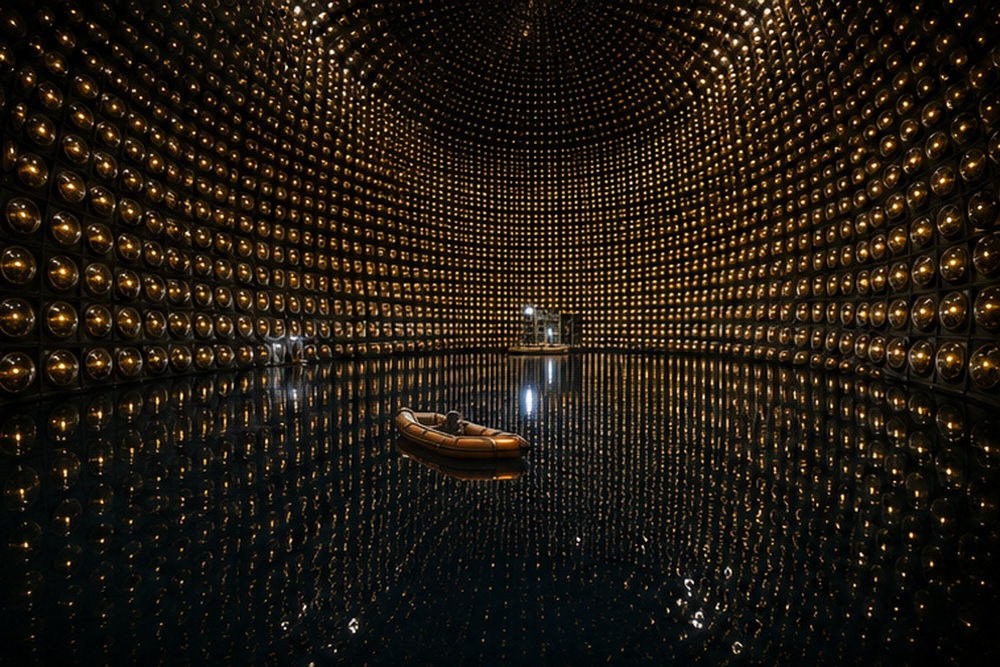
Figure F10-01. Waiting out the odds: a neutrino observatory of the Super-Kamiokande type — fifty thousand tonnes of pure water in a mountain cavern, walled with golden photomultiplier eyes, watching for the blue flash of a ghost’s rare touch.
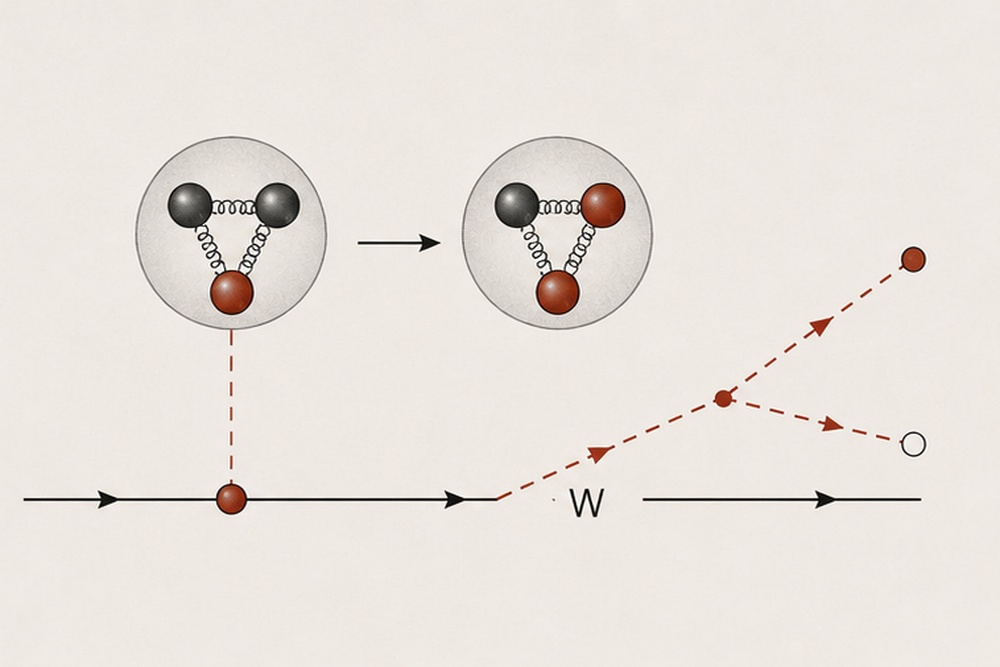
Figure F10-02. Beta decay, itemised: one down quark in the neutron changes identity to an up quark; the W boson carries the transaction, briefly, before materialising as an electron and the antineutrino that balances the books Pauli refused to see broken.
10.4 The mirror inventory: antimatter
A debt from chapter 8 now falls due. When Dirac unified quantum mechanics with relativity in 1928, his equation yielded the electron’s spin as an unforced bonus — and a second, unwelcome bonus: for every electron solution, a mirror solution of opposite electric charge. After some interpretive agony, Dirac accepted the equation’s verdict over his instincts and predicted a new particle: the positron, an electron’s perfect twin in mass and spin, positive in charge. Carl Anderson found it in cosmic-ray cloud-chamber photographs in 1932 — the third jewel of that annus mirabilis — curling the wrong way in his magnetic field.
The principle generalises without exception: every particle species has an antiparticle of identical mass and opposite charges (a few neutral species, the photon among them, serve as their own). Brought together, particle and antiparticle annihilate: the entire rest mass of both converts to energy — E = mc² cashed in full, not the fractional percentages of fission and fusion but the whole ledger, gram for gram the most concentrated energy release physics permits. Antimatter is correspondingly rare and expensive: it must be minted in accelerators at extravagant cost, and it stores badly, annihilating on first contact with any container. Yet it is also, unexpectedly, a working medical technology: PET scanning — positron emission tomography — tags a patient’s bloodstream with a short-lived positron-emitting isotope and images the tissue by the telltale paired gamma rays of positrons annihilating with the body’s own electrons. Several million times a year, antimatter quietly maps human hearts and tumours.
The deep puzzle is the inventory imbalance. The laws as written are almost perfectly even-handed between matter and antimatter; an even-handed Big Bang should have minted both in equal measure and annihilated both to light, leaving a universe of radiation and essentially nothing else. Instead, everything we observe — every galaxy, every atom — is matter, with antimatter present only as transient, manufactured traces. Roughly one part in a billion of the original matter evidently survived some imperfectly understood asymmetry in the laws; that surviving billionth is the material universe, this book’s subject included. The asymmetry’s known ingredients and missing pieces are taken up in chapter 18.
10.5 Three copies of everything
With forces and mirrors in place, the matter inventory itself can be tabulated — and its strangest feature stated plainly: nature stocks ordinary matter’s ingredients in triplicate.
The first hint arrived in 1936, in cosmic rays: a particle identical to the electron in every measured respect except mass — some two hundred times heavier — and stability, decaying in microseconds. The muon answered no outstanding question, completed no pattern then known, and served no role in matter; the physicist I. I. Rabi’s reaction, this chapter’s epigraph, has stood ever since as the community’s honest position. In 1975 the joke repeated at higher stakes: a third electron-copy, the tau, heavier than a proton, gone in trillionths of a second. Each of the three charged leptons (the family name for fundamental particles indifferent to the strong force) comes paired with its own variety of neutrino — electron-neutrino, muon-neutrino, tau-neutrino — for six leptons in all.
The quarks repeat the pattern with eerie fidelity. The up and down of chapter 9 are merely the first and lightest pair. A second pair — charm and strange — was completed in the “November revolution” of 1974; a third — top and bottom — in 1977 and 1995 respectively, the top quark arriving at a mass so gross (roughly that of an entire tungsten atom, from a particle with no size at all) that a single accelerator complex on Earth has ever produced it. Thus the full matter sector: six quarks and six leptons, organised as three generations — three complete copies of the same two-quark, two-lepton kit, identical in every charge and quantum number, escalating only in mass.
| Generation | Quarks | Leptons |
|---|---|---|
| I | up, down | electron, e-neutrino |
| II | charm, strange | muon, μ-neutrino |
| III | top, bottom | tau, τ-neutrino |
Why three? No one knows — the question sits on chapter 18’s list — but that the answer is exactly three, at least for generations containing light neutrinos, is itself a measurement: the decay rate of the Z boson, dissected with exquisite precision at CERN in the 1990s, counts the neutrino varieties it can decay into, and the count is three, with no room for a fourth of similar kind. What is clear is the generations’ division of labour: the heavier copies are unstable, cascading by weak-force identity changes down to generation I within fractions of a second of their creation. The cold, settled matter of the universe is therefore built exclusively from the first generation — and not even all of that. Up quark, down quark, electron: there, in three species, is every atom in existence. The other nine matter particles appear only in accelerators, cosmic-ray strikes and the universe’s hot first instants — understudies who left the stage thirteen billion years ago, their purpose, if that word even applies, unknown.
All twelve are fermions — spin-½, subject to exclusion, matter’s antisocial bricks, in chapter 8’s terms — where the force messengers (photon, gluon, W, Z) are bosons, the gregarious field-quanta. One inventory line remains, and it is neither brick nor messenger.
10.6 The field that weighs the world’s ingredients
The electroweak theory validated at CERN in 1983 carried an internal embarrassment: its symmetry, taken at face value, requires the W and Z — and, on inspection, the fundamental fermions too — to be exactly massless, like the photon. They are spectacularly not. The escape, proposed independently by several theorists in 1964 (Robert Brout, François Englert and Peter Higgs foremost), was a new field: one with the unique property of being “switched on” everywhere — taking a nonzero value throughout all space, vacuum included — so that every particle coupling to it moves, always and everywhere, through a kind of universal background medium. Coupling to that medium is what mass is, for a fundamental particle: the W and Z couple strongly and are heavy; the electron couples faintly and is light; the photon does not couple at all and is massless; the three generations of §10.5 are, on this account, three strengths of grip on one invisible substrate. Like any quantum field, this one supports a ripple — a quantum — and finding that ripple became the multi-decade test of the whole construction. On 4 July 2012, the two great detectors of CERN’s Large Hadron Collider announced it: the Higgs boson, mass about 134 protons, properties to date exactly as prescribed. Englert and Higgs received the Nobel Prize the following year; Brout had not lived to share it.
KEY CONCEPT — What the Higgs does, and does not do Public mythology has inflated the Higgs into “the origin of mass,” and chapter 9 already equips the reader to deflate it. Some ninety-nine per cent of an atom’s mass is the confined energy of quarks and gluons — QCD’s contribution, which would persist essentially unchanged if the Higgs field were switched off. What the Higgs mechanism supplies is the mass of the fundamental particles: the W and Z (hence the weak force’s short range), the quarks’ small intrinsic masses, and — the entry that matters most to chemistry — the electron’s. That last is no footnote. The size of an atom (§8.1) is set inversely by the electron’s mass: a massless electron means atoms of infinite size, which is to say no atoms, no chemistry, no condensed matter at all. The Higgs field does not weigh the world; it weighs the world’s ingredients — and on the electron’s entry in particular, the existence of everything in Part I’s story was contingent.
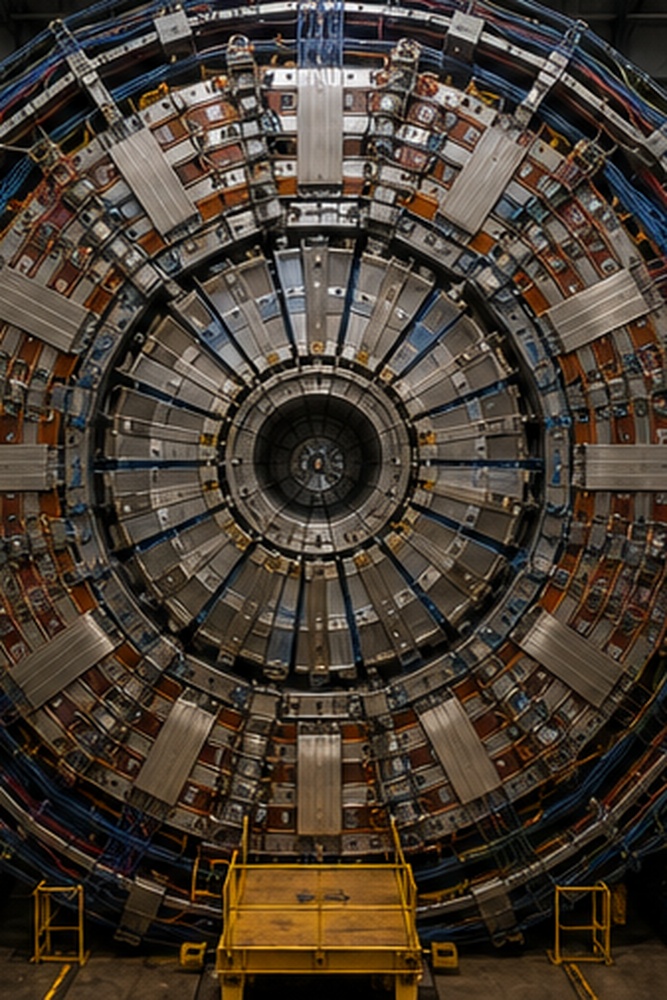
Figure F10-03. The foundry: a cathedral-sized particle detector wrapped around a collision point. Machines of this scale minted the W, the Z, the top quark and the Higgs — and weigh each new ripple of the underlying fields.
10.7 The table, and the atom’s seat at it
The inventory is complete, and compact enough to state in a breath. Twelve fermions — six quarks, six leptons, in three generations. Four force messengers — the photon (electromagnetism), the gluon (the strong force), the W and Z (the weak force). One Higgs boson. Seventeen species; four forces, of which the Standard Model describes three with quantitative completeness — gravity, too feeble to measure between individual particles and so far irreconcilable with quantum field theory’s methods, stands outside the model entirely, a structural absence that chapter 17 inherits. The whole edifice runs on about nineteen numerical parameters — the masses, the coupling strengths — which the theory does not predict but takes from measurement: dials, set by hand, at values without explanation. Within those dialled values, the model’s record is without parallel in science: five decades of colliders, precision spectroscopy and cosmic-ray observatories have failed to produce a single confirmed laboratory contradiction, while its predictions — W, Z, gluon jets, top, Higgs — have arrived one after another, on specification, across forty years.
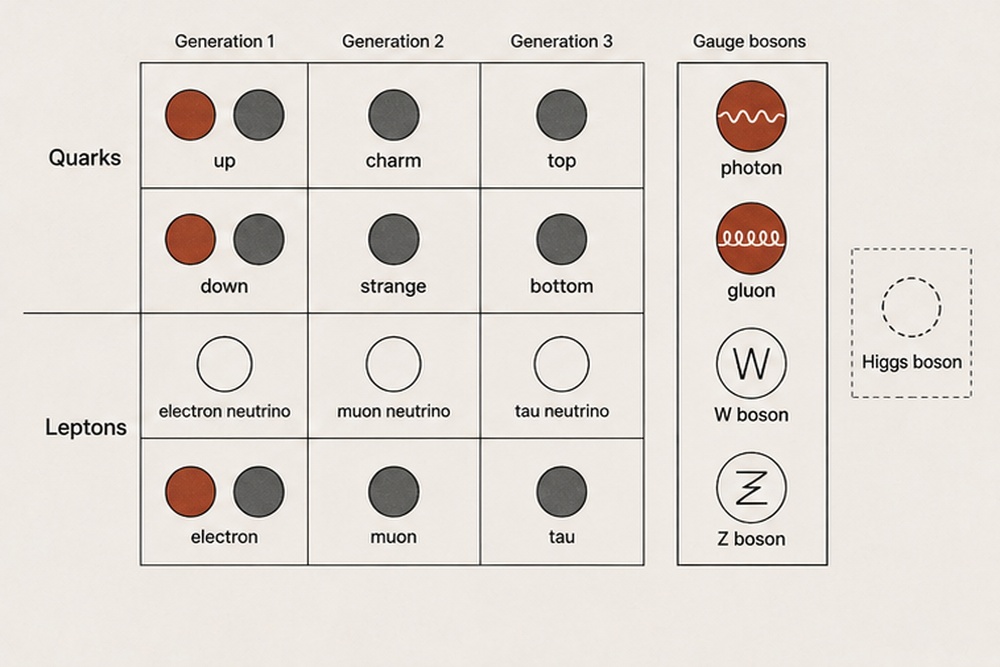
Figure F10-04. Seventeen ingredients, four forces, one table. Highlighted: the five entries from which everyday reality is built — three of matter (up, down, electron), two of force (photon, gluon).
And the atom’s place? Almost comically economical. Build a carbon atom: up quarks and down quarks, gluon-bound into protons and neutrons (chapter 9); electrons, photon-bound into chapter 8’s shells; the Higgs field as silent background, lending the electron the mass that sets the atom’s size; the W boson on retainer, called in only should a nucleus need its identity adjusted. Three particles of matter, two messengers, one background field: from this five-and-a-half-piece kit, every element of Mendeleev’s table, every molecule of chapter 11, every mineral, protein, ocean and reader. The remaining dozen fundamental species play no role whatever in the structure of ordinary matter — a profligacy without explanation, as if the universe shipped with a vast toolkit and built everything visible using the three smallest tools in it. (Visible is, as chapter 16 will show, a word doing enormous work in that sentence; the standard accounting holds the atomic matter of this chapter to be barely a twentieth of the universe’s total contents — a demotion this book must eventually face. The reader is asked to enjoy, for six more chapters, the parochial comfort of the baryonic world.)
The Standard Model is thus two things at once, and Part III of this book lives in the tension between them: the most precisely verified theory ever constructed, and a structure visibly unfinished — silent on gravity, on dark matter, on the neutrino’s mass, on the matter–antimatter imbalance, on the meaning of three generations and nineteen dials. A triumph with a punch-list. Its discoverers would recognise the situation; this book has described it twice before, in 1869 and in 1913.
10.8 Back up to daylight
The descent is over. Below the quark and the electron, nothing further is established — only conjecture, scheduled for chapter 17. The narrative therefore turns and climbs: out of the cellar of fields and generations, back up through the nucleus, past the electron shells, to the floor where atoms meet one another — where two hydrogens and an oxygen become water, where carbon builds diamonds and DNA, and where the quantum rules of chapter 8, applied to atoms in company, generate the entire material world. Chemistry, properly understood, is the Standard Model’s first generation at work; chapter 11 watches it build.
Chapter 11 — Atoms Together
“…all things are made of atoms…” — Richard Feynman, nominating the single most information-rich sentence in science
11.1 Why atoms combine at all
The atom of chapters 8 to 10 was a solo performer: one nucleus, its electron cloud, in vacuum. Almost nothing in human experience is like that. The air is paired nitrogens and oxygens; water is triplets; a grain of salt is a single ordered assembly of quintillions; the reader is a cooperative of perhaps 10²⁷ atoms whose collaboration is so intricate it is currently reading about itself. This chapter supplies the missing physics: why atoms join, the three great strategies by which they do, the weaker handshakes between assembled molecules, and — the chapter’s running thesis — how every familiar property of matter (hardness, shine, conductivity, wetness, slipperiness) is derivable from the joining.
The governing principle is bare energy accounting. Physical systems settle, given the chance, into the lowest-energy arrangement available — a ball rolls to the valley floor — and a chemical bond exists wherever two or more atoms, arranged together, have lower total energy than the same atoms held apart. The energy difference is the bond’s strength: the deposit that must be repaid, as heat or light or violence, to separate them again. Its scale is the electronvolt — chemistry’s coin, established in chapter 9’s box — typically a few eV per bond: a million times below nuclear transactions, which is why a bonfire rearranges molecules and leaves every nucleus in it untouched.
Which arrangements lower the energy? Chapter 8 has already supplied the ledger. An atom’s chemical conduct is the conduct of its valence electrons, and the configurations of conspicuously low energy are the sealed, noble-gas shells. The noble gases themselves are this chapter’s control group: their shells complete, they have nothing to gain from any partnership, and accordingly they drift through the world alone — the only elements whose ordinary state is the solitary atom. Every other element carries an unbalanced outer shell, and an incentive; and there are exactly three broad strategies by which incentive becomes bond. An atom may transfer electrons outright, share them in pairs, or pool them in common. The three strategies — ionic, covalent, metallic — generate three great families of materials, and we take them in turn.
11.2 Transfer: the ionic bond
Pair the table’s most eager donor with its most eager acceptor. Sodium (chapter 8: a single loose 3s electron over a sealed neon core) achieves a closed shell by losing one electron; chlorine (one vacancy short of the argon configuration) achieves one by gaining it. Let them meet and the transaction completes itself: the electron transfers, leaving a positively charged sodium ion and a negatively charged chloride ion — two closed-shell, chemically pacified particles that now attract one another by plain electrostatics. The bond is the attraction; there is nothing else to it.
But note what such a bond is not: it is not a private partnership. An ion’s electrical pull radiates in all directions indifferently, so each sodium gathers chlorides on every side and each chloride gathers sodiums, and the result is not a molecule but a lattice — an endless three-dimensional checkerboard, each ion gripped by six neighbours of the opposite sign, repeating with crystalline perfection in all directions. A grain of table salt is precisely this: not a heap of NaCl molecules (no such individual exists in the solid) but one continuous architectural unit. The geometry even surfaces to the eye — left to grow undisturbed, salt crystallises in sharp little cubes, the checkerboard’s right angles writ macroscopic, an ordinary kitchen exhibit of the principle that external form betrays internal order.
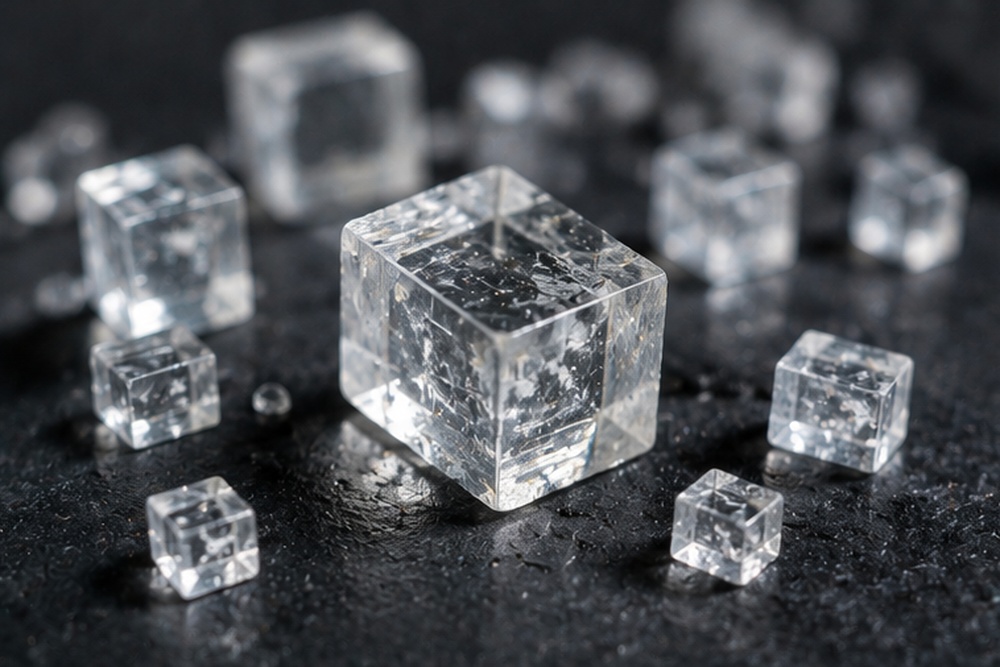
Figure F11-01. Architecture made visible: salt grains under magnification are near-perfect cubes, because the ions beneath stack in a cubic checkerboard. The crystal’s face is the lattice’s confession.
The lattice now derives the properties of the ionic family, item by item. Melting demands shaking the entire architecture loose against every ion’s six-way grip: melting points run high (salt holds to about 800 °C). The solid cannot conduct electricity — every electron is locked into a sealed shell, every ion locked into the lattice — but the melt conducts handsomely, and so does the solution, because there the ions themselves become the mobile charge carriers: one substance, conductor or insulator by state, exactly as the picture requires (and the basis of electrolysis, Humphry Davy’s element-cracking tool from chapter 3). And ionic solids are brittle in a characteristic way: strike the crystal so that one plane of ions shifts a half-step against the next, and suddenly positive faces positive, negative faces negative — attraction flips wholesale to repulsion, and the crystal does not dent but cleaves. A hammer-tap on rock salt is a structural experiment, and the shards report the checkerboard.
KEY CONCEPT — Electronegativity: the tug-of-war number Pure transfer and pure sharing are idealised endpoints of one continuum, and chemistry grades the continuum with a single number. Electronegativity measures how fiercely an element’s atoms pull on bonding electrons — rising along each period toward the halogens (fluorine, at 4.0 on Pauling’s scale, is the table’s undisputed champion) and falling down each group, for reasons chapter 8 makes obvious: pull strengthens with nuclear charge and weakens with screening and distance. Bond character then reads off the difference between two partners. A large mismatch (sodium 0.9 against chlorine 3.2) and the tug-of-war is a rout: transfer, ionic. A small or zero mismatch and the contest is a draw: sharing, covalent. Between lies a graded majority of real bonds — shared, but unequally, the electron cloud leaning toward the stronger puller. Such lopsided sharing makes one end of a bond slightly negative and the other slightly positive: a polar bond, a small built-in battery whose consequences (§11.5) include the entire behaviour of water.
11.3 Sharing: the covalent bond
Where no atom is willing to surrender outright, atoms share — and the sharing is where the quantum mechanics of chapter 8 earns its keep in everyday matter.
Take the simplest case, two hydrogen atoms. Each brings one electron in a 1s cloud. Brought close, the two clouds overlap, and the rules of waves apply: the electron waves can superpose constructively, reinforcing in the region between the nuclei. In that combined state — a molecular orbital, a standing wave belonging to both atoms at once — the shared probability piles up precisely in the internuclear gap, and the arrangement’s energy audit comes out below two separate atoms: each electron now enjoys the attraction of two nuclei, and each nucleus is screened from the other’s repulsion by the intervening cloud. Both electrons settle into this lowered level — exactly two, opposite spins, by Pauli’s ration — and the result is the covalent bond: a shared pair of electrons whose between-the-nuclei probability is the glue. When in 1927 Heitler and London carried out this calculation for H₂ — the first quantum-mechanical computation of a chemical bond — and the measured strength and length of the bond emerged from Schrödinger’s equation, chemistry’s annexation by physics, foreseen in Dirac’s remark of chapter 8, formally began.
Covalent bonds, unlike ionic attraction, are directional — they form along the lines of orbital overlap and they saturate when the shared pairs are full — and directionality is destiny: it is why covalent matter comes in molecules, discrete assemblies with definite memberships and, crucially, definite shapes. The shapes follow from one serviceable principle: the electron pairs around an atom, bonding pairs and unshared “lone” pairs alike, repel one another and spread as far apart as geometry allows. Four pairs spread to the corners of a tetrahedron — hence methane, CH₄, a carbon at the centre of four hydrogens at 109.5°, the tetrahedral angle that recurs throughout chemistry. Water’s oxygen also carries four pairs, but two are lone: the molecule’s visible shape is the remaining bent V of the two O–H bonds, squeezed by the bulkier lone pairs to about 104.5°. Ammonia, with one lone pair, is a squat pyramid. The catalogue continues through all of chemistry, and its stakes are highest in biology, where molecular shape is function: enzymes recognise their targets, drugs their receptors, antibodies their antigens, by three-dimensional fit, lock to key. The bent water molecule and the tetrahedral carbon are not trivia; they are two of the load-bearing geometries of life.
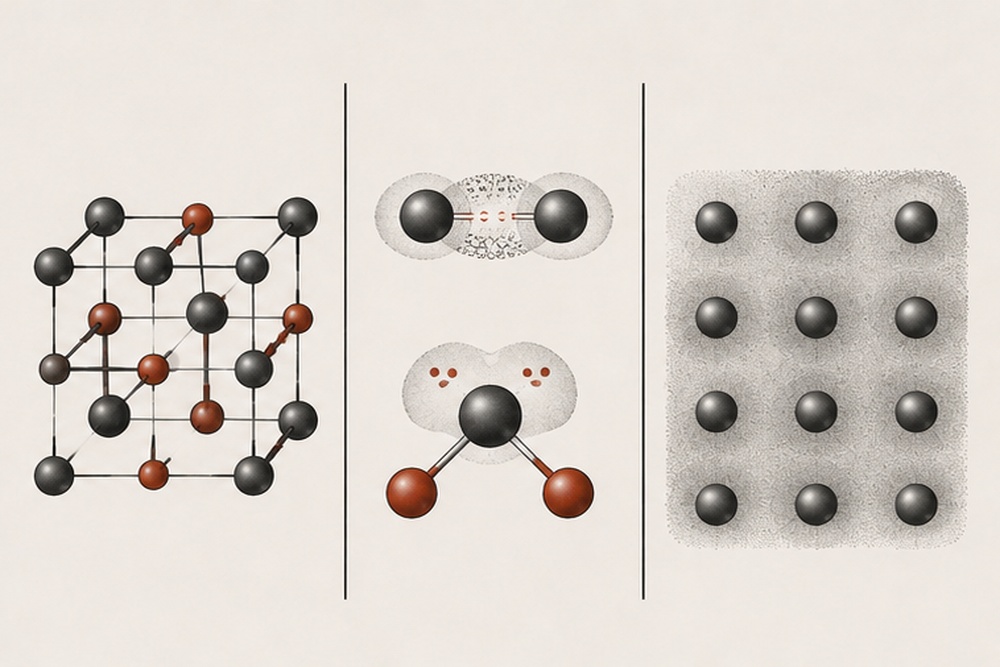
Figure F11-02. Three strategies, three families of matter: transfer builds lattices, sharing builds shaped molecules, pooling builds metals.
Atoms can share more than one pair: two shared pairs make a double bond, three a triple, each addition shortening and strengthening the link. The showcase is the air. Atmospheric nitrogen is N₂, two atoms locked by a triple bond that ranks among the strongest in chemistry — nearly ten electronvolts to break — and nitrogen’s notorious inertness follows at once: four-fifths of every breath is a bystander gas, too expensively bonded to react. The biosphere’s nitrogen famine (proteins and DNA require the element that the air hoards) was historically broken only by lightning, by specialised bacteria — and, since 1909, by the Haber process, which spends industrial heat and pressure to crack the triple bond and feeds, by standard estimate, roughly half the protein in living humanity. The strength of one bond, set by the overlap arithmetic of two small atoms, sits in the supply chain of every meal.
11.4 Pooling: the metallic bond
Three-quarters of the elements are metals: atoms from the table’s left and centre, holding one, two or three loosely bound valence electrons over sealed cores — donors by disposition, with no acceptors in sight when surrounded by their own kind. Their solution is the third strategy: pool everything. In a lump of sodium or copper, every atom surrenders its valence electrons not to a neighbour but to the collective: the electrons delocalise, forming a mobile communal sea in which the now-positive ion cores sit in an orderly lattice, bound by their shared attraction to the sea that flows among them.
The metallic family’s signature properties now derive as readily as salt’s did. Conduction: the sea is mobile charge by construction; apply a voltage and it flows — and the same restless sea ferries heat, which is why metals feel cold to the touch (they conduct your warmth away) and why the best electrical conductors are the best thermal ones. Malleability: the bond is gloriously non-directional — the ion cores sit in a featureless attractive medium, and one plane of them can slide past another without the like-meets-like catastrophe that cleaves an ionic crystal; the lattice shifts and re-settles, and the metal dents, draws and rolls rather than shattering. Smithing, coining, wire-drawing and the Bronze and Iron Ages are applications of bond non-directionality. Lustre: a sea of free electrons responds to the full range of visible light’s frequencies, oscillating with the incoming wave and re-radiating it — which is to say, reflecting it, all colours, efficiently: the white shine of silver and steel is the optical signature of delocalised electrons (and gold’s exceptional warmth of colour is the relativistic fine print of chapter 8). A polished spoon is a quantum demonstration: it shines because its electrons belong to no atom in particular.
KEY CONCEPT — From levels to bands: copper, diamond, silicon Chapter 8 gave the isolated atom a staircase of sharp energy levels. Pack N atoms into a solid and each level, perturbed by all its neighbours, splits into N imperceptibly spaced sub-levels: the staircase’s rungs broaden into bands, ribbons of allowed energy separated by forbidden gaps. One question then classifies all solid matter electrically: how full is the topmost occupied band? Partly full (metals): electrons sit beside vacant levels of negligibly higher energy, the faintest voltage promotes and moves them — a conductor. Exactly full, with a wide gap to the next band (diamond: about 5.5 eV): no electron can accept a small nudge, for there is no vacant level to accept it into — an insulator; and since visible light’s photons (2–3 eV) are likewise too poor to bridge the gap, the crystal cannot absorb them and is transparent — diamond’s clarity and its insulation are one fact. Exactly full but with a narrow gap (silicon: 1.1 eV): a semiconductor — modest heat or light promotes a trickle of carriers, and, decisively, the trickle can be engineered: seed the crystal with trace atoms of one extra or one fewer valence electron (doping) and its conductivity becomes adjustable, switchable, gateable. The transistor (1947) is this paragraph rendered in hardware; the information age is chapter 8’s staircase, broadened into bands and tuned with parts-per-million chemistry.
11.5 The weak handshakes
The three strategies build molecules and lattices; but a question remains that the strategies cannot answer. Nitrogen’s atoms are spoken for — sealed into their triple-bonded pairs, valences saturated, no further bonds on offer. Why, then, does nitrogen gas, cooled enough, condense to a liquid at all? Why does anything molecular condense? Something must attract one finished molecule to the next — forces feebler than bonds, but universal — and these weak handshakes, two in particular, turn out to govern an unreasonable share of the world, the reader’s biochemistry included.
The first is universal and at first sight impossible: even perfectly symmetrical, sealed-shell particles — noble-gas atoms, nitrogen pairs — attract one another. The mechanism is pure chapter 6. An electron cloud is a probability distribution, and at any instant its charge may fluctuate momentarily off-centre, making the atom a fleeting electrical dipole; that flicker polarises the neighbouring cloud in sympathy, and the two transient dipoles attract — an effect renewed continuously, fluctuation by fluctuation. This dispersion force (London, 1930; the senior member of the loose family called van der Waals forces) is feeble — hundredths of an electronvolt — but it acts between all matter, and it grows with the size and looseness of the clouds involved: hence the stately rise of boiling points down the noble-gas column (helium clings so faintly it liquefies only four degrees above absolute zero; xenon, electron-rich, holds on to −108 °C), and hence the liquefiability of everything. And feeble forces multiplied are not feeble: the gecko, promised in chapter 9, walks on glass and ceilings by dispersion alone — each foot carries millions of microscopic hair-like setae, branching into billions of spatula tips that flatten against the surface so intimately that the summed flickers of their electron clouds will support many times the lizard’s weight. No glue, no suction, no chemistry: a gecko adheres to the ceiling by quantum fluctuations, and unsticks by peeling them off at an angle.

Figure F11-03. Climbing by quantum fluctuation: a gecko’s foot on glass. Billions of spatula-tipped hairs press close enough for the flickering of electron clouds — the dispersion force — to carry the whole lizard.
The second handshake is stronger, more selective, and arguably the most consequential interaction in the living world. Where hydrogen is covalently bonded to a fierce electron-puller — oxygen, nitrogen or fluorine, by §11.2’s electronegativity ledger — the shared cloud is dragged so far toward the puller that the hydrogen stands at the molecule’s surface as a nearly bare, intensely concentrated positive site; and that exposed site binds, with real strength, to a lone pair on the oxygen or nitrogen of a neighbouring molecule. This is the hydrogen bond: around a tenth the strength of a covalent bond, ten or more times the strength of a dispersion flicker — a calibrated middle weight whose importance lies exactly in its middling-ness, strong enough to structure, weak enough to release.
Its showcase is water, and water’s celebrated strangeness is the hydrogen bond audited. Each H₂O — bent, polar, with two donor hydrogens and two acceptor lone pairs — can hydrogen-bond four neighbours, and liquid water is a seething, continuously re-forming network of such bonds. Consequences, item by item. Water’s boiling point is preposterous for so small a molecule — its nearest structural cousin, hydrogen sulfide, boils at −60 °C; water’s network must be paid off to a hundred above zero, and an Earth with unbonded water would hold no liquid ocean. Its heat capacity is enormous (warming water spends energy loosening bonds before speeding molecules), which is why oceans moderate climate and coastal Ireland is mild for its latitude. Its surface tension is the network resisting exposure — striders walk on it. It is the near-universal solvent of biochemistry because its polar molecules pry ionic lattices apart and escort the ions in solvent jackets. And — the anomaly with the largest biography — ice floats. Freezing locks the network into a fully hydrogen-bonded lattice of hexagonal symmetry (every snowflake advertises it) that is more open than the jostling liquid: the solid is about 8 per cent less dense, so lakes freeze from the top down, the ice lid insulating liquid water beneath, in which life overwinters. Nearly every other substance freezes from the bottom up; on such a planet, ponds and seas would freeze solid annually, and the four-billion-year continuity of aquatic life — the only kind, for most of Earth’s history — is difficult to imagine. The biosphere rests, in part, on the packing geometry of one weak bond.
One further client of the hydrogen bond deserves its sentence: the double helix. The two strands of DNA are clasped to one another base by base through hydrogen bonds — two per adenine–thymine pair, three per guanine–cytosine — and the choice of this interaction, rather than covalent permanence or dispersive vagueness, is the design point of heredity: the strands hold faithfully at body temperature, yet unzip on demand for copying and reading. Genetics runs on a bond strong enough to remember and weak enough to forget.
11.6 Case study: carbon, the connector
If the chapter’s thesis is that architecture determines properties, one element supplies the controlled experiment, and it is the element of which the reader is chiefly made. Carbon’s credentials are written in its configuration: four valence electrons in a small atom — exactly half a shell, equally disposed to share in all four directions, compact enough that its bonds, including bonds to itself, are strong. Self-bonding without practical limit is carbon’s signature: chains, branches, rings, sheets and cages, each carbon a four-way junction, yield a combinatorial space of structures that no other element approaches — the catalogue of characterised carbon compounds runs beyond a hundred million and underwrites the existence of organic chemistry, plastics, pharmaceuticals and biochemistry as fields. Silicon, one floor below in the same group, offers the same four valences in a larger, weaker-bonding atom — enough for rocks and semiconductors, not for self-assembling complexity; if life had a shopping list, carbon was its first item.
The controlled experiment is allotropy: one element, several architectures. Bond each carbon to four neighbours at the tetrahedral angle, propagating in three dimensions, and the result is a single covalent molecule the size of the specimen: diamond — by band-gap accounting (§11.4’s box) transparent and insulating, and by the unbroken rigidity of its bond network the hardest natural material, each scratch resisted by electronvolt-grade bonds in every direction. Bond each carbon instead to three neighbours in flat hexagonal sheets — chicken-wire of perfect honeycombs — and the fourth electron per atom delocalises across the sheet in a two-dimensional metallic sea: graphite, black, soft and a conductor. The sheets within are bonded harder than diamond’s links; but sheet binds to sheet only by §11.5’s feeble dispersion flickers, so the planes shear and slide at a touch — graphite is a lubricant, and a pencil writes by exfoliating quantum-bonded sheets onto paper through van der Waals transfer. Hardest and softest, insulator and conductor, transparent and black: identical atoms, differing solely in connection. In 2004 two Manchester physicists, using laboratory sticky tape with heroic persistence, peeled graphite down to the single sheet — graphene, one atom thick, the first true two-dimensional material: stronger weight-for-weight than steel, a better conductor than copper, and the founding specimen of a still-expanding flat-materials zoo (the work took the 2010 Nobel Prize, and reappears among chapter 15’s atomic technologies). Closed carbon cages and rolled tubes — fullerenes and nanotubes — complete the family album.
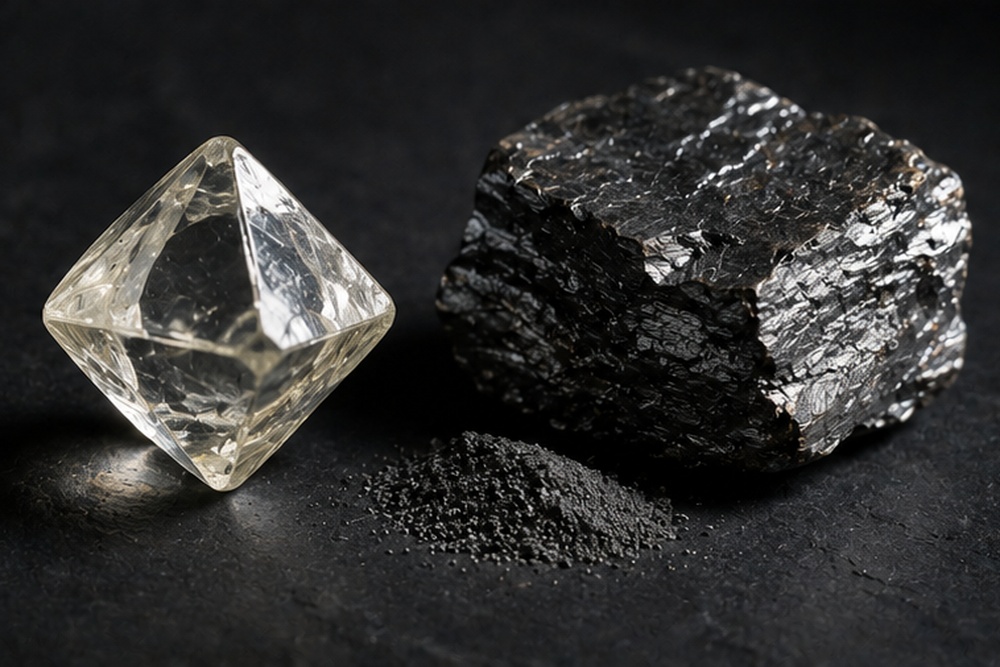
Figure F11-04. One element, two worlds: rough diamond and a lump of graphite. Identical atoms — tetrahedral architecture in one, sliding hexagonal sheets in the other. Structure is destiny.
11.7 The synthesis, and the staircase of states
Stand back, finally, to the largest scale of organisation: the states of matter themselves. Solid, liquid and gas are the outcomes of a single contest — binding energy against thermal agitation — and a substance’s melting and boiling points are therefore bond-strength meters, readable straight off this chapter’s inventory. Helium, held only by the faintest dispersion flickers, surrenders to thermal motion four degrees above absolute zero. Molecular solids (ice, wax, sugar) melt low: only handshakes need breaking, the molecules themselves surviving intact. Ionic lattices and metals occupy the hundreds-to-thousands of degrees; and the covalent network solids and refractory metals — diamond, tungsten — endure toward four thousand, every step of melting a genuine bond-breaking. From four kelvin to four thousand, the thermometer is reading the same ledger of electron arrangements that this chapter opened. (Heat matter past all bonds and past the atom’s own grip on its electrons and a fourth state appears — plasma, a gas of bare ions and free electrons. It is exotic on Earth and utterly standard in the universe, which holds most of its visible atoms in precisely this state, inside stars; the observation is the doorway to the next chapter.)
The synthesis deserves its plain statement, because it completes the promise on which Part II opened. Every material property surveyed — salt’s cleavage and conduction-by-state, nitrogen’s aloofness, copper’s gleam and ductility, silicon’s tunability, water’s lid of floating ice, the gecko’s ceiling, diamond against graphite, the unzippable helix — has been derived, without a new postulate anywhere, from the quantum atom of chapter 8: orbitals, exclusion, electronegativity, and electromagnetism doing the arithmetic. The whole of the material world is the first generation of the Standard Model, bonded three ways and handshaking two more. Dirac’s 1929 boast stands audited.
Yet one ledger in the chapter has been silently assumed: the atoms themselves — the ninety-two kinds, in their particular cosmic abundances, carbon and oxygen conveniently plentiful, gold conveniently rare. Chapters 8 to 11 explain what atoms do; none of them explains where atoms come from. The answer involves the restless side of the nucleus that Part I discovered and chapter 9 budgeted — decay, fission, fusion — operating in furnaces of unimaginable scale and, in the final act, in collisions that shake spacetime itself. The next chapter follows the atoms home.
Chapter 12 — The Restless Nucleus
“I tell them to go and find a hotter place.” — Arthur Eddington, to critics who said the stars were too cold for fusion
12.1 Decay as quantum chance
Chapter 11 closed with matter standing still; this chapter follows the nucleus through time — its spontaneous self-destructions, their domestication in reactors and clocks, and finally the question Part II has left conspicuously unasked: where the atoms themselves were manufactured. The itinerary runs from a granite kitchen floor to the collision of dead stars, and it begins by settling a debt outstanding since chapter 5: what decides the moment a quantum jump happens?
For radioactive decay, the answer of record is: nothing. A nucleus of uranium-238 is unstable — perched, by chapter 9’s audit, high on the binding-energy slope, with energy to release — yet it does not slide promptly downhill; it waits, and the waiting has no schedule. Two such nuclei, identical in every respect that physics can define or measure, will decay at different moments: one this afternoon, its perfect twin in six billion years. No examination of an individual nucleus reveals which it will be; no ageing process accumulates — a nucleus that has waited an aeon is exactly as likely to decay in the next second as one minted this morning. The randomness is not ignorance of a hidden clock; on the standard understanding (the dice Einstein protested, chapter 6), there is no clock. And yet the lawlessness of individuals composes, in crowds, into statistical law of stopwatch precision: in any fixed interval, a fixed fraction of a large population decays. The interval in which half goes is the half-life — the species’ signature, invariant under heat, pressure, chemistry and history (Marie Curie’s foundational observation, chapter 4, now stated in its mature form) — and the population accordingly falls by repeated halving: one half survives the first half-life, one quarter the second, one eighth the third. Measured half-lives span nature’s full patience, from fractions of a thousandth of a second (polonium-214: 164 microseconds) to spans exceeding the universe’s age a hundred-trillion-fold (tellurium-128). One mechanism, fourteen-plus orders of magnitude of tempo — a range that itself demands explanation, and receives one of quantum theory’s strangest.
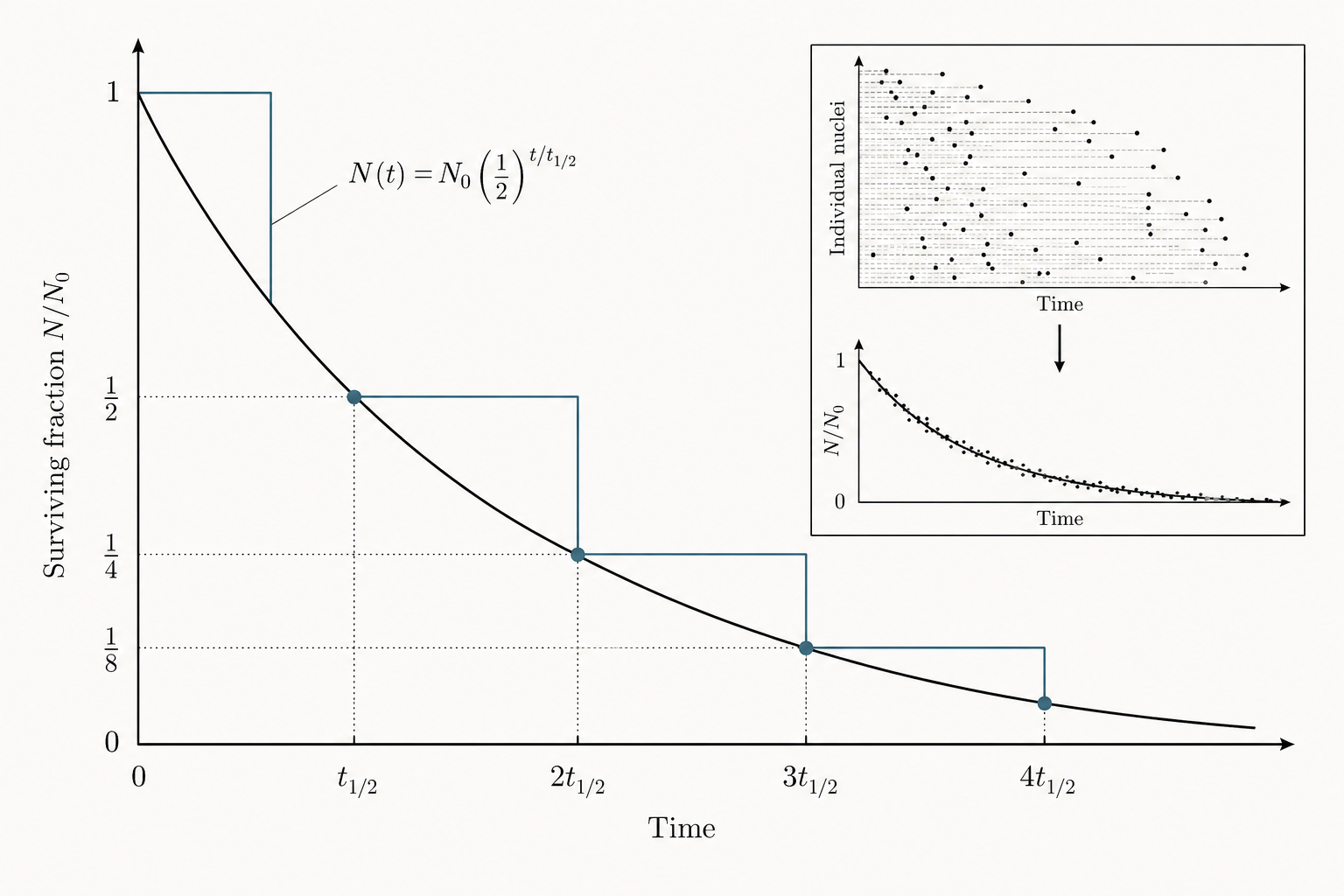
Figure F12-01. Lawless individually, lawful in crowds: no nucleus has a schedule, yet every population halves on one.
12.2 The escape mechanism: tunnelling
Consider alpha decay’s locked-room problem. Within a uranium nucleus, by chapter 9, an alpha particle — that pre-fabricated, super-bound foursome — exists ready-made, and energy bookkeeping favours its departure. But between the alpha and freedom stands the electrical barrier: inside, the strong force grips; outside, repulsion expels; and between lies a wall of energy that the alpha demonstrably does not possess the means to climb — the particle’s measured exit energy is far below the barrier’s crest. Classically, the alpha is imprisoned forever; observationally, out it comes. The resolution (George Gamow, 1928 — the first triumph of quantum mechanics inside the nucleus) is that the alpha is not a ball but a wave, and a wave confronting a barrier it cannot surmount does not stop dead at the wall: its amplitude penetrates, decaying steeply but not instantly with depth, so that if the wall is thin enough a remnant of the wave exists on the far side — which is to say, by Born’s rule, a small probability that the particle is simply found outside, never having possessed the energy to cross. The phenomenon is quantum tunnelling, and it converts the half-life mystery into arithmetic: the alpha, rattling against the barrier some 10²¹ times per second, faces a minuscule escape probability per attempt; the product of frantic attempts and fantastic improbability is the measured half-life. Better: because the wave’s penetration falls off exponentially with barrier width and height, modest differences in decay energy translate into gigantic differences in half-life — and the fourteen-orders-of-magnitude tempo range of §12.1 collapses into one smooth law relating energy to lifetime, confirmed across the decay chains. The locked room has porous walls, and the porosity is calculable.
KEY CONCEPT — Tunnelling: leakage through the impossible A quantum particle confronting an energy barrier taller than its resources has a finite probability of appearing on the far side — not by climbing, not through any hidden crack, but because its describing wave penetrates the classically forbidden region and survives, attenuated, beyond it. The thinner and lower the barrier, the better the odds; the dependence is exponential and savage. Tunnelling is no nuclear curiosity: it is how alpha particles leave nuclei, how (within pages) the Sun manages to burn at all, how electrons leak across the gaps in flash memory, and how the microscope that first imaged single atoms (chapter 13) operates. A respectable share of the modern world runs on the controlled leakage of waves through walls.
Beta decay’s tempo has a different governor, and the contrast is itself a measurement. Alpha emission and gamma emission are conducted by the strong and electromagnetic forces, whose natural transaction times are unimaginably brief; beta decay must route through the weak force (chapter 10), and weakness here becomes visible as slowness: a free neutron, though energetically cleared to decay, survives a leisurely ten minutes or so — about 10²⁶ times longer than a strong-force process of the same energy scale would take. The feebleness of a fundamental interaction, read directly off a stopwatch.
12.3 Chains, clocks and a warm planet
Heavy nuclei rarely reach stability in one step. Uranium-238 opens a decay chain of fourteen successive transmutations — eight alpha steps and six beta — cascading down chapter 9’s valley wall through thorium, radium (the Curies’ prize, revealed as a way-station), and the rest, terminating only at lead-206, the valley floor. One intermediate deserves the reader’s domestic attention: radon-222, three and a half minutes’ worth of decays below radium, is a noble gas — chemically uncapturable, by chapter 8 — and therefore the only member of the chain that can leave the rock. Seeping from uranium-bearing ground into enclosed buildings, where its own short-lived daughters lodge in lung tissue, radon is the largest source of radiation exposure for most populations and a non-trivial cause of lung cancer; parts of Ireland, with its granites, rank among Europe’s more radon-prone territories, which is why national authorities offer the inexpensive home test. The uranium series, in other words, is not an abstraction: its middle rungs are a public-health line item.
The chains’ grand gift to science, though, is time. A decay process of known half-life, sealed in a mineral with its products, is a clock that winds itself: measure the surviving parent against the accumulated daughter, and the elapsed time follows. Radiocarbon dating serves the human past: cosmic rays striking the upper atmosphere continuously mint carbon-14 (half-life 5,730 years), which living things absorb throughout life and cease absorbing at death, whereupon the internal ratio of carbon-14 to ordinary carbon begins its long halving — readable, after calibration against tree-ring sequences, across some fifty thousand years of bones, charcoal, parchment and Iceman. For deep time, the uranium–lead clocks in zircon crystals — minerals that accept uranium at crystallisation but exclude lead, so every lead atom found within is decay’s bookkeeping — date the oldest terrestrial grains past four billion years and, applied to meteorites (work completed by Clair Patterson in 1956, en route to his second career exposing industrial lead pollution), fix the solar system’s age at 4.54 billion years, with admirable precision. The same physics, finally, heats the ground beneath the reader: roughly half of the ~47 terawatts flowing out of the Earth’s interior is current disbursement from the radioactive trust fund — uranium, thorium and potassium-40 decaying in mantle and crust — a budget now audited directly by detecting the geoneutrinos those decays emit (chapter 10’s ghost, employed as a geologist). Plate tectonics, volcanism, the geomagnetic dynamo that shields the atmosphere: all run substantially on decay heat. The deposit’s origin — who funded the trust — is §12.6’s denouement.
12.4 Fission, domesticated
Chapter 7 left the chain reaction at its first criticality under the Chicago stands; the deferred engineering belongs here, and it reduces to managing one number. Each fission releases two to three neutrons; call k the average number of those that go on to cause another fission. At k below 1 the reaction dwindles; above 1 it multiplies exponentially — doubling generation upon generation, with generations measured in fractions of a millisecond; at k = 1 it proceeds steadily, fission for fission. A reactor is a machine for holding k at exactly one.
The control problem decomposes into the physics this book has already supplied. Natural uranium is 99.3 per cent uranium-238, which mostly swallows neutrons without splitting; the fissile minority partner, uranium-235 (0.7 per cent), splits eagerly — but, by Fermi’s paraffin discovery (chapter 7), far more eagerly for slow neutrons than for the fast ones fission emits. Hence the moderator: a light substance (graphite, or ordinary water) through which neutrons rattle and slow before their next encounter, tilting the competition toward fission; hence too enrichment, the costly isotope-sorting that raises the 235 fraction (modestly, to 3–5 per cent, for power reactors — weapons demand a different order entirely, and different physics deliberately not elaborated here). Control rods of neutron-gluttonous material — boron, cadmium — slide in and out to trim k about unity. That trimming is humanly possible at all courtesy of a providential fine print: a small fraction of fission’s neutrons (about 0.65 per cent, for uranium-235) are delayed — emitted seconds to minutes later by the excited fragments rather than instantly — and a reactor operated so that it is critical only with their contribution responds on those leisurely seconds rather than on millisecond doubling times. The margin between controllable power station and uncontrollable excursion lives in that fraction of a per cent; the Chornobyl disaster was, among other failures, an excursion past it.
Beyond the core, a nuclear power station is — the deflationary summary is standard in the trade — an elaborate kettle: fission heat boils water (directly or through intermediate loops), steam spins turbines, turbines spin generators, exactly as in a coal station, the difference being chapter 9’s million-fold energy density: a tonne of fuel standing in for millions of tonnes of coal, and no combustion carbon. The genuinely novel liabilities are likewise nuclear. Fission fragments are born grotesquely neutron-rich — they inherit the heavy parent’s neutron ration, far above the valley of stability’s prescription at their size (chapter 9’s curve, paying out again) — and they therefore beta-cascade toward the valley floor for years to millennia, releasing decay heat that no control rod can switch off: a freshly shut-down reactor still generates megawatts from its fragments, which is why spent fuel rests for years in cooling ponds, glowing with the lovely blue Cherenkov light of beta particles outrunning light’s speed in water, and why station-blackout cooling failure — Fukushima’s mechanism — is the accident mode engineers respect most. The waste profile follows the same physics: ferociously radioactive components are short-lived (intensity and longevity trade off — a fast clock runs down fast), while the long-lived residue is correspondingly mild; the genuinely awkward inventory is the middle, plus the artificial heavy elements bred by neutron capture in the 238.
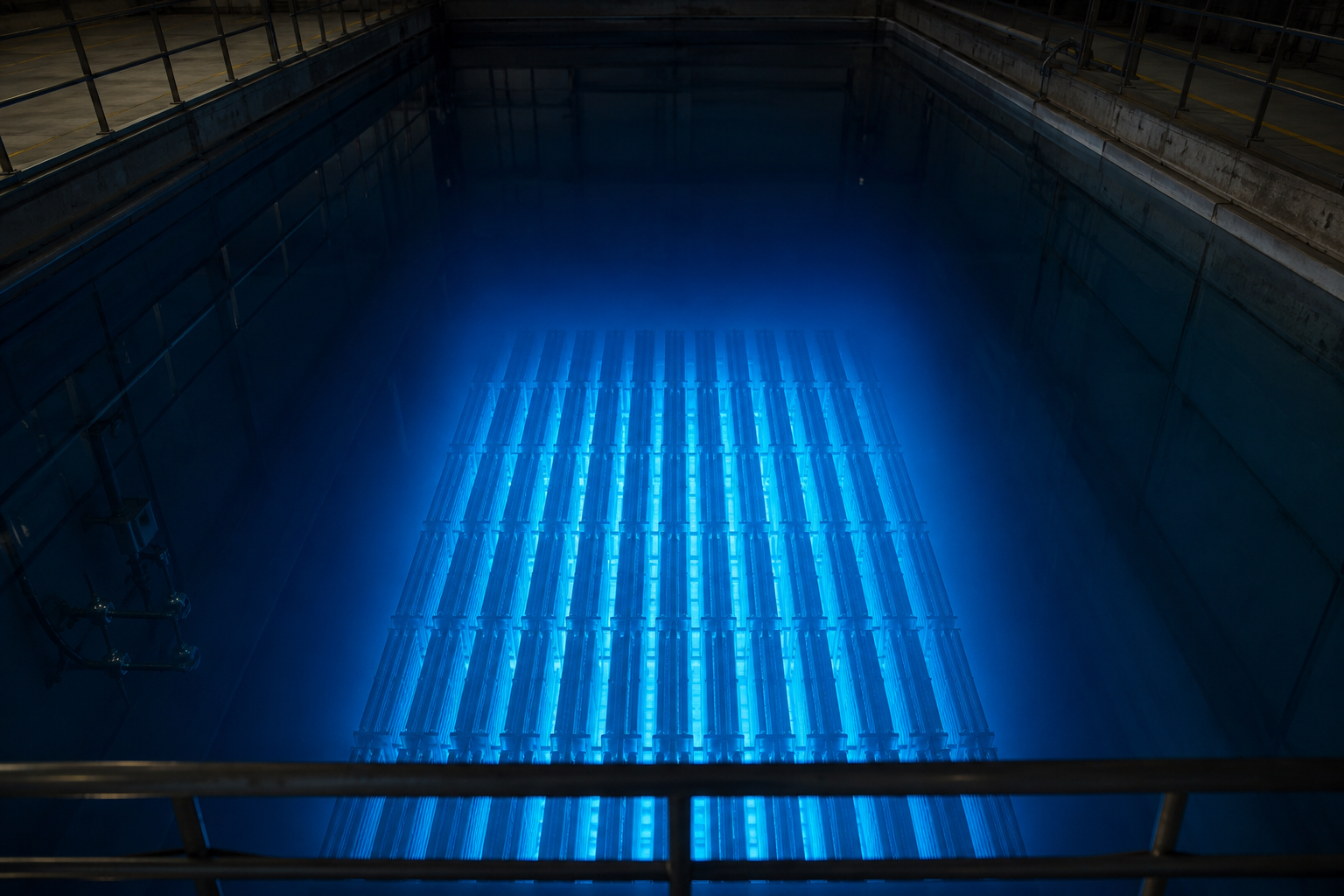
Figure F12-02. Decay heat made visible: spent fuel assemblies in their cooling pond, wrapped in the blue Cherenkov glow of beta particles outrunning light’s speed in water. The fragments’ books take years to balance.
One natural postscript keeps the engineering humble. Two billion years ago, when uranium-235’s faster decay had not yet thinned it (its natural fraction then stood near today’s enriched grade), groundwater percolating through a rich uranium deposit at Oklo, in present-day Gabon, served as moderator — and the deposit went critical by itself. At least sixteen natural reactor zones operated there, pulsing as the water boiled off and returned, for some hundreds of thousands of years; the proof is isotopic, the ore retaining fission’s signature daughter inventory. Fermi’s 1942 pile was anticipated by geology, by roughly the age of multicellular life.
12.5 Fusion: the Sun’s slow fire
The binding curve’s left slope — fusion, the richer transaction — powers no terrestrial grid yet (chapter 14 audits the attempts), because its entry barrier is the mirror of alpha decay’s exit one: to fuse, two nuclei, both positive, must approach to femtometre range against their mutual repulsion, and the speeds required correspond to temperatures of millions of degrees. No material vessel survives contact with such matter — which is, by chapter 11’s closing note, fully ionised plasma — and the stars’ solution is to dispense with vessels: confine the fire by gravity, with the weight of a star.
The Sun is the worked example, and its engine room repays a careful audit. Core conditions: some 15.7 million degrees, densities thirteen-fold lead’s. Even so — the detail is delicious — the temperature is classically insufficient: average proton energies fall well short of the electrical barrier between two protons, and on pre-quantum physics the Sun cannot burn (hence this chapter’s epigraph; Eddington, who in 1920 proposed solar fusion on the strength of Aston’s brand-new measurement that four hydrogens outweigh one helium — the missing sliver, conscripted to pay for sunlight — met exactly that objection). The escape is §12.2’s box read in reverse: protons tunnel through the barrier they cannot climb. Sunshine is leakage through a classically forbidden wall.
The reaction sequence, the proton–proton chain, assembles helium-4 from four protons by stages — two protons fusing to deuterium, deuterium capturing a proton to helium-3, helium-3 pairs merging to helium-4 — and its first step hides the most consequential bottleneck in astrophysics: fusing two protons requires one of them, during the collision, to convert to a neutron, and proton-to-neutron conversion is the weak force’s business (chapter 10). The step is therefore fantastically improbable — an average core proton waits billions of years for it — and the Sun, in consequence, burns with astonishing gentleness: per cubic metre, its core releases power comparable to a compost heap, and the reader’s own metabolism out-generates solar matter weight for weight. A star outshines a compost heap by volume, not intensity. The aggregate remains formidable — some six hundred million tonnes of hydrogen fused per second, four million tonnes of mass converted outright to light — but the bottleneck stretches the Sun’s fuel across ten billion years of steady output. Biology’s existence depends on the stretch: a strong-force-mediated sun would have spent itself before evolution cleared its throat. The feeblest force sets the tempo of life’s available time.
KEY CONCEPT — Slow by design The Sun’s longevity is not an accident of size but a consequence of which force holds the ignition key. Because the chain’s first step is weak-force business, the solar fire idles; because it idles, it lasts ten billion years; because it lasts, planets have time to cool, chemistry to complicate, and evolution to run its long programme. Astronomy’s quiet dependence on the Standard Model’s most reluctant interaction deserves a place beside the better-advertised cosmic coincidences.
The audit closes with a verification of satisfying directness: the core’s weak-force conversions emit neutrinos, two per assembled helium, streaming unimpeded from the Sun’s centre to terrestrial detectors in eight minutes — and the measured flood (after the oscillation accounting of chapter 10 reconciled an infamous early shortfall) matches the model. We have, in the strict sense, seen the solar engine running, by the only light that escapes it directly.
12.6 The factory: where atoms come from
Now the chapter’s destination — Part II’s last great question. The periodic table’s ninety-two species exist in wildly uneven cosmic abundances: hydrogen and helium total ninety-eight per cent of ordinary matter; everything else — carbon, oxygen, iron, gold, the reader — is trace contamination. Where was the contamination made?
Not in the Big Bang, whose own furnace was magnificent but brief. The infant universe cooked for roughly its first twenty minutes — long enough to convert about a quarter of its hydrogen (by mass) into helium, with traces of lithium — and then expansion chilled and thinned it below operating conditions, permanently. The primordial inventory is thus two and a half elements; the remaining ninety were manufactured afterwards, retail, and the factories were stars. The case, assembled definitively in the 1950s (the landmark 1957 synthesis is known by its authors’ initials, B²FH — Margaret and Geoffrey Burbidge, William Fowler, Fred Hoyle), now reads element by element from chapter 9’s binding curve, run as a production schedule.
A star’s life is a sequence of fuel crises. Main-sequence hydrogen burning (§12.5) ends when the core is helium ash; the core contracts, heats, and — in stars of sufficient mass — ignites the ash: helium burning, fusing three heliums to carbon-12 through the triple-alpha process. The step is a near-miracle of timing: two heliums make beryllium-8, which disintegrates in 10⁻¹⁶ seconds, so carbon requires a third helium to strike within that instant — viable only because carbon-12 happens to possess an excited energy state almost exactly resonant with the collision energy, a state Fred Hoyle famously predicted in 1953 on the grounds that carbon-based astronomers exist and therefore carbon must be makeable; the Caltech measurement found his level within a whisker of the prescription. (What, if anything, to conclude from the convenience of that resonance is deferred to chapter 18’s fine-tuning discussion.) Heavier stars iterate: carbon burning, neon, oxygen, silicon, each stage hotter, briefer and ashier, building the nuclear onion — concentric shells each fusing the layer-below’s ash — until the centre arrives at iron, and chapter 9’s curve delivers the verdict planted there: iron is the summit; fusing it costs energy; the central fire, for the first time in millions of years, goes out. For a star, an iron core is not a milestone but a death certificate.
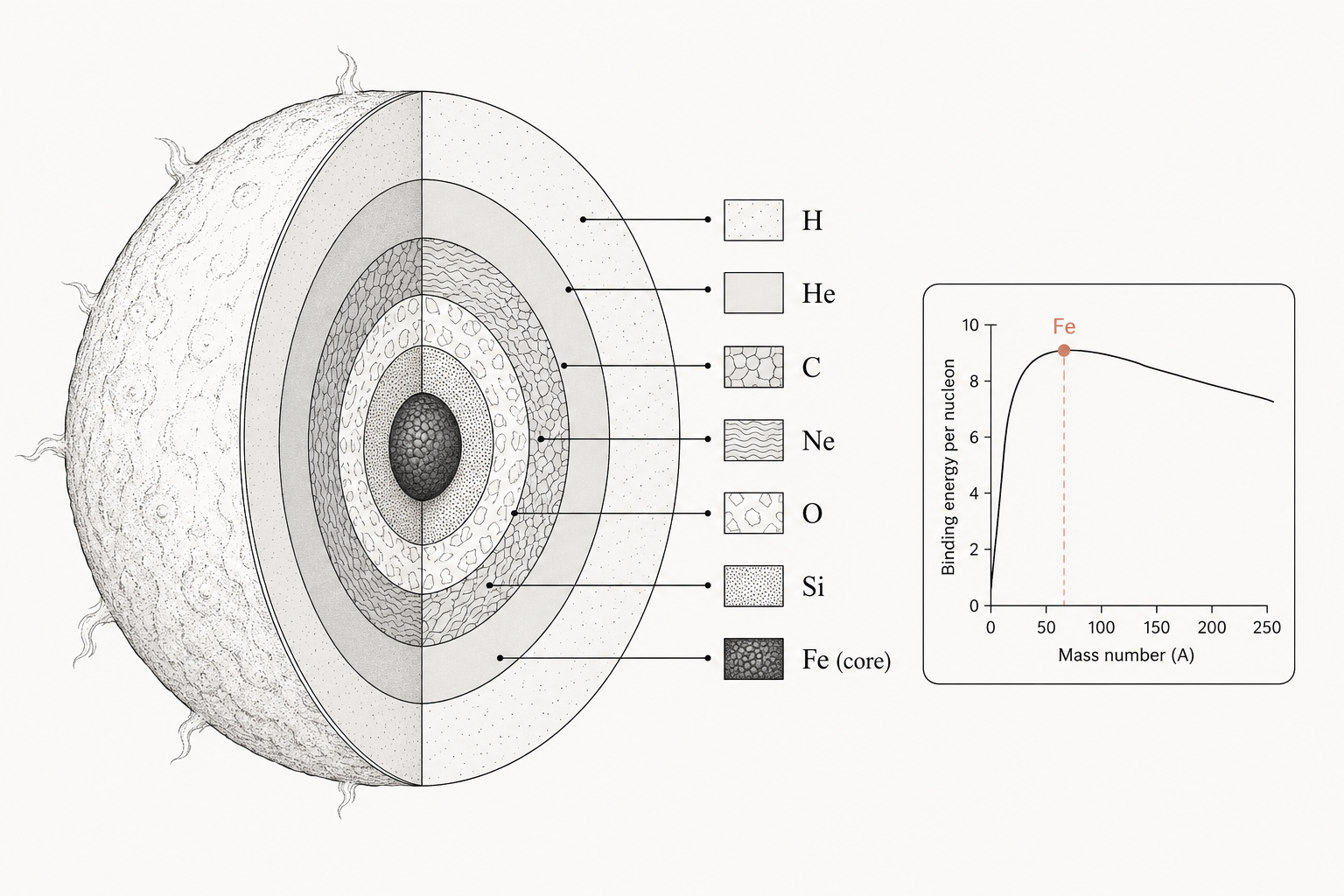
Figure F12-03. The nuclear onion: each shell burns the ash of the one above. When the centre turns to iron — the summit of the binding curve — the fire has nowhere left to go.
What follows occupies seconds. Bereft of fusion’s supporting pressure, the iron core — a sun-and-a-half of mass in an Earth-sized ball — collapses at a respectable fraction of light speed, crushing protons and electrons together into neutrons (the weak force, again, performing the conversion wholesale): a neutron star is born, ordinary atomic architecture obliterated, a single city-sized nucleus of chapter 9’s billion-tonne-teaspoon matter. The outer star, falling onto this suddenly incompressible floor, rebounds; the shock — driven, in the standard account, substantially by the colossal flood of neutrinos the collapse emits (the ghost particle, in its one act of cosmic violence) — detonates the star: a core-collapse supernova, briefly outshining its galaxy, broadcasting the onion’s accumulated elements — the oxygen, carbon, neon, silicon, calcium of every future planet and reader — into the interstellar medium. (The neutrino flood is not theory alone: nineteen of them, from Supernova 1987A, arrived in terrestrial detectors hours before its light was noticed.)
The elements beyond iron — silver, gold, uranium: the right-hand slope, costing energy to make — are forged not by fusion but by neutron capture: bathe seed nuclei in neutrons (the chargeless key, admitted without resistance) and they fatten, beta-decaying upward in atomic number along or above the valley of stability. The slow version (the s-process), operating over millennia in the gentle neutron drizzle of elderly red-giant interiors, builds roughly half the heavy inventory — barium, strontium, most lead. The rapid version (the r-process) demands a neutron blizzard so dense that nuclei capture dozens before they can blink, and nature’s confirmed venue for it was identified only in 2017, when gravitational-wave observatories caught two neutron stars spiralling to collision (the spacetime-shaking finale promised at chapter 11’s close) and telescopes watched the aftermath glow with the radioactive light of freshly minted heavy elements — strontium identified outright in the spectra, gold and platinum inferred by the planet-load. Current accounting makes such mergers a principal r-process foundry, with collapse-driven events contributing in proportions still under active audit. The reader’s iron, meanwhile, derives the larger share from a third factory: white-dwarf detonations (Type Ia supernovae), which burn a stellar corpse wholesale to the iron group.
The synthesis is the famous sentence, earned: we are made of star-stuff, as Carl Sagan put the consensus. Audited against the reader’s own composition — oxygen and carbon from helium-burning cores scattered by supernovae; nitrogen from intermediate stars; calcium and phosphorus from explosive burning; iron substantially from white-dwarf detonations; the trace iodine in the thyroid and any gold on the reader’s hand plausibly from neutron-star collisions; only the hydrogen, two-thirds of the body’s atoms, surviving from the Big Bang’s first minutes — the sentence is not poetry but provenance. Each atom now reading these words has passed through at least one stellar interior, most through several, across generations of stars that lived and died before the Sun existed; the solar nebula of 4.6 billion years ago was the pooled estate of those predecessors, its uranium and thorium the r-process deposits whose half-life disbursements (§12.3) warm the planet still. The trust fund of chapter 9 has its settlors: dead stars, and the chapter’s books — energy, mass and matter alike — close balanced.
Figure F12-04. The factory floor, after hours: a supernova remnant’s filaments — a dead star’s manufactured elements, dispersing toward the nebulae where future planets, and their readers, will condense.
12.7 From furnaces to fingertips
Part II’s survey of the working atom is nearly complete: structure (chapters 8–10), assembly (11), and now origin and restlessness (12). One chapter remains, and it inverts the scale of this one entirely: from furnaces that forge atoms by the Earth-mass, to laboratory instruments that see, hold, prod and arrange them one at a time — the technologies that converted the atom, within living memory, from inference’s masterpiece into an object of direct human handling. The tunnelling of §12.2, the reader is warned, has already been hired for the job.
Chapter 13 — Seeing and Touching Atoms
“There’s plenty of room at the bottom.” — Richard Feynman, 1959
13.1 The threshold of sight
Part II has anatomised the atom from electron shell to quark, and one fact about the entire account deserves emphasis before its final chapter: until alarmingly recently, every word of it rested on inference. Brownian statistics, scattering counts, spectral barcodes, mass-spectrograph deflections — evidence of magnificent indirectness, but no one had ever, in any defensible sense, looked at an atom. This closing chapter records how that changed within living memory: the instruments that now image individual atoms, lift and place them singly, hold one in space for months at a time, and — the chapter’s destination — employ their perfect identicality as civilisation’s master timekeeper. It is also, deliberately, the hinge to Part III, for these are the workshop tools with which the frontiers of the final chapters are being cut.
Why was seeing so long impossible? Not for want of magnification but as a matter of wave physics. An imaging wave cannot resolve detail much finer than its own wavelength — ripples metres long pass a mooring post as if it were absent — and visible light’s wavelengths run several thousand atomic diameters: to optical light, an atom is not small print but sub-ripple smoothness, unresolvable by any lens at any magnification, in principle. The first escape route follows from chapter 6: if matter is waves, use matter as the illumination. An electron accelerated through modest voltages has a de Broglie wavelength far below atomic size, and the electron microscope (Ernst Ruska, from 1931 — magnetic fields serving as lenses) carried imaging from light’s limit down through cells, viruses and crystal planes; its modern aberration-corrected descendants genuinely resolve the columns of atoms in a crystal lattice, and a related 1950s instrument, Erwin Müller’s field-ion microscope, produced the first true portraits of individual atoms — the gleaming dot-array of a needle tip’s own apex. But the instrument that made single atoms an everyday working material — and earned its inventors a share of Ruska’s long-delayed 1986 Nobel Prize — operated on a different principle entirely: not illumination at all, but touch at a distance, through the quantum leakage introduced in the last chapter.
13.2 Seeing by leakage: the scanning tunnelling microscope
The scanning tunnelling microscope (STM) — Gerd Binnig and Heinrich Rohrer, IBM’s Zurich laboratory, 1981 — is mechanically almost insolent in its simplicity. A metal needle, sharpened until its working tip is ideally a single atom, is brought to within about a nanometre of a conducting surface — close, but never touching: a vacuum gap remains, and a vacuum gap is, for the electrons on either side, precisely the classically forbidden barrier of chapter 12’s box. Apply a small voltage and electrons tunnel across the gap: a measurable trickle of current flows through the impossible. The instrument’s superpower is the exponential savagery of that tunnelling: widen the gap by a single atom’s radius and the current collapses roughly tenfold. The current is therefore a gap-gauge of preposterous sensitivity — and almost all of it flows through the one tip atom closest to the surface, which is what makes a hand-sharpened needle a single-atom probe. Scan the tip across the surface (piezoelectric crystals, which flex by fractions of a nanometre under applied voltages, provide motion control finer than any mechanical screw), let a feedback circuit raise and lower it to hold the current constant, and the tip’s recorded altitude traces the surface’s atomic landscape, row by row — provided the whole apparatus is isolated from vibration so thoroughly that a footstep in the corridor does not slam the tip through the sample. Within a year of operation the STM had imaged the long-disputed arrangement of atoms on a silicon crystal’s surface, settling at a glance a controversy that surface science had prosecuted for twenty years, and the era of atomic-resolution imaging was open.
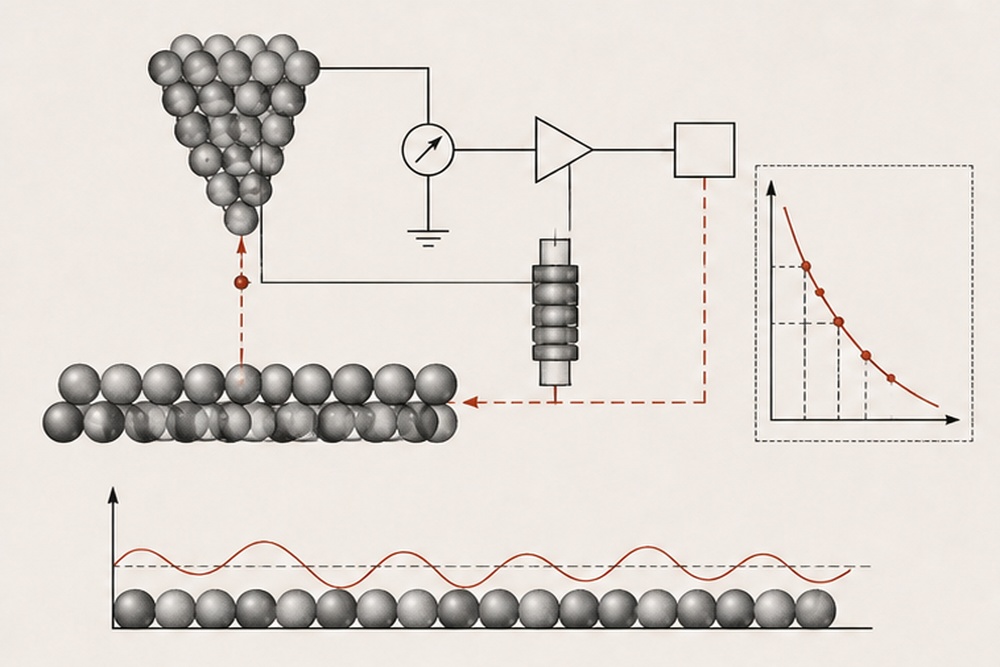
Figure F13-01. Touch at a distance: the tip never lands, the current leaks across the forbidden gap, and a tenfold change per atomic radius turns leakage into landscape.
KEY CONCEPT — What it means to “see” an atom Candour about epistemology: an STM image is not a photograph. No light is gathered; what is mapped is the surface’s electron probability density at the energy the tunnelling samples — the instrument feels its way across chapter 8’s clouds, and the luminous bumps in published images are orbitals’ outer reaches, not little balls. Two remarks keep this honest without deflating it. First, the caveat cuts equally against ordinary sight: eyes, too, detect nothing but interactions — photons that electron clouds have scattered — and “seeing” a chair is likewise an inference from leakage, merely a habitual one. Second, the maps are true: independently calculable from chapter 8’s theory, reproducible between instruments, and reliable enough to do engineering on. To withhold the word “seeing” from atomic imaging while granting it to vision would be a prejudice in favour of the eye’s particular wavelength band. Atoms have been seen; the seeing simply required admitting what sight always was.
13.3 Touching: matter, arranged by intention
The STM’s second career began with what should have been a nuisance. Tips sometimes dragged loose surface atoms about — contamination from the experimenter’s point of view, until Don Eigler at IBM’s Californian laboratory recognised it as a handle. Lower the tip until its attraction to a chosen atom (the van der Waals handshake of chapter 11, at point-blank range) outcompetes the surface’s grip; slide tip and captive atom together to the destination; withdraw, and the atom stays. In the closing weeks of 1989, Eigler and Erhard Schweizer, working at four degrees above absolute zero to keep their material from wandering, used the technique to place thirty-five xenon atoms, one at a time, hours per letter, into the shape of their employer’s three-letter logo. The image circulated worldwide, and earned the circulation: for the first time in the history of matter, atoms stood in a pattern because a mind had chosen it — the literal fulfilment of Feynman’s 1959 conjecture (this chapter’s epigraph) that physics permitted arranging matter atom by atom, and the founding demonstration of the field now called nanotechnology, whose engineering future is chapter 15’s business.
The same group promptly converted the trick from stunt to instrument. In 1993 they arranged forty-eight iron atoms into a closed ring — a quantum corral — on a copper surface, fencing in a patch of the copper’s mobile surface electrons; the STM image of the interior shows the fenced electrons’ probability standing in circular ripples, crest within crest, exactly as chapter 6’s wave mechanics computes for a confined wave. The reader should pause on what that picture is: the probability waves on which this book’s entire second half rests, not inferred from spectra but imaged — interference you can frame. Few objects in science so compactly certify a theory’s reality.
The STM’s one limitation — its surface must conduct, or no current tunnels — was answered by Binnig’s 1986 encore, the atomic force microscope (AFM), which replaces the current with force: an exquisitely flexible cantilever, tip at its end, bends measurably under the same interatomic pushes and pulls, and so feels its way across insulators — glass, minerals, living cells in water — at resolutions now rivalling the STM’s. Its refinements border on the implausible: an AFM tip deliberately capped with a single carbon-monoxide molecule, brushed across a flat organic molecule, resolves the individual bonds within it — the hexagons and linkages of the chemist’s structural formulae, drawn for a century as hopeful hieroglyphics, photographed as architecture. Chemistry’s diagrams turn out to have been portraits.
13.4 Holding: the still, cold atom
Imaging and nudging address atoms pinned to surfaces. The subtler prize is the free atom — held alone in space, undisturbed, for study or employment — and the obstacle is speed: at room temperature, air molecules average several hundred metres per second. Temperature, the reader should now hold firmly, is molecular motion (the insight latent since Bernoulli and Boyle’s springy air in chapter 1): to still an atom is by definition to cool it, and the stilling of single atoms required inventing the coldest places in the universe.
The brake is light itself. Photons carry momentum (chapter 6); an atom absorbing a photon recoils by the corresponding kick, and although one kick is feeble, a laser can deliver tens of millions per second, each followed by re-emission in a random direction whose pushes average to nothing — net effect, a headwind. The masterstroke (Steven Chu and colleagues, 1985) is tuning the laser slightly below the atom’s resonant absorption line and opposing pairs of beams along all three axes: by the Doppler effect, only an atom moving toward a beam sees its light shifted up into resonance, so each atom preferentially absorbs from whichever beam it approaches — braked automatically, in whatever direction it flees, by light that ignores it when it behaves. Atoms wandering into the six-beam crossfire slow within milliseconds from bullet speeds to a stagger, as though wading in syrup; the configuration is called, with justice, optical molasses, and it chills its captives to millionths of a degree above absolute zero — with refinements (subtler polarisation tricks discovered when the molasses outperformed its own theory) reaching colder still. Add a gentle magnetic field to herd the slowed atoms toward a common centre and one has the magneto-optical trap, the standard workhorse: a faintly glowing mote of millions of cold atoms, hovering at a beam crossing in a vacuum chamber — visible to the unaided eye as a dim star indoors. The 1997 Nobel Prize (Chu, Claude Cohen-Tannoudji, William Phillips) certified the field; its tools now furnish hundreds of laboratories.
Figure F13-02. Syrup made of light: at the crossing of six laser beams in a vacuum chamber, a cloud of atoms hangs braked to a millionth of a degree — a faint indoor star of stilled matter.
For the solitary atom, the elegant cage is electrical. Charged atoms — ions — can be suspended at the null point of rapidly oscillating electric fields (Wolfgang Paul’s trap, Nobel-recognised in 1989), laser-cooled to near rest, and kept: single ions have been held, continuously interrogated, for months. A cooled trapped ion, fluorescing under its cooling laser, scatters so steadily that an ordinary camera on long exposure records it directly — a celebrated 2018 photograph shows one strontium ion as a minute violet star between the trap’s electrodes, centimetres of apparatus framing a single atom shining for its portrait. (Neutral atoms submit to subtler cages: a tightly focused laser beam itself forms a trap — optical tweezers, Arthur Ashkin’s invention, 2018’s Nobel — holding one atom at the focus; arrays of hundreds of such tweezers, loaded one atom each, are among chapter 15’s quantum machines.)
Figure F13-03. One atom, photographed: a single trapped ion, laser-lit, as a faint star between its electrodes. Democritus’ uncuttable, sitting for its portrait on an ordinary camera.
KEY CONCEPT — Cold, properly understood Temperature measures the random motion of particles; absolute zero is the floor where (quantum fidgeting aside) motion stops; cooling is the removal of motion, by any means — and laser cooling removes it photon-kick by photon-kick. The scale achieved deserves contemplation: deep space, warmed by the Big Bang’s afterglow, sits at 2.7 degrees above absolute zero; laser-cooled clouds sit at millionths, and the coldest engineered samples at billionths and below. The coldest matter in the known universe is not between the galaxies; it hangs at laser crossings in physics buildings, including several in Ireland and Britain. Cold of that grade is not a curiosity but a resource: it is the stillness in which an atom’s quantum character — its wave spread, its interference, its perfect ticking — stands exposed, undrowned by thermal jitter. Part III’s machines all begin by buying this silence.
One consequence of extreme cold completes a promise from chapter 8. Cool a dense-enough cloud of bosonic atoms (whole-spin atoms — the gregarious party of the fermion/boson divide) below a critical threshold near a hundred-billionth of a degree, and the atoms’ spreading de Broglie waves overlap until, abruptly, a macroscopic fraction condenses into a single shared quantum state: tens of thousands of atoms, one wavefunction — a Bose–Einstein condensate, predicted by Einstein in 1925, achieved by Eric Cornell, Carl Wieman and Wolfgang Ketterle in 1995 (Nobel, 2001). A condensate is, functionally, a super-atom the size of a printed full stop: split one and recombine it and the halves interfere, painting chapter 6’s zebra stripes in matter at a scale visible to a camera. The double-slit mystery, scaled from one electron to a cloud you can photograph, closes Part II’s quantum arc where it began.
13.5 The atom as timekeeper
The chapter’s technologies converge on one supreme application, and its premise is a fact this book established in chapter 5 and has leaned on ever since: every atom of an element is perfectly identical. Every caesium-133 atom in the universe carries exactly the same energy staircase, and therefore absorbs and emits each of its transitions at exactly the same frequency — a pendulum without manufacture, wear, or national variation, issued identically everywhere matter exists. Build an oscillator disciplined to such a transition and one has a clock that any laboratory on Earth — in principle, any civilisation in the galaxy — can replicate exactly. Humanity adopted the standard in 1967: the second is defined as 9,192,631,770 oscillations of the radiation matching a particular hyperfine transition of caesium-133. Time itself, by international law, is something atoms do.
The art since has been letting the atom tick undisturbed, and every §13.4 technology enlists. Modern caesium fountain clocks laser-cool a cloud to microkelvins and toss it gently upward through the interrogating microwaves, querying the atoms in near-free-fall for the long, calm second of their rise and return: accuracies near one second’s error in a hundred million years. The current frontier moves the pendulum from microwaves to light: optical lattice clocks hold thousands of strontium or ytterbium atoms in an egg-carton of standing laser waves (the lattice tuned to a “magic” wavelength at which the trap, by careful cancellation, does not disturb the tick), interrogating an optical transition that oscillates tens of thousands of times faster than caesium’s — a finer-toothed gear, read by the laser frequency-measuring “combs” that earned 2005’s Nobel Prize. Their performance has ceased to sound like metrology: systematic uncertainties near two parts in a million billion (10⁻¹⁸), corresponding to an error under one second across the present age of the universe. A redefinition of the SI second onto an optical standard is scheduled, on the international roadmap, for around 2030.
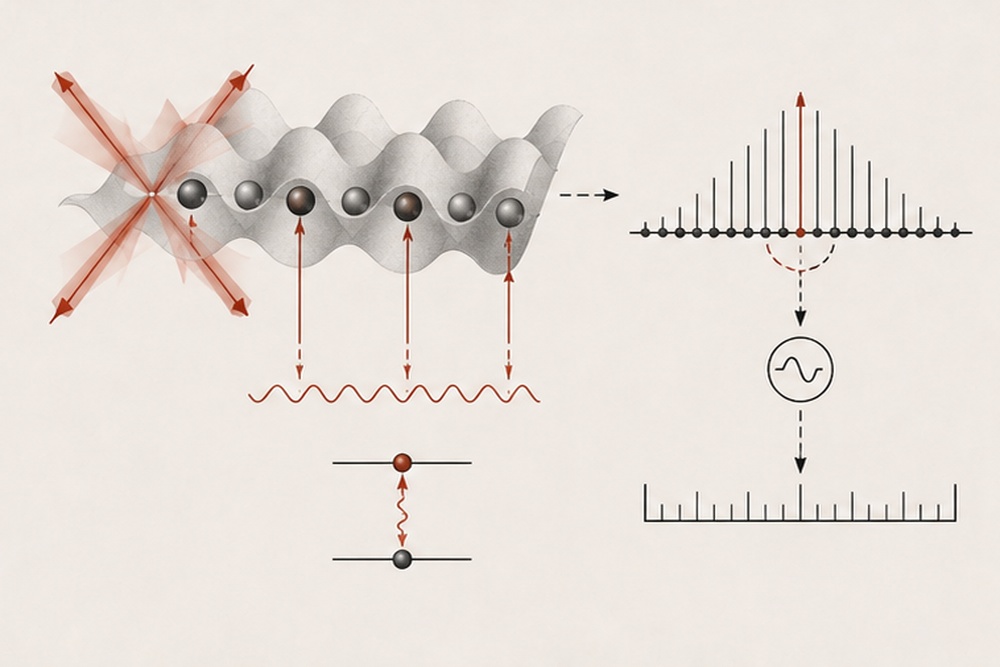
Figure F13-04. The state of the art of time: atoms parked in wells of light, ticking optically, accurate to a second in the age of the universe.
Precision of that order stops being about timekeeping and becomes an instrument for physics and for the planet — three exhibits. Navigation: every satellite-positioning fix is a triangulation of atomic-clock time signals, and the system functions only because it corrects, continuously, for relativity — orbital clocks run fast against ground clocks by some 38 microseconds per day (gravitational and motional effects netted), which uncorrected would corrupt positions by kilometres daily; every uneventful car journey is thus a working confirmation of Einstein and of caesium jointly. Geodesy: by general relativity, a clock higher in Earth’s gravity ticks faster; optical clocks now resolve the effect across a single millimetre of height — the laboratory bench’s altitude read in the rate of time — opening the prospect of surveying the planet’s gravity, mapping magma and groundwater, with portable clocks. Fundamental constancy: compare two clocks built on different transitions for years, and any slow drift in nature’s constants would surface as a drift between them — a quiet ongoing audit of whether the laws themselves are stable, whose null results so far, and whose stakes, belong to chapter 18.
It rewards a final step back. The instrument by which this civilisation defines time, navigates its oceans and aircraft, synchronises its markets and timestamps its science is the identicality of atoms — the property that, in chapter 5, was a metaphysical scandal demanding explanation, and that quantum mechanics explained as the sameness of solutions to one equation. Yesterday’s paradox is today’s national standard.
13.6 Part II closes
The anatomy lesson is finished, and its arc bears stating once, plainly. Part II opened with the atom as the quantum theory’s solved problem and closes with the atom as equipment: imaged by tunnelling, its orbital clouds and probability ripples photographed; lifted and placed singly into human designs; cooled to the coldest stillness in the universe and held alone for months; merged by the thousand into single quantum objects; and installed, by its perfect self-identity, as the working definition of the second. A particle whose existence respectable scientists disputed in 1900 became, within one human lifetime of that dispute, something a laboratory arranges into corporate logos and reads the height of a table by.
Which is precisely why this book is not finished. Tools of such reach do not close a subject; they open its frontiers — and the frontiers are Part III. Ahead: the campaign to extend Mendeleev’s table beyond its 118th seat and to ignite fusion’s fire in earthbound vessels (chapter 14); the conversion of trapped ions and tweezer arrays from specimens into computers and sensors (chapter 15); the disquieting cosmic audit holding that the atoms of this entire book are a minority of reality (chapter 16); the conjecture that quarks and electrons are themselves notes of something smaller (chapter 17); and the honest ledger of what remains unknown (chapter 18). The atom’s history is told; its future is funded and under construction. Part III reports from the sites.
Part III — Frontiers
Chapter 14 — Stretching the Periodic Table
“Fusion will be ready when society needs it.” — Lev Artsimovich, father of the tokamak
14.1 The table’s open edge
Part III reports from the frontiers, and the first frontier is the oldest object in this book: Mendeleev’s table itself. Chapter 9 established why nature’s table ends — beyond bismuth nothing is permanently stable, and beyond uranium (Z = 92) the strong force cannot balance the electrical books at any neutron ration. But “cannot balance permanently” is not “cannot exist,” and since 1940 humanity has been extending the table by manufacture: building nuclei that nature’s furnaces either never made or made and long since lost to decay. The campaign’s two running questions are the agenda of this chapter’s first half. How far can the table go? And — the deeper one — does an island of unusual stability wait somewhere beyond the visible shore?
The manufacturing history compresses into three technological eras. The first ran on chapter 7’s skeleton key: park uranium in a reactor’s neutron flood, let capture and beta decay ratchet it up the staircase — neptunium and plutonium (1940) by this route, and so on, element by harder-won element, to about fermium (Z = 100), where the ratchet jams: the intermediate nuclei begin fissioning faster than they can capture. The second era turned to chapter 5’s method at industrial intensity: fuse the desired nucleus whole, slamming a lighter projectile nucleus into a heavy target with just enough energy to tunnel the electrical barrier and merge — too little spare energy and they never join; too much and the merged drop boils apart. Berkeley under Glenn Seaborg’s generation, then the German GSI laboratory at Darmstadt and Russia’s Joint Institute at Dubna, climbed by this route through the 100s (the era’s priority disputes — the “transfermium wars” over naming rights — occupied committees for decades), with GSI’s cold-fusion variant delivering elements 107 through 112. The third era was Dubna’s masterstroke: hurling the doubly magic, neutron-rich projectile calcium-48 (its 20 protons and 28 neutrons both closed shells — chapter 9’s magic numbers, employed as ammunition) into targets of artificial actinides, a combination so favourable it yielded every element from 114 to 118. The 2016 christenings completed the table’s seventh row: nihonium, moscovium, tennessine and — named for Yuri Oganessian, the only living person on the table — oganesson, Z = 118.
The reader should not picture ingots. Superheavy synthesis is the rarest manufacturing in existence: beams of trillions of projectiles per second, played for months onto milligram targets, for product counts in single figures — total recorded oganesson production stands at a handful of atoms, each surviving under a millisecond. The economics are correspondingly heroic; the science extracted from those atomic handfuls, remarkable.
KEY CONCEPT — Chemistry, one atom at a time How does one do chemistry on three atoms with one-second half-lives? With conveyor belts and statistics. A freshly made superheavy atom, identified in flight by its decay chain’s fingerprint, can be swept in a gas stream along a channel whose walls are paved with test surfaces — gold panels, ice panels — held along a temperature gradient; where the atom finally sticks, registered by its decay flash, measures how volatile and how chemically clingy it is, one adsorption event per atom, accumulated over weeks into a verdict. By such methods copernicium (112) and flerovium (114) have been weighed for metallic character and volatility against their lighter table-column relatives. Mendeleev’s discipline — predict from the column, then test — is thus still running, on samples of n = 3.
14.2 The island of stability
Why press on past 118, at such cost? Because chapter 9’s nuclear shell model makes one of the great outstanding predictions in physics. The magic numbers — closed nucleon shells at 2, 8, 20, 28, 50, 82, and (for neutrons) 126 — confer extra binding wherever they occur; the next closed shells are calculated to fall near proton number 114–126 and neutron number 184; and a nucleus near a doubly closed configuration there should be dramatically more resistant to decay than its neighbours. On the chart of the nuclides, the prediction draws an unforgettable map: the long peninsula of known nuclei, tapering into a “sea of instability” where half-lives collapse toward nothing — and then, offshore, an island of stability, a region of enhanced half-lives centred near N = 184. Early projections of the island’s altitude ran to millions of years; modern calculations are humbler — minutes, days, perhaps years for the summit — but even minutes would be a revolution: a superheavy element that persists is a superheavy element whose chemistry, and perhaps applications, can be studied as a substance rather than an event.
The map is not pure theory; its shoals have been sighted. Within the calcium-48 elements, half-lives lengthen markedly as isotopes gain neutrons toward 184 — exactly the rising seabed the island predicts — and every nucleus yet made approaches the island only from its neutron-poor side, beached on the near shore: no available projectile-plus-target combination carries enough neutrons to land at N = 184 itself. The island’s heart is, for now, unreachable; its existence, on the accumulating slope evidence, is the working consensus.
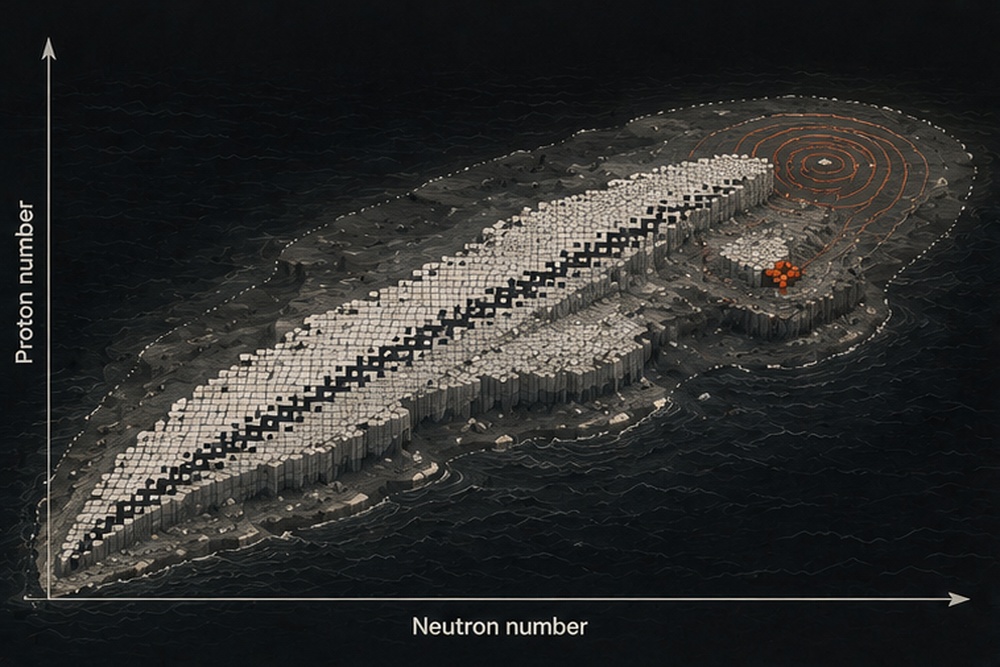
Figure F14-01. The nuclear archipelago: known matter as a peninsula, and the predicted island of stability offshore. Every synthesis so far has landed on the near beach.
The campaign for the eighth row — elements 119 and 120 — is, at this writing, live, multipolar and reshaped by geopolitics. Calcium-48 itself has hit a wall of chemistry rather than physics: making 119 or 120 with it would require targets of einsteinium or fermium, which cannot be produced in the milligram quantities a target demands, so the laboratories must graduate to heavier projectiles — titanium, vanadium, chromium — whose fusion odds were until recently unknown. The decisive reconnaissance came in 2024 at Berkeley, where a titanium-50 beam fired into plutonium for twenty-two days produced two atoms of livermorium (116) — proof that the titanium route works, and a calibration of how long element 120 should take. Berkeley’s plan, reviving a laboratory that discovered sixteen elements but none since 1974, is titanium-50 on a californium-249 target — about 45 milligrams of it, supplied by Oak Ridge — with the experiment to follow once the facility is upgraded for so radioactive a target. RIKEN in Japan is pursuing element 119 with vanadium beams on curium; Dubna — its long collaboration with the American laboratories severed by sanctions following the invasion of Ukraine — continues its own programme, including chromium-54 experiments that watched element 120’s compound nucleus form and fission almost immediately, instructive even in failure. The races’ tempo is set by cross-sections measured in femtobarns — production rates of an atom per months of beam — and no laboratory had announced success as of mid-2026. Whichever flag plants first, the eighth row will open, and with it a question this book has earned the right to ask sharply: at such nuclear charges, where chapter 8’s relativistic effects on the inner electrons grow from fine print to dominant physics, do the columns still mean anything? Calculations suggest oganesson’s electron shells are already smeared toward a near-uniform fog — a “noble gas” that may be neither noble nor, at room temperature, a gas — and somewhere in the eighth or ninth row the periodic law itself, this book’s oldest pattern, is expected to dissolve into relativity. The table has an edge in principle, not merely in manufacture; finding it is the point.
(A companion frontier deserves its paragraph: the same fusion-and-separation art, applied not upward but outward, manufactures light nuclei at the edges of existence — stuffed with neutrons to the “drip line” where the next neutron simply will not stay. Out there the shell model’s own magic numbers shift and migrate, and structures appear with no stable-world counterpart: halo nuclei such as lithium-11, its last two neutrons orbiting in a quantum haze that makes the eleven-nucleon system as large as lead. Facilities built for this cartography — the Facility for Rare Isotope Beams in Michigan the newest — are, in effect, surveying the r-process’s territory from chapter 12, measuring on Earth the exotic nuclei through which neutron-star mergers built the heavy elements.)
Figure F14-02. Element factory: a heavy-ion beamline and its separator magnets. Months of beam, milligrams of target, and a yield counted in single atoms — identified one decay chain at a time.
14.3 The other fusion problem
The chapter’s second frontier applies the same physics — forcing positive nuclei together against their repulsion — to a different end: not new elements but power. Chapter 12 established the terms. The binding curve pays roughly seven times more per kilogram for fusion than fission; the easiest earthly reaction is deuterium–tritium (D–T), whose fuel economics are absurdly favourable (deuterium from seawater; tritium bred on-site from lithium); the catch is ignition temperature — D–T needs its plasma at 100–200 million degrees, hotter than the Sun’s core, because a power plant cannot imitate the Sun’s other trick of waiting (the weak-force patience of §12.5 is exactly what a reactor must do without). The requirement compresses into one engineering scoreboard, the triple product: density × temperature × confinement time must exceed a threshold for the plasma to pay its own heating bill. Two grand strategies pursue it — hold a thin plasma for seconds in magnetic bottles, or crush a dense one for nanoseconds with converging lasers — and the honest scoreboard for both requires one preliminary.
KEY CONCEPT — Q, honestly “Net energy” hides three different claims, routinely conflated in headlines. Scientific gain (Q-plasma) compares fusion energy out to heating energy delivered into the plasma or target: Q = 1 is “breakeven,” the physics milestone. Engineering gain compares fusion out to wall-plug electricity in — and the gap is brutal: a laser facility may draw hundreds of megajoules from the grid to deliver two into its target. Commercial gain demands engineering gain large enough, at high duty cycle and tolerable capital cost, to sell electricity against alternatives. Every fusion claim in the pages that follow should be slotted into this hierarchy; most public confusion about fusion is the failure to do so.
14.4 Magnetic bottles
The dominant strategy descends from a 1950s Soviet design whose name survives as a word in every language: the tokamak, a torus — a doughnut — of magnetic field in which the plasma’s charged particles, unable to cross field lines (chapter 4’s deflection physics, employed as a wall), spiral endlessly along them, touching nothing material. Sixty years of tokamaks established the physics: Europe’s JET achieved the first significant D–T power in 1997 (16 megawatts, Q-plasma ≈ 0.7) and closed its career in the 2020s with record-setting D–T energy campaigns. The scaling laws extracted from that lineage say bigger is better — confinement improves with machine size — and their logical terminus is ITER, under assembly by a 35-nation consortium in southern France: a 23,000-tonne tokamak designed for Q-plasma = 10 (500 megawatts of fusion from 50 of heating), explicitly a physics demonstration, generating no electricity. Its history is the field’s cautionary exhibit: conceived in 1985, repeatedly re-baselined, and re-scheduled again in 2024 — research operations now to start in 2034, full magnetic energy in 2036, and the decisive deuterium–tritium phase in 2039, a four-year slip carrying roughly five billion euros of additional cost, with the plasma-facing first wall switched from beryllium to the more reactor-relevant tungsten. ITER will very probably work; the question its schedule begs is whether the route — one generation-spanning machine per generation — can matter to mid-century energy.
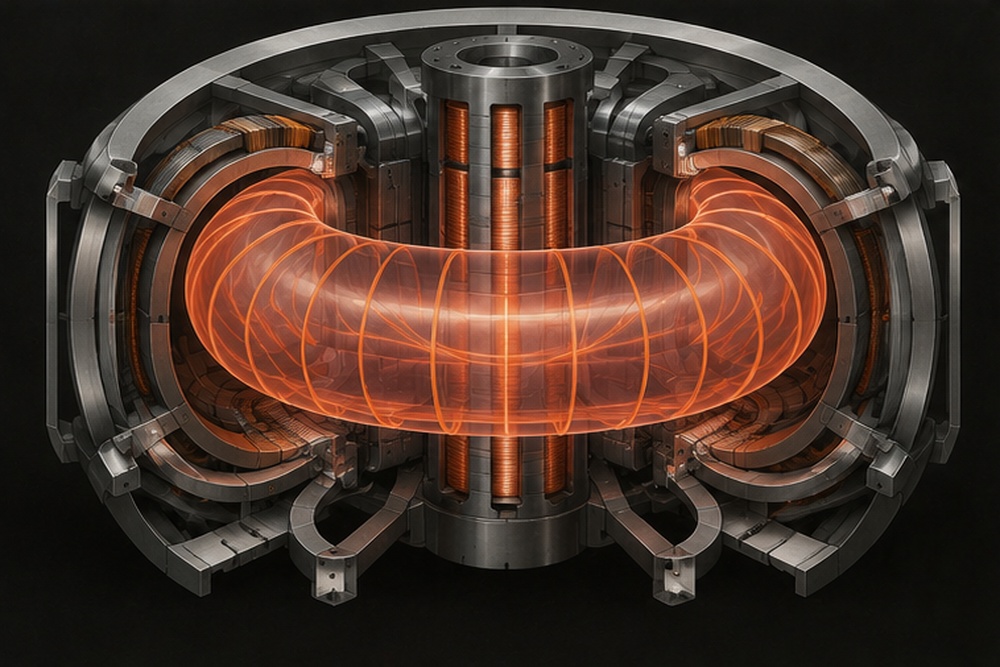
Figure F14-03. A bottle made of fields: the tokamak holds star-grade plasma on magnetic lines it cannot cross.
Two developments have transformed the field’s tempo since ITER was designed. The first is the maturing of the tokamak’s elegant rival, the stellarator, which achieves the necessary twist of the field not with a driven plasma current (the tokamak’s internal current is both its engine and its chief instability) but with fantastically contorted external coils, computed to purpose — a design unbuildable before supercomputers. Germany’s Wendelstein 7-X, the flagship, has in the mid-2020s sustained high-performance plasmas for tens of minutes and posted record long-pulse triple products: steadiness is the stellarator’s dowry, and reactor designers have noticed.
The second is capital. Roughly ten billion dollars of private investment has flowed into some forty fusion companies, and the bellwether is Commonwealth Fusion Systems, an MIT spin-out whose founding bet was a materials technology: high-temperature superconductors (REBCO tape) wound into magnets roughly twice the field strength of ITER’s — and since fusion power density scales steeply with field, doubling the field shrinks a Q>1 tokamak from cathedral scale to industrial-building scale, buildable in years on private money. Its demonstration machine, SPARC, stood about three-quarters built in Massachusetts in spring 2026, with first plasma targeted around the turn of 2026–27 and the company “aiming for Q greater than one as fast as humanly possible” thereafter; the follow-on ARC — a planned ~400-megawatt grid-connected plant in Virginia for the early 2030s — has already attracted a 200-megawatt power purchase agreement from Google, against roughly three billion dollars raised. The wider private field hedges every variable at once: spherical tokamaks (Tokamak Energy), magnetised-target compression (General Fusion), Z-pinches (Zap), and Helion’s field-reversed approach, which aims at direct electricity recovery and has famously pre-sold power to Microsoft on a late-2020s schedule that the cautious reader will file under “extraordinary claims, pending.” The honest summary: private fusion has compressed timelines and multiplied shots on goal; none of its machines had demonstrated Q-plasma > 1 as of mid-2026, and the sector’s nearest-term promises are exactly the ones requiring the most salt.
14.5 The laser route
The rival strategy abandons confinement altogether: implode a millimetre sphere of frozen D–T so fast and so symmetrically that it burns before it can fly apart — confinement by inertia, for nanoseconds, star pressure in a bottle of momentum. Its flagship is the American National Ignition Facility (NIF): 192 laser beams, building-sized amplifier halls, converging on a gold thimble (the hohlraum) whose X-ray bath crushes the capsule within. NIF’s primary mission, candour requires noting, is nuclear-weapons science — the physics of thermonuclear burn, studied without test explosions — and fusion energy rides as passenger. But the passenger made history: on 5 December 2022, a NIF shot produced 3.15 megajoules of fusion from 2.05 delivered — Q-target ≈ 1.5, the first laboratory ignition of any kind, the Lawson criterion met at last, eighty-nine years after Rutherford’s “moonshine.” The years since have converted milestone into method: ignition has been achieved nine further times since that first success, with steadily improving target craftsmanship credited as the largest single factor, and the record standing, from an April 2025 shot, at 8.6 megajoules — a target gain above four. An approved upgrade, the Enhanced Yield Capability, will raise NIF’s laser energy by a fifth, with target designs aimed at thirty megajoules and beyond.
Now the §14.3 hierarchy, applied without mercy. Those gains are Q-target: against the ~300 megajoules of grid electricity each shot consumes, NIF’s wall-plug ledger remains two orders of magnitude underwater — its 1970s-era lasers were never meant to be efficient. And a laser power plant must fire not once per day, as NIF does, but several times per second, on targets costing cents rather than the present five-figure artisanal capsules, with machinery surviving the neutron blast of each. None of this is unphysical — modern diode-pumped lasers reach tens-of-percent efficiencies, and an inertial-fusion-energy startup sector (Xcimer, Focused Energy and others) is engineering toward exactly these specifications — but the distance between “ignition, repeatedly” and “inertial fusion electricity” is the distance between the Wright Flyer and a scheduled airline, and should be stated as such. What NIF has irreversibly changed is the category of the debate: thermonuclear burn in the laboratory is no longer a hypothesis to defend but a tool in routine, improving use.
Figure F14-04. The smallest furnace: a gold hohlraum, the thimble at the focus of 192 laser beams. Within it, for a nanosecond, the hottest matter in the solar system.
14.6 An honest balance sheet
Where, then, does earthbound fusion genuinely stand in 2026? The scientific question — can it be done? — is answered: ignition is demonstrated and repeatable on the inertial route, and the magnetic route’s physics basis is solid enough that its remaining Q milestones are widely regarded as engineering schedule rather than open science. The unanswered questions have migrated wholesale into engineering and economics, and deserve listing without varnish. Materials: D–T’s 14-MeV neutrons, far harsher than fission’s, will embrittle and transmute any first wall; no material has yet been qualified under reactor-lifetime doses, and the dedicated irradiation facilities are themselves still under construction. Tritium: a power plant must breed its own fuel — each fusion neutron must, via the lithium blanket, yield slightly more than one new tritium — and a breeding ratio above unity has never been demonstrated in an integrated system; the world’s startup inventory of tritium is measured in tens of kilograms. Duty and cost: a power plant is a machine that runs, year-round, against competitors — and fusion’s rivals, unlike fusion, get cheaper every year it is late. Against the ledger’s debit column stand the credits that keep nations and investors paying: chapter 9’s million-fold energy density; fuel reserves measured in geological time; no chain reaction to run away and no meltdown class of accident (a failing fusion plasma simply quenches); and a waste profile of activated structure rather than long-lived spent fuel. The famous gibe — thirty years away, and always will be — has earned retirement in one respect at least: for the first time in the field’s seventy years, its milestones are being set by machines under construction rather than machines under proposal, and the early 2030s will deliver verdicts, one way or the other, from SPARC, from ARC’s financing, from NIF’s upgraded yields and from ITER’s assembly hall. Artsimovich’s epigraph may yet prove exactly calibrated: society’s need, on a warming planet, has rarely been clearer.
Both halves of this chapter, it is worth noticing in closing, are the same enterprise at heart: chapter 9’s binding-energy curve, prosecuted at its two ends — pushing the table’s heavy edge outward atom by atom, and harvesting the curve’s left slope megajoule by megajoule. The next chapter turns from the nucleus’s energy to the atom’s information: the conversion of chapter 13’s trapped ions and tweezer arrays from laboratory specimens into computers, sensors and instruments — the atom, employed.
Chapter 15 — The Atom as a Machine
“Nature isn’t classical, dammit.” — Richard Feynman, 1981, proposing the quantum computer
15.1 From specimen to component
Chapter 13 ended with atoms imaged, held, cooled and ticking; this chapter reports what engineering is now building from them. The transition has a name in the trade — the second quantum revolution — and the name marks a genuine boundary. The first quantum revolution gave the twentieth century its technologies of the ensemble: the transistor, the laser, the LED all exploit quantum mechanics, but exploit it statistically, in the mass behaviour of trillions of electrons and photons, with no individual quantum object ever addressed. The second revolution is the deliberate engineering of quantum mechanics’ two strangest assets — superposition and entanglement — in individual, named, controlled atoms and their kin: computers whose registers are single ions; sensors whose working part is one matter wave; memories written one atom per bit. Its raw materials are precisely chapter 13’s instruments — the Paul trap, the optical tweezer, the laser-cooled cloud — promoted from apparatus to component; and its honest assessment, which this chapter attempts throughout, requires sorting a field of genuine breakthroughs from a publicity climate that has not always deserved them.
15.2 Information goes quantum
Begin with the unit. A classical bit is a system with two states, 0 or 1, and is in one of them. A qubit is a quantum two-state system — and the natural specimen is this book’s oldest friend, the staircase atom of chapter 5: take an atom, designate its ground state |0⟩ and one chosen excited state |1⟩, and the rules of chapter 6 permit what no classical switch can do. The atom can occupy a superposition — a single definite quantum state that is neither 0 nor 1 but a weighted blend of both, with the weights (amplitudes) continuously adjustable by laser pulse; measured, it yields 0 or 1 with the corresponding odds, the superposition collapsing in the act, Born’s rule presiding. And two or more qubits can be entangled: prepared in joint states in which neither atom individually has a definite value, yet their measured values are locked in correlation — a relationship with no classical counterpart, whose full strangeness (and its experimental vindication over Einstein’s objections) is deferred to chapter 18, but whose engineering role can be stated now: entanglement is the wiring of quantum computation, the channel by which qubits inform one another.
The power on offer scales alarmingly. A register of n qubits occupies a superposition described by 2ⁿ amplitudes — three hundred qubits suffice for more amplitudes than there are atoms in the observable universe — and a quantum computation choreographs the interference of all of them at once. The phrase to strike from the reader’s mental lexicon, however, is “tries every answer in parallel.”
KEY CONCEPT — What a quantum computer is not The folklore picture — the machine explores all solutions simultaneously and prints the right one — fails at its last step: a measurement returns one outcome, by chance, and a computer that merely superposed every candidate answer would output random noise. A genuine quantum algorithm is a piece of wave choreography: it arranges the computation so that paths leading to wrong answers interfere destructively — chapter 6’s zebra-stripe cancellation, weaponised — while paths to the right answer reinforce, so that the final measurement finds the odds rigged heavily toward truth. Designing such choreography is fiendishly hard, which is why useful quantum algorithms are rare and precious rather than automatic. The quantum computer is not a parallel oracle; it is an interference instrument — the double slit, scaled up and aimed at mathematics.
What is the choreography for? Three honest answers, in descending order of certainty. First and foremost, simulating nature — Feynman’s founding argument (this chapter’s epigraph): quantum systems are exponentially expensive for classical computers to model exactly, and chemistry, materials science and nuclear physics are full of problems (catalysts, superconductors, drug binding, the nitrogen-fixing enzyme that the Haber process of chapter 11 brute-forces) where a controllable quantum system simulating another quantum system is the natural tool. Second, certain structured mathematical tasks, the famous case being Shor’s algorithm (1994), which factors large numbers efficiently and would thereby break the public-key cryptography securing most of the world’s communications — a threat distant in hardware terms but present in policy terms, since encrypted data harvested today can be decrypted by tomorrow’s machine; the migration to “post-quantum” cryptographic standards, formalised internationally in 2024, is already underway for exactly this reason. Third, a tail of more modest speedups for search and optimisation, where the honest verdict is: real, bounded, and frequently oversold.
15.3 The contenders, atoms front and centre
A qubit can be built from many physical systems, and the field is a genuine multi-platform race; this book’s subject supplies two of the leaders.
Trapped ions are chapter 13’s caged atoms, employed whole. Each qubit is one ion — typically ytterbium or barium — suspended in a Paul trap’s oscillating fields, its |0⟩ and |1⟩ encoded in two hyperfine levels of exquisite stability; laser pulses write, rotate and read each qubit, and two-qubit logic exploits the ions’ shared electrically-coupled motion as a communication bus. The platform’s virtues read like this book’s greatest hits: the qubits are atoms, hence perfectly identical (chapter 5’s scandal, now a manufacturing specification no factory can match), with coherence times in minutes and the highest gate fidelities in the industry — flagship two-qubit operations now succeed at 99.92 per cent, with research devices pressing 99.99. The costs are speed (gates run slow against solid-state rivals) and scaling, since ever-longer ion chains grow unwieldy — answered by architectures that shuttle ions physically between trap zones on patterned chips, and by efforts to replace racks of lasers with chip-integrated electronic control. The platform’s flagship machines run around a hundred physical qubits, with 256-qubit systems on 2026 roadmaps.
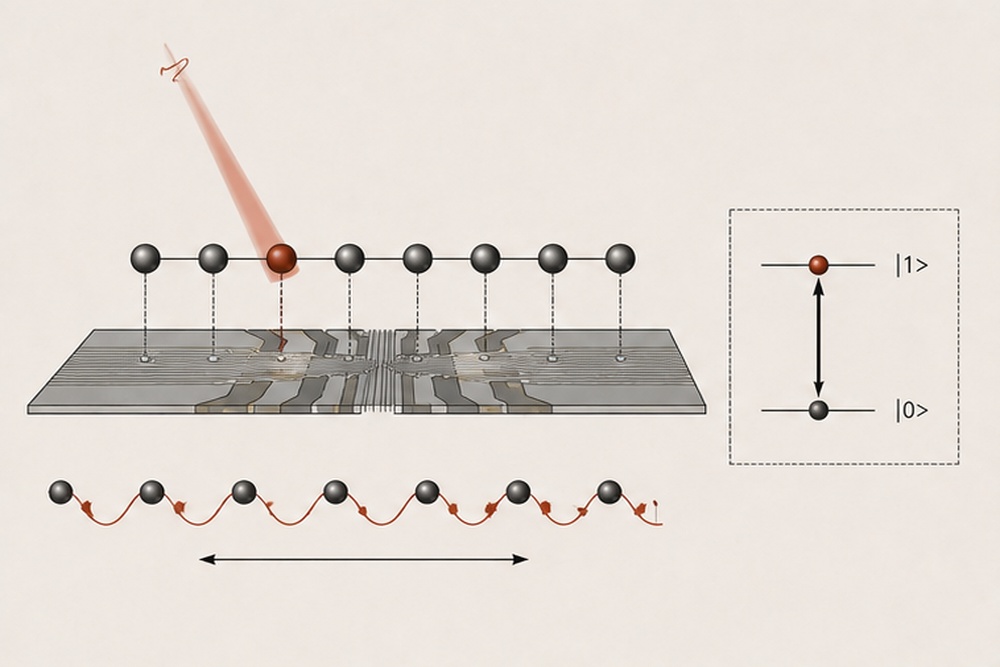
Figure F15-01. The atom as register: each ion one qubit, written and read by laser, wired to its neighbours through their shared motion.
Neutral atoms are chapter 13’s optical tweezers, employed by the hundred: individual uncharged atoms (rubidium, caesium, strontium, ytterbium) held one per laser-focus in reconfigurable grids, qubits again in internal levels. Their trick for two-qubit logic is among the prettiest in the field: exciting an atom to a Rydberg state — an outer electron promoted to a colossal orbit, swelling the atom thousands-fold — switches on strong interactions with its neighbours, so that one atom’s puffed-up presence blocks the excitation of the next: conditional behaviour, which is all logic requires, toggled by laser at will. Neutrality buys quiet (less coupling to stray fields) and, above all, scale: arrays of over a thousand trapped atoms are demonstrated, with academic arrays beyond six thousand, and the tweezers can rearrange the register’s very geometry mid-computation — qubits picked up and carried to new neighbours, a connectivity no wired chip can imitate.
For context, the platform this book’s subject does not supply currently leads the raw-count tables: superconducting circuits — microfabricated rings whose current states behave as the levels of an “artificial atom,” a designation this book’s readers can appreciate as more than metaphor — are the technology of Google’s and IBM’s processors, fast of gate, factory-compatible, and obliged to live in dilution refrigerators colder than chapter 13’s records. Photonic, silicon-spin and other platforms round out a field in which, unusually for a technology race, no winner is yet sensibly callable — a fact underlined in 2026 when Google, long the standard-bearer of superconducting qubits, opened a parallel neutral-atom programme, becoming the first major player to run both modalities at once.
KEY CONCEPT — Decoherence: why this is hard The qubit’s enemy has appeared in this book before, wearing a different label. A superposition survives only while the qubit’s quantum state remains private; any stray interaction that lets the environment “find out” the qubit’s state — a scattered photon, a jostling gas atom, a flicker of magnetic field — acts exactly like the which-slit detector of chapter 6, collapsing the delicate amplitudes into mundane definiteness. This is decoherence, and it is why quantum computing is an engineering war against information leakage: ultra-high vacuum, magnetic shielding, laser-cooled stillness, operations completed faster than the environment can eavesdrop. Hold the concept; it explains the field’s central economics (error correction, below), it answers the perennial “why don’t we see superposed teacups” at one stroke — big warm objects decohere in unimaginably small fractions of a second — and, inverted, it is the entire business model of §15.4: a system that responds measurably to the faintest environmental whisper is, renamed, a perfect sensor.
Decoherence sets the field’s true scoreboard, which is not qubit count but error management. Physical qubits err — once per few hundred to few thousand operations at the state of the art — while algorithms of commercial consequence require error rates billions of times lower. The remedy, quantum error correction, spreads one logical qubit’s information redundantly across many physical qubits, detecting and repairing faults on the fly without illegally “reading” the data itself; the governing theorem says that if physical errors sit below a threshold, adding redundancy suppresses logical errors exponentially — the machine improves as it grows. Crossing from below to above that threshold is the field’s sound-barrier, and the mid-2020s will be remembered as the years it was crossed in public. Google’s Willow chip demonstrated in late 2024 the canonical below-threshold scaling — logical errors falling as its code grew. The atomic platforms answered in kind, and the record book as this book went to draft reads as follows: Quantinuum’s 98-ion Helios system demonstrated 48 logical qubits at launch in late 2025 and was operating 94 logical qubits from those same 98 ions by March 2026, after demonstrating the “magic-state” operations that fault-tolerant universality requires; QuEra demonstrated 96 verified logical qubits on 448 neutral atoms — the first machine past fifty, with error-corrected operations across the full set — doubling the previous record; and in June 2026 Atom Computing reported the first sustained, multi-round error correction on a neutral-atom architecture, logical errors falling as physical qubits were added, with a 50-logical-qubit commercial system targeted for late in the year. The era of the logical qubit, in short, has opened — substantially on atomic hardware.
The honest hype audit, then. Real: below-threshold error correction; tens-of-logical-qubit machines; cloud access as routine commerce; “quantum advantage” demonstrations on contrived benchmark tasks. Not yet real: any commercially decisive advantage on a problem anyone independently wanted solved; the thousands of logical qubits (and accompanying millions of physical ones) that Shor-class cryptanalysis or definitive chemistry would require — a distance most sober roadmaps measure in years-to-a-decade, not months. The reader equipped with this paragraph’s distinction — logical versus physical, demonstrated versus projected — can deflate or credit most quantum headlines unaided.
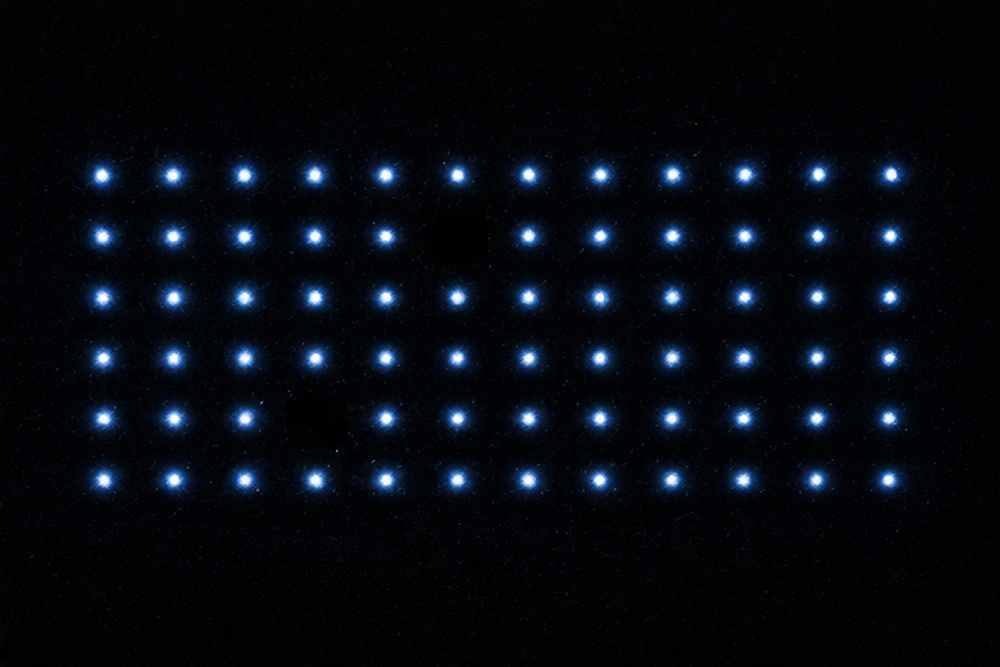
Figure F15-02. A register of atoms: fluorescence image of a neutral-atom tweezer array — each point of light a single atom, each atom a qubit, the grid rearrangeable mid-computation.
15.4 The atom as instrument
Invert decoherence and the second quantum revolution acquires its already-profitable wing. If a qubit’s curse is responding to every environmental whisper, then a calibrated qubit is a microphone for those whispers — and quantum sensing, less publicised than quantum computing, is further along, with hardware in field trials and clinics rather than press releases.
The flagship technique is atom interferometry, and the reader owns every part already. Take a laser-cooled atom in free fall; with a pulse of light, split its matter wave (chapter 6) into a superposition of two trajectories — one nudged upward, one not; let the halves fly apart for a second, separating by centimetres; recombine them with further pulses and read the interference. The fringes record, with interferometric mercilessness, any difference the two paths experienced — and if the difference is gravity, the device is a gravimeter reading the local pull of the Earth to parts per billion: the double-slit experiment, repurposed as a surveying tool. Applications have left the laboratory. Gravimetric gradiometers — twin atom interferometers, differenced to cancel vibration — have detected buried tunnels in outdoor field conditions, opening a prospecting-by-gravity trade (voids, pipes, mineral density, magma movement, aquifer depletion) that needs no drilling and cannot be shielded against, gravity being unblockable. Navies and avionics firms are field-testing quantum inertial navigation: an atom interferometer measuring its own accelerations so faithfully that a submarine or aircraft can track its position for long periods without satellite signals — dead reckoning with matter waves, immune to GPS jamming, a capability whose strategic appeal needs no elaboration. And scaled to extravagance, the same instrument becomes fundamental physics: hundred-metre vertical interferometers now under construction drop atom clouds down mineshafts, hunting (among other quarry) the feeble signatures of certain dark-matter candidates and the gravitational waves of frequencies no mirror-based observatory can reach — a sentence whose first quarry is the business of the next chapter. (The atomic clocks of chapter 13 belong to the same family: a clock pair is a sensor for anything that touches the flow of time, height included, as the millimetre-resolution gravitational redshift measurements showed.)
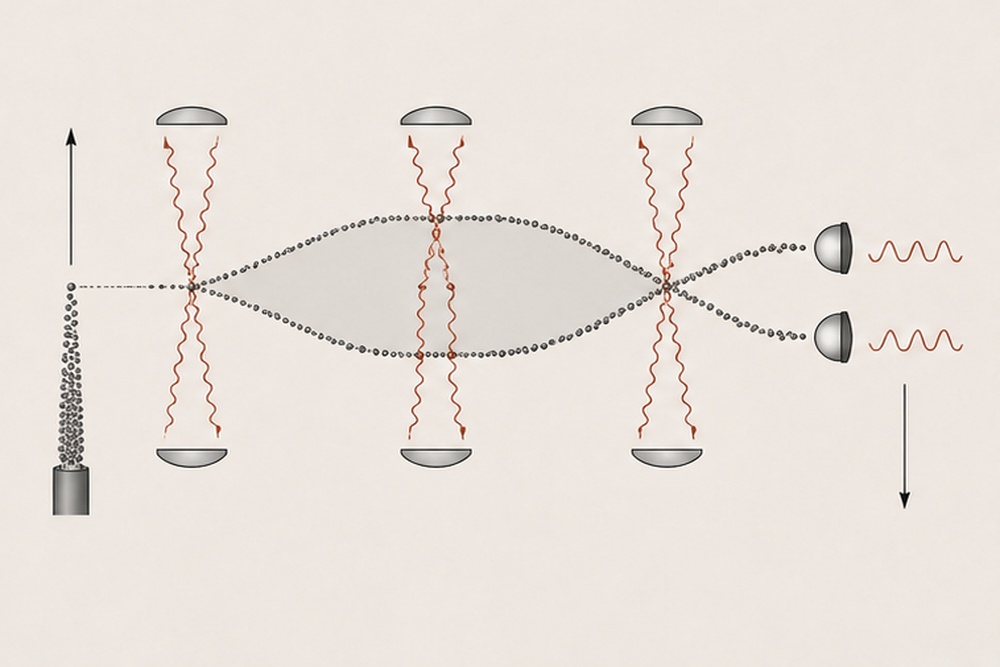
Figure F15-03. The double slit, employed: one atom, two paths, and interference fringes that read the Earth’s gravity to parts per billion.
A second sensor family miniaturises the atom into the solid state. The nitrogen-vacancy (NV) centre — a defect in diamond where a nitrogen atom sits beside a missing carbon — behaves as a single trapped atomic spin embedded in the most rugged material in chapter 11, readable by its fluorescence at room temperature. One NV centre is a magnetometer of nanometre size: brought against a sample, it senses the magnetic murmur of individual electron and nuclear spins, and the programme of nanoscale magnetic-resonance imaging — MRI, scaled from hospital to single protein — is among the field’s live frontiers. At human scale, quantum magnetometry has already entered the clinic: wearable magnetoencephalography helmets, their sensors miniature optically-pumped atomic vapour cells, map the brain’s faint magnetic activity on patients who move freely — children, epilepsy cases mid-seizure — where the old fixed, helium-cooled scanners demanded statue stillness. The reader’s lifetime will likely include a medical measurement taken by the precession of alkali atoms in a helmet.
15.5 Building with atoms
The chapter’s third wing extends chapter 13’s xenon logo from demonstration to discipline: fabrication at the atomic limit. The semiconductor industry arrived at the neighbourhood from above — its finest transistor features now span mere dozens of atoms, so that the placement statistics of individual dopant atoms measurably scatter the behaviour of nominally identical devices; “conventional” chipmaking is already, unavoidably, atomic engineering. The deliberate version proceeds from below. Scanning-probe lithography — an STM tip desorbing single hydrogen atoms from a silicon surface to expose chosen sites — now positions individual phosphorus dopants in silicon with atomic precision, yielding single-atom transistors and small arrays of donor-based qubits: the prospect, pursued seriously, of quantum hardware drawn atom by atom in the same material as the classical industry. Atomic memory has been prototyped — a kilobyte written in the positions of single vacancies, at a density that would put humanity’s entire book inventory on a postage stamp, albeit at cryogenic reading speeds. And a complementary art assembles designer matter: chapter 11’s graphene and its two-dimensional kin, stacked and twisted sheet upon sheet — at certain “magic” twist angles, the moiré pattern between layers rewrites the electronic rules wholesale, switching one pair of carbon sheets between insulator and superconductor by rotation alone — while optical lattices loaded with cold atoms serve as programmable crystal simulators, matter built to order so that hypotheses about real materials can be run, parameter by parameter, on atoms instead of equations. Fabrication, simulation and computation, the reader will notice, are converging on a single toolkit; that is the second quantum revolution’s quiet signature.
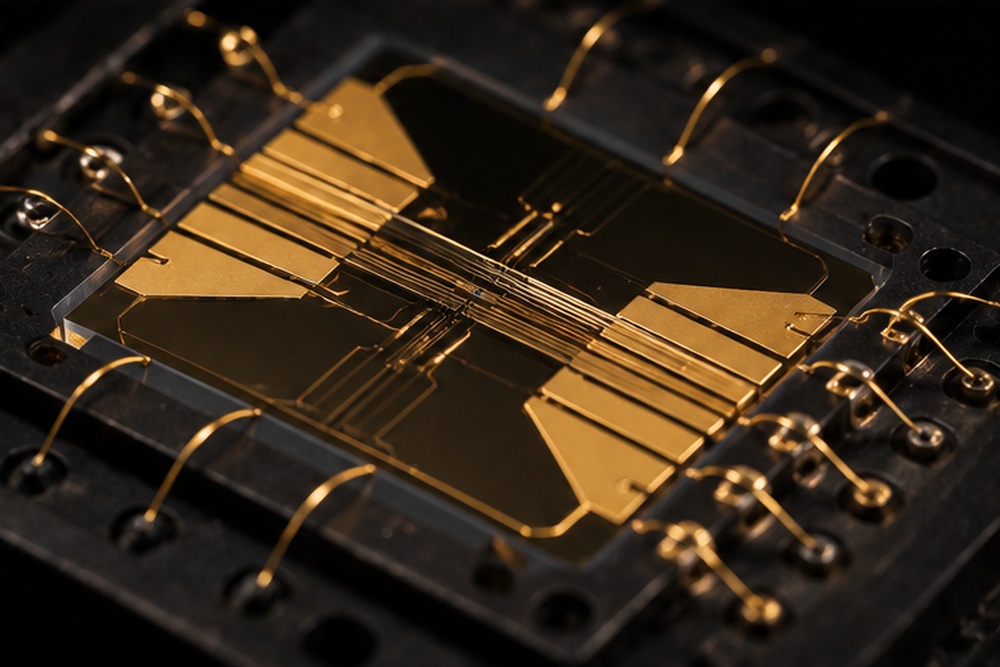
Figure F15-04. The cage, engineered: macro view of an ion-trap chip — a centimetre of patterned gold electrodes whose oscillating fields suspend single atoms a hair’s breadth above the surface.
15.6 The scoreboard, and the turn outward
This chapter’s promised audit — real, near, hype — can now be issued in one paragraph each. Real, today: atomic clocks defining civil time and steering navigation; quantum gravimeters surveying in the field; wearable atomic magnetometry in clinics; below-threshold error correction and machines of fifty to a hundred logical qubits; quantum-key links in commercial operation. Near, plausibly within the decade: logical-qubit machines performing chemistry and materials simulations beyond classical reach on problems of independent interest; quantum inertial navigation in service; NV-based molecular imaging in laboratories; atomically fabricated devices in niche production. Hype, until proven otherwise: imminent cryptographic apocalypse (the migration matters; the deadline-mongering does not); universal speedups for everyday computing; any roadmap whose milestones are all in the future tense. The pattern of this book counsels neither cynicism nor credulity: the gap between Thomson’s corpuscle and the transistor was fifty years; between Eigler’s xenon logo and ninety-six logical qubits, thirty-five. The atom’s conversion from object of knowledge to medium of technology is proceeding at the historically usual pace, which is to say faster than the sceptics and slower than the prospectuses.
And with that, the book’s outward business is concluded — the atom understood, assembled, originated, harnessed and employed. What remains for the final three chapters is the reckoning: the discoveries and conjectures that put the atom in its cosmic place, and the questions that remain open at the bottom of everything. It begins with a demotion of breathtaking scale. The instruments of this very chapter — the interferometers in their mineshafts, the clocks in their comparisons — have joined a hunt whose premise the reader has so far been spared in full: that everything in this book, every quark, electron, atom, molecule, star and reader, constitutes about one-twentieth of what the universe contains. The case for that astonishing audit — and for the dark matter and dark energy that make up the rest — is the next chapter.
Chapter 16 — The Dark Universe
“Science progresses best when observations force us to alter our preconceptions.” — Vera Rubin
16.1 The demotion
Every so often, science delivers humanity a demotion. Copernicus removed our planet from the centre of the cosmos; geology and Darwin removed our species from the centre of creation; and within living memory, cosmology has delivered the third great displacement, which this book — being a history of atoms — is obliged to report against interest. The current standard accounting of the universe’s contents runs as follows: ordinary atomic matter, the entire subject of the preceding fifteen chapters, amounts to about five per cent of the total. Roughly twenty-seven per cent is dark matter — substance of unknown identity, detected so far only by its gravity, outweighing all atoms about five to one. The remaining sixty-eight per cent is dark energy — not substance at all in any ordinary sense, but a property of space itself, driving the universe’s expansion to accelerate. Everything chemistry, biology and engineering have ever touched; every star this book credited with manufacturing the elements; every reader — a minority constituent, a film of luminous contamination on a universe made principally of two things nobody has identified.
Extraordinary claims require the chapter that follows. The case for the dark sector is not one observation but a fabric of independent ones, assembled over ninety years, and the honest reader deserves to see its weave — including where it is contested.
16.2 The case for dark matter
The clusters. The first thread was pulled in 1933 by Fritz Zwicky — Caltech’s brilliant, abrasive Bulgarian-Swiss astrophysicist, a man whose insults and insights were equally ahead of their time. Measuring the speeds of galaxies swarming within the Coma cluster, he found them moving far too fast: the cluster’s visible mass supplied nowhere near the gravity needed to hold such traffic, and by its own stars’ weight the swarm should long since have flown apart. Zwicky concluded that the cluster must be dominated by dunkle Materie — dark matter — and was, in the manner this book has made familiar, comprehensively ignored for forty years.
The galaxies. The thread that could not be ignored was spun in the 1970s by Vera Rubin and Kent Ford, measuring how fast stars and gas orbit at different distances from their galaxies’ centres. The expectation was solar-system behaviour: in any system whose mass sits centrally, outer orbits are slower — Mercury hurtles, Neptune strolls — with speeds declining in the precise manner Kepler and Newton prescribe. Galaxy after galaxy refused. Rubin’s rotation curves stayed stubbornly flat: stars at a galaxy’s visible edge, and gas far beyond it, orbiting as fast as material near the core — Neptune matching Mercury. Worked backwards through Newton, flat curves mean the enclosed mass keeps growing with radius, long after the starlight has run out: each luminous galaxy sits embedded in a vastly larger, roughly spherical halo of unseen mass, five to ten times its visible weight. The result reproduced across hundreds of galaxies, and survives every refinement since.
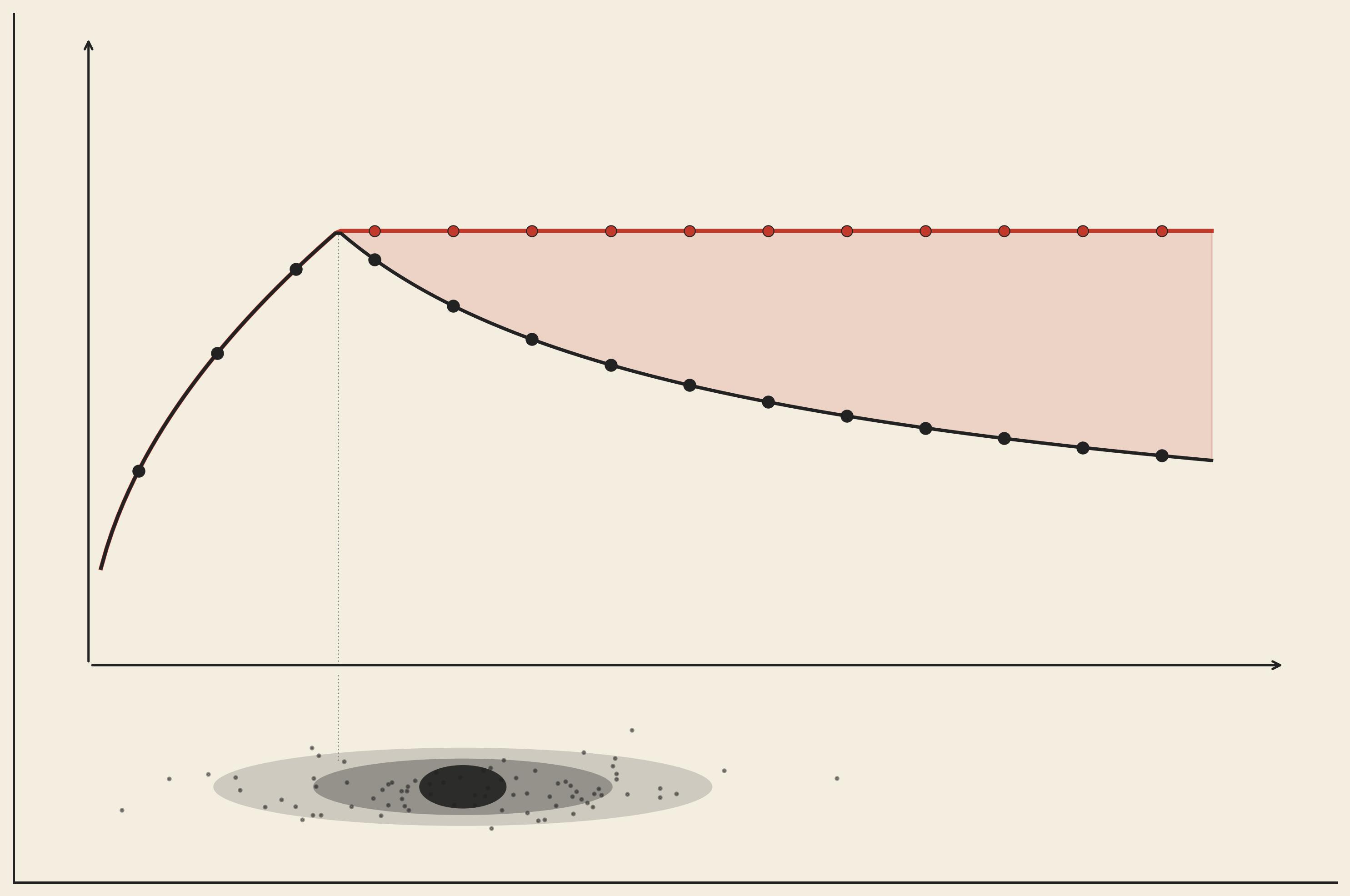
Figure F16-01. The graph that weighed the invisible: stars at a galaxy’s edge orbit as fast as those near its heart. Red: observed. Black: predicted from visible mass alone, which should fall as 1/√r. The shaded gap is the dark halo.
The lensing. General relativity supplies an independent scale: mass bends passing light, so a massive foreground object distorts the images of background galaxies — stretching them into arcs and, in alignment, rings. The distortion measures the total intervening mass, luminous or not, with no assumptions about orbits at all. Cluster after cluster weighs five-to-six times its atomic content. And one system elevated lensing from measurement to portrait: the Bullet Cluster, two galaxy clusters photographed in the aftermath of a collision. In any cluster, most of the atomic mass is not stars but diffuse hot gas; in the collision the two gas clouds slammed together, shocked, and stalled — X-ray telescopes show them piled up at the crash site — while lensing shows the bulk of each cluster’s mass sailing serenely onward, ahead of its own gas, on either side. Something dominant, dark, and so weakly interacting that two clouds of it passed through each other without flinching, had decoupled from the ordinary matter in exactly the manner a halo of aloof particles should.
The cosmic blueprint. The deepest thread is woven into the cosmic microwave background — the Big Bang’s afterglow, whose mottled temperature map records the universe at age 380,000 years. The pattern of those mottles (sound waves, in effect, frozen mid-oscillation in the primordial plasma) is a measuring instrument of astonishing scope: its peaks’ heights and spacings yield the universe’s recipe — atoms, dark matter, dark energy — to percent-level precision, and the atomic share comes out at five per cent. More structurally still: a universe of atoms alone could not have built galaxies on the observed schedule. Through the first 380,000 years, atomic matter was locked to the blaze of radiation, unable to begin clumping; dark matter, indifferent to light, could — quietly assembling the gravitational scaffolding into which, once released, the atoms fell. Strike the dark matter from the simulation and the modelled universe today is a thin, structureless gruel; include it at five-to-one and the simulated cosmic web — filaments, clusters, voids — matches the mapped sky in statistical detail. Galaxies are, on this account, dark-matter constructions with luminous trim; the subject of this book did not even build its own house.
KEY CONCEPT — Counting the atoms twice Could the “missing” mass simply be ordinary matter hiding — cold gas, dead stars, lonely planets? The decisive answer is an audit performed by two unrelated accountants. Accountant one: Big Bang nucleosynthesis (chapter 12) — the primordial twenty minutes left a deuterium residue whose abundance depends sensitively on how dense the universe’s baryons (ordinary nuclear matter) were; measured deuterium fixes the atomic budget. Accountant two: the microwave background’s acoustic peaks, physics of a different era and kind entirely, fix the same budget independently. The two agree — about five per cent — and both fall short of the gravitating total by the same factor of five-plus. The dark majority therefore cannot be atoms in any disguise: atoms have been counted, twice, by methods that share no assumptions, and there are not enough of them. Whatever dominates the universe’s matter, it is not on Mendeleev’s table — the first substance in this book’s long history of which that can be said with confidence. (Dedicated searches confirmed the bookkeeping retail: surveys for dark stellar bodies by microlensing found far too few, and the hot-gas inventory is seen directly in X-rays.)
KEY CONCEPT — Or is it the law? The MOND question Intellectual honesty requires the rival hypothesis its hearing. Since 1983, Modified Newtonian Dynamics (MOND) has proposed that no new matter exists; rather, gravity (or inertia) departs from Newton at the extremely feeble accelerations of galactic outskirts. On galaxy rotation curves MOND is genuinely impressive — one new constant fits hundreds of galaxies, and it predicted regularities (notably a tight relation between visible mass and rotation speed) that dark-matter models must labour to reproduce. The mainstream verdict against it rests on the larger scales: MOND under-explains clusters (needing unseen matter anyway), strains against the Bullet Cluster’s mass-gas separation, and has no fully successful account of the microwave background’s peak pattern, which particle dark matter fits effortlessly. The working consensus — dark matter real, MOND’s galactic regularities a clue any final theory must explain — is a judgement, not a theorem, and the reader should know that a serious minority dissents. Chapter 1’s lesson applies: the dispute will be settled by what is found, or persistently not found, in the detectors.
16.3 The suspect list
Grant the substance; what is it? The constraints carve a tight profile. It must be dark — no electric charge, no light emitted, absorbed or scattered (chapter 10’s inventory makes this stringent: it can couple to none of the electromagnetic ledger). It must be cold — slow-moving when galaxies formed, else it would have free-streamed and smeared the small structures we observe (this convicts the Standard Model’s one candidate, the neutrino: genuinely dark, but far too light and fleet — the cosmic neutrino background contributes a whisper, not the budget). It must be stable across thirteen billion years, and present in five-to-one abundance. No particle on chapter 10’s table qualifies. Dark matter is, therefore, the most empirical of all arguments that the Standard Model is incomplete: not a theoretical itch but five-sixths of the matter in the sky.
Two candidate classes have dominated four decades of hunting. The WIMP — weakly interacting massive particle — is a hypothetical heavyweight (tens to thousands of proton masses) feeling the weak force or something like it; its long reign rested on the “WIMP miracle,” a genuinely striking coincidence: run the early universe’s thermodynamics for a particle of weak-scale mass and interactions, and the relic abundance freezing out of the Big Bang lands, unbidden, at about the observed dark density. The same mass scale was independently predicted to harbour new particles by supersymmetry — the era’s favoured extension of the Standard Model — whose lightest particle made a ready-made WIMP. (Candour: the Large Hadron Collider’s failure to find supersymmetry where it was most expected has dented, though not destroyed, this elegant convergence.) The axion is the featherweight alternative — an ultralight particle originally proposed for unrelated reasons (it cures a fine-tuning puzzle in the strong force: why the neutron, a bag of charged quarks, shows no measurable electric lopsidedness), which happens, if it exists, to be produced in the early universe in cold, dark abundance; axion dark matter would behave less like a swarm of particles than a vast, slowly oscillating field. Behind these front-runners stretches a long bench — sterile neutrinos; whole hidden “dark sectors” with their own forces; primordial black holes (revived by gravitational-wave discoveries, then heavily constrained); “fuzzy” ultralight candidates with galaxy-sized wavelengths — a diversification that itself tells the story of the front-runners’ forty null years.
16.4 The hunt
The search proceeds on three fronts, and the first is this book’s oldest method wearing its newest equipment. Direct detection stakes everything on one assumption: if the galaxy’s halo is particles, billions stream through every square metre of the Earth per second, and very occasionally one must clip an atomic nucleus — Rutherford scattering, with the cosmos as beam. The signature is a single nucleus recoiling, struck by nothing visible; the experimental problem is that cosmic rays and ambient radioactivity produce similar twitches constantly, so the detectors operate at the bottom of mines and mountain tunnels — a kilometre and more of rock as cosmic-ray umbrella — built from materials screened to fanatic radiopurity. The reigning technology is the liquid-xenon time projection chamber: tonnes of frigid xenon watched by photomultiplier arrays, in which a recoiling nucleus betrays itself by paired flashes of light and charge. Three such instruments — LZ in a South Dakota gold mine, XENONnT under Italy’s Gran Sasso, PandaX in China’s Jinping mountain — have pressed the WIMP’s hiding space relentlessly: LZ’s latest results, reported at the end of 2025, set the world’s most stringent limits yet, with no credible signal, and the experiment will more than double its exposure by 2028, while a unified next-generation successor (XLZD) is in design. (One famous dissent persists: the DAMA experiment under Gran Sasso has reported for decades an annual modulation of its event rate — the seasonal rhythm a halo wind should produce — but purpose-built replications with the same target material have found nothing, and the community’s verdict is unexplained-but-not-dark-matter.)
The hunt has, in fact, just crossed a boundary of almost poetic neatness. The xenon detectors have become so sensitive that they now register solar neutrinos nudging their nuclei — LZ’s 2025 data delivered strong evidence of boron-8 neutrinos from the Sun’s core scattering coherently off xenon, confirming earlier hints from its two rivals — which means chapter 10’s ghost particle, once itself undetectable for a generation, has become the background for the next undetectable thing. This “neutrino fog” is both triumph and toll-gate: proof the instruments perform exactly as designed, and an irreducible mist (LZ reports having entered it already at the low-mass end of its searches) through which any deeper WIMP hunt must now discriminate its quarry from the Sun’s own whisper.
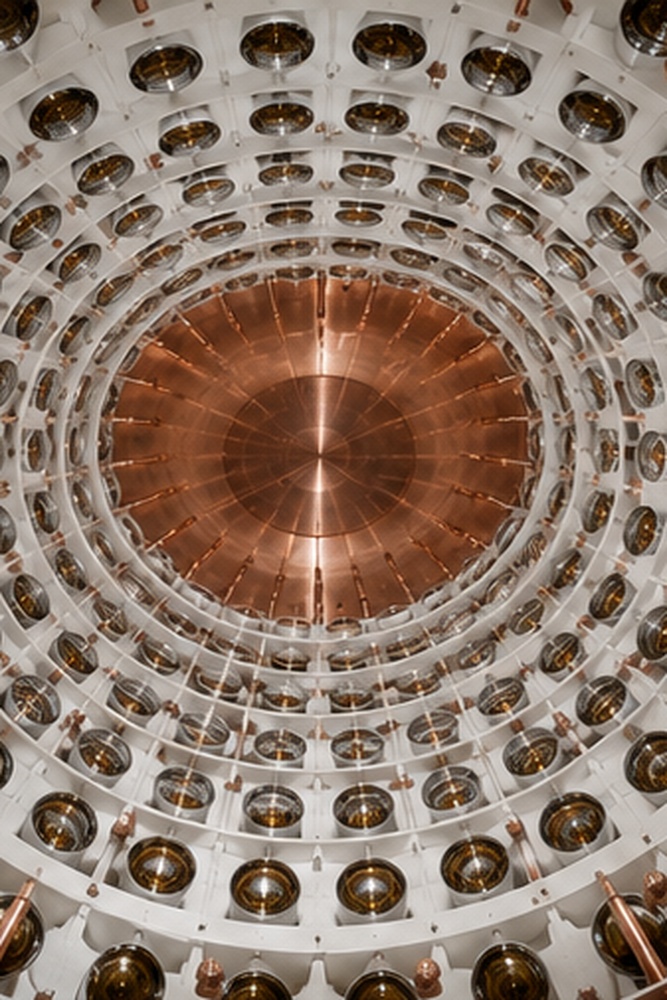
Figure F16-02. A trap for a ghost wind: inside a liquid-xenon detector — photomultiplier arrays watching tonnes of ultra-pure xenon, a kilometre underground, for the single flash of a struck nucleus.
The axion demands an entirely different trap: in a strong magnetic field, an axion should very occasionally convert into a photon of radio frequency set by its (unknown) mass — so axion “haloscopes” such as ADMX tune a supercooled resonant cavity across the dial, listening band by band for a whisper of excess static from the galactic halo: the hunt as radio search, decades long, with most of the dial still ahead. Indirect detection watches the sky for dark matter annihilating with itself — an unexplained gamma-ray glow does hover around the galactic centre, but disputes over mundane explanations (old pulsars) have kept it at “intriguing” for a decade. Production completes the triangle: the LHC searches for collisions whose visible debris fails to balance, the signature of dark particles minted and departing unseen — null, so far. And the newest hunters are chapter 15’s own instruments: networks of atomic clocks and atom interferometers now search for ultralight, field-like dark matter, which would announce itself not as a recoil but as a faint synchronized oscillation in the constants of nature — the atom, employed to ask what the atom is not.
Status, stated plainly: after four decades, no laboratory detection. The negative results are themselves precision science — vast tracts of candidate parameter space are closed forever — but the field has entered its no-stone-unturned era, and the possibility that dark matter interacts with ordinary matter through gravity alone, and will never trip any terrestrial trigger, is discussed aloud at conferences in a way it once was not.
16.5 Dark energy
The chapter’s second darkness was discovered in 1998, by two rival teams pursuing a measurement both expected to come out the other way. Their tool descends directly from chapter 12: Type Ia supernovae — exploding white dwarfs — detonate at a characteristic mass and hence with near-uniform intrinsic brightness, making them standard candles whose observed faintness reads out their distance across billions of light-years. Surveying dozens, both teams sought the universe’s deceleration: expansion, born in the Big Bang, ought to be coasting down under the braking of all that gravitating matter, dark included. The supernovae returned the opposite verdict — distant explosions systematically fainter, hence farther, than any decelerating universe allows. The expansion of the universe is accelerating: some influence, overpowering gravity on the grandest scales, is pressing the cosmos apart faster with time. The teams shared the 2011 Nobel Prize; the influence was named dark energy; and the microwave background’s bookkeeping, independently, requires exactly the missing two-thirds share that the acceleration implies. (The reader may enjoy the genealogy: the atoms of chapter 12’s white dwarfs, employed as candles, discovered the component that dethroned atoms altogether.)
What is it? The default candidate has a distinguished pedigree: Einstein’s cosmological constant, Λ — a uniform energy of empty space itself, which general relativity permits and which (a quirk of the equations) gravitates repulsively. Einstein inserted it in 1917 to prop up a static universe, discarded it after Hubble’s expansion as his greatest blunder; restored, with the observed value, it fits essentially all data. Quantum field theory even offers a physical reading — chapter 10’s fields, restless in their vacuum state, should endow empty space with energy — and here the account collides with the most embarrassing number in physics: naive estimates of that vacuum energy overshoot the observed dark energy by some 120 orders of magnitude, the worst quantitative failure of any successful theory in history. Why the vacuum gravitates so close to zero, yet not at zero, has no agreed answer; it is, by common consent, among the deepest problems in science, and it sits exactly at the junction of the quantum theory and gravity whose unification is the next chapter’s subject.
And the plot, at this writing, is actively thickening. The Dark Energy Spectroscopic Instrument (DESI) — five thousand robotic fibre-positioners on an Arizona telescope, charting the cosmic web in three dimensions — completed its planned five-year survey in April 2026 with more than forty-seven million galaxies and quasars mapped, the largest such atlas ever made, and has been extended to 2028. Its successive analyses have produced the decade’s most discussed cosmological hint: combined with supernova and microwave-background data, the measurements show mounting — the collaboration’s word at its 2025 release was strengthened — evidence that dark energy may not be constant at all, but evolving, its influence weakening over cosmic time. The signal’s significance hovers in the suggestive-but-not-decisive range, independent analyses dispute how the datasets should be combined, and the sober summary is that the question stands genuinely unsettled — but if it firms, Λ falls, the standard cosmological model is rewritten, and dark energy becomes dynamical: a field with a history, perhaps a future. The stakes include the ending of everything: a true constant drives the universe toward an eternal, accelerating cold emptiness — the “big freeze,” with galaxies receding beyond every horizon — while an evolving dark energy leaves all eschatology, from re-collapse to stranger fates, formally open. Rarely has so large a question rested on the third decimal place of survey statistics; the verdicts of DESI’s extension, of Europe’s Euclid space telescope and of the Rubin Observatory’s decade-long sky movie are awaited accordingly. (One further crack deserves its sentence: measurements of the universe’s present expansion rate disagree — early-universe inference and late-universe measurement diverge beyond their stated errors, the “Hubble tension,” unresolved for a decade and possibly related, possibly not.)
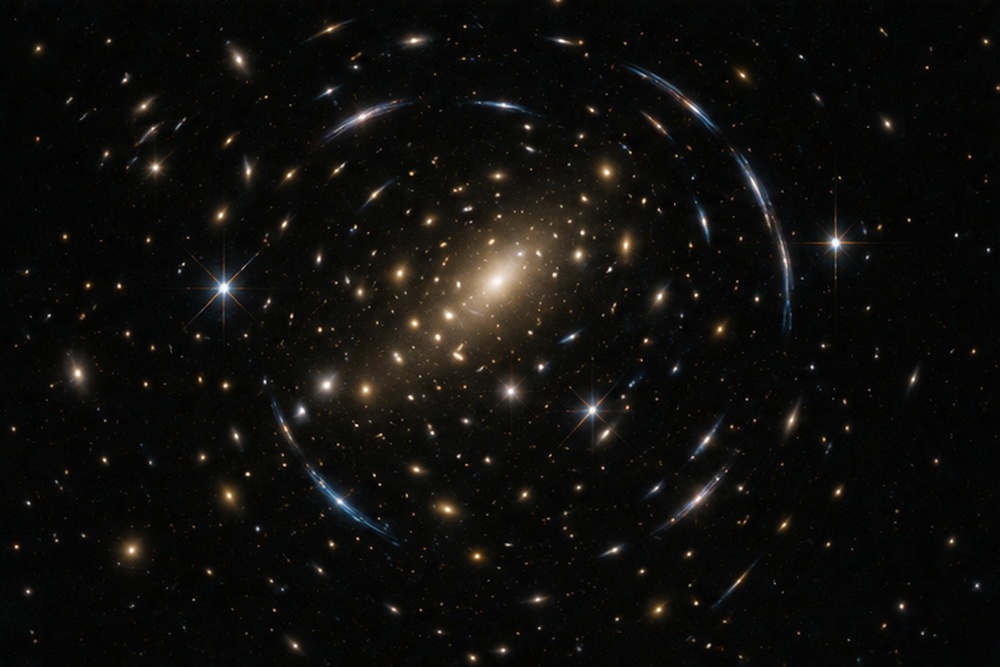
Figure F16-03. Weighing the universe with bent light: a massive galaxy cluster stretches the images of galaxies behind it into arcs. The distortion measures total mass — and it always exceeds the atoms.
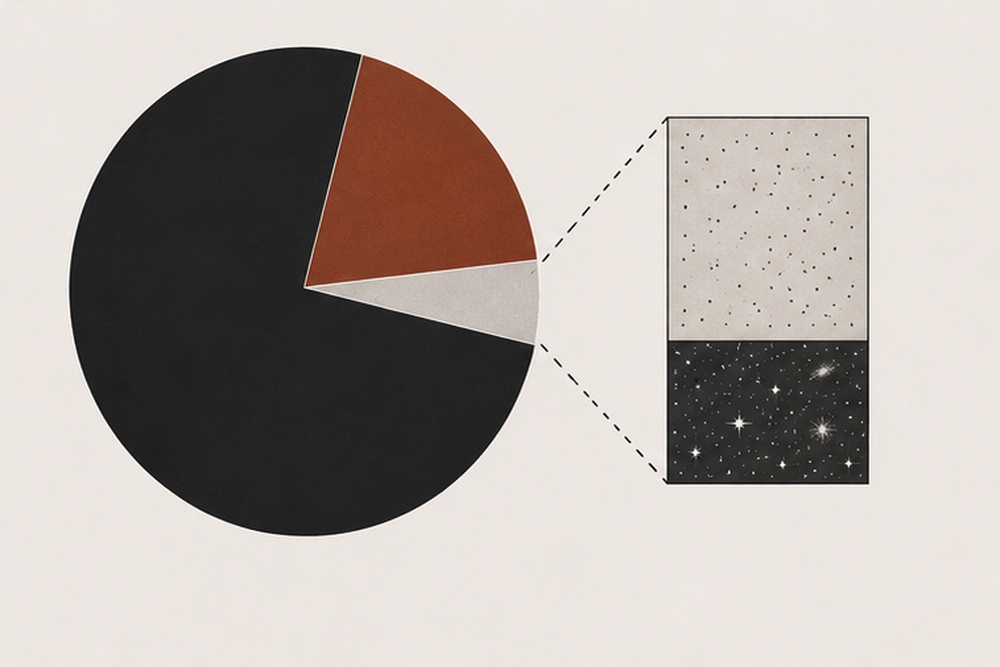
Figure F16-04. The audit this book must live with: its entire subject is the bright sliver. And of that bright sliver, most is diffuse intergalactic gas (upper inset); only a fraction is luminous stars (lower inset).
16.6 The minority report
How should a history of the atom absorb its subject’s demotion? Two readings are available, and the second is the truer.
The first is deflationary: ninety-five per cent of reality is not this book’s subject, and the grand reductionist march of Parts I and II — everything is atoms; atoms are quarks and electrons — explained, it turns out, the trimmings. The second reading notices who performed the audit. Dark matter and dark energy were discovered, weighed and profiled entirely by the five per cent: by atoms arranged into telescopes, photographic plates, xenon tanks, robotic spectrographs and the brains of astronomers; every property the dark sector is known to have, it is known to have because baryonic instruments registered it. The atom’s standing after the demotion is, if anything, stranger and grander than before: a minority constituent, but the only constituent that keeps accounts — the universe’s auditing department, five per cent of the books and one hundred per cent of the bookkeeping. And the dark sector now sets the atom’s research agenda at both ends of this book’s scale: underground, where xenon nuclei wait for the halo wind; and at the blackboard, where the vacuum-energy catastrophe and the dark particles’ absence from chapter 10’s table both point the same direction — toward physics beneath the Standard Model, at depths the present theory cannot reach. Whether anything is actually down there — whether the quark and the electron, this book’s current ground floor, are themselves the vibrations of something smaller — is the next chapter’s question, and the most speculative in the book. The reader is advised that, for the first time since chapter 1, we are about to leave the realm of the measured.
Chapter 17 — Strings and the Deepest Layer
“…part of twenty-first-century physics that fell by chance into the twentieth.” — Daniele Amati on string theory, as quoted by Edward Witten
17.1 The question beneath the floor
A warning before the descent: this chapter differs in kind from every chapter before it. Through sixteen chapters, each claim has been anchored — however indirectly — in measurement: weighed, scattered, imaged, counted. This chapter reports from below the waterline of experiment, on the question of whether the quark and the electron, the book’s current ground floor, rest on anything deeper — and the candid answer throughout will be that nobody knows, that the leading proposal is mathematically magnificent and observationally unconfirmed after half a century, and that its rivals share the predicament. The reader is owed the speculation, because it is where the discipline’s deepest thinkers have laboured for two generations; the reader is equally owed the label on the jar.
The question itself is forced by this book’s own plot. The “uncuttable” atom acquired electrons and a nucleus; the elementary proton dissolved into quarks; each floor, mistaken for bedrock, lasted roughly a scientific generation beyond the instruments that established it. Induction whispers: why should the quark and electron be different? Against the whisper stands a fact: probed to the present limit of resolution — about 10⁻¹⁹ metres, a ten-thousandth of a proton’s breadth — both remain perfect points, structureless and sizeless. But the present limit is the operative phrase, and here the chapter’s defining proportion must be stated. Theory supplies a natural smallest scale — the Planck length, of which more in a moment — at about 10⁻³⁵ metres. Between the finest distance ever probed and that floor stretch sixteen orders of magnitude: a basement deeper, in powers of ten, than the entire staircase this book has descended from the reader’s hand to the quark. We have explored, by the natural yardstick, rather less than half the way down — and into that unexplored vastness, theorists project their candidate foundations.
Why suspect the basement is inhabited at all? Partly the Standard Model’s punch-list (chapter 10): nineteen unexplained dials, three unexplained generations, the dark sector of chapter 16 knocking from outside. But chiefly because of a structural absence that is not a loose end but a load-bearing crack: the Standard Model’s silence on gravity.
17.2 The gravity problem
Physics presently runs on two master theories, each essentially perfect in its domain and each built on premises the other violates. General relativity describes gravity as the smooth curvature of a dynamical spacetime — deterministic, geometric, with every quantity definite. Quantum field theory describes the other three forces as chapter 10 told it — probabilistic, grainy, with superposition mandatory — but describes them on a fixed spacetime stage it never questions. For most purposes the theories partition the world amicably: gravity is so feeble between particles (some 10³⁶ times weaker than electromagnetism between two electrons) that laboratories ignore it, while astronomy’s gravitating bodies are too large for quantum fuzz to matter. The amicability is a fair-weather arrangement, and physics knows exactly where the weather breaks: wherever enormous mass occupies minute volume. The centre of a black hole; the first instant of the Big Bang — at both, general relativity drives itself to infinities it cannot interpret, precisely in regimes where quantum mechanics must dominate, and physics, lacking a theory containing both, simply has no equations to write down. Nor is the conflict confined to exotica: quantum mechanics permits a mass to occupy a superposition of two places, whereupon general relativity faces a question it cannot parse — where, exactly, does its spacetime curve? The incompatibility is one of principle, present in every cubic centimetre; the singularities merely make it undeniable. And one thought experiment has sharpened it into the field’s organising test problem: Hawking’s 1974 demonstration that black holes slowly evaporate by quantum effects raises the question of what happens to the information that fell in — quantum theory forbids its destruction, relativity provides no exit — a paradox (the black hole information problem) over which every candidate quantum gravity is expected to prove itself.
The obvious remedy — quantize gravity as the other forces were quantized, with a messenger particle (the graviton) exchanged as photons are — was attempted early and fails instructively. The infinities that arise in any quantum field calculation are tamed, in the Standard Model, by the disciplined bookkeeping called renormalization; applied to gravitons, the bookkeeping breaks — the infinities multiply uncontrollably, requiring infinitely many hand-set corrections, and the theory dissolves into non-prediction. The failure’s diagnosis matters: it stems from treating the graviton as a point, interacting at zero distance, in a theory where the field being quantized is distance itself. Something about points, or about spacetime, has to give at the bottom.
KEY CONCEPT — The Planck scale Where is the bottom? Nature volunteers an answer through its own constants. Take the three deepest: c (relativity’s speed), ħ (the quantum of action), and G (gravity’s strength). There is exactly one way to combine them into a length, and it yields 10⁻³⁵ metres — the Planck length, with companion Planck time (~10⁻⁴³ s) and Planck energy (~10¹⁹ GeV, a thousand trillion times the LHC’s reach). Its meaning can be put operationally: to resolve a Planck-length detail, a probe needs (by de Broglie) so much energy crammed into so small a region that it would collapse into a black hole of that very size — measurement itself self-destructs; distance, below that scale, may not be meaningfully defined. This is where every approach expects smooth spacetime to dissolve into something else — “quantum foam,” in Wheeler’s coinage — and the scale’s remoteness is the chapter’s tragedy stated as a number: a collider built on present principles to reach Planck energy would be roughly galactic in circumference. The basement is real, theoretically; the staircase to it, experimentally, does not exist.
17.3 The string idea
The leading candidate for the basement’s contents entered physics, fittingly for this book, by accident and through the nucleus. In 1968 Gabriele Veneziano, seeking merely to fit patterns in hadron-scattering data, wrote down a formula whose underlying picture proved to be vibrating elastic strings — a fine model for the flux-tubes of chapter 9, soon outcompeted by QCD and shelved. But the shelved theory had a defect its undertakers could not unsee: its spectrum stubbornly contained a massless particle of spin 2 — useless for hadrons, and exactly the calling card a graviton must carry. In 1974 Joël Scherk and John Schwarz proposed the great repurposing: shrink the strings from nuclear size to Planck size and read the embarrassment as destiny — string theory was not a failed theory of hadrons but a candidate theory of everything, gravity included. A decade of obscurity ended in 1984, when Schwarz and Michael Green showed the theory’s quantum bookkeeping could close consistently (the “first superstring revolution”); a second revolution in 1995, led by Edward Witten, unified the theory’s five competing versions as facets of a single deeper structure, M-theory, and added higher-dimensional membranes (“branes”) to its cast.
The core proposal can be stated with this book’s own vocabulary, because — the reader may feel the symmetry arriving — it is the book’s oldest motif, installed at the bottom of the world. Replace every point particle with a one-dimensional filament of energy, around 10⁻³⁵ metres long, vibrating. A vibrating string sustains discrete modes — the fundamental, the overtones: chapter 6’s guitar string, whose whole-numbered harmonics explained Bohr’s staircase and whose three-dimensional avatars became chapter 8’s orbitals. In string theory, the modes are the particles: one species of string, and its different notes are the electron, the quarks, the photon, the graviton — chapter 10’s seventeen-member zoo recast as the repertoire of a single instrument. The unification is total in conception: not seventeen fundamental things, but one thing, heard seventeen ways. (Matter’s particles require the strings to carry an additional symmetry — supersymmetry, whence “superstrings” — which predicts partner particles for every known species; the LHC’s failure to find them at accessible energies, noted in chapter 16, is a genuine strain, though the partners may simply be heavy.)
Two structural gifts follow, and they are why the theory has commanded such allegiance. First, gravity is not optional: that spin-2 massless mode is present in every consistent version — string theory does not accommodate the graviton, it insists on it, the only framework known in which quantum gravity emerges rather than being bolted on. Second, the infinities die of natural causes: where point particles interact at zero distance — the singular instant that wrecks renormalization — strings, having extension, interact smearedly, their collisions blurred over the Planck length; the fatal sharpness of §17.2 is removed not by bookkeeping but by anatomy. A minimum size to everything, healing the mathematics of the world: Democritus, one suspects, would have followed the argument with professional approval.
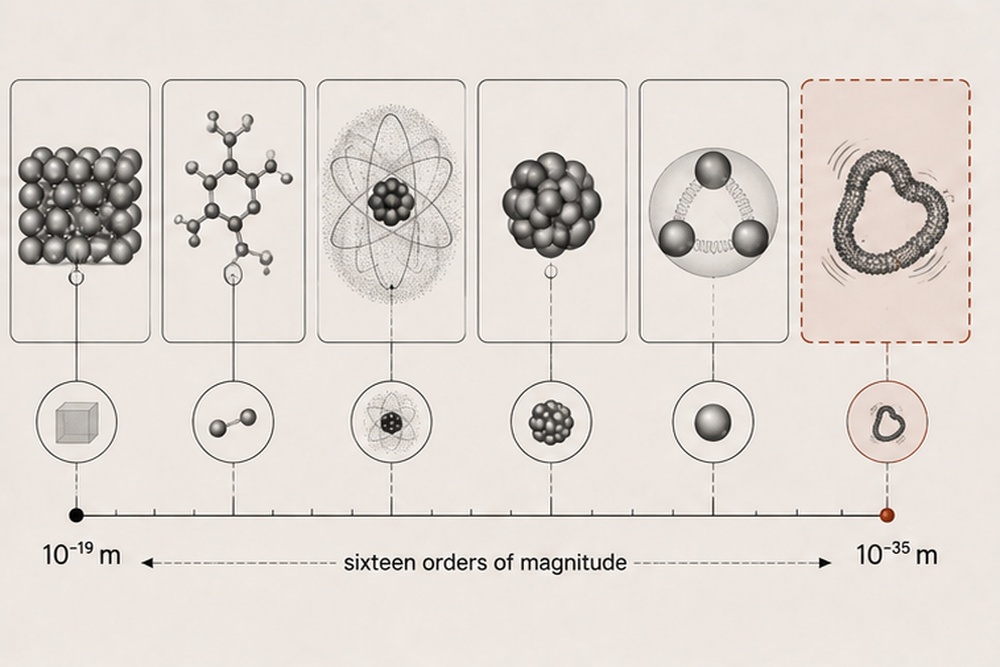
Figure F17-01. The descent so far, and the conjectured bottom: below the quark, sixteen unexplored orders of magnitude — and, perhaps, a vibrating string. The final panel is dashed to flag its conjectural status; no instrument has ever resolved that scale.

Figure F17-02. One instrument, many notes: the string conjecture in domestic form. As a string’s modes are its tones, a fundamental string’s vibrations would be the particles — electron, quark, photon, graviton as harmonics of one object.
17.4 The price: dimensions, and too many worlds
Theories of such ambition exact prices, and string theory’s two are famous.
The first is dimensional. The theory’s quantum consistency — the same unforgiving bookkeeping that killed the point-graviton — refuses to close in the three-plus-one dimensions of experience: superstrings demand ten spacetime dimensions (M-theory, eleven). The standard reconciliation is that the surplus six are compactified — curled up so small, plausibly near the Planck scale, that nothing yet built could notice them. The honest analogy is the garden hose: viewed from across a field it is a one-dimensional line; an ant on its surface knows a second dimension, curled into a tiny circumference, at every point of the first. Our three grand dimensions, the proposal runs, carry six such curled directions at every point, knotted into intricate shapes (the Calabi–Yau spaces of the trade) — and here the idea turns from burden to engine: the geometry of the hidden knot dictates the vibration modes the strings can sustain, which is to say it dictates the particle spectrum, the forces, the constants. Chapter 10’s nineteen arbitrary dials would not be arbitrary at all; they would be the resonant signature of the universe’s hidden shape — physics as the acoustics of unseen geometry. It is, even sceptics concede, one of the most beautiful explanatory structures ever conceived.

Figure F17-03. The garden-hose principle: from afar, a line; to the ant, a surface with a small curled dimension at every point. String theory proposes six such hidden directions at every point of space.
The second price follows from the first, and may be the theory’s tragedy. Which knot? The candidate compactifications are not few; standard estimates run to 10⁵⁰⁰ and beyond — each a mathematically consistent universe with its own particles, forces and constants, our world (if the theory is right) one address in a “landscape” beyond all enumeration. The dream that launched the enterprise — that consistency would force a unique theory, deriving the electron’s mass the way geometry derives π — inverted into its opposite: a framework apparently compatible with almost any low-energy physics, and therefore hard-pressed to forbid anything. One response embraces the inversion: perhaps the landscape is populated — a multiverse of regions realising different vacua — and we find ourselves, unavoidably, in an address whose constants permit chemists (the reader met this style of reasoning at Hoyle’s carbon resonance in chapter 12; the landscape would give the universe’s apparent fine-tunings the same explanation as the Earth’s: observers congregate where observers can). Whether that is a profound resolution or an abdication of physics’ explanatory duty is debated with genuine heat; a research programme (the “swampland”) labours to show the landscape is at least bounded — that string theory forbids some conceivable physics, and so risks something. For the critics, the ledger is summarized in a borrowed phrase: a framework that predicts everything predicts nothing, and the gravest charge — levelled in book-length form, under a title recycling Pauli’s old put-down “not even wrong” — is that the theory has drifted beyond chapter 3’s gold standard, the risky public prediction, altogether. The charge is contested; it is not frivolous; and this book, having built its spine on Mendeleev’s gaps and Einstein’s photoelectric gamble, is obliged to record it.
17.5 What the strings have actually delivered
Fairness now requires the other column, because string theory’s defenders do not rest on beauty alone; the framework has produced results — internal, indirect, but solid — of a kind no rival matches.
The showpiece concerns black holes. Thermodynamic arguments by Bekenstein and Hawking in the 1970s assigned every black hole an entropy — implying, by the deepest principles of statistical physics, that a black hole must possess a colossal number of hidden microscopic states, with nothing in relativity to say what they are. In 1996 Andrew Strominger and Cumrun Vafa, for a special class of black holes built from string theory’s branes, counted the microstates directly — and the count reproduced the Bekenstein–Hawking formula exactly, coefficient and all. A quantum theory of gravity had, for the first time, audited a black hole’s interior bookkeeping and balanced it against the thermodynamic ledger: not an observation, but a non-trivial consistency check passed with full marks.
KEY CONCEPT — Holography The framework’s strangest gift arrived in 1997, when Juan Maldacena conjectured — with evidence now overwhelming, in the mathematical sense — that certain universes with gravity are exactly equivalent to quantum field theories without gravity living on those universes’ boundaries: every event in the gravitational interior encoded, with nothing lost, on the boundary surface, as a hologram encodes a scene on a film. The AdS/CFT correspondence (its technical name; the model universe involved is not ours, a caveat to keep loaded) became the most-cited result in the history of high-energy physics for a practical reason — it is a dictionary, translating intractable gravity problems into tractable field theory and back, and it has been borrowed by outsiders to illuminate quark–gluon plasmas and exotic superconductors. Its conceptual freight is heavier still: it is the sharpest existing hint that spacetime itself may be emergent — not fundamental scenery but a derived description, woven (in the formulation now pursued under banners like “it from qubit”) out of patterns of quantum entanglement, chapter 15’s wiring promoted to the loom of geometry. The boldest conjectures in this direction — that entangled particles and microscopic wormholes are two descriptions of one thing — are flagged as exactly that: conjectures. But the direction of travel is itself a result: among quantum-gravity researchers of most persuasions, the question has shifted from “how does spacetime behave at the bottom?” toward “what is spacetime made of?” — and the leading answer on the table is: information.
The honest summary of the column: string theory has paid its way as mathematics, as method, and as a generator of deep structural insight — while never yet predicting a number that an experiment subsequently measured. Fifty years in, that asymmetry is the whole controversy.
17.6 The rivals
String theory’s predicament — and its instinct to unify everything at once — has kept alternative roads open, and the most developed takes this book’s thesis to its logical terminus. Loop quantum gravity (LQG) declines to unify; it asks only the focused question — what is quantum spacetime? — and answers by quantizing geometry itself, with no background stage assumed. Its central results, derived rather than postulated, are quanta of geometry: in LQG, area and volume come in discrete units — there is a smallest possible area, a smallest volume, of Planck dimensions — and space is woven from a network of elementary loops (the “spin networks”), its apparent smoothness an average over Planckian stitching, exactly as a cotton sheet’s smoothness averages its threads. The reader has earned the resonance: a book that began with Democritus declaring matter grainy against all appearance ends with a living research programme declaring space itself grainy against all appearance — atomism’s final escalation, the void itself made of atoms. Applied to cosmology, the graininess famously dissolves the Big Bang’s singularity into a “big bounce” — a prior contracting universe rebounding at maximum density — though such results remain model-dependent. LQG’s costs mirror string theory’s gifts inverted: it offers no account of matter’s particles and forces (the Standard Model must be imported, not derived), and demonstrating that its woven space reliably averages into Einstein’s smooth equations remains incompletely settled. Beyond the two main camps, a candid census finds a half-dozen further programmes — asymptotic safety (perhaps point-gravity’s bookkeeping converges after all), causal dynamical triangulations, causal sets, thermodynamic/emergent-gravity approaches — whose very plurality is the field’s clearest self-diagnosis: when a science cannot consult experiment, schools proliferate. Chapter 1 described two thousand years of exactly this condition; physics has been re-living it, at the Planck scale, for fifty.
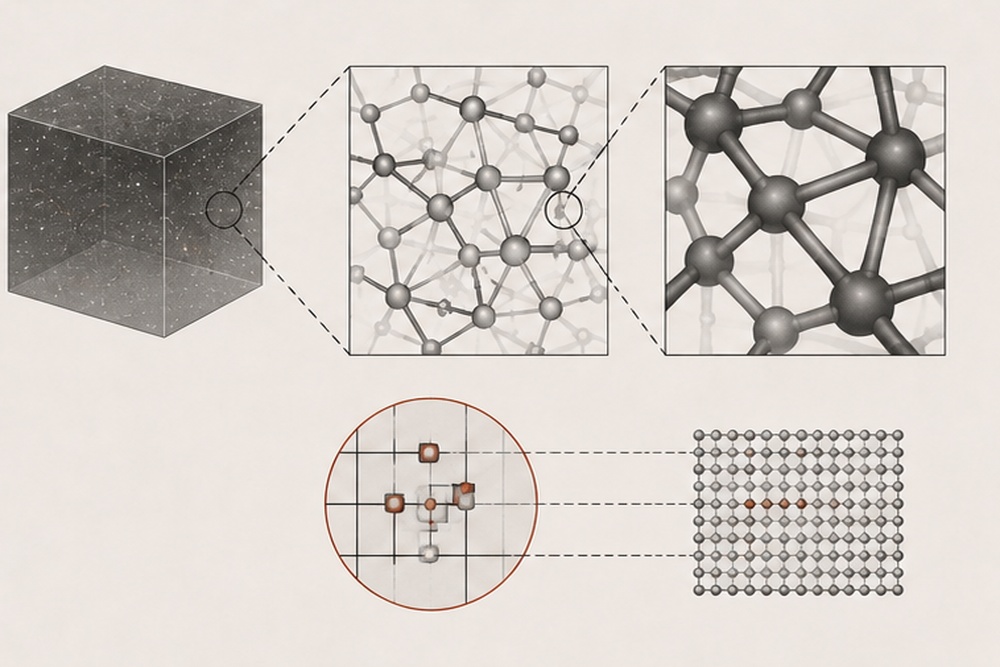
Figure F17-04. Atomism’s last escalation: in loop quantum gravity, space itself is grainy — woven from Planck-scale loops, smooth only on average. Democritus, applied to the void.
Is the experimental despair total? Not quite, and the loopholes deserve their paragraph. Planck-scale graininess might leave cumulative fingerprints: light crossing billions of years could disperse minutely if spacetime is foamy — gamma-ray-burst timing has already constrained (not detected) such effects, genuinely excluding some models. The infant universe was briefly a Planck-energy laboratory, and primordial gravitational waves from that era would have imprinted a specific curl (“B-modes”) on the microwave background’s polarisation — sought now by dedicated telescopes, a detection would be quantum gravity’s first observational toehold. Black holes, newly observable by gravitational-wave ringdowns and horizon-scale imaging, are quantum gravity’s chosen test animals, and exotic near-horizon structure is being actively listened for. And chapter 15’s tabletop frontier has joined: experiments are under design to test whether gravity can entangle two masses — which would establish, without reaching the Planck scale at all, that gravity is quantum in the first place. None of these is the galaxy-sized collider; together they are the difference between a question physics cannot ask and one it is asking badly, at the edge of audibility.
17.7 The verdict the book can give
Where does that leave the deepest layer? In a condition this book is uniquely equipped to assess, because it has seen the condition before. A proposal of great explanatory beauty, beneath the reach of any experiment, commanding brilliant adherents and brilliant critics, unresolved for generations: that was atomism, from Democritus to Dalton — twenty-three centuries between the guess and the weighing. The history counsels two things at once. Against the sneer that untestable-now means worthless: the atom was real all along, and the guess organised the eventual science. Against the swoon that beauty means truth: Aristotle’s elements were beautiful, coherent, fertile — and wrong, for two thousand authoritative years. String theory will be settled the way the atom was settled — by some descendant of the balance and the gold foil that nobody has yet imagined — or it will be quietly succeeded, the way the aether was, by a reformulation that dissolves its questions. The single safest statement in this chapter is the one carved by the whole book: the argument from elegance has never once, in this entire history, substituted for the argument from measurement — and on the deepest layer, measurement has not yet voted.
What measurement has established, meanwhile, is a precise and growing list of things the present theories cannot explain — the dark sector, the matter surplus, the dials, the silence of the proton’s decay, the meaning of the quantum dice. That list is not a confession of failure; it is the most valuable document in physics, the exact shape of the next revolution’s doorway. The final chapter of this book walks through it, item by item — and asks what a history of the atom, written a century from now, might contain.
Chapter 18 — Open Questions
“We must know. We will know.” — David Hilbert, 1930 (carved on his tombstone)
18.1 The most valuable document in physics
Every revolution in this book began as a list of nuisances. Kelvin’s two clouds became relativity and the quantum; Mendeleev’s gaps became gallium and germanium; the unbalanced energy books of radium became the nucleus and E = mc². The discipline’s most valuable document, in every generation, has been its honest inventory of what it cannot explain — the anomalies are the architecture of the next theory, photographed before construction. This final chapter is the current inventory: the questions left standing at the end of the atom’s story, each presented with what is known, what is being done, and what an answer would cost or buy. Some items the reader has already met and need only their cross-reference here — the identity of dark matter and the nature of dark energy (chapter 16), the quantization of gravity and the reality of the deepest layer (chapter 17), the meaning of three generations and nineteen dials (chapter 10). The remainder — the missing antimatter, the neutrino’s secrets, the proton’s patience, the constancy of the constants, the unfinished argument over Einstein’s dice, and the disquieting convenience of it all — occupy the pages that follow, before the book permits itself a closing look backward, and forward.
18.2 The missing half of the universe
Chapter 10 left the largest accounting discrepancy in science unresolved: the laws are nearly symmetric between matter and antimatter, an even-handed Big Bang should have minted both equally and annihilated both totally, and yet here stands a universe of matter — the surviving residue, by the standard count, of roughly one part in a billion that somehow escaped the great mutual annihilation. Every atom in this book is a member of that unexplained remainder; the question “why is there something rather than annihilation?” is, remarkably, a quantitative physics problem with entrance requirements.
KEY CONCEPT — Sakharov’s recipe The entrance requirements were written down in 1967 by Andrei Sakharov — Soviet hydrogen-bomb architect turned dissident and Nobel Peace laureate — in a short paper decades ahead of its audience. For any universe to grow a matter surplus from balanced beginnings, three conditions must all hold. First, the tally of matter minus antimatter (baryon number) must be violable — some process must be able to change it, else an initial zero stays zero forever. Second, the laws must genuinely distinguish matter from antimatter — must break the mirror symmetry called CP — else every surplus-producing process is exactly cancelled by its mirror twin. Third, the universe must pass through episodes out of thermal equilibrium — moments of rapid, irreversible change — else every forward process is undone by its reverse. The recipe converts a metaphysical lament into a checklist, and the modern hunt is the auditing of each line.
The audit’s status is tantalising. Condition three is free: the expanding early universe supplied disequilibrium in abundance. Condition two is confirmed but insufficient — and therein lies the mystery’s modern form. That nature distinguishes matter from antimatter at all was a genuine shock when discovered in 1964 in the decays of kaons (a Nobel-winning bombshell: the universe is not even-handed); CP violation has since been measured richly in heavier quark systems and, in 2019, in charm. But run the Standard Model’s measured CP violation through the early universe and it generates a surplus orders of magnitude too small — a billionth is far beyond its means. The asymmetry we are made of requires CP violation from somewhere beyond the established theory, and the search for that somewhere defines a research front. The most promising suspect is the neutrino: the great oscillation experiments now under construction — DUNE, firing a beam from Fermilab through 1,300 kilometres of rock to detectors deep in South Dakota, and Japan’s Hyper-Kamiokande, successor to chapter 10’s golden cavern — are designed precisely to measure whether neutrinos and antineutrinos oscillate differently, with early hints from the present generation suggestively nonzero but inconclusive. A neutrino-sector asymmetry would power the favoured origin scenario, leptogenesis: the surplus born first among leptons in the universe’s opening instants, through the decays of超-heavy neutrino partners, then converted to the quark surplus we inherit — a scenario whose keystone test is described in the next section. Meanwhile antimatter itself is interrogated directly: CERN’s antimatter factory traps and spectroscopically compares antihydrogen — a positron orbiting an antiproton, the anti-atom of this book’s first element — against hydrogen, finding their spectra identical to ever-tightening precision; and in 2023 the ALPHA experiment settled a question philosophers had enjoyed for a century by simply dropping antihydrogen: it falls down, as relativity insisted it must. Every such symmetry confirmed sharpens the paradox: the more perfectly antimatter mirrors matter, the more mysterious the universe’s preference.
Figure F18-01. The surplus we are: of each billion matter-antimatter pairs minted by the Big Bang, annihilation claimed all but a residue of one. No established physics explains the residue.
18.3 The neutrino’s secrets
The Standard Model’s lightest known particle carries an outsized share of its open questions, and chapter 10’s promissory note on the neutrino’s mass now falls due. The oscillation discoveries established that neutrino masses are nonzero yet absurdly small — at least a million times lighter than the electron, a hierarchy gap unlike anything else in the particle table. The favoured explanation, the seesaw mechanism, is named for its arithmetic: in a broad class of theories the lightness of the known neutrinos is the counterweight to the enormous heaviness of undiscovered partner neutrinos — the smaller the one, the vaster the other — with the partners’ implied mass scale landing, suggestively, near the grand-unification energies of the next section, and their early-universe decays supplying exactly the leptogenesis engine of §18.2. The whole structure pivots on one experimentally decidable question: is the neutrino, uniquely among matter particles, its own antiparticle (a “Majorana” particle)? The decisive test is a hypothetical nuclear process — neutrinoless double beta decay, in which two neutrons in a nucleus beta-decay simultaneously and the two would-be neutrinos, being their own antiparticles, cancel and never appear — and a generation of ultra-quiet underground experiments (germanium arrays, xenon chambers: the dark-matter hunt’s siblings, often its neighbours) is listening for a decay with a half-life beyond 10²⁶ years. A detection would, in one stroke, reveal the neutrino’s deep nature, certify that lepton number can be violated (Sakharov’s first condition, in the lepton ledger), and lend leptogenesis its foundation: arguably the highest-leverage null-or-not measurement in particle physics. Alongside it queue the bookkeeping questions — the ordering and absolute scale of the three neutrino masses (direct kinematic limits now press below an electronvolt) — and a prediction of lovely audacity: the Big Bang must have released a cosmic neutrino background, a 1.95-degree sea of relic neutrinos a billion-fold older than the microwave background, never yet detected, washing through every reader at this sentence.
18.4 The patient proton
Are atoms forever? The question sounds rhetorical; it is a live experimental programme. The grand unified theories (GUTs) sketched after the Standard Model’s completion noticed that the three quantum forces’ strengths, extrapolated to high energy, converge — nearly meeting at around 10¹⁶ GeV, as though they were one force at the universe’s hot birth — and almost every such unification carries an unavoidable consequence: quarks and leptons sit in shared multiplets, processes converting one into the other exist, and therefore the proton can decay — the hydrogen atom’s heart dissolving, after sufficient patience, into (say) a positron and a flash of pions. The predicted patience is stupendous — 10³⁰-plus years against a universe aged 10¹⁰ — but half-life statistics (chapter 12) rescue the experiment: watch 10³⁴ protons, and a 10³⁴-year half-life yields a decay a year. Super-Kamiokande’s fifty thousand tonnes of water have watched for decades and seen nothing: the proton’s half-life into the classic channel now exceeds some 2 × 10³⁴ years, a silence that has already executed the simplest unified theories (minimal SU(5), the 1970s favourite, predicted decays Super-K would have seen by the thousand) while leaving the broader unification idea alive at longer lifetimes that Hyper-Kamiokande will probe next decade. The stakes justify the patience: proton decay is the only foreseeable direct handle on physics at 10¹⁶ GeV — twelve orders beyond any collider, the scale where chapter 17’s theories live — and its observation would simultaneously confirm unification, supply Sakharov’s first condition in the quark ledger, and amend this book’s title concept: the atom, eternal through eighteen chapters, would acquire an expiry date. (Readers preferring their matter immortal may take limited comfort: even a stable proton inhabits chapter 16’s accelerating universe, whose default far future — the big freeze — retires all atoms to cold dispersal regardless. Permanence was never on the menu; only timescales.)
18.5 Are the laws themselves loyal? The precision frontier
A question stranger than any particle’s existence: are the constants of nature actually constant? Nothing in physics derives the fine-structure constant (electromagnetism’s strength, the number that sizes every atom and tunes every spectral line in this book); it is dial number such-and-such of chapter 10’s nineteen, measured, not explained — and a dial unexplained is a dial that might, conceivably, drift. The question is answerable, and the answering instruments are this book’s own. Chapter 13’s optical clocks, compared across years — two different atomic species whose tick rates depend differently on the fine-structure constant — would betray any drift as a slowly opening gap between them; the comparisons constrain present-day variation to parts in 10¹⁹ per year, among the most exquisite null measurements ever made. Deep time corroborates: quasar light that crossed ten billion years carries absorption barcodes (chapter 3’s fingerprints, used as fossils) whose analysed structure limits change over cosmic history — and, in this book’s most satisfying internal cross-reference, the Oklo natural reactors of chapter 12 serve as a two-billion-year-old laboratory, their isotopic ashes so sensitive to nuclear resonance energies that they certify the constants’ loyalty across half the age of the Earth. Why persist against unbroken nulls? Because several live theories — chapter 17’s extra dimensions, chapter 16’s ultralight field-like dark matter — generically predict feeble drifts or oscillations; the clock networks now searching for dark matter and testing constancy are the same instruments running the same data.
The constancy hunt exemplifies a broader strategy that has quietly become particle physics’ second front: where the energy frontier stalls (no collider will reach 10¹⁶ GeV), the precision frontier advances — measuring known quantities so exactly that new physics betrays itself as a discrepancy in the next decimal place, virtual heavy particles (chapter 10’s bookkeeping) leaving fingerprints far below their creation threshold. Its case studies cut both ways, and the honest chapter reports both. The cautionary tale: the muon’s magnetism, measured at Fermilab through the 2020s to extraordinary precision, stood for years some four standard deviations from prediction — heralded widely as new physics — until the theory side’s hardest ingredient was recomputed by independent lattice methods and the 2025 consensus prediction moved to meet the measurement: the anomaly substantially dissolved, the lesson being that a discrepancy has two sides and theory errs too. The standing triumph: the electron’s electric dipole moment — any slight egg-shape to its charge would violate the CP symmetry of §18.2 — has been bounded by tabletop molecular experiments to below 10⁻²⁹ in the natural units, a roundness so perfect it strangles whole families of proposed theories whose new particles should have deformed it: a measurement on a laser table in Colorado vetoing physics at energies no collider will ever reach. The atom, in its precision employment, has become the instrument by which physics audits its own foundations — exactly the role this chapter’s remaining sections require of it.
Figure F18-02. Listening at the next decimal place: when the energy frontier stalls, precision advances — and every tightened null closes theories no collider could reach.
18.6 Einstein’s dice: the argument, settled and unsettled
The book’s longest-running promissory note — issued at the Solvay conference in chapter 6 — now matures. Einstein never disputed that quantum mechanics works; his charge was incompleteness: the theory’s probabilities, he held, must be averages over a deeper, definite reality — hidden variables the formalism omits, dice loaded by machinery not yet seen. In 1935, with Podolsky and Rosen, he sharpened the charge into the EPR argument using entangled pairs: measure one particle and the partner’s outcome is instantly fixed however distant — absurd as physical influence (“spooky action”), therefore (EPR concluded) the outcomes must have been pre-set locally all along, in variables quantum mechanics fails to describe. For thirty years the dispute was filed under philosophy. In 1964 the Northern Irish physicist John Stewart Bell — a Belfast CERN theorist doing foundations in his spare time — removed it from that file with one of the profoundest short calculations of the century: he proved that the entire class of Einstein-style theories, anything local with pre-set values, obeys a strict numerical ceiling on how strongly paired measurements can correlate — while quantum mechanics predicts correlations exceeding the ceiling. Metaphysics had become an inequality; the dice could be interrogated.
KEY CONCEPT — Bell’s test, in one box The logic needs no mathematics. Imagine two distant stations each receiving one particle of an entangled pair, each station randomly choosing among measurement settings and recording outcomes. If the particles left the source carrying pre-agreed answers (local hidden variables — like paired gloves, left and right decided at dispatch), then no strategy of pre-agreement whatsoever can make the stations’ results agree and disagree across the setting combinations more than a fixed amount: that is Bell’s ceiling, a theorem about all possible pre-set strategies, not about any particular theory. Quantum entanglement’s predicted correlations break the ceiling. Run the experiment, and nature must show her hand: under the ceiling, Einstein; over it, the quantum.
Nature answered over the ceiling — repeatedly, and finally definitively. From the pioneering experiments of Clauser (1972) and Aspect (1982, closing the communication loophole with settings switched in-flight) to the 2015 generation of loophole-free tests — entangled electrons and photons across Delft, Vienna and Colorado, every escape hatch (slow switching, undetected pairs) welded shut simultaneously — Bell’s inequality is violated exactly as quantum mechanics prescribes; the 2022 Nobel Prize ratified the verdict. The conclusion is among the deepest facts ever established: no theory of local pre-set values can reproduce our world. Einstein’s specific escape route is closed — not by argument but by counted coincidences — and the correlations entanglement weaves (the same resource computing in chapter 15’s machines and, perhaps, weaving spacetime in chapter 17’s) are irreducibly, certifiably non-classical.
And yet — the unsettled half — closing Einstein’s exit did not settle what the dice are. A century after 1925, with the formalism tested to twelve decimal places, physics still hosts incompatible accounts of what happens in a measurement: whether the wave’s collapse is a real physical event (and if so, triggered by what — objective-collapse models add a mechanism, and make testable predictions that chapter 15’s growing macroscopic superpositions are beginning to squeeze); or no event at all, every outcome occurring in perpetually branching worlds (Everett’s reading — mathematically the formalism unadorned, ontologically the most expensive proposition ever advanced); or guidance of definite particles by a real pilot wave (Bohm’s, explicitly nonlocal, as Bell showed any such account must be); or a statement about agents’ information rather than the world (the QBist family). These are not stylistic preferences — they disagree about what exists — and the embarrassment of their century-long coexistence is softened only by the new fact that the frontier has turned experimental: collapse models face falsification by levitated nanoparticles and matter-wave interferometry at growing mass; and the tabletop gravity-entanglement experiments of chapter 17 would, at a stroke, force the quantum and the geometric into one laboratory sentence. The dice are real, loaded by nothing local, and still — at the centenary — of disputed manufacture.

Figure F18-03. The dice, interrogated: Einstein insisted they were loaded by hidden machinery; Bell found a way to ask, and the loophole-free experiments answered. No local pre-arrangement can mimic the quantum throw.
18.7 The disquieting convenience
One question of a different flavour, deferred since Hoyle’s carbon resonance in chapter 12, deserves its honest airing before the close. Survey this book’s constants — the strong force’s grip (a few per cent stronger and the early universe burns all its hydrogen; weaker and no element beyond it holds), the Hoyle level’s placement (shift it slightly and stars make no carbon), the electron’s Higgs-given mass (chapter 10: no mass, no atoms), the cosmological constant’s 120-orders restraint (chapter 16: more vigour and no galaxies condense) — and a pattern presses itself forward: the dials sit, repeatedly, in narrow life-permitting ranges. What, if anything, follows? Three families of response, none commanding consensus. Derivation: the values are forced by a deeper theory not yet possessed — chapter 17’s founding dream, currently unredeemed and, in the landscape’s 10⁵⁰⁰ vacua, arguably undermined by its own leading candidate. Selection: the values vary across a multiverse, and observers unavoidably sample the hospitable addresses — an explanation with impeccable logic, the Hoyle case as its pilot success, and a permanent methodological controversy over whether claims about unobservable sibling universes belong inside science’s fence. Deflation: the tuning is overstated — we know neither how robust life’s requirements are nor how the dials could co-vary, and a sample size of one universe supports no statistics. The reader is entitled to a position; the book’s duty, discharged here, is to report that physics does not yet have one.
18.8 The 2126 edition
What might the closing chapters of this book’s bicentennial successor contain? Forecasting is the one method this history has shown to fail reliably (Rutherford’s moonshine; the finished physics of 1894), so what follows is a spread of futures, not a prediction. In the generous future, the 2126 edition reports the dark matter particle’s discovery date as casually as this one reports the electron’s; dark energy’s evolution measured and its identity argued over in past tense; fusion a paragraph in the history of electricity; quantum simulators having done for chemistry what the microscope did for biology; perhaps a confirmed quantum-gravity signature in the primordial sky, and the strings or loops of chapter 17 promoted from conjecture to curriculum. In the austere future — the one a candid physicist must also table — the “desert” hypothesis proves true: no new physics inhabits the energies any feasible instrument will reach; the dark sector interacts by gravity alone and is never caught; the Standard Model’s dials are brute environmental facts; and the 2126 edition’s final chapters are a more refined version of this one’s ignorance, its discipline having learned the hardest scientific virtue, patience without progress. The probable future, as always, lies between and athwart these — and the only forecast this book makes with confidence is structural: some entry on the current open list will fall to an instrument or an idea that nobody, in 2026, has imagined, and its fall will reorganise the rest. That is not optimism; it is the induction from twenty-four centuries of this very story.
For the story now closes where it opened. Take off the gold ring once more — the one from chapter 1 — and ask the old question with everything the book has gathered. Cut it in half, and in half again: does the cutting ever stop? We can now answer as no century before ours could. The halving runs some twenty-three steps before reaching a single atom of gold — seventy-nine electrons in their exclusion-ruled shells, which are why the ring is yellow (relativity), conducting (a pooled sea), and metal at all. One more cut, in any meaningful sense, and gold ceases: the nucleus stands revealed, 118 nucleons of r-process manufacture, forged — the isotopes testify — in the collision of dead stars and delivered to a forming planet as part of the estate of stellar generations now dispersed. Cut on, with accelerator rather than knife: each nucleon opens into three quarks and a blaze of gluons whose imprisoned energy is almost all the ring’s weight on the finger. And there — at quark and electron, pointlike to the finest probe ever aimed — the knife of 2026 stops, sixteen orders of magnitude above the floor where strings or loops or something unconceived may wait. The ring is, by volume, 99.9999999999996 per cent void; its substance, 99 per cent confined energy; its matter, a billionth’s surplus from an annihilation unexplained; its element, a minority constituent of a universe five-sixths dark. Almost Nothing: the title has been audited and holds — at every level, the closer one looks, the less there is.
And yet. The “almost” has carried this book, and deserves the final word. The same near-nothing — the void’s standing waves, the surplus billionth, the auditing five per cent — assembled itself, by the chapters’ own physics, into stars, planets, chemistry, readers; into Democritus guessing, Marie Curie stirring her vats, Meitner on the snow-log, Bell at his inequality; into instruments that weigh the invisible, clocks that out-tick the universe, and a primate species that, in twenty-four centuries of stubborn interrogation, traced its own substance down to the eleventh decimal place and had the honesty to publish the remaining ignorance as a list. “In truth,” said the laughing philosopher, twenty-four hundred years ago, “atoms and the void.” He was right about far more than he could have known, and wrong in the most wonderful way available: the atoms have insides, the void has structure, and the truth — this book’s last open question — still has room at the bottom.

Figure F18-04. The ring, answered: twenty-three halvings to the atom, three more levels to the present floor of knowledge — void, imprisoned energy, a surplus billionth, stardust. The oldest question in physics, and how far we have come down.
Back Matter
Glossary
Every technical term used in this book, defined in plain language. Chapter references point to the fuller treatment.
A
Absolute zero — The floor of temperature (−273.15 °C; 0 kelvin), at which the random motion of particles reaches its quantum minimum. Unreachable exactly; approached to billionths of a degree in laser-cooling laboratories (ch. 13).
Accelerator (particle) — A machine using electric and magnetic fields to drive charged particles to enormous energies, serving both as microscope (higher energy resolves finer detail) and as foundry (collision energy condenses into new particles via E = mc²) (ch. 10).
Alchemy — The pre-chemical tradition seeking to transmute metals and prepare elixirs. Its theory was wrong; its laboratory techniques, apparatus and discovered substances founded chemistry (ch. 1).
Allotrope — One of two or more structural forms of the same element, with different properties arising purely from different atomic arrangements — diamond and graphite are allotropes of carbon (ch. 11).
Alpha particle / alpha decay — A bundle of two protons and two neutrons (a bare helium nucleus) ejected whole by certain heavy nuclei. The least penetrating radiation, stopped by paper, but the heaviest projectile — Rutherford’s probe of choice (chs. 4–5, 12).
Annihilation — The mutual destruction of a particle meeting its antiparticle, converting the entire mass of both into energy: E = mc² cashed in full (ch. 10).
Antimatter / antiparticle — For every particle species, a twin of identical mass and opposite charges, predicted by Dirac (1928) and found in 1932. Why the universe contains so little of it is a leading open question (chs. 10, 18).
Atom — The smallest unit of a chemical element that still behaves as that element: a nucleus of protons and neutrons surrounded by electrons. From the Greek atomos, “uncuttable” — a name it outgrew (chs. 1, 7).
Atomic clock — A clock disciplined to the unvarying tick of an atomic transition. The second is defined by caesium; optical lattice clocks now err by under a second across the age of the universe (ch. 13).
Atomic force microscope (AFM) — An instrument that maps surfaces, including non-conducting ones, by sensing the minute forces on a needle-tipped cantilever; refined versions image the individual bonds within molecules (ch. 13).
Atomic number (Z) — The count of protons in a nucleus, hence of electrons in the neutral atom. It fixes the element’s identity and orders the periodic table (ch. 7).
Atomic weight — The average mass of an element’s atoms (on a scale where carbon-12 is 12), an average across its natural blend of isotopes — which is why it is rarely a whole number (chs. 2, 7).
Axion — A hypothetical ultralight particle, proposed to fix a puzzle in the strong force, that is also a leading dark-matter candidate; hunted with tuned electromagnetic cavities (ch. 16).
B
Band / band gap — In a solid, the atom’s sharp energy levels broaden into bands of allowed energy separated by forbidden gaps. Whether the topmost occupied band is partly full, full with a wide gap, or full with a narrow gap makes the solid a conductor, insulator or semiconductor (ch. 11).
Baryon — A particle built of three quarks, such as the proton or neutron; “baryonic matter” is cosmology’s term for ordinary atomic matter (chs. 9, 16).
Beta particle / beta decay — A fast electron ejected when a neutron in a nucleus converts to a proton (or the mirror process), mediated by the weak force and accompanied by an antineutrino (chs. 4, 10).
Big Bang — The hot, dense early state from which the universe has been expanding for 13.8 billion years; its first twenty minutes forged the primordial hydrogen and helium (ch. 12).
Binding energy — The energy required to dismantle a nucleus into free protons and neutrons; equivalently, the energy released when it forms, registered as missing mass. Its per-particle curve, peaking at iron, governs all nuclear energy (ch. 9).
Blackbody radiation — The glow emitted by matter purely by virtue of its temperature. Explaining its colour recipe forced Planck to the quantum in 1900 (ch. 6).
Black hole — An object collapsed so far that nothing, light included, escapes its gravity; its centre is where general relativity and quantum mechanics openly conflict (ch. 17).
Bohr model — The 1913 picture of the atom as electrons restricted to numbered orbits, jumping between them with emission of light. Superseded by wave mechanics, immortal as a logo (ch. 5).
Bond (chemical) — Any arrangement joining atoms whose total energy is lower than the separated atoms’; the energy difference is the bond’s strength. The three strategies are ionic (transfer), covalent (sharing) and metallic (pooling) (ch. 11).
Bose–Einstein condensate (BEC) — A cloud of bosonic atoms cooled until they merge into a single shared quantum state — thousands of atoms behaving as one matter wave (ch. 13).
Boson — A particle of whole-number spin. Bosons are gregarious — any number may share one state — and include all force-carrying particles and the photon (chs. 8, 10).
Brane — In string/M-theory, a membrane-like object of two or more dimensions on which strings may end (ch. 17).
Brownian motion — The ceaseless jitter of microscopic grains in fluid, caused by molecular bombardment; Einstein’s 1905 analysis and Perrin’s measurements made it the clinching proof that atoms exist (ch. 6).
C
Cathode / anode; cathode rays — The negative and positive terminals of an electrical device. Cathode rays — the glow-causing emanation from the negative plate of a vacuum tube — proved to be streams of electrons (ch. 4).
Chain reaction — A self-sustaining cascade in which each fission’s released neutrons trigger further fissions; held at exactly one successor per fission, it is a reactor; unleashed, a weapon (chs. 7, 12).
Cherenkov radiation — The blue glow emitted when a charged particle outruns light’s speed in a medium (never in vacuum); the light of spent-fuel ponds and neutrino detectors (ch. 12).
Cloud chamber — A vessel of supersaturated vapour in which passing charged particles condense visible trails of mist — the first instrument to photograph subatomic events (ch. 7).
Compactification — In string theory, the curling-up of the required extra dimensions into shapes too small to detect, whose geometry would dictate the observed particles and forces (ch. 17).
Confinement — The rule of the strong force that quarks are never found alone: pulling them apart stores energy in an elastic flux tube until it snaps into new quark pairs (ch. 9).
Conservation of mass — Lavoisier’s foundation stone: in chemical change, total mass is unchanged — matter is rearranged, never created or destroyed. Refined by relativity: it is mass-energy that is conserved (chs. 2, 9).
Control rod — A rod of neutron-absorbing material (boron, cadmium) inserted into a reactor core to trim the chain reaction (ch. 12).
Cosmic microwave background (CMB) — The Big Bang’s afterglow: faint microwave light from the universe at age 380,000 years, whose mottled pattern encodes the cosmic recipe of atoms, dark matter and dark energy (ch. 16).
Cosmological constant (Λ) — A uniform energy of empty space, gravitationally repulsive, which Einstein introduced and disowned; restored, it is the default identity of dark energy (ch. 16).
Covalent bond — A bond formed by two atoms sharing a pair of electrons, whose probability piles up between the nuclei; directional, hence the maker of shaped molecules (ch. 11).
CP violation — Any failure of the laws to treat matter and mirror-reflected antimatter identically; established in 1964, required (in greater measure than yet found) to explain the universe’s matter surplus (ch. 18).
Criticality — The condition of a chain reaction in which each fission causes exactly one successor (k = 1): steady power (ch. 12).
D
Dark energy — The unknown influence, about 68 per cent of the cosmic budget, driving the universe’s expansion to accelerate; consistent with a cosmological constant, with current hints it may evolve (ch. 16).
Dark matter — Unidentified substance, about 27 per cent of the cosmic budget, detected only by its gravity, outweighing atoms five to one; required by galaxy rotation, lensing and the CMB alike (ch. 16).
de Broglie wavelength — The wavelength associated with any moving particle: matter is waves, with wavelength shrinking as momentum grows. The root of electron microscopy, atom interferometry and the quantum atom itself (ch. 6).
Decay chain — The cascade of successive radioactive decays by which a heavy nucleus steps down to stability — uranium-238’s fourteen-step descent to lead being the classic (ch. 12).
Decoherence — The destruction of quantum superposition by stray interaction with the environment, which “measures” the system unbidden; the central enemy of quantum computing and the reason everyday objects behave classically (ch. 15).
Delayed neutrons — The small fraction of fission neutrons emitted seconds late by the fragments; their leisurely timescale is what makes reactor control humanly possible (ch. 12).
Deuterium — Heavy hydrogen: one proton plus one neutron. A Big Bang relic whose abundance fixes the universe’s atomic budget, and one half of fusion’s easiest fuel (chs. 12, 14, 16).
Dispersion (London) force — The universal weak attraction between all matter, arising from momentary fluctuations of electron clouds polarising their neighbours; the glue of liquefied gases and gecko feet (ch. 11).
Doppler effect — The shift in a wave’s received frequency when source and receiver move relative to one another; exploited in laser cooling to brake only atoms moving toward the beam (ch. 13).
Double-slit experiment — The defining quantum demonstration: single particles, sent one at a time through two openings, land as individual dots that collectively build a wave’s interference stripes — unless one asks which opening, whereupon the stripes vanish (ch. 6).
E
Electron — The light (1/1836 of a proton), negatively charged, apparently pointlike particle whose cloud forms the atom’s outer structure and conducts all of chemistry. Discovered by Thomson, 1897 (ch. 4).
Electron configuration — The listing of which orbitals an atom’s electrons occupy (e.g. oxygen: 1s² 2s² 2p⁴); its outermost line is the element’s chemical personality (ch. 8).
Electronegativity — A number grading how fiercely an element’s atoms pull on bonding electrons; the difference between two partners sets a bond’s position on the ionic-covalent continuum (ch. 11).
Electronvolt (eV) — The energy an electron gains crossing one volt: the natural coin of atomic physics. Chemistry trades in single eV; nuclear physics in millions (MeV) — a gap that explains why no furnace touches the nucleus (ch. 9).
Element — A substance that chemical analysis cannot break down further; in modern terms, the set of atoms sharing one atomic number. Ninety-two occur in nature; the rest are manufactured (chs. 2, 7, 14).
Energy level — One of the discrete rungs of energy available to a bound quantum system; an atom’s spectral lines are the price list of jumps between its rungs (ch. 5).
Enrichment — Raising the proportion of the fissile isotope uranium-235 above its natural 0.7 per cent by isotope-sorting (ch. 12).
Entanglement — A quantum relationship between particles whose joint state is definite while the individuals’ states are not, producing correlations no pre-arranged local mechanism can mimic (Bell’s theorem). The working resource of quantum computing (chs. 15, 18).
Exclusion principle (Pauli) — No two electrons in an atom may share all four quantum numbers; hence at most two (opposite-spin) electrons per orbital. The source of shell structure, the periodic table, and matter’s rigidity (ch. 8).
F
Fermion — A particle of half-unit spin, subject to the exclusion principle: matter’s antisocial bricks, including electrons, quarks, protons and neutrons (chs. 8, 10).
Fine-structure constant — The pure number (about 1/137) setting electromagnetism’s strength, hence atomic sizes and spectra; whether it is truly constant is tested by clocks, quasars and the Oklo reactors (ch. 18).
Fission — The splitting of a heavy nucleus into two mid-table fragments plus neutrons, releasing about 200 MeV per event from binding-energy difference. Discovered 1938 (chs. 7, 12).
Fluorescence — Light emitted by a substance while being excited by other radiation; the glow of cathode-ray screens, scintillation detectors and trapped ions under laser light.
Frequency — How many wave crests pass per second; for light, frequency sets each photon’s energy (ch. 6).
Fusion — The merging of light nuclei into heavier ones, releasing binding-energy difference; the power source of stars and the goal of tokamaks and laser ignition (chs. 12, 14).
G
Gamma ray — The most energetic form of light, emitted by nuclei rearranging internally; chargeless, massless, stopped only by thick dense shielding (ch. 4).
Generation (particle) — One of the three complete copies of the matter-particle kit (two quarks, a charged lepton, a neutrino) at escalating mass. Ordinary matter uses only the first; why three exist is unknown (ch. 10).
Gluon — The massless carrier of the strong force, binding quarks; itself colour-charged, which makes the force grow with distance and imprisons quarks permanently (ch. 9).
Gravitational lensing — The bending of light by mass, predicted by general relativity; the distortion of background galaxies weighs foreground matter, dark included (ch. 16).
Graviton — The hypothetical quantum of gravity, a massless spin-2 particle; mandatory in string theory’s spectrum, undetected by any experiment (ch. 17).
Ground state — A quantum system’s lowest energy level — the floor below which no fall is possible, and the reason atoms are stable and identical (ch. 5).
Grand unified theory (GUT) — Any theory merging the strong, weak and electromagnetic forces into one at very high energy (~10¹⁶ GeV); generically predicts proton decay, not yet observed (ch. 18).
H
Hadron — Any particle built from quarks and bound by the strong force; protons, neutrons, pions and the rest of the mid-century “zoo” (ch. 9).
Half-life — The time in which half of any large population of a radioactive species decays; fixed for each species, untouched by heat, pressure or chemistry (ch. 12).
Halo (dark matter) — The vast, roughly spherical cloud of unseen mass in which each luminous galaxy is embedded, inferred from flat rotation curves (ch. 16).
Higgs field / Higgs boson — A field switched on throughout space, coupling to which gives the fundamental particles their masses (the W, Z, quarks and — critically for atoms’ size — the electron); its quantum, the Higgs boson, was found in 2012. It does not supply most of an atom’s mass, which is confinement energy (ch. 10).
Hohlraum — The thimble-sized gold cylinder at a laser-fusion facility’s focus, converting laser light to the X-ray bath that implodes the fuel capsule (ch. 14).
Holography (AdS/CFT) — The demonstrated mathematical equivalence, in model universes, between a gravitating interior and a gravity-free quantum theory on its boundary; the sharpest hint that spacetime may be emergent (ch. 17).
Hydrogen bond — The middling-strength attraction between a hydrogen atom bonded to a strong electron-puller and a neighbouring molecule’s lone pair; the architect of water’s anomalies and DNA’s zip (ch. 11).
I
Inertial confinement — The laser-fusion strategy: implode a fuel capsule so fast it burns before it can fly apart, confined for nanoseconds by its own inertia (ch. 14).
Interference — The hallmark of waves: overlapping crests reinforce, crest-on-trough cancels, painting bands of strength and stillness. Finding interference is finding a wave (ch. 6).
Ion — An atom (or molecule) that has lost or gained electrons and so carries net electric charge (chs. 4, 11).
Ionic bond — Bonding by outright electron transfer, leaving oppositely charged ions bound electrostatically into lattices rather than molecules (ch. 11).
Ionisation energy — The energy needed to strip one electron from a neutral atom; its sawtooth pattern across the elements is shell structure drawn by measurement (ch. 8).
Island of stability — The predicted region of enhanced half-lives among superheavy nuclei near 184 neutrons, where closed nuclear shells should resist decay; approached but not yet reached (ch. 14).
Isotope — Atoms of one element (same proton count) differing in neutron count, hence in mass; most elements are natural blends of several (ch. 7).
L
Landscape (string theory) — The enormous catalogue (10⁵⁰⁰ and beyond) of consistent ways to curl string theory’s extra dimensions, each a different effective universe; the theory’s predictivity problem (ch. 17).
Laser cooling — Braking atoms with light: photons absorbed preferentially head-on (by Doppler tuning) slow the atom kick by kick, to millionths of a degree (ch. 13).
Lepton — A fundamental matter particle indifferent to the strong force: the electron, muon, tau, and their three neutrinos (ch. 10).
Leptogenesis — The favoured scenario for the universe’s matter surplus: an asymmetry born among leptons via heavy neutrino decays, later converted to the quark surplus we inherit (ch. 18).
Liquid drop model — Picturing the nucleus as a charged liquid drop bound by surface tension; the model in which Meitner and Frisch understood fission (chs. 7, 9).
Logical qubit — An error-corrected qubit whose information is spread redundantly across many physical qubits, repaired faster than it decays; the true unit of useful quantum computing (ch. 15).
Loop quantum gravity — The rival to string theory that quantizes geometry itself: area and volume come in Planck-scale quanta, space woven from a network of loops (ch. 17).
M
Magic numbers — Proton or neutron counts (2, 8, 20, 28, 50, 82, 126) conferring extra nuclear stability via closed nuclear shells — the periodic table’s logic, one floor down (ch. 9).
Magnetic confinement — Holding fusion plasma on magnetic field lines it cannot cross, in tokamaks and stellarators, so that 150-million-degree matter touches no wall (ch. 14).
Majorana particle — A fermion that is its own antiparticle; whether the neutrino is one is tested by the search for neutrinoless double beta decay (ch. 18).
Mass defect — The amount by which a nucleus weighs less than its separated parts: the binding energy, registered on the scales via E = mc² (ch. 9).
Mass number (A) — The total count of protons plus neutrons in a nucleus; the whole number nearest its atomic weight (ch. 7).
Mass spectrograph / spectrometer — A precision scale for atoms, sorting them by mass along curved paths through electric and magnetic fields; revealed isotopes and the whole-number rule (ch. 7).
Metallic bond — Bonding by pooling: atoms surrender valence electrons to a shared mobile sea around a lattice of ion cores — whence conduction, malleability and shine (ch. 11).
Moderator — A light material (water, graphite) that slows fission neutrons by collisions, making them far more readily captured; essential to most reactors (ch. 12).
Molecule — A discrete cluster of atoms bonded into one unit — from two-atom gases to proteins of millions (chs. 2, 11).
MOND (Modified Newtonian Dynamics) — The minority hypothesis that galaxy rotation anomalies reflect modified gravity at tiny accelerations rather than dark matter; strong on galaxies, strained on clusters and cosmology (ch. 16).
M-theory — The conjectured eleven-dimensional framework unifying the five string theories, revealed through their dualities in 1995 (ch. 17).
Multiverse — The conjecture that our universe is one region among many realising different physical constants; paired with anthropic selection as one proposed answer to fine-tuning (chs. 17, 18).
Muon — The electron’s unstable second-generation copy, two hundred times heavier; “Who ordered that?” (ch. 10).
N
Neutrino — The almost massless, almost non-interacting neutral lepton emitted in beta decay; trillions stream through every reader each second. Its tiny mass is the Standard Model’s first confirmed amendment (ch. 10).
Neutrino fog — The irreducible background of astrophysical neutrinos now registering in dark-matter detectors sensitive enough to feel them; the new floor of the direct-detection hunt (ch. 16).
Neutrino oscillation — The in-flight shape-shifting of neutrinos among their three varieties, possible only if they have mass; discovered via solar and atmospheric deficits (ch. 10).
Neutron — The proton’s neutral partner in the nucleus, discovered by Chadwick in 1932; contributor of nuclear glue without electrical tax, and the chargeless key that unlocks all nuclei (ch. 7).
Neutron star — The city-sized, nucleus-dense remnant of a collapsed stellar core; collisions of neutron stars forge much of the universe’s gold and heaviest elements (ch. 12).
Noble gas — An element with a sealed outer electron shell (helium, neon, argon…): chemically aloof, monatomic, the periodic table’s control group (chs. 3, 8).
Node — A surface or point where a standing wave’s amplitude is zero; more nodes mean higher harmonics and higher energy, in flutes and in atoms alike (ch. 8).
Nucleon — Collective term for protons and neutrons, the nucleus’s residents (ch. 9).
Nucleosynthesis — The manufacture of chemical elements: hydrogen and helium in the Big Bang’s first minutes; everything else in stars, stellar explosions and neutron-star mergers (ch. 12).
Nucleus — The minute, dense core of the atom — one ten-thousandth its diameter, over 99.9 per cent of its mass — discovered by Rutherford’s gold-foil scattering (ch. 5).
NV centre — A nitrogen-vacancy defect in diamond behaving as a single trapped atomic spin: a room-temperature, nanometre-scale magnetic sensor (ch. 15).
O
Optical lattice — An egg-carton of standing laser light whose wells hold individual cold atoms; the architecture of the best clocks and of quantum simulators (ch. 13).
Optical tweezers — A tightly focused laser beam that traps a particle — down to a single atom — at its focus; arrays of tweezers are a leading quantum-computing platform (chs. 13, 15).
Orbital — A stationary-state probability cloud for an electron in an atom: not a path but a three-dimensional standing-wave pattern (s spheres, p dumbbells, d cloverleaves) holding at most two electrons (ch. 8).
P
Periodic table — The arrangement of elements by atomic number in which chemical character recurs down columns; Mendeleev’s pattern, explained by electron shells (chs. 3, 8).
Phlogiston — The eighteenth century’s supposed fire-substance, released in burning; killed by Lavoisier’s balance when combustion proved to be combination with oxygen (ch. 2).
Photoelectric effect — The ejection of electrons from metal by light, with energies set by the light’s colour rather than brightness; Einstein’s evidence that light comes in particles (ch. 6).
Photon — The particle of light: a massless quantum of the electromagnetic field whose energy is fixed by its frequency (ch. 6).
Pion — The lightest quark-antiquark particle, whose exchange between nucleons usefully pictures the residual strong force (ch. 9).
Planck constant (h) — The fundamental quantum of action, setting the size of energy packets, the scale of uncertainty trade-offs, and ultimately the size of atoms (ch. 6).
Planck scale — The natural floor built from c, ħ and G: about 10⁻³⁵ metres and 10¹⁹ GeV, where smooth spacetime is expected to fail and all quantum-gravity proposals live (ch. 17).
Plasma — The fourth state of matter: a gas heated until atoms are stripped to bare ions and free electrons. Rare on Earth, standard in stars (chs. 11, 14).
Plum-pudding model — Thomson’s 1904 atom: electrons embedded in a diffuse sphere of positive charge. The first model of atomic structure; demolished by the gold foil (chs. 4–5).
Positron — The electron’s antiparticle, positive in charge; predicted by Dirac, found in 1932, employed daily in PET medical scanning (ch. 10).
Proton — The positively charged nucleon, a bound trio of quarks; its count (Z) defines the element. Whether it ever decays is a standing experimental question (chs. 7, 9, 18).
Q
Quantum — The smallest possible unit of some quantity — of light, an energy packet (photon); generally, the graininess at nature’s floor (ch. 6).
Quantum chromodynamics (QCD) — The theory of the strong force: quarks carrying three “colour” charges, bound by self-interacting gluons; the origin of confinement and of 99 per cent of ordinary mass (ch. 9).
Quantum electrodynamics (QED) — The quantum field theory of electromagnetism; the most precisely verified theory in science, accurate to twelve significant figures (ch. 10).
Quantum error correction — Spreading one logical qubit redundantly across many physical qubits so faults can be detected and repaired without reading the data; below an error threshold, bigger codes mean exponentially better qubits (ch. 15).
Quantum field theory — The framework in which fields fill space and particles are their discrete ripples; forces are exchanges of field quanta (ch. 10).
Quark — The fundamental constituent of protons, neutrons and all hadrons, carrying fractional electric charge; six species in three generations, never observed alone (ch. 9).
Qubit — A quantum two-state system serving as the unit of quantum information, capable of superposition and entanglement; realised in ions, neutral atoms, circuits and light (ch. 15).
R
Radioactivity — The spontaneous transformation of unstable nuclei with emission of alpha, beta or gamma radiation; a property of the individual nucleus, untouched by chemistry (chs. 4, 12).
Radiocarbon dating — Reading the age of once-living material from the decay of its carbon-14 (half-life 5,730 years), absorbed in life and halving after death (ch. 12).
Radon — The decay chains’ only gaseous member: a noble gas that seeps from uranium-bearing ground into buildings, the largest radiation dose for most populations (ch. 12).
Renormalization — The disciplined bookkeeping that tames the infinities of quantum field calculations; it works for the Standard Model’s forces and fails for point-particle gravity (ch. 17).
r-process / s-process — The rapid and slow neutron-capture processes building elements beyond iron: the s-process in red-giant interiors, the r-process in neutron-rich cataclysms, notably neutron-star mergers (ch. 12).
Rydberg state — An atom with its outer electron promoted to an enormous orbit, swelling the atom thousands-fold and switching on strong neighbour interactions; the logic gate of neutral-atom computers (ch. 15).
Rotation curve — The graph of orbital speed against radius in a galaxy; observed flat where visible mass predicts decline — the classic evidence for dark halos (ch. 16).
S
Sakharov conditions — The three requirements for a universe to grow a matter surplus: baryon-number violation, CP violation, and departure from equilibrium (ch. 18).
Scattering — Probing an unseen target by throwing projectiles and reading the ricochets; the master method from Rutherford’s foil to the LHC (ch. 5).
Schrödinger equation — The master equation of quantum mechanics, governing how matter waves evolve; fed the hydrogen atom, it yields the energy staircase as natural harmonics (ch. 6).
Semiconductor — A solid whose full band sits below a narrow gap, conducting feebly but tunably — especially when doped with trace atoms; the basis of the transistor (ch. 11).
Shell — A set of orbitals sharing the principal quantum number; closed shells confer stability on atoms (noble gases) and, with different magic numbers, on nuclei (chs. 8–9).
Spectral lines / spectroscopy — The sharp colours an element emits or absorbs — its barcode — read by spreading light through a prism or grating; the price list of jumps on its energy ladder (chs. 3, 5).
Spin — A particle’s intrinsic, unalterable angular momentum, with no classical counterpart; for the electron, two-valued (up/down), the fourth quantum number (ch. 8).
Standard candle — An astronomical object of known intrinsic brightness (Type Ia supernovae foremost), whose apparent faintness reads out its distance; the tool that found cosmic acceleration (ch. 16).
Standard Model — The established inventory of fundamental physics: six quarks, six leptons, four force carriers and the Higgs, governing three of the four forces with unmatched precision — and visibly incomplete (ch. 10).
Standing wave — A wave confined so that it must close on itself, surviving only in whole-numbered patterns; the reason strings sound fixed notes and atoms have fixed levels (ch. 6).
Stationary state — A quantum state of definite energy in which a system persists without radiating; Bohr’s decree, wave mechanics’ harmonic (chs. 5, 8).
Stellarator — The tokamak’s rival: a fusion device whose confining twist comes from fantastically contorted external coils rather than a driven plasma current, buying steadiness (ch. 14).
Scanning tunnelling microscope (STM) — The instrument that images and manipulates individual atoms by the exponential sensitivity of electrons tunnelling across a vacuum gap to a single-atom tip (ch. 13).
String theory — The proposal that fundamental particles are vibration modes of Planck-length strings; it predicts gravity and demands extra dimensions, and awaits any experimental test (ch. 17).
Strong force — The short-range force binding quarks into nucleons (fundamentally) and nucleons into nuclei (residually); a hundredfold stronger than electromagnetism within its femtometre reach (ch. 9).
Superheavy element — A manufactured element beyond the actinides (Z > 103), made atom by atom in accelerator fusion; the table currently ends at oganesson, 118 (ch. 14).
Superposition — The defining quantum condition of being in a weighted blend of states at once — both rungs, both paths — until measurement collapses the blend by its odds (chs. 6, 15).
Supersymmetry — The conjectured symmetry pairing every particle with a partner of opposite social type (fermion↔︎boson); required by superstrings, unfound at the LHC (chs. 16–17).
Supernova — A stellar explosion: the core-collapse death of a massive star, or the detonation of a white dwarf (Type Ia); the dispersal mechanism of the manufactured elements (ch. 12).
T
Tokamak — The doughnut-shaped magnetic bottle that is fusion’s leading machine: plasma spiralling along field lines it cannot cross (ch. 14).
Transmutation — The conversion of one element into another by changing its nuclear proton count; impossible to chemistry, routine to radioactivity, reactors and stars (chs. 4, 7).
Triple-alpha process — The stellar manufacture of carbon from three helium nuclei via a fleeting beryllium step, made viable by a fortunate resonance Hoyle predicted from our existence (ch. 12).
Triple product (Lawson criterion) — Fusion’s scoreboard: plasma density × temperature × confinement time must exceed a threshold for the fire to pay its own heating bill (ch. 14).
Tritium — Hydrogen’s radioactive heavy isotope (one proton, two neutrons): half of D–T fusion fuel, bred from lithium (ch. 14).
Tunnelling — A quantum particle’s finite probability of appearing beyond a barrier it lacks the energy to climb, by wave penetration; the mechanism of alpha decay, sunshine and the STM (ch. 12).
U
Uncertainty principle — Heisenberg’s strict trade-off: the more sharply a particle’s position is defined, the more indefinite its momentum, and vice versa — not instrumental clumsiness but the nature of waves; the reason atoms have size (ch. 6).
Ultraviolet catastrophe — Classical physics’ deranged prediction that warm bodies emit unboundedly at short wavelengths; the failure that forced Planck’s quantum (ch. 6).
V
Valence electrons / valency — An atom’s outermost electrons, which conduct all its chemistry; valency is its combining power — the electrons it can shed, gain or share toward a closed shell (chs. 3, 8).
Valley of stability — The narrow band of stable proton-neutron combinations on the chart of nuclides, bending neutron-rich as nuclei grow and ending beyond bismuth (ch. 9).
van der Waals forces — The family of weak intermolecular attractions, dispersion foremost; feeble singly, lizard-bearing in sum (ch. 11).
Virtual particle — A transient, unobserved field quantum exchanged during an interaction, existing on energy briefly borrowed under the uncertainty trade-off; the itemised form of force (ch. 10).
W
W and Z bosons — The massive carriers of the weak force (about 86 and 97 proton masses), whose heft explains its feebleness and femtometre range; produced at CERN, 1983 (ch. 10).
Wave function — The mathematical object describing a quantum system’s state, whose intensity gives the odds of each measurement outcome (Born’s rule) (ch. 6).
Wavelength — The distance between successive wave crests; short wavelength means high frequency, and sets the finest detail a wave can resolve (ch. 6).
Weak force — The short-range interaction uniquely able to change particle identity — quark species into quark species — and so the agent of beta decay and the bottleneck pacing the Sun (chs. 10, 12).
WIMP — Weakly Interacting Massive Particle: the long-favoured heavyweight dark-matter candidate, hunted by xenon detectors to ever-stricter null limits (ch. 16).
X
X-rays — Light of very short wavelength, born when fast electrons strike matter; Röntgen’s 1895 discovery, Moseley’s element-counting tool, and the inner shells’ fingerprint (chs. 4, 7).
Timeline
Twenty-four centuries of the atom, in milestones. Dates given for events or publications; chapter references point to fuller treatment.
Antiquity: the guess
c. 450 BCE — Leucippus of Miletus proposes atoms and
void; his pupil Democritus develops the doctrine (ch. 1).
c. 350 BCE — Aristotle codifies the rival theory:
matter is continuous, built from earth, water, air and fire. The view
prevails for two thousand years (ch. 1).
c. 60 BCE — Lucretius preserves Greek atomism in the
Latin poem De rerum natura.
The long sleep, and the alchemical interlude
c. 800–1500 — Islamic and European alchemy develop
laboratory technique without atomic theory: distillation,
crystallisation, the mineral acids (ch. 1).
1417 — A single surviving manuscript of De rerum
natura is rediscovered in a German monastery and copied; atomism
re-enters Western thought.
1654 — Otto von Guericke’s Magdeburg hemispheres
dramatise atmospheric pressure and the makeable vacuum (ch. 1).
1661 — Robert Boyle, in The Sceptical Chymist,
redefines “element” as a substance chemistry cannot decompose, and
revives corpuscular thinking (ch. 1).
The chemical revolution
1772–1789 — Antoine Lavoisier, with his wife
Marie-Anne, weighs combustion shut and overthrows the phlogiston theory
(ch. 2).
1789 — Lavoisier’s Traité élémentaire de
chimie lists 33 elements and founds modern chemistry.
1794 — Lavoisier guillotined in the Terror; the judge
reportedly remarks: “The Republic has no need of savants.”
1803 — John Dalton publishes the law of multiple
proportions and his atomic theory: each element a distinct kind of
indivisible atom of fixed weight (ch. 2).
1808 — Joseph Louis Gay-Lussac’s law of combining gas
volumes (ch. 2).
1811 — Amedeo Avogadro proposes that equal volumes of
gases contain equal numbers of particles — ignored for fifty years
(ch. 2).
1860 — The first international scientific congress at
Karlsruhe, where Stanislao Cannizzaro revives Avogadro and the world’s
chemists agree on atomic weights (ch. 2).
The periodic pattern
1869 — Dmitri Mendeleev arranges the elements by
weight and chemistry into a table with gaps, predicting unknown elements
(ch. 3).
1871 — Mendeleev publishes refined predictions for
eka-aluminium, eka-boron and eka-silicon, with detailed
properties.
1875 — Gallium discovered (Mendeleev’s predicted
eka-aluminium); 1879 — scandium (eka-boron); 1886 — germanium
(eka-silicon) — all matching prediction (ch. 3).
The atom cracks open
1895 — Wilhelm Röntgen discovers X-rays
(ch. 4).
1896 — Henri Becquerel discovers natural radioactivity
from uranium salts (ch. 4).
1897 — J. J. Thomson identifies the electron in cathode
rays — the atom is divisible (ch. 4).
1898 — Marie and Pierre Curie isolate polonium and
radium from pitchblende (ch. 4).
1899–1903 — Ernest Rutherford and Frederick Soddy
distinguish alpha, beta and gamma radiation and identify radioactivity
as nuclear transmutation (ch. 4).
1905 — Einstein’s annus mirabilis: Brownian
motion (atoms exist), the photoelectric effect (light is granular),
special relativity and E = mc² (chs. 6, 9).
1908 — Jean Perrin’s Brownian-motion measurements
clinch the case for atoms.
1909–1911 — Hans Geiger and Ernest Marsden’s gold-foil
experiment; Rutherford concludes the atom has a tiny dense nucleus
(ch. 5).
1913 — Niels Bohr models the hydrogen atom with
quantised electron orbits; Henry Moseley orders the elements by atomic
number using X-ray spectra (chs. 5, 7).
1915 — Moseley killed at Gallipoli, aged 27.
The quantum revolution
1900 — Max Planck quantises blackbody radiation; the
quantum is born as a mathematical trick (ch. 6).
1916–1918 — Einstein’s general relativity. Emmy
Noether’s theorems connect symmetries and conservation laws.
1922 — Stern–Gerlach experiment demonstrates spatial
quantisation of angular momentum.
1923 — Arthur Compton scatters X-rays from electrons;
light has momentum (ch. 6).
1924 — Louis de Broglie proposes matter waves
(ch. 6).
1925 — Werner Heisenberg formulates matrix mechanics;
Wolfgang Pauli states the exclusion principle (chs. 6, 8).
1926 — Erwin Schrödinger publishes his wave equation;
Max Born interprets the wave function as probability (ch. 6).
1927 — Heisenberg’s uncertainty principle. Davisson and
Germer confirm electron diffraction. Fifth Solvay Conference: Bohr and
Einstein begin their thirty-year argument (chs. 6, 18).
1928 — Paul Dirac unifies quantum mechanics with
special relativity, predicting antimatter (ch. 10).
Completing the cast
1932 — James Chadwick discovers the neutron. Carl
Anderson discovers the positron — Dirac’s antimatter, confirmed (ch. 7,
ch. 10).
1934 — Enrico Fermi proposes the theory of beta decay,
introducing the weak force (ch. 10).
1938 — Otto Hahn and Fritz Strassmann split the uranium
nucleus; Lise Meitner and Otto Frisch interpret the result as fission
(ch. 7).
1939 — Niels Bohr brings the news of fission to
America. Einstein–Szilárd letter to Roosevelt (ch. 7).
1942 — Fermi achieves the first controlled chain
reaction in Chicago Pile-1, beneath a squash court (ch. 7).
1945 — Trinity test, New Mexico; Hiroshima; Nagasaki.
The end of Part I of this book’s history.
The standard model assembled
1947 — Hans Bethe explains the Lamb shift, opening
the era of precision quantum electrodynamics. Powell discovers the pion
(ch. 10).
1948–1949 — Feynman, Schwinger and Tomonaga complete
renormalised QED (ch. 10).
1952 — Glaser invents the bubble chamber, ushering in
the “particle zoo” (ch. 9).
1956 — Reines and Cowan detect the neutrino at the
Savannah River reactor (ch. 10).
1957 — Burbidge, Burbidge, Fowler and Hoyle publish
B²FH: stellar nucleosynthesis explains the origin of the elements
(ch. 12).
1962 — Brookhaven experiment shows electron and muon
neutrinos are different particles.
1964 — Murray Gell-Mann and George Zweig independently
propose quarks. James Cronin and Val Fitch discover CP violation in kaon
decay (chs. 9, 18).
1964 — John Stewart Bell publishes his inequality —
Einstein’s hidden-variable question becomes experimentally testable
(ch. 18).
1964 — Peter Higgs and others propose the mass-giving
field (ch. 10).
1967–1968 — Glashow, Weinberg and Salam unify the
electromagnetic and weak forces.
1968–1973 — Deep inelastic scattering at SLAC reveals
point-like constituents inside protons: the quarks become real
(ch. 9).
1972 — John Clauser’s first experimental test of Bell’s
inequality (ch. 18).
1973 — Quantum chromodynamics formulated (ch. 9).
1974 — November Revolution: discovery of the charm
quark (J/ψ particle) at SLAC and Brookhaven.
1977 — Bottom quark discovered at Fermilab.
1982 — Alain Aspect closes the locality loophole in
Bell tests (ch. 18).
1983 — W and Z bosons produced at CERN (ch. 10).
1995 — Top quark discovered at Fermilab — the Standard
Model’s matter table complete (ch. 10).
1998 — Super-Kamiokande discovers neutrino oscillation:
neutrinos have mass (ch. 10).
2012 — Higgs boson observed at CERN’s LHC
(ch. 10).
2015 — Loophole-free Bell tests at Delft, Vienna and
NIST close the experimental case against local hidden variables
(ch. 18).
Manipulating the atom
1947 — The transistor, Bell Labs.
1958 — Charles Townes and Arthur Schawlow propose the
laser; Theodore Maiman builds the first one in 1960.
1981 — Binnig and Rohrer invent the scanning tunnelling
microscope at IBM Zurich (ch. 13).
1985 — Hans Dehmelt photographs a single trapped barium
ion (ch. 13).
1986 — Binnig invents the atomic force
microscope.
1989 — Don Eigler spells “IBM” with 35 xenon atoms
(ch. 13).
1995 — First Bose–Einstein condensates produced by
Cornell, Wieman and Ketterle (ch. 13).
1997 — Maldacena’s AdS/CFT conjecture — holography
(ch. 17).
1998–1999 — Two teams independently discover the
universe’s accelerated expansion; dark energy named (ch. 16).
2003 — First optical atomic clock more precise than the
caesium standard.
The new century: frontiers
2010 — Andre Geim and Konstantin Novoselov receive
the Nobel for graphene (ch. 11).
2012 — Higgs boson discovery announced 4 July, CERN
(ch. 10).
2013 — IceCube detects the first astrophysical
high-energy neutrinos.
2015 — LIGO detects gravitational waves from a
black-hole merger.
2016 — Periodic table’s seventh row completed:
nihonium, moscovium, tennessine, oganesson (Z = 113–118) (ch. 14).
2017 — Neutron-star merger GW170817 observed in
gravitational waves and light; r-process element production confirmed
(ch. 12).
2019 — Event Horizon Telescope images the shadow of
M87’s black hole.
2022 — Aspect, Clauser and Zeilinger share the Nobel
for the Bell-test programme (ch. 18).
2022 (December) — National Ignition Facility achieves
inertial-fusion ignition: more energy out of the fuel than in, for the
first time in the laboratory (ch. 14).
2023 — ALPHA experiment confirms that antihydrogen
falls down in Earth’s gravity (ch. 18).
2024 — Berkeley achieves titanium-50 fusion to make
livermorium, opening the route to elements 119 and 120 (ch. 14).
2024 — Google’s Willow chip demonstrates
below-threshold quantum error correction (ch. 15).
2025 — National Ignition Facility delivers 8.6
megajoules of fusion energy, a target gain above four; LZ presents the
world’s most stringent dark-matter limits and reports evidence for solar
neutrino scattering — the “neutrino fog” entered (chs. 14, 16).
2025 — Quantinuum’s Helios system operates 94 logical
qubits on 98 trapped ions; QuEra demonstrates 96 logical qubits on 448
neutral atoms (ch. 15).
2026 — DESI completes its planned five-year survey of
47 million galaxies; strengthened hints of evolving dark energy await
independent confirmation (ch. 16). Atom Computing reports the first
sustained multi-round error correction on a neutral-atom platform
(ch. 15). SPARC tokamak nears completion in Massachusetts.
The book this timeline accompanies, published 2026, is therefore an interim report. The reader is invited to extend the list.